
Lowest Price Guaranteed
Pages
238
Last Updated
July 2026
View Count
20841
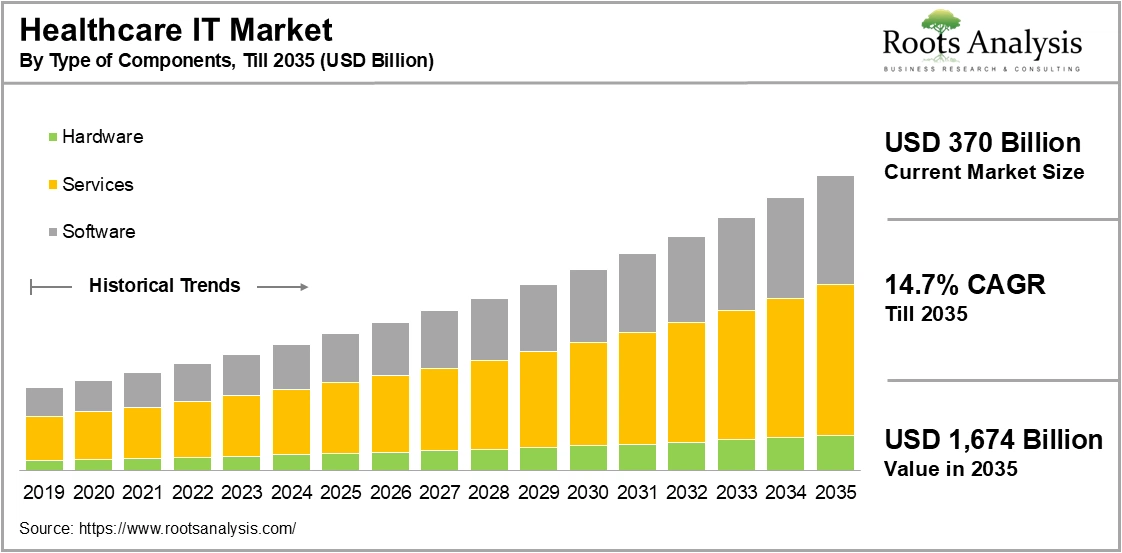
The global healthcare IT market size is worth around USD 370 billion in 2024 and is expected to reach USD 1,674 billion by 2035. It is expected to grow at a CAGR of 14.7% during the forecast period till 2035.
The growing prevalence of chronic diseases has intensified the demand for innovative healthcare solutions, prompting healthcare providers to invest in IT systems that streamline processes and enhance patient care. Recent developments highlight the transformative potential of technologies such as Explainable AI, which aims to make machine learning models more interpretable and transparent.
The healthcare IT industry is segmented into three primary components namely software, services, and hardware. The healthcare IT services market segment dominates the market, accounting for approximately 53% of the overall revenue share, driven by the increasing complexity of healthcare IT infrastructure and the need for continuous support and maintenance. Meanwhile, the healthcare IT software market segment is projected to exhibit the highest CAGR, reflecting the growing demand for electronic health records (EHRs) and telehealth solutions. As healthcare providers strive to enhance operational efficiency and patient care, the market is expected to witness substantial growth across all segments during the forecast period.
 |
The healthcare IT market share by type of product and services is further segmented into healthcare provider solutions, healthcare payer solutions, and HCIT outsourcing services. Amongst these, healthcare provider solutions occupy the highest market share which is almost 40% of the total market. It is further sub-categorized into clinical solutions and non-clinical solutions. The rise in the healthcare provider category can be attributed to the growing number of hospitals, and ambulatory care centers, as well as the hospitals' substantial purchasing power.
The global market is categorized by delivery mode into two primary segments which are on-premise and cloud-based solutions. Currently, the cloud-based segment dominates the market, accounting for a substantial share due to its flexibility, scalability, and enhanced data accessibility. This segment is expected to continue leading the market as healthcare providers increasingly transition to cloud solutions for improved operational efficiency and cost-effectiveness.
The healthcare IT market is segmented by end-user into healthcare providers, which include hospitals, ambulatory care centers, diagnostic & imaging centers, pharmacies, and others. The next end user segment is healthcare payers, comprising private and public payers. The third segment includes home healthcare agencies and assisted living facilities, along with other end users.
The healthcare providers segment dominates the market, with hospitals accounting for the largest share within this category. Hospitals are at the forefront of adopting healthcare IT solutions to streamline operations, enhance patient care, and comply with regulatory requirements. The growing number of hospitals and their strong purchasing power contribute significantly to the segment's dominance.
Meanwhile, the healthcare payers' segment, comprising private and public payers, is expected to exhibit the highest CAGR during the forecast period. This growth is driven by the increasing need for payers to adopt IT solutions to manage claims, fraud analytics, and member eligibility, ultimately improving operational efficiency and reducing costs.
The "Healthcare IT Market: Industry Trends and Global Forecasts, till 2035", market report features a comprehensive study of the current market landscape, market size, market share, market growth, market trends, market value, market forecast, market outlook, statistics, and future opportunities for healthcare IT companies. The market research report presents an in-depth analysis, highlighting the capabilities of various stakeholders across different global regions.
The rise in the healthcare provider category can be attributed to the growing number of patients, hospitals, and ambulatory care centers, as well as the hospitals' substantial purchasing power. The desire to enhance patient care while boosting operational efficiency and strict government restrictions are some important factors driving this industry.
Increased awareness and expectations for improved healthcare have been brought about by rising incomes and the expansion of the middle class, which has increased the use of group insurance and healthcare. The growing requirement for automation across departments is another important factor propelling the healthcare IT industry growth.
The market's growth is hindered by interoperability problems and security concerns, even if e-prescribing, telehealth, and mHealth technologies are becoming increasingly popular. The continuous evolution of healthcare systems, along with the growing patient population, contributes to market constraints. In addition, the healthcare cybersecurity market has its own set of obstacles that limit its expansion and size, such as market risk and difficulties.
The integration of AI in medical devices has garnered significant interest. Although, supporting with multiple dimensions of disease diagnosis and healthcare provision, there are several regulatory challenges owing to the owing to concerns like safety, accountability and trust. In May 2024, the Medicines and Healthcare Products Regulatory Agency (MHRA) of the UK launched AI Airlock (the latest regulatory AI-powered sandox) to address the challenges in regulating standalone AI medical devices.
The healthcare sector is moving towards outpatient settings in an effort to cut cost of care in response to mounting pressure on health systems to do so. According to estimates by Roots Analysis, ambulatory surgery clinics can save patients and payers a significant amount of money compared to inpatient hospital settings, which can range from 30% to 60%.
The convenience of ambulatory care is another factor driving this change. It follows that there will likely be a rise in the need for and use of healthcare IT solutions in outpatient settings. In general, in the upcoming years, it is anticipated that the move towards outpatient settings, especially ambulatory surgery centers will continue to spur cost savings and the use of healthcare IT solutions.
The global healthcare IT industry is experiencing substantial growth, driven by the increasing demand for digital solutions in patient management and care delivery. The market is projected to expand at a CAGR of 14.7% until 2035, fueled by advancements in electronic health records, telemedicine, and mobile health applications.
Additionally, government initiatives promoting digital therapeutics are further enhancing market opportunities, making healthcare IT a crucial component of modern healthcare infrastructure.
North America is expected to lead the healthcare IT industry throughout the forecast period, with the United States holding the greatest share of almost 40% of the total market. Furthermore, Asia-pacific is growing at the highest CAGR of around 22%. The widespread use of healthcare IT products and services is fueling the market expansion in the area as providers want to save costs while enhancing patient care.
Different healthcare providers have different acceptance rates for IT solutions due to a variety of circumstances, one of which being Oregon's high adoption rate for Electronic Health Records (EHR). In the United States, there has been a notable surge in the adoption of EHRs. Additionally, other regions like South Australia through its CareConnect program is giving top priority to the implementation of completely integrated health record systems. These actions and regulations in various countries may boost the overall healthcare IT market growth and demand.
Healthcare IT is a dynamic industry that has gained the interest of several venture capitalists. A lot of funding has been generated specifically by AI powered platform developers. In December 2024, Upheal raised USD 10 million in Series A funding to allow the company to scale-up and scale-up their business. The company has developed an AI-powered mental health platform for use by clinicians.
In the same month, a remote patient monitoring devices start-up Impilo Health raised USD 11.5 million in Series A funding. Founded in 2020, the company is working to serve the at-home patient monitoring market. Few other AI powered platform companies that have received funding in 4Q 2024 include digital pathology company Aignostics, predictive heart monitoring startup GPx, patient consent platform HealthEx and many more.
Examples of key service providers engaged in the Healthcare IT industry (which have also been profiled in this market report; the complete list of companies is available in the full report) include:
Agfa, Athenahealth, Carestream Health, eClinicalWorks, eMDs, GE Healthcare, Hewlett Packard, IBM, IQVIA, McKesson, Novarad, Oracle, Optum, Philips Healthcare, SAS Institute, SAP, Veradigm, Verisk Analytics.
The market research report presents an in-depth analysis of the various companies that are engaged in providing software, hardware or services in healthcare IT industry across different segments, as defined in the table below:
| Key Report Attributes | Details | |
| Historical Trend | 2019-2023 | |
| Base Year | 2023 | |
| Forecast Period | 2024-2035 | |
| Market Size, 2035 | USD 1,674 billion | |
| Market CAGR | 14.7% | |
| Type of Product and Services |
|
|
| Type of Components |
|
|
| Type of Delivery Mode |
|
|
| End User |
|
|
| Key Geographical Regions |
|
|
| Key Companies Profiled |
|
|
| PowerPoint Presentation (Complimentary) |
Available | |
| Customization Scope | 15% Free Customization | |
| Excel Data Packs (Complimentary) |
Available | |
The key objective of the market report is to provide a detailed market analysis to estimate the existing market size, market share, market growth, market trends, market value, market forecast, market outlook, statistics, and future opportunities in the healthcare IT market during the forecast period. We have provided an informed estimate of the likely evolution of the market in the short to mid-term and long-term for the historical and forecast period from 2019 till 2035. In addition, we have segmented the future opportunity across [A] by type of product and services, [B] by type of components, [C] by type of delivery mode, [D] by end users, and [E] by different global regions.
To account for the uncertainties associated with the market and to add robustness to our model, we have provided three market forecast scenarios, portraying the conservative, base, and optimistic tracks of the market's evolution.
All actual figures have been sourced and analyzed from publicly available information forums and primary research discussions. The financial figures mentioned in this market research report are in USD unless otherwise specified.
Several recent developments have taken place in the market. We have outlined some of these recent initiatives below. These developments, even if they took place post the release of our market report, substantiate the overall healthcare IT industry trends that have been outlined in our analysis.