Home Sleep Apnea Testing Market by Device / Product Type (Wearable Sleep Screening Devices, Non-Wearable Sleep Screening Devices, Smart Sleep Diagnostic Equipment, Home Polysomnography PSG Devices and Others), Test Type, Component / Offering, Technology / Data Capture Approach, Clinical Indication, End User, Geographical Regions, and Leading Players - Trends and Forecasts, 2026-2040
Market Size
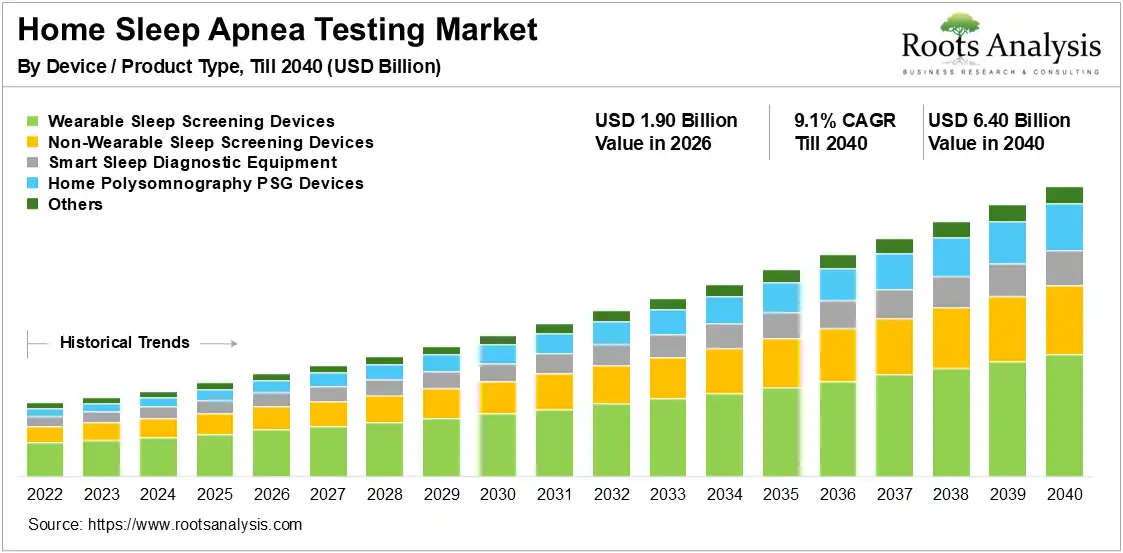
The global Home Sleep Apnea Testing Market reached USD 1.90 billion in 2026 and is projected to reach USD 6.40 billion by 2040, growing at a CAGR of 9.1% over the forecast period 2026 to 2040, driven by untreated OSA prevalence, payer acceptance of HSAT, and AI-enabled multi-night diagnostics.
See What’s in the Full Report – Request Your Complimentary Insights!
Market Report: Key Takeaways
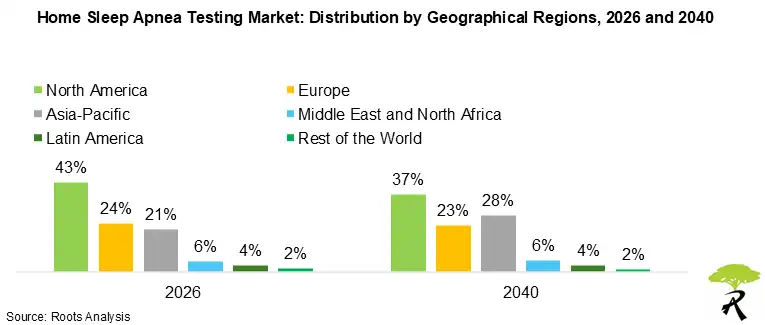
- Based on geography, North America captures 44.0% market share in 2026, whereas Asia-Pacific registers an 11.3% CAGR through 2040, driven by diagnostic-access gaps and local device innovation.
- Based on device / product type, wearable sleep screening devices capture 50.0% market share in 2026, whereas smart sleep diagnostic equipment registers an 11.0% CAGR through 2040, driven by AI-enabled multi-sensor testing.
- Based on test type, Type 3 home sleep apnea tests capture 66.0% market share in 2026, whereas Type 2 home sleep apnea tests register an 11.3% CAGR through 2040, driven by home PSG validation.
- Based on component / offering, hardware captures 62.0% market share in 2026, whereas software registers an 11.7% CAGR through 2040, driven by AI scoring and clinician-review automation.
- Based on end user, sleep clinics capture 34.0% market share in 2026, whereas telehealth and virtual sleep care providers register a 13.1% CAGR through 2040, driven by remote diagnosis-to-treatment workflows.
Home Sleep Apnea Testing Market Outlook
Home sleep apnea testing has moved from clinic-dispensed polygraphy kits toward wearable, software-supported, multi-night diagnostic workflows. The home sleep apnea testing market now reflects a structural shift. Single-use hardware transactions give way to distributed testing, clinician review, and virtual sleep-care pathways. Type 3 home sleep apnea tests still anchor routine OSA diagnosis. Smart sleep diagnostic equipment and cloud-based AI sleep scoring software are changing value capture. AI-assisted interpretation of sleep recordings is one application of artificial intelligence in diagnostics.
Current growth comes from untreated obstructive sleep apnea, home-care convenience, payer familiarity with HSAT, and regulatory support for validated wearable medical devices. NICE-backed use of home-testing devices further strengthens clinical acceptance in sleep pathways, while FDA clearances keep raising the evidence threshold. ResMed launched NightOwl in April 2025, an FDA-cleared disposable test recording up to 10 nights through a fingertip sensor.
Through 2040, the market will stay high growth as diagnosis moves closer to primary care, telehealth, and home care settings. Wearable sleep apnea screening devices will gain share, while software will outpace hardware through automated scoring and clinician-review workflows. Huxley Medical received December 2025 FDA clearance for central sleep apnea detection on SANSA. That clearance shows broader diagnostic use beyond uncomplicated OSA. The outlook remains positive.
Home Sleep Apnea Testing Market Dynamics
Home Sleep Apnea Testing Market Drivers
Untreated obstructive sleep apnea keeps test volumes high because HSAT supports lower-friction diagnosis outside lab capacity. North America holds 44.0% share in 2026 due to reimbursement maturity, sleep-clinic density, and FDA-cleared device availability. Type 3 home sleep apnea tests capture 66.0% share because they balance respiratory-channel depth, cost, and payer familiarity. Telehealth pathways add momentum by connecting ordering, scoring, physician review, and therapy routing.
Home Sleep Apnea Testing Market Restraints
Evidence requirements limit market access because sleep diagnostics must satisfy regulators, payers, and clinicians simultaneously. Hardware still captures 62.0% share in 2026, so vendors face device-validation costs, replacement cycles, and sensor-quality expectations. Home polysomnography PSG devices lose share because setup complexity restricts distributed use. Type 4 tests retain a narrower role because limited channels can reduce confidence in complex apnea differentiation.
Home Sleep Apnea Testing Market Opportunities
Software offers the strongest upside because AI scoring can reduce review bottlenecks across sleep clinics and virtual-care providers. Software expands from 18.0% share in 2026 to 25.0% by 2040, with an 11.7% CAGR. Nox Medical promoted Nox BodySleep 2.0 and AI-enhanced HSAT at SLEEP 2025 in May 2025. Vendors that pair validated devices with workflow software can defend margins.
Home Sleep Apnea Testing Market Challenges
Competitive pressure will intensify as wearables, smart diagnostics, and virtual providers target the same referral pool. Sleep clinics still hold 34.0% share in 2026, but telehealth and virtual sleep care providers grow at 13.1% CAGR through 2040. That shift challenges device-only suppliers. Buyers increasingly need enrollment support, remote upload, clinician review, and treatment handoff. Platform breadth will increasingly decide retention.
Home Sleep Apnea Testing Market Size Estimation Methodology
- As a starting point, we mapped the home sleep apnea testing market across seven dimensions. These included device type, test type, component, technology approach, indication, end user, and geography. The baseline used multiple credible secondary sources, company product pages, FDA clearance evidence, NICE guidance, and verified launch activity. Boundary checks separated narrow HSAT-only estimates from broader sleep-screening estimates. This ensured the forecast captured diagnostic revenue, not general wellness tracking.
- Moving forward, we normalized market scope around reimbursable home sleep apnea diagnosis. We excluded general wellness sleep trackers unless inputs linked them to diagnostic use. We used regulatory submission counts, FDA 510(k) clearance activity, and published product-clearance evidence. These inputs showed which device classes had clinical commercialization support. This step helped distinguish Type 3 home sleep apnea tests from lighter screening tools. It also reduced double counting between hardware, software, and service revenues.
- Building on this, we triangulated demand using OSA diagnosis pathways, sleep-clinic workflows, telehealth distribution, and end-user adoption patterns. Sleep clinics, hospitals, IDTFs, home care settings, and virtual sleep platforms were treated as separate demand pools. Each pool received different adoption assumptions because referral control, physician review, and payer-compliant interpretation vary by setting. Telehealth growth was modeled separately because virtual providers capture value across ordering, testing, and treatment handoff.
- Drawing upon these, we allocated segment shares using verified product evidence and recurring industry taxonomies. Wearable sleep screening devices received the highest 2026 share because they reduce patient setup burden and support multi-night testing. Software received faster growth because AI sleep scoring software and cloud-based clinician review change how test volume scales. Technology splits reflected peripheral arterial tonometry, PPG, pulse oximetry, airflow, mandibular movement, EEG-enabled home PSG, and cloud scoring.
- The projected value was then forecast through 2040 using segment-level growth rates rather than one blended assumption. Higher growth assumptions applied to Asia-Pacific, smart sleep diagnostic equipment, software, and virtual sleep care. Type 2 home sleep apnea tests and central sleep apnea also received higher growth assumptions. These assumptions reflected diagnostic-access gaps, home PSG validation, multimodal sensors, and remote care workflows. Lower-growth assumptions were applied where setup burden or narrower reimbursement fit limited scaling.
- Finally, output was checked against the annual forecast curve, regional outlook, and segment share trends. We ensured North America remained the largest 2026 geography while Asia-Pacific gained share through 2040. The final forecast retained a 9.1% long-term CAGR, consistent with high growth but gradually moderating device adoption. Segment totals were reconciled so every geography, end user, and technology view matched the same market base.
Home Sleep Apnea Testing Market Share Insights
Market Share by Device / Product Type
According to our analysis, wearable sleep screening devices lead because they reduce setup burden and improve multi-night completion. Their cost position also supports telehealth, IDTF, and distributed sleep-clinic workflows. Example: Happy Health, June 2025, received FDA clearance for Happy Ring for at-home sleep testing.
Smart sleep diagnostic equipment will grow faster as algorithms, biosensors, and remote transfer converge. Example: PranaQ, February 2025, received FDA clearance for TipTraQ, combining biosensors, AI, and remote data transfer.
Market Share by Clinical Indication
Obstructive sleep apnea dominates because HSAT reimbursement and clinical pathways focus on suspected uncomplicated OSA. Large undiagnosed prevalence sustains high test volumes. Example: ResMed, April 2025, positioned NightOwl as a simplified home test for diagnosing OSA.
Central sleep apnea will grow fastest as multimodal HSAT improves apnea-type differentiation. Example: Sunrise, May 2026, said Sunrise Air strengthens differentiation between central and obstructive apneas in complex patients.
Want Information on Specific Region / Segment?
Regional Analysis: North America Leads the Market and Asia-Pacific is Likely to Register Higher CAGR
Presently, North America holds 43.0% market share in 2026. The region leads through reimbursement acceptance, FDA-cleared device availability, sleep-clinic networks, and strong digital-health capital access. ResMed’s April 2025 U.S. launch of NightOwl reinforces local commercialization depth for home OSA testing.
On the contrary, Asia-Pacific registers an 11.3% CAGR from 2026 to 2040. The region will grow through diagnostic-access gaps, local engineering, cost-sensitive delivery, and expanding virtual-care adoption. In March 2026, PGIMER and Thapar Institute researchers developed a portable low-cost home OSA detection device in India.
Market Ecosystem Analysis
The ecosystem spans 25 named participants, but five Tier 1 device leaders and 10 specialists anchor most provider-facing activity. The leading consolidation dynamic is vertical integration, led by ResMed’s acquisition of VirtuOx and virtual-care expansion. The strongest commercial force is care-pathway compression: testing, scoring, physician review, and treatment routing now converge inside one workflow. Advantage is shifting toward vendors that combine validated sensors, cloud AI scoring, IDTF capacity, and channel access.
- ResMed made NightOwl available across the US in April 2025, positioning fingertip HSAT around smartphone-enabled, multi-night testing. This strengthens wearable sleep screening and PAT / PPG-based testing, while pressuring traditional Type 3 recorder suppliers on patient setup burden. ResMed then acquired VirtuOx in May 2025, adding IDTF capacity across sleep, respiratory, and cardiac diagnostics. This raises the access barrier for standalone device vendors that lack fulfillment, scoring, and diagnostic-service infrastructure.
- ZOLL Itamar secured FDA clearance documentation for WatchPAT 400 in September 2025, extending its PAT-based HSAT line into a newer home-care device. Sleep Review reported in June 2026 that ZOLL Itamar revealed the reusable WatchPAT 400 at SLEEP 2026. The reusable, app-connected form factor strengthens PAT-based testing and sleep-clinic workflows, while pressuring disposable-only and legacy recorder models.
- Philips remained more visible in downstream sleep-health access than new HSAT hardware in the verified 2025 window. In November 2025, Philips Australia announced a MedAdvisor pharmacy partnership to increase sleep-health awareness through pharmacy channels. This supports screening and referral generation, but it does not directly evidence a new Alice NightOne HSAT product move.
- Nox Medical unveiled expanded Nox Connect capabilities in June 2025, adding AI, web-based scoring, interpretation, and home sleep testing service integration. This shifts Nox from Type 3 hardware competition toward a cloud-enabled diagnostic workflow. The move strengthens respiratory airflow and effort polygraphy, software, and services segments, especially for sleep clinics managing higher HSAT volumes.
- Compumedics received FDA clearance documentation for Somfit D in August 2025 as a diagnostic aid for sleep-related breathing disorders. The clearance also covers sleep staging and snoring detection, giving Compumedics stronger positioning against simpler oximetry-only devices. This strengthens wearable sleep diagnostics and EEG-enabled home PSG / sleep staging segments.
- SleepImage announced in August 2025 that its FDA-cleared system powered a pediatric sleep study using 41,000 nights of data. This supports its positioning beyond adult OSA diagnosis into pediatric sleep quality analytics and longitudinal datasets. It strengthens cloud-based software, pediatric-adjacent sleep assessment, and software-as-a-medical-device differentiation against hardware-only HSAT suppliers.
- BetterNight expanded its Northeast footprint in September 2025 through the acquisition of Coastal Sleep and Epoch Sleep Centers. The acquired in-lab and home-based study programs feed BetterNight’s technology-driven care model. This strengthens sleep clinics, home care settings, and virtual sleep care, while pressuring local centers without digital care coordination.
- Lofta partnered with Bloom Mental Health in May 2025 to enhance access to sleep apnea diagnostics. The partnership connects sleep apnea testing with psychiatric-care referral pathways, expanding consumer-facing access beyond traditional sleep clinics. This strengthens direct-to-patient HSAT services and telehealth pathways, especially where fatigue, mood, and sleep symptoms overlap.
- Ognomy Sleep raised $20 million in Series A financing in June 2026, led by Catalyst Investors. The company said funding supports broader access, product development, and nationwide scaling of virtual sleep apnea care. This strengthens telehealth and virtual sleep-care providers, raising the execution bar for HSAT-only vendors without clinical networks.
Startup Companies and their Key Highlights
- Huxley Medical
- Event type and funding amount: FDA clearance for cellular-enabled SANSA Home Sleep Apnea Test
- Month and year: February 2025
- Stated purpose of the event: Enable SANSA to use cellular data upload capabilities for home sleep apnea testing
- Market implication: This accelerates chest-worn wearable HSAT and remote upload workflows, reducing dependence on smartphone pairing or patient-managed transfer steps
- PranaQ
- Event type and funding amount: FDA 510(k) clearance for TipTraQ
- Month and year: February 2025
- Stated purpose of the event: Support nationwide launch to sleep clinics, telehealth providers, and hospitals
- Market implication: This accelerates fingertip wearable HSAT adoption, strengthening low-burden testing for home care and virtual-care pathways
- Sunrise Group
- Event type and funding amount: $29 million funding round
- Month and year: September 2025
- Lead investor or strategic partner name: Eurazeo
- Stated purpose of the event: Expand Dreem Health nationwide and invest in sleep technology hardware and software
- Market implication: This accelerates virtual sleep-clinic scaling in the US, linking diagnostic devices with services and longitudinal care access
- Ognomy Sleep
- Event type and funding amount: $20 million Series A financing
- Month and year: June 2026
- Lead investor or strategic partner name: Catalyst Investors
- Stated purpose of the event: Expand access, grow the clinical team, and serve more sleep apnea patients
- Market implication: This accelerates virtual sleep medicine delivery, strengthening telehealth-led HSAT and treatment routing across US geographies
- Lofta
- Event type and funding amount: Strategic partnership
- Month and year: May 2025
- Lead investor or strategic partner name: Bloom Mental Health
- Stated purpose of the event: Enhance patient access to sleep apnea diagnostics
- Market implication: This accelerates consumer-facing HSAT demand by connecting sleep testing with mental-health care pathways and referral channels
Home Sleep Apnea Testing Market Trends / Opportunities
Wearable HSAT Devices Reducing Setup Burden and Expanding Telehealth Distribution in the Home Sleep Apnea Testing Market
Wearable formats are shifting HSAT away from complex wired setup and toward patient-led testing. ResMed launched NightOwl in April 2025, with a fingertip sensor recording up to 10 nights of data. This model supports higher completion rates and strengthens consumer-facing diagnostic pathways.
Wearable sleep apnea screening devices hold 50.0% share in 2026 and rise to 56.0% by 2040. Happy Health received June 2025 FDA clearance for Happy Ring for at-home sleep testing. That clearance added another ring-based diagnostic route. Comfort and repeat-night capture will increasingly influence buyer selection.
AI Sleep Scoring Software Compressing Review Bottlenecks and Shifting Value Toward Platforms
Cloud-based AI scoring and clinician review software will gain share as test volumes move beyond sleep-lab staffing capacity. Nox Medical promoted Nox BodySleep 2.0 and AI-enhanced HSAT at SLEEP 2025 in May 2025. Software-led differentiation can reduce manual review time and raise switching costs for providers.
EnsoData’s EnsoSleep position in AI-powered HSAT scoring shows how software can become a central workflow layer. The software segment grows at 11.7% CAGR through 2040, faster than hardware. Vendors that control scoring, editing, and reporting can capture recurring value after device placement.
Multimodal Home Diagnostics Broadening Clinical Use Cases in the Home Sleep Apnea Testing Market
Multimodal devices are moving HSAT beyond uncomplicated obstructive sleep apnea toward broader cardiopulmonary insight. Huxley Medical received December 2025 FDA clearance for SANSA as a diagnostic ECG monitor during home sleep testing. This expands commercial relevance for providers managing sleep and cardiac-risk workflows together.
Acoustic and mandibular movement sensing will grow at 12.9% CAGR through 2040 as clinicians seek clearer respiratory-effort signals. Sunrise received May 2026 FDA clearance for Sunrise Air, adding airflow, oxygen, and snoring analysis to its chin-worn platform. This strengthens differentiation for devices that classify complex breathing patterns with fewer setup barriers.
Regulatory Endorsement and Evidence Raising Barriers While Strengthening Buyer Confidence
Formal health-technology advice is pushing buyers toward validated wearable home-testing devices. In June 2026, the Scottish Health Technologies Group noted NICE recommendations for AcuPebble SA100, Sunrise, WatchPAT 300, and WatchPAT ONE. This supports adoption but raises evidence expectations for smaller entrants.
Clinical validation remains commercially decisive as HSAT platforms compete with in-lab polysomnography. Huxley Medical announced June 2025 multicenter validation data for SANSA in OSA diagnosis. The study showed performance comparable to in-lab PSG. Validated accuracy will matter more as payers and providers compare emerging wearable platforms.
Your Business is Unique – Why Shouldn’t Your Report Be?
Market Access Considerations
Regulatory Clearance and Health Technology Guidance
FDA 510(k) clearance and NICE-linked guidance shape market access because HSAT devices must prove diagnostic credibility before broad adoption. The Scottish Health Technologies Group cited NICE-recommended wearable home-testing devices in June 2026, including AcuPebble SA100, Sunrise, WatchPAT 300, and WatchPAT ONE. This creates a clearer pathway for validated platforms. It also raises the cost, evidence burden, and time required for new entrants seeking clinical trust. Early clearance supports conversations with sleep clinics and virtual providers.
Payer Familiarity with Type 3 HSAT Workflows
Reimbursement maturity favors Type 3 home sleep apnea tests because payers understand their respiratory-channel depth and clinical role. Type 3 tests hold 66.0% share in 2026, giving established device suppliers and sleep clinics a practical access advantage. Vendors outside that pattern need stronger evidence, clearer physician interpretation workflows, or broader sensor value. These requirements shape repeat ordering and slow weaker device claims. They also favor incumbent suppliers during tenders and reimbursement reviews.
Clinical Workflow Control by Sleep Clinics
Sleep clinics remain a critical access gate because they control referrals, scoring, therapy initiation, and payer-compliant interpretation. This group holds 34.0% share in 2026, ahead of hospitals, home care settings, and virtual providers. Device companies that integrate upload, editing, reporting, and clinician review can scale faster. They reduce workload for existing clinical infrastructure and fit established sleep-medicine revenue flows. Integration depth becomes an access requirement, not only a product feature.
Patient Setup Burden and Multi-Night Data Quality
Patient usability determines commercialization speed because failed setup, poor sensor contact, and incomplete nights weaken diagnostic throughput. Wearable sleep screening devices lead with 50.0% share in 2026 because they reduce setup burden and support multi-night capture. ResMed’s NightOwl records up to 10 nights using a fingertip sensor. Simpler formats can improve access, provider confidence, and repeat patient referrals. For distributed programs, data quality becomes as important as device price.
How Stakeholders Benefit from the Key Focus Areas of Our Home Sleep Apnea Testing Market Report
Untreated obstructive sleep apnea, limited lab capacity, and virtual-care adoption make HSAT commercially urgent. This report links market growth, device innovation, reimbursement fit, and competitive positioning to decisions across product planning, investment screening, and channel strategy.
- Unmet Needs and Market Gaps in Home Sleep Apnea Testing Market: The report identifies where diagnostic access remains constrained by sleep-lab capacity, setup complexity, and payer-compliant interpretation needs. Commercial teams can use this view to prioritize wearables, Type 3 HSAT, home care settings, and telehealth channels. Product leaders can decide whether comfort, multi-night capture, or apnea-type differentiation offers the strongest entry point.
- Funding and Venture Investment Opportunities in Home Sleep Apnea Testing Market: The report tracks funding and innovation signals across Sunrise Group, Huxley Medical, PranaQ, Wesper, Acurable, and other emerging platforms. Investors can compare capital activity against regulatory progress, clinical validation, and segment CAGR. This supports decisions on whether to back sensor hardware, AI scoring software, or virtual sleep-care models.
- Technology Innovation and Adoption Trends: The report explains which technologies are gaining share across PPG, peripheral arterial tonometry, pulse oximetry, mandibular movement sensing, home PSG, and cloud-based scoring. Engineering and product teams can benchmark sensor strategy against adoption curves and buyer friction. This helps decide whether to build around wearability, multimodal diagnostics, or workflow automation.
- Home Sleep Apnea Testing Market Competitive Landscape and Industry Analysis: The report ranks established leaders, Tier 2 specialists, and emerging companies by validated role and market positioning. Business development teams can identify device-only suppliers, software workflow vendors, virtual-care platforms, and potential channel partners. This supports partnership targeting, account prioritization, and sales messaging by buyer environment.
- Mapping Strategic Partnerships and Ecosystem Synergies: The report maps how sleep clinics, IDTFs, hospitals, telehealth providers, home care settings, and device vendors connect across the HSAT pathway. Commercial leaders can identify where ownership shifts from device dispensing to enrollment, scoring, review, and therapy routing. This supports decisions on integrations, referral alliances, and care-pathway partnerships.
- Home Sleep Apnea Testing Market CAGR and Growth Trends: The report quantifies a 9.1% CAGR through 2040 and separates growth by geography, technology, component, indication, and end user. Strategy teams can compare North America’s current leadership with Asia-Pacific’s faster growth. Finance teams can use segment-level CAGRs to size opportunities in software, smart diagnostics, and virtual sleep care.
Home Sleep Apnea Testing Market: Scope of the Report
| Key Report Attributes | Details | |
| Forecast Period | Till 2040 | |
| Market Size 2026 | USD 1.90 Billion | |
| Market Size 2040 | USD 6.40 Billion | |
| CAGR (Till 2040) | 9.1% | |
| Segments Covered |
|
|
| Geographical Regions Covered |
|
|
| Key Sections Covered |
|
|
Market Segmentation
The Home Sleep Apnea Testing Market report presents an in-depth analysis, highlighting the capabilities of various stakeholders, based on different segments, such as device / product type, test type, component / offering, technology / data capture approach, clinical indication, end user, geographical regions, and leading players.
By Device / Product Type
- Wearable Sleep Screening Devices
- Non-Wearable Sleep Screening Devices
- Smart Sleep Diagnostic Equipment
- Home Polysomnography PSG Devices
- Others
By Test Type
- Type 2 Home Sleep Apnea Tests
- Type 3 Home Sleep Apnea Tests
- Type 4 Home Sleep Apnea Tests
By Component / Offering
- Hardware
- Software
- Services
By Technology / Data Capture Approach
- Peripheral Arterial Tonometry / PPG-Based Testing
- Pulse Oximetry-Based Testing
- Respiratory Airflow and Effort Polygraphy
- Acoustic / Mandibular Movement Sensing
- EEG-Enabled Home PSG / Sleep Staging
- Cloud-Based AI Scoring and Clinician Review Software
By Clinical Indication
- Obstructive Sleep Apnea
- Central Sleep Apnea
- Mixed Sleep Apnea
- Cheyne-Stokes Respiration / Complex Breathing Patterns
By End User
- Hospitals
- Sleep Clinics
- Ambulatory Care Centers
- Home Care Settings
- Independent Diagnostic Testing Facilities
- Telehealth and Virtual Sleep Care Providers
By Geographical Regions
- North America
- US
- Canada
- Mexico
- Rest of North America
- Europe
- Austria
- Belgium
- Denmark
- France
- Germany
- Ireland
- Italy
- Netherlands
- Norway
- Russia
- Spain
- Sweden
- Switzerland
- UK
- Rest of Europe
- Asia-Pacific
- China
- India
- Japan
- Singapore
- South Korea
- Rest of Asia-Pacific
- Latin America
- Argentina
- Brazil
- Chile
- Colombia
- Venezuela
- Rest of Latin America
- Middle East and Africa (MEA)
- Egypt
- Iran
- Iraq
- Israel
- Kuwait
- Saudi Arabia
- UAE
- Rest of MEA
- Rest of the World


