Hospital at Home Market by Component / Offering (Equipment and Devices, Software Platforms, and Services), Service Type / Care Model, Delivery Mode, Clinical Indication, Care Provider / Operating Model, Geographical Regions, and Leading Players – Trends and Forecasts, 2026-2040
Market Size
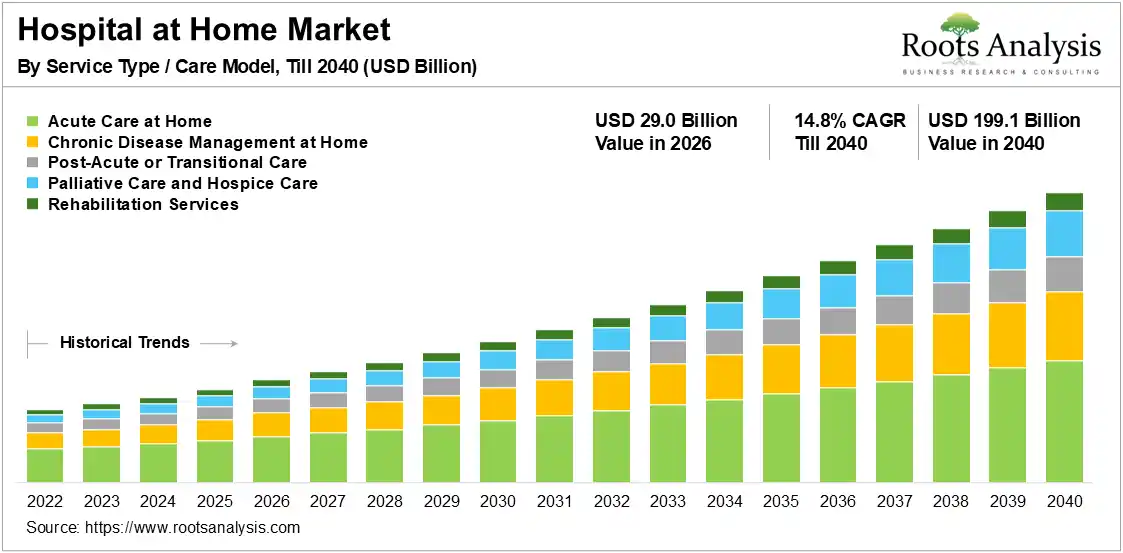
The global hospital at home market reached USD 29.0 billion in 2026 and is projected to reach USD 199.1 billion by 2040, growing at a CAGR of 14.8% over the forecast period 2026 to 2040, driven by hospital capacity constraints.
See What’s in the Full Report – Request Your Complimentary Insights!
Market Report: Key Takeaways
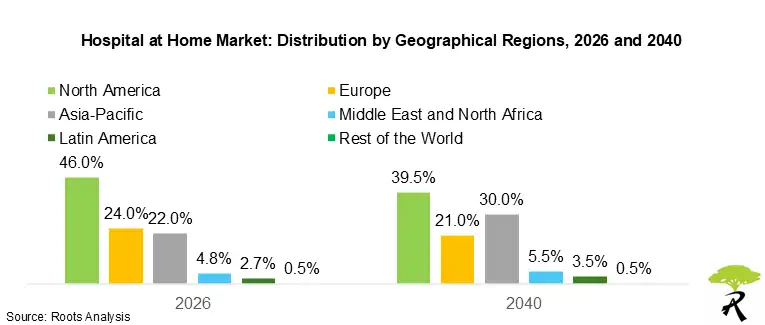
- Based on geography, North America captures 46.0% market share in 2026, whereas Asia-Pacific registers a 17.3% CAGR through 2040, driven by virtual hospital scale-up.
- Based on component / offering, Services capture 54.0% market share in 2026, whereas Software platforms register an 18.4% CAGR through 2040, driven by command-center adoption.
- Based on service type / care model, Acute care at home is both the dominant and fastest-growing category, holding 34.0% share in 2026 and expanding at 15.9% CAGR through 2040, driven by inpatient capacity substitution.
- Based on delivery mode, Hybrid virtual-and-in-home models are both the dominant and fastest-growing category, holding 42.0% share in 2026 and expanding at 16.2% CAGR through 2040, driven by integrated clinical workflows.
- Based on clinical indication, Cardiovascular conditions capture 26.0% market share in 2026, whereas Neurological rehabilitation registers an 18.1% CAGR through 2040, driven by stroke recovery decentralization.
Hospital at Home Market Outlook
Hospital-level care at home has moved from pandemic-era capacity relief into a planned acute-care operating model. Hospitals now combine remote patient monitoring, mobile diagnostics, home-based IV therapy, and virtual command centers to manage inpatient-substitute episodes. Demand has shifted from broad home healthcare toward higher-acuity pathways, especially where bed constraints and discharge bottlenecks pressure hospitals to treat eligible patients outside facilities, without adding inpatient beds or delaying elective throughput.
Current growth depends on reimbursement visibility, operational logistics, and clinical confidence in high-acuity home pathways. The Acute Hospital Care at Home waiver remains central in the US, with the AMA reporting a five-year extension through 2030 in February 2026. Current Health selected Cardinal Health Velocare in March 2026 to scale monitoring-kit fulfillment, installation, and retrieval. That move shows how logistics now shapes hospital at home services market growth.
Through 2040, the hospital at home market will remain high growth as software platforms outpace devices and services. Hybrid virtual-and-in-home models will gain share because acute care requires continuous oversight, escalation protocols, and hands-on response. DispatchHealth and Medically Home closed their merger in June 2025, creating a national complex care-at-home platform. The long-term outlook remains positive but tied to reimbursement durability, workforce coordination, and execution discipline.
Hospital at Home Market Dynamics
Hospital at Home Market Drivers
Hospital capacity pressure and reimbursement continuity are driving acute care at home adoption. CMS maintained program visibility through its March 2026 Acute Hospital Care at Home data release, while the five-year waiver extension through 2030 reduced near-term reimbursement uncertainty. Hospitals also use remote patient monitoring, in-home visits, and mobile diagnostics to shift eligible admissions away from inpatient beds during peak demand.
Hospital at Home Market Restraints
Regulatory uncertainty still limits capital planning, vendor contracting, and physician adoption. Healthcare Dive reported in January 2026 that the Acute Hospital Care at Home waiver faced a January 30 deadline before the later extension, creating operational uncertainty for participating hospitals. Inbound Health shut down in December 2025 after waiver uncertainty affected funding prospects, showing how policy risk can restrict commercialization.
Hospital at Home Market Opportunities
Software platforms and logistics partnerships create the strongest near-term expansion opportunities for providers. Biofourmis was selected by AdventHealth in January 2025 to support an acute care-at-home program in Central Florida. Current Health selected Cardinal Health Velocare in March 2026 to support last-mile monitoring-kit deployment, retrieval, and installation. These moves favor integrated vendors over single-function device suppliers at scale.
Hospital at Home Market Challenges
Clinical execution remains difficult because acute home episodes require continuous monitoring, staffing, escalation, pharmacy, and diagnostics coordination. Hybrid virtual-and-in-home models hold the strongest position, but they need command-center workflows and reliable field operations. Politico reported in October 2025 that shutdown-related waiver disruption pushed some hospitals to pause or scale back programs, showing how fragile operating models remain when policy and staffing risks converge.
Hospital at Home Market Size Estimation Methodology
- As a starting point, the forecast anchored the hospital at home market against verified acute-care-at-home and virtual-ward scope boundaries. Generic home healthcare was excluded because it includes custodial care, routine nursing, and non-acute services. The model prioritized AHCAH activity, NHS-style virtual wards, hospital program launches, high-acuity monitoring deployments, and home-based acute-care logistics.
- Moving forward, the baseline used multiple credible secondary sources and reconciled them against known acute-care capacity constraints. Outlier growth cases above the accepted range were excluded because they overstated near-term reimbursement certainty. The remaining curve reflected a 14.8% CAGR from 2026 to 2040, with adoption moving from policy-supported pilots toward scaled operating models and recurring vendor contracts.
- Building on this, segment shares were assigned using service mix, delivery model, clinical indication, and operating model evidence. The analysis weighed CMS waiver activity, hospital program announcements, remote patient monitoring adoption, virtual ward rollouts, and platform partnerships. Services led the 2026 structure because hospital-at-home episodes still require clinicians, diagnostics, medication administration, logistics, and escalation coverage across every eligible patient pathway.
- Drawing upon these, regional estimates combined reimbursement maturity, public health policy signals, hospital capacity pressure, and virtual hospital programs. North America received the largest current share because CMS waivers and integrated health systems support earlier acute-care substitution. Asia-Pacific received the highest growth rate because virtual hospital pilots and remote monitoring capacity planning are moving into mainstream care delivery across major health systems.
- The projected value was then allocated across component, service type, delivery mode, clinical indication, and operating model categories. Software platforms gained share because command centers, RPM dashboards, care orchestration, and workflow integration scale faster than device volumes. Acute care at home and hybrid virtual-and-in-home models gained share because they directly address inpatient capacity, escalation needs, and payer-recognized acute episodes.
- Finally, the forecast was cross-checked against recent developments, company roles, and segment-level commercial evidence. Policy milestones, program launches, mergers, logistics partnerships, and virtual ward examples were used to test whether each growth assumption matched market behavior. The final forecast avoided publisher-specific bias and treated reimbursement durability as the main sensitivity for hospital at home market forecast confidence and investment timing.
Hospital at Home Market Share Insights
Market Share by Component / Offering
According to our analysis, services lead because hospital-at-home still requires clinical labor, medication administration, diagnostics, and logistics. DispatchHealth closed its Medically Home merger in June 2025, combining clinical care, technology, logistics, and scale.
Software platforms will grow fastest as command centers, RPM dashboards, AI triage, and workflow tools scale. Biofourmis was selected by AdventHealth in January 2025 for an acute care-at-home RPM program.
Market Share by Clinical Indication
Cardiovascular conditions lead because heart failure, arrhythmia, and post-procedure pathways need frequent monitoring. The American Heart Association launched Connected Care with Cadence in August 2025 for at-home heart failure support.
Neurological rehabilitation will grow fast as stroke pathways shift toward supported recovery outside hospitals. HSE highlighted UHL stroke virtual ward advances in October 2025, extending specialist stroke care beyond hospital walls.
Want Information on Specific Region / Segment?
Regional Analysis: North America Leads the Market and Asia-Pacific is Likely to Register Higher CAGR
Presently, North America holds a 46.0% share in 2026. North America leads because CMS waivers, payer experimentation, large IDNs, and home-based acute-care vendors support scale. The region also benefits from capital access and deeper RPM platform adoption. CMS published an Acute Hospital Care at Home data release in March 2026.
On the contrary, Asia-Pacific registers an 17.3% CAGR from 2026 to 2040. Asia-Pacific will expand fast as virtual hospitals, remote monitoring, and care-at-home pilots move into mainstream capacity planning. Policy support and local digital-health infrastructure will accelerate adoption in Australia, Singapore, India, and Japan. Victoria detailed its Virtual Hospital Pilot in January 2026, supporting patients who otherwise required hospital stays.
Market Ecosystem Analysis
In the mapped cohort, 15 of 25 companies are Tier 1 leaders; four are specialists and six are emerging entrants. The bulk of visible commercial activity sits with about eight operators, enablement platforms, monitoring suppliers, and logistics firms. Platform convergence now dominates consolidation, while CMS waiver volatility and health-system economics reshape buying behavior.
- DispatchHealth announced in March 2025 that it would merge with Medically Home, combining home-based acute care operations. The transaction increased scale across major U.S. metro markets, health systems, payers, and value-based care partners. This raises the operating barrier for private hospital-at-home providers and strengthens acute care at home in North America.
- Mayo Clinic and Cleveland Clinic formed a home-based care research consortium in October 2025. The consortium focuses on advancing evidence, scalability, and sustainability for high-acuity care delivery at home. This pressures vendors to prove clinical outcomes, not only deploy monitoring platforms.
- Kaiser Permanente highlighted its Advanced Care at Home model in April 2026, reinforcing the payer-provider pathway. Its integrated structure pressures platform vendors to show value inside capitated and value-based models. This strengthens hospital and health-system operating models in North America.
- Best Buy sold Current Health back to co-founder Christopher McGhee in June 2025. Best Buy later described exiting its care-at-home initiative in September 2025. This weakened retail-led high-acuity enablement and favored specialist platforms with deeper clinical workflows.
- Current Health announced in March 2026 that Cardinal Health’s Velocare would support in-home monitoring kit fulfillment. The partnership covers delivery, installation, and retrieval for Current Health’s clinical monitoring kits. This lowers onboarding friction for hospitals and strengthens equipment, services, and acute care at home.
- Inhealthcare and FibriCheck expanded their partnership in February 2025 for NHS virtual ward heart monitoring. The collaboration brings hospital-grade heart monitoring into patients’ homes through virtual ward pathways. This strengthens cardiovascular indications, remote monitoring, and UK virtual ward software segments.
- Doccla and NHS Greater Glasgow and Clyde announced an April 2025 partnership for virtual hospital care. The program targets the first 1,000 virtual beds through a co-developed regional model. This gives Doccla a large Scottish reference site and strengthens European virtual ward capacity.
- Medway NHS Foundation Trust transitioned to Feebris in June 2025 to scale its virtual hospital platform. The implementation was completed over six weeks and supported Medway’s broader virtual hospital strategy. This lowers perceived switching barriers and strengthens hospital-led virtual ward models in the UK.
- Caregility raised USD 25 million in September 2025 to accelerate AI-enabled virtual care capabilities. The company named computer vision, ambient listening, and sensor-based solutions as priority growth areas. This moves virtual care platforms toward command-center workflows, strengthening telehealth and hybrid care delivery.
Startup Companies and their Key Highlights
- Huma
- Event type: Strategic partnership and acquisition
- Month and year: May 2025
- Acquisition target: Eckuity Capital
- Stated purpose of the event: Build next-generation technology infrastructure for healthcare and research digital solutions
- Market implication: Accelerates respiratory remote monitoring and virtual-care infrastructure for hospital-at-home pathways
- Doccla
- Event type: Strategic partnership
- Month and year: April 2025
- Lead investor or strategic partner name: NHS Greater Glasgow and Clyde
- Stated purpose of the event: Co-develop next-generation virtual hospital care, including the first 1,000 virtual beds
- Market implication: Accelerates European virtual ward capacity and strengthens NHS-linked acute care at home
- Feebris
- Event type: Platform deployment and technology transition
- Month and year: June 2025
- Lead investor or strategic partner name: Medway NHS Foundation Trust
- Stated purpose of the event: Scale a full virtual hospital model within Medway’s care strategy
- Market implication: Accelerates UK virtual hospital adoption by proving rapid migration from legacy workflows
- Inhealthcare
- Event type: Expanded partnership
- Month and year: February 2025
- Lead investor or strategic partner name: FibriCheck
- Stated purpose of the event: Bring hospital-grade heart monitoring into patients’ homes through NHS virtual ward pathways
- Market implication: Accelerates cardiovascular virtual wards and strengthens remote monitoring for cardiac indications
- Caregility
- Event type and funding amount: USD 25 million financing
- Month and year: September 2025
- Stated purpose of the event: Accelerate AI, computer vision, ambient listening, and sensor-based virtual care solutions
- Market implication: Accelerates command-center virtual care and strengthens hybrid hospital-at-home delivery models
Hospital at Home Market Trends / Opportunities
Hybrid Acute-Care Workflows in the Hospital at Home Market Driving Platform Consolidation
Hybrid virtual-and-in-home care is becoming the core delivery model because acute episodes need monitoring and physical intervention. DispatchHealth and Medically Home closed their merger in June 2025 to combine visits, hospital-level care, transitional care, logistics, and technology. This favors scaled platforms that can contract across multiple use cases.
Hospital systems are selecting vendors that can support whole-program operations rather than isolated digital tools. Valley Health System and Inbound Health partnered in June 2025 to launch a Hospital at Home program for eligible New Jersey patients. This shifts competition toward providers with clinical operations, payer knowledge, and command-center capability.
Monitoring-Kit Logistics in the Hospital at Home Market Raising Scale Barriers
Device logistics are becoming a competitive bottleneck because monitoring kits must reach patients quickly and return reliably. Current Health selected Cardinal Health Velocare in March 2026 for last-mile fulfillment, installation, and retrieval of hospital-at-home monitoring kits. This gives supply-chain partners a larger role in commercial scalability.
Software adoption is accelerating as hospitals need reliable RPM dashboards and workflow integration. Biofourmis was selected by AdventHealth in January 2025 to support a new acute care-at-home program in Central Florida. This strengthens vendors that connect monitoring data with physician workflows and escalation protocols.
Virtual Wards and Specialty Pathways Shifting Competitive Focus Toward Clinical Depth
Specialty virtual wards are expanding beyond general capacity relief into defined clinical pathways. HSE highlighted UHL stroke virtual ward advances in October 2025, extending specialist stroke care beyond hospital walls. This creates differentiation for vendors that can support neurology-specific monitoring, rehabilitation, and escalation needs.
Cardiovascular pathways are anchoring demand because heart failure patients need frequent monitoring outside inpatient settings. The American Heart Association launched Connected Care with Cadence in August 2025 for at-home heart failure support. This reinforces cardiovascular care as a high-value use case for remote patient monitoring vendors.
Waiver Stability and Policy Disruption Reshaping Commercial Risk Assessment
Policy continuity is now a commercial requirement because hospitals need reimbursement certainty before scaling acute care at home. The AMA reported in February 2026 that the federal funding law extended the AHCAH waiver through 2030. This supports longer sales cycles, larger contracts, and deeper health-system commitments.
Policy disruption can quickly weaken provider confidence and vendor funding. Politico reported in October 2025 that shutdown disruption affected waiver renewals and pushed some hospitals to pause or scale back programs. This makes regulatory exposure a central factor in vendor valuation and partnership strategy.
Your Business is Unique – Why Shouldn’t Your Report Be?
Market Access Considerations
AHCAH Waiver Visibility and Reimbursement Dependence
Reimbursement access depends heavily on the Acute Hospital Care at Home waiver, because hospitals need payer recognition for inpatient-substitute episodes. The AMA reported in February 2026 that Section 6210 extended the waiver through 2030. This enables longer contracting cycles, but it also concentrates market access around providers that can meet hospital-level documentation, admission, patient selection, and escalation requirements across compliant programs. Weak compliance limits payer confidence and repeat referrals.
Last-Mile Logistics and Monitoring-Kit Operations
Scale depends on rapid kit deployment, installation, retrieval, and device turnaround across patient homes. Current Health selected Cardinal Health Velocare in March 2026 to support last-mile fulfillment for hospital-at-home monitoring kits . This raises entry costs for software-only vendors and improves positioning for companies that can coordinate devices, field services, clinical workflow reliability, and repeatable home setup processes. Logistics depth increasingly determines contract readiness for health systems expanding across service regions.
Clinical Governance and Escalation Readiness
Market access requires physician governance, escalation protocols, and reliable coordination between command centers and home visits. CMS continued to publish Acute Hospital Care at Home program data in March 2026, which keeps program performance visible to policymakers and hospitals. Providers with stronger governance can support higher-acuity cases, while weaker operators face slower adoption, limited referrals, and lower health-system trust. Governance strength increasingly separates clinical partners from technology vendors.
Policy Volatility and Provider Confidence
Commercialization remains exposed to policy volatility because hospitals pause investment when waiver status becomes uncertain. Politico reported in October 2025 that federal shutdown disruption affected waiver renewals and pushed some hospitals to pause or scale back programs. This makes regulatory monitoring, contingency planning, diversified payer strategies, and flexible staffing models essential for competitive positioning. Policy risk directly affects vendor financing, expansion timing, and provider willingness to outsource operations.
How Stakeholders Benefit from the Key Focus Areas of Our Hospital at Home Market Report
Hospital capacity pressure, waiver visibility, and virtual ward expansion make this market commercially urgent in 2026. The report supports decisions on segment prioritization, platform selection, partnership strategy, reimbursement exposure, and long-term growth planning.
- Unmet Needs and Market Gaps in Hospital at Home Market: The report identifies where acute care at home still lacks scalable logistics, command-center workflows, and specialty pathways. Health-system planners can use this view to prioritize gaps in monitoring, home visits, diagnostics, and escalation coverage. The analysis supports decisions on which service lines should move first into hospital-level home care.
- Funding and Venture Investment Opportunities in Hospital at Home Market: The report separates investable growth areas from policy-sensitive models. Funding teams can compare software platforms, private hospital-at-home providers, logistics partners, and care-at-home operators using segment CAGR and share-shift evidence. This supports decisions on whether to back asset-light platforms, integrated operators, or supply-chain enablers.
- Technology Innovation and Adoption Trends: The report tracks how RPM dashboards, virtual command centers, home-compatible infusion devices, and hybrid care workflows are gaining adoption. Technology leaders can evaluate which tools support acute-care substitution rather than low-acuity home health. This helps buyers decide whether to build, partner, or procure hospital-at-home technology stacks.
- Hospital at Home Market Competitive Landscape and Industry Analysis: The report maps Tier 1 leaders, Tier 2 specialists, emerging platforms, hospital operators, and supply-chain participants. Strategy teams can assess where DispatchHealth, Contessa Health, Current Health, Biofourmis, Cardinal Health, Masimo, and major health systems fit across the value chain. This supports positioning decisions, white-space analysis, and competitive benchmarking.
- Mapping Strategic Partnerships and Ecosystem Synergies: The report explains how partnerships connect hospital operators, RPM vendors, logistics providers, and care-at-home platforms. Business development teams can identify which alliances support monitoring-kit deployment, clinical staffing, home visits, and program launch execution. This supports partner screening, channel strategy, and health-system account planning.
- Hospital at Home Market CAGR and Growth Trends: The report shows a 14.8% CAGR through 2040, with software platforms, private providers, neurological rehabilitation, and hybrid models outpacing the market. Commercial teams can use this view to prioritize the fastest-growing sub-segments without losing sight of dominant current revenue pools. This supports market-entry timing, product roadmap planning, and regional expansion choices.
Hospital at Home Market: Scope of the Report
| Key Report Attributes | Details | |
| Forecast Period | Till 2040 | |
| Market Size 2026 | USD 29.0 Billion | |
| Market Size 2040 | USD 199.1 Billion | |
| CAGR (Till 2040) | 14.8% | |
| Segments Covered |
|
|
| Geographical Regions Covered |
|
|
| Key Sections Covered |
|
|
Market Segmentation
The Hospital at Home Market report presents an in-depth analysis, highlighting the capabilities of various stakeholders, based on different segments, such as component / offering, service type / care model, delivery mode, clinical indication; care provider / operating model, geographical regions, and leading players.
By Component / Offering
- Equipment and Devices
- Software Platforms
- Services
By Service Type / Care Model
- Acute Care at Home
- Chronic Disease Management at Home
- Post-Acute or Transitional Care
- Palliative Care and Hospice Care
- Rehabilitation Services
By Delivery Mode
- Remote Monitoring and Telehealth
- In-Person Home Visits
- Hybrid Virtual-And-In-Home Models
By Clinical Indication
- Cardiovascular Conditions
- Respiratory Diseases
- Orthopedic and Post-Surgical Recovery
- Infectious Diseases
- Neurological Rehabilitation
- Others
By Care Provider / Operating Model
- Hospitals And Health Systems
- Home Health Agencies
- Primary Care or Physician Groups
- Private Hospital-At-Home Providers
By Geographical Regions
- North America
- US
- Canada
- Mexico
- Rest of North America
- Europe
- Austria
- Belgium
- Denmark
- France
- Germany
- Ireland
- Italy
- Netherlands
- Norway
- Russia
- Spain
- Sweden
- Switzerland
- UK
- Rest of Europe
- Asia-Pacific
- China
- India
- Japan
- Singapore
- South Korea
- Rest of Asia-Pacific
- Latin America
- Argentina
- Brazil
- Chile
- Colombia
- Venezuela
- Rest of Latin America
- Middle East and Africa (MEA)
- Egypt
- Iran
- Iraq
- Israel
- Kuwait
- Saudi Arabia
- UAE
- Rest of MEA
- Rest of the World


