
Lowest Price Guaranteed
Pages
132
Last Updated
July 2026
View Count
13661
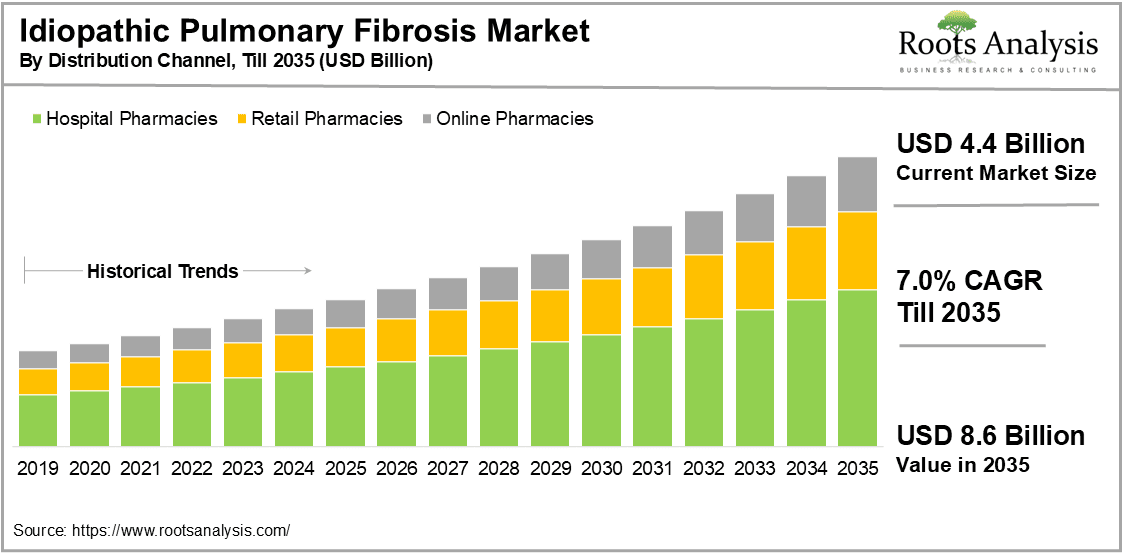
The global idiopathic pulmonary fibrosis market is projected to grow from USD 4.4 billion to USD 8.6 billion by 2035, representing a healthy CAGR of 7.0% during the forecast period.
To learn more about this report, request a free sample copy
The new market report provides an in-depth analysis of industry size, trends, market drivers, and future trends.
Idiopathic pulmonary fibrosis (IPF) refers to a chronic lung disease characterized by stiff and thick tissues of the lungs. The disease causes tissue scars that result in breathing difficulties, and the lungs are unable to transport optimal oxygen to the organs. It is a progressive disease and may cause irreversible damage to the lungs. The exact reason for idiopathic pulmonary fibrosis is not known, however, some factors may trigger acute exacerbation of the disease. It is worth noting here that COVID-19 has increased the acute exacerbation of idiopathic pulmonary fibrosis - the condition negatively impacts the prognosis of patients with the disease. The pandemic crisis has brought significant attention to respiratory health and associated diseases.
Further, according to the American Lung Association data, nearly 50,000 new cases of idiopathic pulmonary fibrosis have been reported annually. The growing awareness about idiopathic pulmonary fibrosis amongst healthcare experts and patients has surged the demand for therapeutic drugs and diagnosis procedures to mitigate the growing concern of disease. Currently, several pharmaceutical companies and drug developers are actively investing time and resources on the development of drugs to address the unmet treatment requirement for IPF patients. Notably, in October 2023, Bristol Myers Squibb announced receiving US FDA Breakthrough Therapy Designation for its investigational LAP1 Antagonist to treat patients with progressive pulmonary fibrosis diseases.
Driven by the growing introduction of new therapeutic drugs, including immunosuppressants, antifibrotic agents, and targeted therapies to improve patient outcomes, we believe that the idiopathic pulmonary fibrosis market will grow at a steady rate during the forecast period.
The market report covers an in-depth analysis of various companies that are active in the global idiopathic pulmonary fibrosis industry across different segments, as defined in the table below.
| Key Report Attributes | Details | |
| Historical Trend | Since 2019 | |
| Forecast Period | Till 2035 | |
| Current Market Size | USD 4.4 Billion | |
| Market Size 2035 | USD 8.6 Billion | |
| Distribution by Drug Type |
|
|
| Mode of Action |
|
|
| Route of Administration |
|
|
| Type of Treatment |
|
|
| Distribution Channel |
|
|
| Key Geographical Region |
|
|
| Key Companies Profiled |
|
|
| PowerPoint Presentation (Complimentary) |
Available | |
| Customization Scope | 15% Free Customization | |
| Excel Data Packs (Complimentary) |
Available | |
One of the key objectives of this market research report is to provide a comprehensive market forecast analysis in order to estimate the existing market size and future opportunities in the market over the next decade.
Based on multiple parameters, such as drug type (nintedanib, pirfenidone, and other drug types), mode of action (antifibrotic agents, tyrosine kinase inhibitors, and other modes of action), route of administration (oral and injectables), type of treatment (oxygen therapy, lung transplant and other), distribution channel (hospitals pharmacies, retail pharmacies, and other pharmacies), and geography region (North America, Europe, Asia-Pacific, Middle East and Africa, and Latin America); we have developed informed estimates on the evolution of the market for the forecast period, till 2035. The market research report also features the likely distribution of the current and forecasted opportunity across idiopathic pulmonary fibrosis industry segments.
To account for the future uncertainties and to add robustness to our model, we have provided three idiopathic pulmonary fibrosis market forecast scenarios, namely conservative, base, and optimistic scenarios, portraying different tracks of the anticipated industry's growth.
All actual figures have been sourced and analyzed from publicly available information forums. Financial figures mentioned in this market research report are in USD unless otherwise specified.
Based on the drug type, the idiopathic pulmonary fibrosis market is bifurcated into nintedanib, pirfenidone, and other drug types. For FY 2023, Ofev (nintedanib) brought in revenues of USD 3.8 billion for its developer Boehringer Ingelheim, an increase of more than 12% Year-on-year. However, in addition to Ofev a number of nintedanib generic drugs are also available in the market. The second branded drug Esbriet (pirfenidone) from Roche, the company recorded dropping sales due to generic competition. The drug generated revenues of USD 229 million in FY 2023.
According to our projection, nintedanib accounts for the largest share of the market. The drug has been approved for the treatment of patients with idiopathic pulmonary fibrosis disease and has shown higher efficacy during clinical studies. However, in the long run, pirfenidone drug is anticipated to grow at a higher CAGR during the forecast period. This can be attributed to the fact that pirfndidone has shown positive outcomes at different stage of idiopathic pulmonary fibrosis disease. Furthermore, the drug has higher safety profile and show low side effects specifically associated with gastrointestinal concerns.
Based on the drug type, the IPF market is bifurcated into antifibrotic agents, tyrosine kinase inhibitors, and other modes of action. According to our projection, antifibrotic agents account for the largest share. This can be attributed to the higher efficacy in targeting fibrosis process within idiopathic pulmonary fibrosis. However, in the long run, tyrosine kinase inhibitors are expected to grow at a higher CAGR during the forecast period.
Based on the route of administration, the idiopathic pulmonary fibrosis market is segmented into oral and injectables. According to our projection, currently oral route accounts for the highest share of the market and is poised to capture 55% of overall revenue share by 2035. This can be attributed to the growing preferences for oral route for drug administration owing to ease of delivery. It is important to highlight here that the oral segment will grow at a higher CAGR during the projected period driven by the growing preferences for oral route of administration.
Based on the type of treatment, the idiopathic pulmonary fibrosis market is segmented into oxygen therapy, lung transplant and others. According to our projection, currently oxygen therapy accounts for the highest share and is poised to grow at a higher CAGR during the forecast period. This can be attributed to the rising incidence of patients with idiopathic pulmonary fibrosis across the globe.
The global idiopathic pulmonary fibrosis market is segmented into hospitals pharmacies, retail pharmacies, and online pharmacies. According to our projection, currently the hospital pharmacies segment accounts for the largest share, capturing 54.18% share of the market in 2024. The growth can be attributed to the fact that hospitals pharmacies are the primary distributors of therapeutic drugs and providers of treatment for idiopathic pulmonary fibrosis disease. Driven by the primary source for therapeutic drug distribution, this segment will continue to grow at a higher CAGR during the forecast period.
Based on the key geographical insight, the global market is distributed across North America, Europe, Asia-Pacific, the Middle East and North Africa, and Latin America. According to our projection, currently North America accounts for the largest idiopathic pulmonary fibrosis market share, capturing 39.5% of the market. The largest share can be projected due to the rising incidence of IPF in the US, favorable reimbursement policies, and heightened awareness about idiopathic pulmonary fibrosis disease in this region. However, in Asia-Pacific, the market of idiopathic pulmonary fibrosis will grow at a higher CAGR of 7.6% during the forecast period.
The “Idiopathic Pulmonary Fibrosis Market: Industry Trends and Global Forecast, till 2035” market report features a detailed study of the current market landscape, market size, market forecast and future opportunities for the drug developers targeting idiopathic pulmonary fibrosis.
The global landscape for the companies developing drugs targeting idiopathic pulmonary fibrosis features the presence of several well-established players and startups who are actively focusing on the development of innovative therapies and drugs to improve patient outcomes. Additionally, various research institutes are adopting advanced technologies to address the unmet medical requirements of patients with IPF.
The startups are gaining the attention of both venture firms and big pharmaceutical companies interested in the area of fibrosis. US based startup, Mediar Therapeutics, which was launched in 2019, raised USD 85 million in Series A funding led by Novartis’ venture fund and Sofinnova Partners, and co-led by Pfizer, Eli Lilly and Bristol Myers Squibb. In May 2024, the company initiated phase I clinical trials for its first candidate, MTX-463, an antibody therapeutic targeting WISP-1 mediated fibrotic signaling.
The growing prevalence of idiopathic pulmonary fibrosis among the elderly population has raised the demand for appropriate treatment methodologies, which is anticipated to be the key driver of this market. In addition to therapeutic drug research, pharmaceutical players are actively exploring the latest diagnostics techniques that can aid in the early detection of IPF and help in designing personalized diagnostic plans to treat patient outcomes. Considering the growing necessity of finding innovative treatments, regulatory agencies such as the US FDA and EMA are providing supportive guidelines for the approval of promising therapies, which is further an important idiopathic pulmonary fibrosis market driver.
The market has faced a dry spell since the launch of Ofev and Esbriet in 2014. However, there are some potential candidates in phase III clinical trials. One such molecule is Boehringer Ingelheim’s nerandomilast, an oral phosphodiesterase 4B (PDE4B) inhibitor, which was evaluated in a phase III trial with more than 1,000 participants. Full data from the trial are expected in H1 2025, with the company planning new drug application (NDA) submission to the FDA soon after. Another candidate gaining attention is Bristol Myer Squibb’s BMS-986278, an oral lysophosphatidic acid receptor 1 (LPA1) antagonist which entered phase III clinical trial in September 2023.
Currently, idiopathic pulmonary fibrosis patients have limited access to therapies. For both the marketed drugs, Ofev and Esbriet, a number of generic versions are available in the market. As stated by Ganesh Raghu, MD, of the University of Washington in Seattle “The efficacy of marketed drugs is limited, and many patients can't tolerate them”.
Further, complex disease pathology makes it difficult to diagnose and develop effective therapies, leading to a high failure rate in clinical trials. Additionally, a limited understanding of the mechanism of disease progression and cause hinders the idiopathic pulmonary fibrosis market during the projected period. The most recent IPF drug to fail in phase III clinical trial is FibroGen’s pamrevlumab, which failed to preserve lung function as a result of which the drug was shelved for this indication.
The global idiopathic pulmonary fibrosis market size is expected to be propelled by the growing research on advanced technologies to understand the molecular and genetic basis of IPF. These advances in biomarker and diagnostic technologies offer opportunities to the leading players to develop personalized treatments with precise diagnoses. The drug developers are also entering into partnerships and collaborations to propel the frug development forward. For instance, in May 2024, Ferrer gained distribution rights of United Therapeutics’ Tyvaso®, a drug device combination product approved for WHO Group 3 Pulmonary Hypertension associated with Interstitial Lung Disease (PH-ILD), and for WHO Group 1 Pulmonary Arterial Hypertension (PAH). The contract also includes potential indication for the drug, including IPF and progressive pulmonary fibrosis.
In addition to growing research, several players have entered into partnerships and collaboration agreements to strengthen their product portfolio and enhance research on advanced therapeutics. For instance, in April 2022, Bristol Myers Squibb successfully acquired Acceleron Pharma, aiming to expand their research and product portfolio for the treatment of patients with IPF.
Currently, the global idiopathic pulmonary fibrosis market is valued at USD 4.4 billion and is poised to reach at USD 8.6 billion by 2035. This lucrative growth is likely to be the result of growing incidence of chronic lung diseases across the globe and rising research on the drugs. In order to enhance the research, several industrial leaders are forging strategic partnerships and collaboration agreements. For instance, in October 2024, GSK and BU enter into the collaboration agreement to drive research on pulmonary fibrosis diseases with no existing cure. It is also important to highlight here that North America is currently dominating the market and this region will continue to remain dominant during the forecast period. This can be attributed to the growing research by the established players in this field for the development of therapeutic drugs to treat idiopathic pulmonary fibrosis diseases. Driven by ongoing research and rising partnerships, we believe that the market will continue to grow steadily during the forecast period.
Examples of the leading players active in the industry (the complete list of which is included in the detailed report on the IPF Market) ) includes Alembic Pharmaceuticals, AstraZeneca, Biogen, Boehringer Ingelheim GMBH, Bristol Myers Squibb Company, Celix Pharma, Cipla, Daewoong Pharmaceutical, FibroGen, Galapagos NV, Galecto Biotech, GNI Group, Horizon Therapeutics, Intas Pharmaceuticals, Johnson & Johnson, Jubilant Pharmova, Medicinova, Neopharm Group, Novartis, Pfizer and Roche.
Several recent developments have taken place in the field of idiopathic pulmonary fibrosis. We have outlined some of the recent initiatives below. These developments, even if they took place post the release of our market report, substantiate the overall market trends and have been outlined in our analysis.