


 Download Free Sample
 Buy Now
Market Size
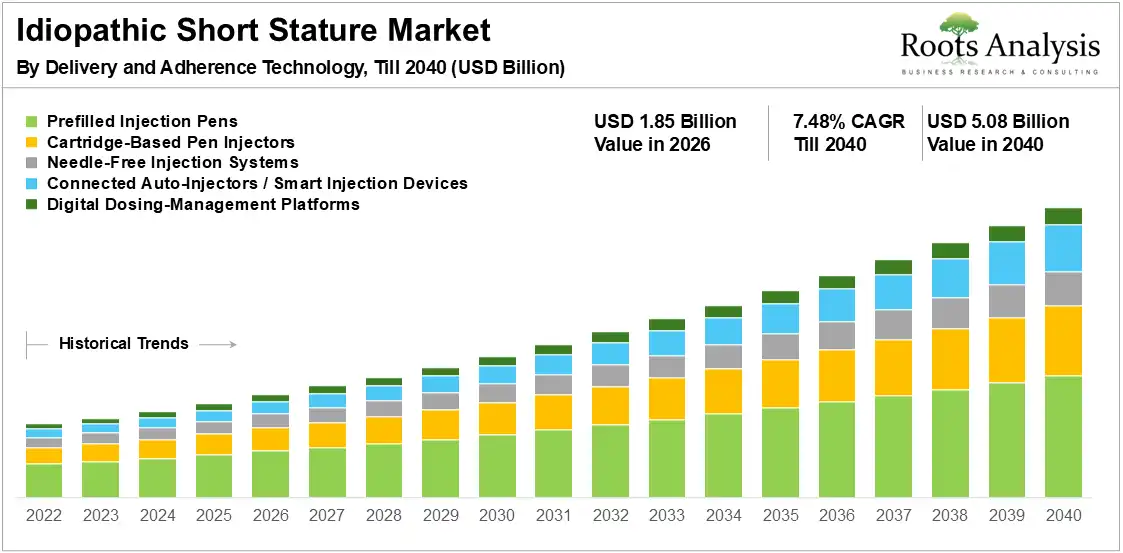
The global idiopathic short stature market is expected to rise from USD 1.85 billion in 2026 to reach USD 5.08 billion by 2040, growing at a CAGR of 7.48% over the forecast period 2026 to 2040, driven by weekly growth hormone adoption, home-based treatment, and genetic reclassification of short stature.
See What’s in the Full Report – Request Your Complimentary Insights!
Market Report: Key Takeaways
- Based on Geography, North America captures 45.0% market share in 2026, whereas Asia-Pacific registers a 10.2% CAGR through 2040, driven by faster private endocrine care expansion.
- Based on Therapy Type, branded recombinant human growth hormone captures 70.0% market share in 2026, whereas Oral growth hormone secretagogues / pipeline therapies register an 18.7% CAGR through 2040, driven by injection-free pipeline adoption.
- Based on Route of Administration, daily subcutaneous injection captures 78.0% market share in 2026, whereas Oral formulations / pipeline registers an 18.7% CAGR through 2040, driven by adherence-focused route innovation.
- Based on Delivery and Adherence Technology, Prefilled injection pens capture 46.0% market share in 2026, whereas Connected auto-injectors / smart injection devices register a 12.9% CAGR through 2040, driven by objective adherence tracking.
- Based on End User / Care Setting, Specialty endocrine clinics capture 45.0% market share in 2026, whereas Home-care settings register a 9.9% CAGR through 2040, driven by weekly dosing and remote support.
Idiopathic Short Stature Market Outlook
Weekly growth hormone is shifting ISS care from daily somatropin dependence toward longer acting, adherence focused regimens. Established branded recombinant human growth hormone still controls prescribing, reimbursement, and clinic workflows, but biosimilar somatropin and weekly analogs are gaining share. The idiopathic short stature market now reflects a wider care model. Specialty endocrine clinics diagnose patients, home care supports administration, and genetic testing narrows the truly idiopathic population.
Current growth comes from label expansion, payer recognized use cases, and device designs that reduce pediatric injection burden. Novo Nordisk secured FDA labeling for Sogroya in pediatric idiopathic short stature in February 2026. The update strengthened weekly somapacitan therapy against daily somatropin benchmarks. Commercial adoption still depends on medical necessity criteria, dose monitoring, IGF-1 testing, and family willingness to sustain multiyear therapy.
Through 2040, the market will remain high growth, supported by a 7.5% CAGR. Weekly injection, connected devices, and oral formulations will drive the treatment mix. Ascendis Pharma initiated the Phase 3 HighLiGHts basket trial in January 2026. The trial covers ISS, SHOX deficiency, Turner syndrome, and SGA. Growth will favor therapies that combine height outcomes, lower treatment burden, and access evidence.
Idiopathic Short Stature Market Dynamics
Idiopathic Short Stature Market Drivers
Label expansion and dosing convenience are moving growth hormone therapy from daily compliance pressure toward weekly treatment choice. FDA labeling added pediatric idiopathic short stature to Sogroya in February 2026, giving weekly somapacitan therapy a clear regulatory anchor. This shifts physician discussions from only height velocity to treatment burden, injection frequency, and long term adherence evidence.
Idiopathic Short Stature Market Restraints
Payer scrutiny limits access because ISS therapy requires long duration, high drug spend, and careful eligibility documentation. UnitedHealthcare updated its commercial growth hormone medical necessity policy in December 2025, covering somatropin products and long acting growth hormone products. Prior authorization, auxology records, bone age data, and IGF-1 monitoring slow starts and favor brands with stronger support services.
Idiopathic Short Stature Market Opportunities
Oral and connected treatment models create the strongest market growth opportunity beyond legacy branded recombinant human growth hormone. Lumos Pharma advanced a Phase 3 OraGrowtH design for daily oral LUM-201 in 2025. The program supports injection free disruption from a small base. Merck Healthcare Korea launched Growzen Connect in March 2026. The platform shows how adherence data can differentiate mature GH franchises.
Idiopathic Short Stature Market Challenges
Molecular diagnosis can shrink the idiopathic pool while raising workup costs for families and providers. Short stature genetic panels, exome sequencing, and genome sequencing increasingly reclassify children previously treated as ISS. Endocrine Abstracts described whole exome sequencing in 212 pediatric short stature patients in 2025, reinforcing the shift toward molecular stratification. This challenges volume assumptions and pushes companies toward narrower evidence packages.
Idiopathic Short Stature Market Size Estimation Methodology
- As a starting point, the model built the idiopathic short stature market baseline from multiple credible secondary sources. These sources covered ISS specific revenue, broader human growth hormone ceilings, and pediatric short stature treatment demand. The estimate excluded broad HGH figures that overstated ISS use and seven market scopes that undercounted global demand. This created a conservative base across somatropin, biosimilars, long acting analogs, and oral pipeline therapies.
- Moving forward, the model separated therapy level revenue into branded recombinant human growth hormone, biosimilars, long acting analogs, and oral secretagogues. Official drug labels, drug approval timelines, regulatory submission counts, and company pipeline disclosures shaped adoption curves. Weekly therapy gained share where approved pediatric indications and adherence benefits supported substitution from daily injections.
- Building on this, route and delivery assumptions tracked daily injection, weekly injection, oral formulations, prefilled pens, cartridge pens, and needle free systems. The model also tracked connected auto injectors and digital dosing platforms. Device product pages, launch announcements, and dosing management tools informed the technology migration curve. Platforms that reduced caregiver burden or generated objective adherence data received higher growth assumptions.
- Drawing upon these, end user and distribution splits used specialty endocrine clinic workflows, hospital pharmacy access, and retail refill behavior. The model also used online pharmacy support and clinic based dispensing. Payer medical necessity policies shaped eligible starts, continuation requirements, and documentation friction. Diagnostic workflows used IGF-1, IGFBP-3, stimulation testing, bone age assessment, genetic panels, exome sequencing, and genome sequencing.
- The projected value was then calculated by applying segment specific CAGRs to the 2026 base across each dimension. Branded somatropin lost share because mature products faced biosimilar and weekly analog competition. Oral formulations grew fastest from a tiny base, while exome and genome sequencing gained as unexplained short stature moved toward molecular classification.
- Finally, regional adoption signals shaped the reconciliation step. These signals covered North America leadership, Asia-Pacific acceleration, European reimbursement controls, and emerging market access barriers. Scenario checks tested payer restrictions, regulatory label expansion, clinical trial progress, and device adoption. The resulting forecast supports idiopathic short stature market forecast planning without overstating pipeline revenue before regulatory conversion.
Idiopathic Short Stature Market Share Insights
Market Share by Route of Administration
According to our analysis, daily subcutaneous injection leads because legacy ISS care still depends on mature somatropin labels and trained injection workflows. Novo Nordisk, February 2026, compared Sogroya against once-daily somatropin in REAL8, confirming daily therapy’s benchmark role.
Conversely, oral formulations / pipeline will expand fastest because they remove injection burden and target adherence-sensitive families. Lumos Pharma, 2025, described LUM-201 as an oral growth hormone secretagogue in a Phase 3 pediatric trial design.
Market Share by End User / Care Setting
According to our analysis, specialty endocrine clinics lead because ISS diagnosis requires auxology, exclusion testing, treatment selection, and dose titration. Pediatric Endocrine Society, March 2026, summarized FDA authorization of Sogroya for ISS and related pediatric growth disorders.
On the other hand, home-care settings will grow fast as weekly dosing and easier devices reduce clinic dependency. Novo Nordisk, February 2026, described once-weekly Sogroya as offering 313 injection-free days per year.
Want Information on Specific Region / Segment?
Regional Analysis: North America Leads the Market and Asia-Pacific is Likely to Register Higher CAGR
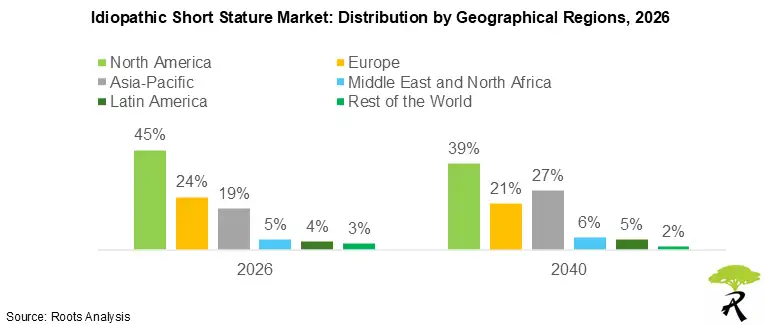
Presently, North America holds 45.0% share in 2026. The region leads through FDA-recognized ISS labels, dense pediatric endocrinology networks, specialty pharmacy infrastructure, and strong commercial payer access. Novo Nordisk, February 2026, secured FDA approval for Sogroya in pediatric ISS.
Fastest-growing region: Asia-Pacific registers a 10.2% CAGR from 2026 to 2040. The region benefits from rising private endocrine care, urban pediatric screening, digital adherence platforms, and strong growth hormone utilization in Korea and China. Korea Biomedical Review, May 2025, reported rising Korean pediatric growth hormone use and KRW 480 billion supply value in 2023.
Market Ecosystem Analysis
Within the 25-company scope, eight commercial therapy suppliers anchor most prescription activity. The broader field includes 7 Tier 1 leaders, 10 specialists, and 8 emerging entrants. Platform convergence now dominates, linking weekly GH analogs, skeletal-dysplasia drugs, genomic workups, and connected injection systems. Supply continuity and reduced injection burden reshape behavior, as available daily brands compete against weekly ISS authorization. Competitive advantage shifts toward evidence-backed convenience, diagnostic precision, and adherence capture, not simple recombinant growth-hormone access.
- Novo Nordisk gained the clearest ISS-specific weekly advantage in February 2026. FDA authorization extended Sogroya to ISS, SGA, and Noonan syndrome, moving weekly therapy into pediatric short-stature workflows. This pressures daily somatropin brands to defend adherence, titration flexibility, and pharmacy access in specialty endocrine clinics.
- Ascendis Pharma disclosed in January 2026 that it had initiated a Phase 3 basket trial covering ISS, SHOX deficiency, Turner syndrome, and SGA. The move broadens TransCon hGH from pediatric GHD toward multi-indication short-stature coverage. It raises the clinical evidence barrier for both weekly and daily hGH suppliers.
- Pfizer and Sandoz gained continuity positioning in ASHP’s December 2025 shortage update, which listed Genotropin and Omnitrope as available. Reliable SKU access now matters because chronic pediatric therapy cannot tolerate repeated switching. This strengthens branded and biosimilar daily injection segments across hospital, retail, and specialty pharmacy channels.
- BioMarin reinforced its skeletal short-stature franchise in August 2025. VOXZOGO revenue rose 20% in the second quarter, with treated children across 51 countries by quarter-end. This scale deepens prescriber familiarity and raises access barriers for emerging skeletal-dysplasia entrants.
- BridgeBio shifted oral FGFR3 inhibition closer to commercialization relevance in February 2026. Its oral infigratinib improved growth in a late-stage achondroplasia study and challenged injectable incumbents on convenience. The result strengthens the oral formulations and skeletal short-stature pipeline segment.
- TYRA Biosciences expanded oral FGFR3 competition in November 2025. The company reported first patient dosing in BEACH301 for dabogratinib in pediatric achondroplasia. This increases pressure on BridgeBio to differentiate selectivity, safety, and pediatric endpoint durability.
- GeneDx and Natera pushed rare-disease genomics deeper into pediatric diagnostic pathways. GeneDx launched Infinity in September 2025 to support ExomeDx and GenomeDx interpretation. Natera launched Zenith Genomics in March 2026 for rare-disease diagnosis. These moves strengthen exome and genome sequencing for syndromic short-stature differentiation.
- Merck KGaA and Ypsomed are making adherence data a competitive layer. Merck Healthcare Korea launched Growzen Connect in March 2026 around Saizen, Easypod, and growth-therapy monitoring. Ypsomed received FDA clearance for SmartPilot in September 2025, adding digital connectivity to YpsoMate. This strengthens connected auto-injectors, smart devices, and digital dosing-management platforms.
- LG Chem and Changchun GeneScience are localizing adherence advantage in Asia-Pacific. LG Chem launched Eutropin EcoPen 48 in April 2026 with a replaceable-cartridge injector format. GenSci stated in October 2025 that Jintrolong covered GHD, ISS, and Turner syndrome, with weekly dosing replacing daily injections. Together, they strengthen regional weekly injection and cartridge-based pen segments.
Startup Companies and their Key Highlights
- BridgeBio Pharma
- Event type: Phase 3 topline clinical readout
- Month and year: February 2026
- Stated purpose: Report PROPEL 3 results for oral infigratinib in children with achondroplasia.
- Market implication: Advances oral skeletal short-stature therapy and pressures injectable incumbents on convenience and proportionality outcomes.
- TYRA Biosciences
- Event type: Clinical program update
- Month and year: November 2025
- Stated purpose: Report first patient dosing in BEACH301 and SURF302 for dabogratinib programs.
- Market implication: Accelerates oral FGFR3-selective skeletal dysplasia competition and strengthens pediatric specialty-clinic pipeline visibility.
- GeneDx
- Event type: Genomic platform launch
- Month and year: September 2025
- Stated purpose: Introduce GeneDx Infinity to support ExomeDx and GenomeDx rare-disease interpretation.
- Market implication: Expands genome-scale differential diagnosis for syndromic short stature and rare pediatric growth disorders.
- Natera
- Event type: Commercial launch
- Month and year: March 2026
- Strategic partner name: MyOme
- Stated purpose: Debut the Zenith rare-disease portfolio with Natera and launch long-read methylation analysis.
- Market implication: Expands rare-disease genomics capacity for complex short-stature workups requiring broader molecular diagnosis.
Idiopathic Short Stature Market Trends / Opportunities
Weekly GH Label Expansion Shifting Idiopathic Short Stature Market Share Toward Long Acting Brands
Long acting growth hormone analogs are moving from niche use toward mainstream pediatric endocrine prescribing. Sogroya gained FDA labeling for pediatric ISS in February 2026. The label strengthened weekly somapacitan against daily somatropin. This gives Novo Nordisk a stronger branded position in adherence sensitive families.
Basket trial strategies are widening the competitive field beyond single indication pediatric growth programs. Ascendis Pharma initiated the Phase 3 HighLiGHts basket trial in January 2026. The trial covers ISS, SHOX deficiency, Turner syndrome, and SGA. This approach can spread trial investment across multiple short stature labels.
Connected Injection and Digital Dosing Platforms Raising Adherence Differentiation
Adherence technology is becoming a competitive layer around mature growth hormone brands. Merck Healthcare Korea launched Growzen Connect in March 2026. The platform supports Saizen dosing cycle management by healthcare professionals. This supports franchise defense through service data, not only molecule differentiation.
Easier injection hardware is reducing practical barriers to home care growth hormone delivery. LG Chem launched Eutropin EcoPen 48 in April 2026. The cartridge replacement device targets pediatric GH injection. Device improvements can lift persistence and protect regional brands against weekly analog competition.
Genetic Reclassification Reshaping Idiopathic Short Stature Market Targeting and Diagnostics Revenue
Molecular workups are narrowing the patient population treated as idiopathic short stature. Endocrine Abstracts described whole exome sequencing in 212 pediatric short stature patients in 2025. This creates revenue upside for genomic diagnostics while pressuring broad ISS therapy assumptions.
Biochemical screening remains the first diagnostic gate before stimulation testing and genetic escalation. Pediatrics in Review emphasized IGF-1 and IGFBP-3 evaluation in short stature assessment in June 2025. This sustains demand for endocrine laboratory testing even as sequencing gains share.
Oral Secretagogues Challenging Injection Based Forecasting and Pipeline Valuation
Oral growth hormone secretagogues are creating option value beyond injectable recombinant human growth hormone. Lumos Pharma advanced the Phase 3 OraGrowtH design for daily oral LUM-201 in 2025. This positions oral therapy as a potential adherence led challenger from a small base.
Injection burden keeps oral formulations commercially relevant despite limited near term revenue share. The oral route rises from 1.0% share in 2026 to 6.0% by 2040. This creates upside for successful oral entrants but keeps valuation tied to trial execution.
Your Business is Unique – Why Shouldn’t Your Report Be?
Market Access Considerations
Pediatric Label Scope and Indication Boundaries
Regulatory label scope determines which short stature patients can move from off label discussion to structured reimbursement review. FDA labeling added pediatric ISS to Sogroya in February 2026, giving Novo Nordisk a formal access pathway for weekly somapacitan. Products without ISS specific labels face slower payer acceptance and more medical exception requests. They also face weaker positioning against approved weekly growth hormone options.
Payer Medical Necessity and Prior Authorization Controls
Commercial access depends on proof that height, growth velocity, bone age, and biochemical testing meet payer thresholds. UnitedHealthcare updated its growth hormone medical necessity policy in December 2025 across somatropin and long acting GH products. These rules slow starts, raise documentation costs, and reward manufacturers that fund reimbursement support. Benefits checks and continuity programs also matter during every renewal cycle.
Diagnostic Evidence Requirements and Molecular Reclassification
Diagnostic access increasingly requires both endocrine screening and genetics informed exclusion of alternative causes. Pediatrics in Review emphasized IGF-1 and IGFBP-3 evaluation in June 2025, while exome sequencing evidence expanded molecular workups. This behavior supports laboratory revenue across pediatric endocrine networks and prior authorization packets. It can reduce eligible ISS volumes when genetic panels identify syndromic or skeletal causes.
Home Administration Infrastructure and Adherence Monitoring
Home based scaling depends on devices, training, refill reliability, and monitoring tools that reduce caregiver friction. Merck Healthcare Korea launched Growzen Connect in March 2026 for Saizen dosing cycle management by healthcare professionals. LG Chem launched Eutropin EcoPen 48 in April 2026. The device supports pediatric self injection and regional brand retention in home care settings.
How Stakeholders Benefit from the Key Focus Areas of Our Idiopathic Short Stature Market Report
Weekly dosing, payer scrutiny, and genetic reclassification now make ISS a more complex pediatric endocrine opportunity. The report helps commercial, investment, product, and access teams choose where to compete, partner, and allocate resources. It links therapy share shifts to route, device, diagnostics, and distribution decisions.
- Unmet Needs and Market Gaps in Idiopathic Short Stature Market: The report isolates unmet needs around daily injection fatigue, long treatment duration, eligibility documentation, and family adherence. Commercial planning teams can use these gaps to decide whether to prioritize weekly GH, oral pipeline assets, or adherence support. Operations teams can assess where clinic workflows and home care training constrain therapy starts.
- Funding and Venture Investment Opportunities in Idiopathic Short Stature Market: The report identifies higher growth pockets, including oral growth hormone secretagogues, connected auto injectors, digital dosing platforms, and exome sequencing. Investment teams can compare 18.7% CAGR oral pipeline growth against regulatory conversion risk. Corporate development groups can decide whether to pursue platform licensing, diagnostic partnerships, or regional device opportunities.
- Technology Innovation and Adoption Trends: The report tracks the shift from daily subcutaneous injection toward weekly dosing, connected devices, and oral formulations. Product teams can compare prefilled pens, cartridge pens, needle free systems, and smart injection devices by adoption trajectory. Digital health teams can evaluate whether dosing management platforms create measurable adherence differentiation.
- Idiopathic Short Stature Market Competitive Landscape and Industry Analysis: The report maps established GH franchises, biosimilar suppliers, long acting platform developers, diagnostics providers, and injection device suppliers. Strategy teams can compare Novo Nordisk, Pfizer, Eli Lilly, Sandoz, Genentech, and Merck by role. Separate analysis covers Ascendis Pharma, OPKO Health, and LG Chem across platform and regional positions. This supports prioritization across therapy ownership, device control, and diagnostic influence.
- Mapping Strategic Partnerships and Ecosystem Synergies: The report shows where therapy companies depend on laboratories, self injection platforms, specialty pharmacies, and endocrine clinics. Business development teams can use this map to shortlist diagnostic partners, adherence technology providers, or regional commercialization allies. The ecosystem view also identifies where device suppliers such as Ypsomed and Haselmeier can support chronic biologic delivery.
- Idiopathic Short Stature Market CAGR and Growth Trends: The report explains why overall growth runs at 7.5% CAGR while segment performance diverges sharply. Finance teams can compare Asia-Pacific growth, home care expansion, weekly injection adoption, and oral route acceleration by region and care setting. This supports pricing, entry timing, portfolio sequencing, and sensitivity analysis across reimbursement, trial, and adoption scenarios.
Idiopathic Short Stature Market: Scope of the Report
| Key Report Attributes | Details | |
| Forecast Period | Till 2040 | |
| Market Size 2026 | USD 1.85 Billion | |
| Market Size 2040 | USD 5.08 Billion | |
| CAGR (Till 2040) | 7.48% | |
| Segments Covered |
|
|
| Geographical Regions Covered |
|
|
| Key Sections Covered |
|
|
Market Segmentation
The idiopathic short stature market report presents an in-depth analysis, highlighting the capabilities of various stakeholders, based on different segments, such as therapy type, route of administration, delivery and adherence technology, end user / care setting, distribution channel, diagnostic and screening support, geographical regions, and leading players.
By Therapy Type
- Branded Recombinant Human Growth Hormone
- Biosimilar Recombinant Human Growth Hormone
- Long-Acting Growth Hormone Analogs
- Oral Growth Hormone Secretagogues / Pipeline Therapies
By Route of Administration
- Daily Subcutaneous Injection
- Weekly Subcutaneous Injection
- Oral Formulations / Pipeline
By Delivery and Adherence Technology
- Prefilled Injection Pens
- Cartridge-Based Pen Injectors
- Needle-Free Injection Systems
- Connected Auto-Injectors / Smart Injection Devices
- Digital Dosing-Management Platforms
By End User / Care Setting
- Hospitals
- Specialty endocrine clinics
- Home-care settings
By Distribution Channel
- Hospital Pharmacies
- Retail Pharmacies
- Online Pharmacies
- Clinic-Based Dispensing / Specialty Endocrine Centers
By Diagnostic and Screening Support
- IGF-1 and IGFBP-3 Testing
- Growth Hormone Stimulation Testing
- Bone-Age and Auxology Assessment
- Short-Stature Genetic Panels
- Exome And Genome Sequencing
By Geographical Regions
- North America
- US
- Canada
- Mexico
- Rest of North America
- Europe
- Austria
- Belgium
- Denmark
- France
- Germany
- Ireland
- Italy
- Netherlands
- Norway
- Russia
- Spain
- Sweden
- Switzerland
- UK
- Rest of Europe
- Asia-Pacific
- Australia
- China
- India
- Japan
- New-Zealand
- Singapore
- South Korea
- Rest of Asia-Pacific
- Latin America
- Argentina
- Brazil
- Chile
- Colombia
- Venezuela
- Rest of Latin America
- Middle East and Africa (MEA)
- Egypt
- Iran
- Iraq
- Israel
- Kuwait
- Saudi Arabia
- UAE
- Rest of MEA
- Rest of the World


