


 Download Free Sample
 Buy Now
Market Size
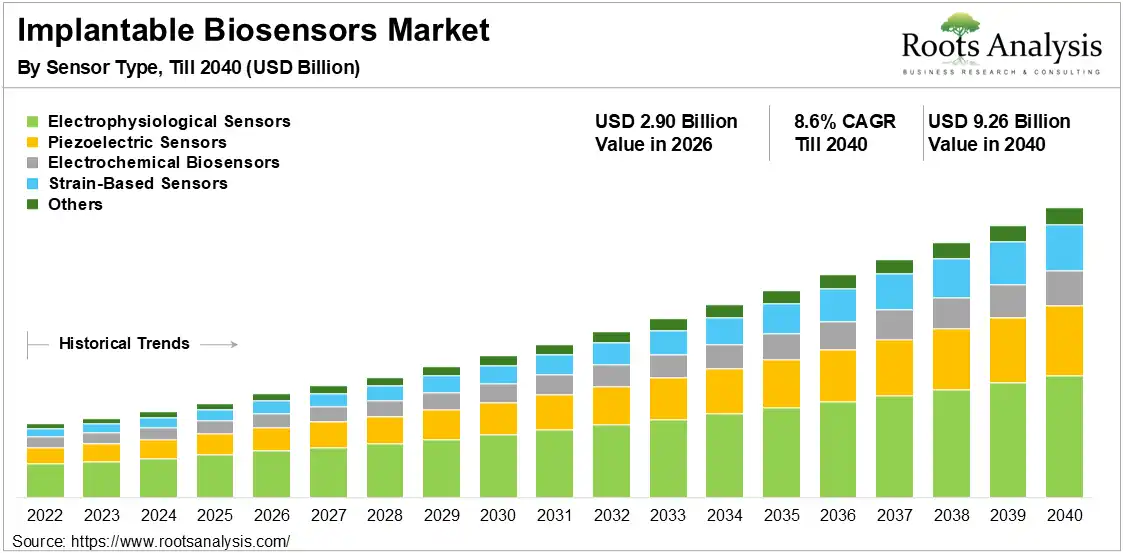
The global implantable biosensors market is expected to rise from USD 2.90 billion in 2026 to reach USD 9.26 billion by 2040, growing at a CAGR of 8.6% over the forecast period 2026 to 2040, driven by long-duration continuous monitoring.
See What’s in the Full Report – Request Your Complimentary Insights!
Market Report: Key Takeaways
- Based on sensor type, electrophysiological sensors capture 37.0% market share in 2026, whereas electrochemical biosensors register a 9.9% CAGR through 2040, supported by longer-life metabolite sensing.
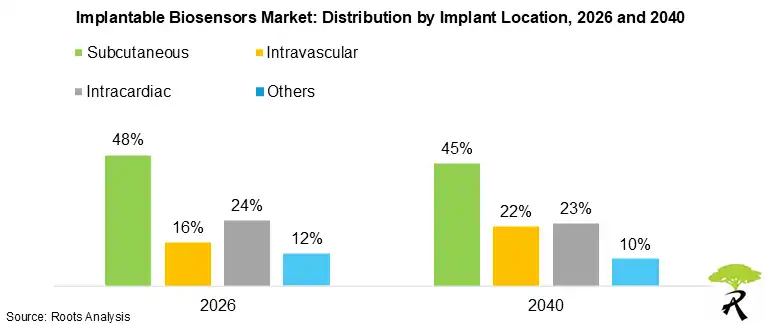
- Based on implant location, subcutaneous implants capture 48.0% market share in 2026, whereas intravascular implants register an 11.1% CAGR through 2040, supported by direct blood-based measurement.
- Based on application, diabetes monitoring captures 42.0% market share in 2026, whereas cardiac monitoring registers a 9.3% CAGR through 2040, supported by continuous arrhythmia detection.
- Based on end user, hospitals and specialty clinics capture 62.0% market share in 2026, whereas homecare settings register a 10.8% CAGR through 2040, supported by connected remote monitoring.
- Based on geography, North America captures 44.5% market share in 2026, whereas Asia-Pacific registers an 11.4% CAGR through 2040, supported by expanding digital-health infrastructure.
Implantable Biosensors Market Outlook
Long-duration monitoring is shifting implantable biosensors from episodic diagnostics toward continuous, connected disease management across cardiology, diabetes, orthopedics, and neurology. Earlier demand centered on mature electrophysiological implantable sensors used for rhythm surveillance. Current demand increasingly favors electrochemical platforms, intravascular measurement, wireless implant telemetry, and remote patient monitoring implants. Hospitals still control implantation and interpretation, but connected homecare models are expanding faster than clinic-centered workflows. This shift widens addressable clinical use cases.
Growth now reflects longer sensor life, stronger clinical evidence, reimbursement support, and rising demand for continuous chronic-disease surveillance. Regulatory pathways remain decisive because implanted platforms require rigorous safety, stability, and performance evidence before broad commercialization. In January 2025, CMS established national coverage for approved implantable pulmonary artery pressure sensors under Coverage with Evidence Development. The policy improved heart-failure monitoring access. This decision reduces uncertainty for qualifying providers and developers.
Through 2040, the implantable biosensors market will remain high-growth, with an 8.6% CAGR driven by electrochemical sensing, intravascular platforms, and home-based monitoring. Competition will increasingly depend on sensor longevity, biocompatible biosensor materials, automated interpretation, and scalable implantation workflows. In April 2026, Senseonics launched Eversense 365 in selected European markets, advancing one-year implantable continuous glucose monitoring systems. The outlook remains favorable but evidence-intensive across regulated clinical applications.
Implantable Biosensors Market Dynamics
Implantable Biosensors Market Drivers
Longer implant duration and continuous chronic-disease monitoring are expanding demand across diabetes, cardiac rhythm, and heart-failure care. Electrophysiological sensors hold 37.0% of 2026 revenue, while electrochemical biosensors will grow at 9.9% through 2040. Automated insulin delivery integration and artificial intelligence based arrhythmia interpretation increase clinical value beyond basic data collection. These capabilities strengthen recurring monitoring workflows and support wider adoption across specialty clinics and connected homecare programs.
Implantable Biosensors Market Restraints
Clinical adoption remains constrained by biocompatibility, calibration stability, implantation risk, and evidence requirements for long-term performance. Intravascular platforms face added thrombosis-control and sensor-fouling challenges despite an expected 11.1% CAGR through 2040. Hospitals and specialty clinics still represent 62.0% of 2026 demand because trained teams manage insertion and interpretation. These requirements raise commercialization costs and slow expansion beyond established cardiac and diabetes pathways.
Implantable Biosensors Market Opportunities
Brain-computer interfaces, blood-based glucose sensing, and connected heart-failure monitoring create new revenue pools beyond established rhythm and diabetes applications. In June 2026, Paradromics and the University of Michigan completed the first Connexus BCI implantation in an FDA-approved early feasibility study. Successful clinical translation could expand platform licensing, specialist partnerships, and investment interest across high-data-rate neural sensing. This pathway also tests regulatory readiness for fully implantable neural interfaces.
Implantable Biosensors Market Challenges
Scaling homecare use requires reliable wireless implant telemetry, simple patient workflows, secure data transfer, and timely clinician response. Homecare settings will grow at 10.8% through 2040, but hospitals remain responsible for implantation, calibration, and adverse-event management. Developers must therefore support both clinical infrastructure and remote monitoring operations. Companies that cannot integrate devices, analytics, reimbursement, and follow-up services may struggle to convert technical performance into durable adoption.
Implantable Biosensors Market Size Estimation Methodology
- As a starting point, the forecast defined the implantable biosensors market across sensor type, implant location, application, end user, and geography. Historical revenue series from multiple credible secondary sources established the market direction through 2026. Product portfolios then confirmed commercial activity in continuous glucose monitoring, cardiac rhythm surveillance, pulmonary pressure monitoring, smart orthopedic implants, and neural interfaces. This structure prevented overlap between devices, components, and monitoring services.
- Moving forward, the analysis built a bottom-up company database covering established manufacturers, specialist suppliers, and clinical-stage developers. Product status, implant duration, sensing modality, target application, and commercial geography supported comparable revenue allocation. Enabling components, including electrodes, batteries, telemetry platforms, and thin-film sensors, were included only where they directly served implanted sensing systems. Tiering reflected commercial maturity rather than claimed market-share leadership.
- Building on this, segment shares were assigned using installed clinical pathways, reimbursement maturity, procedure volumes, specialist capacity, and product availability. Electrophysiological sensors received the largest 2026 share because insertable cardiac monitoring already uses established clinical infrastructure. Subcutaneous devices also received the leading location share because outpatient insertion supports diabetes and cardiac workflows. Cardiac, diabetes, and specialist-clinic workflows received greater near-term weighting.
- Drawing upon these, growth assumptions reflected regulatory submission counts, clinical trial progress, reimbursement decisions, funding activity, and sensor-longevity evidence. FDA Investigational Device Exemptions, 510(k) clearances, CE Mark approvals, and CMS coverage decisions signaled commercialization readiness. Clinical evidence for arrhythmia detection, year-long glucose sensing, and blood-based monitoring informed segment-specific adoption curves. Funding rounds indicated capital availability but did not replace clinical evidence.
- The projected value was then calculated by applying distinct annual growth rates to every sensor, location, application, end-user, and regional segment. Faster rates were assigned to electrochemical biosensors, intravascular implants, homecare settings, cardiac monitoring, and Asia-Pacific. Annual values were reconciled so each segmentation dimension equaled the total implantable biosensors market throughout 2026 to 2040. Share gains were constrained by corresponding losses within each dimension.
- Finally, the forecast was triangulated against company activity, clinical maturity, regional infrastructure, and competitive intensity. Sensitivity checks tested slower approvals, reimbursement delays, implantation constraints, and faster remote-monitoring adoption. The final 8.6% CAGR represents the balanced case, while segment-level rates show where technology, access, and evidence could shift market share. Results were checked for internal consistency across all forecast years.
Implantable Biosensors Market Share Insights
Market Share by Sensor Type
According to our analysis, electrophysiological sensors lead because cardiac rhythm monitoring has mature clinical pathways, specialist infrastructure, and established reimbursement. Their processing ecosystems support reliable arrhythmia detection across large implanted patient populations. In January 2025, Medtronic reported LINQ monitor data supporting AI-based atrial fibrillation risk stratification.
Electrochemical biosensors will grow fastest as developers extend enzyme stability and pursue direct continuous metabolite measurement. Longer sensor life can improve replacement economics and reduce interruptions in chronic monitoring. In April 2026, Glucotrack published year-long stability evidence for electrochemical glucose sensors used within its implantable CBGM.
Market Share by Implant Location
Subcutaneous implants lead because insertion is minimally invasive, outpatient-friendly, and compatible with established diabetes and cardiac workflows. This position also benefits from clinician familiarity and scalable specialty-practice reimbursement. In January 2026, Senseonics received European approval for Eversense 365, whose sensor rests completely under the skin.
Intravascular devices will grow fastest from a smaller base because blood-based sensing can improve biomarker immediacy and accuracy. Progress will depend on biocompatibility, thrombosis control, sensor stability, and long-term regulatory evidence. In May 2026, Glucotrack submitted a US IDE for its fully implantable blood-based continuous glucose platform.
Want Information on Specific Region / Segment?
Regional Analysis: North America Leads the Market and Asia-Pacific is Likely to Register Higher CAGR
Presently, North America holds 44.5% market share in 2026. North America will retain leadership through mature clinical infrastructure, predictable regulatory pathways, and broad specialist access. Strong capital availability supports implantable sensor development, evidence generation, reimbursement preparation, and commercial deployment. In May 2026, Glucotrack submitted an IDE application to begin a US study of its fully implantable blood-based glucose-monitoring technology. The filing demonstrates the region’s ability to move emerging implantable platforms toward regulated human evaluation.
On the contrary, Asia-Pacific grows at a 11.4% CAGR from 2026 to 2040. Asia-Pacific will expand through digital-health investment, localized technology partnerships, and rising demand for continuous chronic-disease monitoring. Growing hospital capacity and connected-care infrastructure will improve access beyond major metropolitan centers. In October 2025, BIOTRONIK and the University of Sydney established a three-year digital cardiac-care partnership. The program combines implanted-device expertise, remote monitoring, AI, and clinical decision support for scalable regional deployment.
Market Ecosystem Analysis
Within the 25-company set, seven Tier 1 leaders anchor commercial activity, alongside seven specialists and eleven emerging entrants. Acquisition-driven consolidation is strongest in cardiac pressure monitoring, demonstrated by Edwards Lifesciences’ September 2025 purchase of Vectorious. CMS study approvals in February 2025 made reimbursable evidence generation a central competitive force for implantable heart-failure platforms. Competitive advantage is shifting toward platforms combining validated sensors, analytics, connectivity, and care workflows supporting timely clinical intervention.
- In February 2026, Abbott received FDA approval for CardioMEMS HERO, a smaller reader with cellular and Wi-Fi connectivity. The upgrade improves daily home use and reinforces Abbott’s position in intracardiac cardiac monitoring. CMS-approved evidence studies also raise the clinical barrier for challengers entering pulmonary artery pressure monitoring.
- In September 2025, Edwards Lifesciences fully acquired Vectorious and added V-LAP left atrial sensing to its portfolio. The transaction broadens Edwards beyond pulmonary artery monitoring and pressures specialists built around single-parameter cardiac implants. It strengthens intracardiac sensing, cardiac monitoring, and physician-guided homecare.
- In September 2025, Senseonics agreed to internalize Eversense commercialization and distribution from Ascensia Diabetes Care. The move tightens vertical integration and gives Senseonics direct control over payer, provider, and patient access. It pressures emerging implantable CGM developers lacking dedicated commercial infrastructure.
- In January 2026, Senseonics launched Eversense 365 integration with Sequel’s twiist automated insulin delivery system. The combination makes implanted glucose data a direct therapy-control input and raises interoperability requirements across diabetes monitoring. It strengthens subcutaneous sensing, diabetes monitoring, and homecare applications.
- In March 2025, Zimmer Biomet showcased a shorter Persona IQ smart-knee stem that captures postoperative recovery data. The format broadens eligible orthopedic workflows and raises the system-integration barrier for standalone sensor suppliers. It strengthens strain-based sensing, activity monitoring, and hospital specialty-clinic use.
- In April 2025, Precision Neuroscience received FDA clearance for its temporary Layer 7 cortical interface. The clearance enables brain-mapping use and expands access to high-resolution neural data for algorithm development. It advances electrophysiological sensing across hospital specialty clinics and other implant locations.
- In June 2025, Neuralink raised $650 million as its fully implanted BCI entered multinational clinical trials. The financing widens capital and manufacturing gaps facing smaller high-channel neural-interface developers. It strengthens electrophysiological sensing across neurological and other applications.
- In November 2025, Synchron raised $200 million to accelerate Stentrode trials, commercialization, and next-generation development. Its catheter-based endovascular approach differentiates Synchron from open-brain competitors and supports familiar hospital workflows. It strengthens intravascular electrophysiological sensing within other applications.
Startup Companies and their Key Highlights
- Neuralink Corp.
- Event type and funding amount: Funding round totaling USD 650 million
- Month and year: June 2025
- Stated purpose: Expand patient access, support clinical trials, restore independence, and advance brain-interface capabilities
- Market implication: Accelerates fully implanted, high-channel electrophysiological sensing for neurological and other applications
- Synchron, Inc.
- Event type and funding amount: Series D financing totaling USD 200 million
- Month and year: November 2025
- Lead investor: Double Point Ventures
- Stated purpose: Accelerate clinical trials, commercialization, cognitive-AI operations, and next-generation interface development
- Market implication: Strengthens intravascular electrophysiological sensing through an endovascular platform compatible with catheter-based hospital workflows
- Precision Neuroscience Corporation
- Event type: FDA 510(k) clearance for the Layer 7 Cortical Interface
- Month and year: April 2025
- Stated purpose: Support neural recording and mapping for up to 30 days while expanding medical brain-mapping applications
- Market implication: Advances electrophysiological sensing in hospitals and enables larger neural datasets for future BCI algorithms
- Paradromics Inc.
- Event type: FDA Investigational Device Exemption approval for the Connect-One early feasibility study
- Month and year: November 2025
- Stated purpose: Evaluate long-term Connexus BCI use for speech restoration and computer control
- Market implication: Accelerates high-data-rate electrophysiological sensing for severe motor impairment and neurological applications
- Glucotrack, Inc.
- Event type: Positive final results from a completed first-in-human clinical study
- Month and year: June 2025
- Strategic partner: OneTwo Analytics
- Stated purpose: Validate the safety and accuracy of a fully implantable, blood-based continuous glucose-monitoring system
- Market implication: Accelerates intravascular and subcutaneous diabetes monitoring through direct blood measurement and long-duration sensor positioning
Implantable Biosensors Market Trends / Opportunities
Longer-Life Sensors Expanding Implantable Biosensors Market Competition in Diabetes Monitoring
Longer sensor duration is reducing replacement frequency and improving the value proposition for implantable continuous glucose monitoring systems. In January 2026, Senseonics received CE Mark approval for Eversense 365, whose sensor remains fully under the skin for one year. Longer wear periods strengthen differentiation around continuity, convenience, and total monitoring cost.
Electrochemical stability is becoming a central competitive benchmark for long-term metabolic sensing. In April 2026, Glucotrack published peer-reviewed evidence supporting year-long stability for sensors used in its implantable continuous blood glucose platform. Developers with durable sensing chemistry can improve replacement economics and reduce interruptions in chronic monitoring.
Direct Blood Measurement Shifting the Implantable Biosensors Market Toward Intravascular Platforms
Intravascular sensing is gaining momentum because direct blood measurement can improve biomarker immediacy and reduce dependence on interstitial readings. In May 2026, Glucotrack submitted an Investigational Device Exemption application for a US study of its fully implantable blood-based glucose system. Regulatory progress could unlock an 11.1% growth segment while raising evidence requirements.
Implantable pressure sensing is also moving closer to reimbursed, connected heart-failure management. In January 2025, CMS established national coverage for approved pulmonary artery pressure sensors under Coverage with Evidence Development. Coverage support improves provider economics, but competitors must still prove clinical benefit within structured evidence programs.
AI-Enabled Cardiac Monitoring Expanding Homecare Revenue and Clinical Utility
Continuous rhythm data is broadening implantable cardiac monitoring from event detection toward proactive risk management. In May 2026, Medtronic reported arrhythmias in 77% of monitored heart-failure patients within two years. High event capture strengthens demand for analytics that prioritize clinically actionable signals.
Daily home readings are shifting follow-up workloads from scheduled visits toward remote surveillance. In February 2026, Abbott received US approval for CardioMEMS HERO, which transmits patient readings to clinicians from home. Integrated devices, telemetry, and clinician workflows will determine which suppliers capture homecare growth.
Brain-Computer Interface Trials Intensifying Funding and Platform Competition
Early feasibility studies are moving high-data-rate neural implants from laboratory development toward regulated human evaluation. In June 2026, Paradromics and the University of Michigan completed the first Connexus BCI implantation in the Connect-One study. Clinical execution now shapes platform credibility, partnership access, and future financing.
Large funding rounds are increasing the pace and scale of brain-computer interface development. In June 2025, Neuralink raised USD 650 million to expand trials and implant development. Capital-rich developers can accelerate evidence generation, manufacturing preparation, and specialist-site expansion, increasing pressure on smaller neural-interface companies.
Your Business is Unique – Why Shouldn’t Your Report Be?
Market Access Considerations
Regulatory Evidence Pathways for Long-Term Implants
FDA Investigational Device Exemptions, 510(k) clearances, and CE Mark approvals determine when developers can begin trials or commercialize implantable platforms. Evidence requirements cover sensor accuracy, stability, procedure safety, and long-term tissue interaction. In November 2025, Paradromics received FDA approval to begin the Connect-One early feasibility study. Companies with stronger regulatory planning can shorten study transitions and secure specialist-site participation. Poorly sequenced submissions can delay financing milestones, investigator commitments, manufacturing scale-up, and planned entry across target markets.
Reimbursement Coverage and Evidence Development
Coverage policy directly shapes provider adoption because implantation, monitoring, and follow-up create costs beyond the device itself. CMS Coverage with Evidence Development supports approved pulmonary artery pressure sensors while requiring structured clinical evidence. The January 2025 national coverage decision improved access for heart-failure management. Suppliers that align trials with payer evidence needs gain stronger commercialization positions than technology-only competitors. Unclear coverage can restrict hospital budgets, patient access, and forecasting accuracy across planned regional launches and care networks.
Specialist Implantation Capacity and Clinical Workflow Integration
Hospitals and specialty clinics control 62.0% of 2026 demand because trained teams manage implantation, calibration, interpretation, and adverse events. Subcutaneous devices benefit from outpatient-friendly procedures, but scaling still requires endocrinology or cardiology capacity. In June 2025, Senseonics highlighted Eversense insertion experience through a specialist diabetes center. Companies that simplify procedures can expand eligible sites and reduce training barriers. Procedure standardization therefore affects launch speed, utilization rates, training costs, and expansion beyond leading specialist centers.
How Stakeholders Benefit from the Key Focus Areas of Our Implantable Biosensors Market Report
Continuous monitoring, longer sensor life, and remote care are moving implantable biosensors into more chronic-disease workflows. The report links clinical evidence, segment growth, regulatory access, and company positioning. These inputs support market entry, investment allocation, product design, and partnership decisions.
- Unmet Needs and Market Gaps in Implantable Biosensors Market: The analysis identifies gaps in durable metabolite sensing, direct blood measurement, neural interfaces, and routine home follow-up. Product and strategy teams can compare these needs against current subcutaneous, cardiac, and glucose platforms. This supports indication selection, feature prioritization, and decisions to build, license, or partner. It also shows where specialist dependence may limit adoption.
- Funding and Venture Investment Opportunities in Implantable Biosensors Market: Funding analysis separates capital-backed platform expansion from early technical validation. Investment committees can benchmark Neuralink’s USD 650 million raise for clinical trials and implant development. They can also assess FIRE1’s USD 120 million financing for the NORM heart-failure monitoring system. These comparisons support investment sizing, diligence priorities, and portfolio-risk decisions.
- Technology Innovation and Adoption Trends: The technology analysis tracks electrochemical biosensors, intravascular implants, AI-enabled cardiac monitoring, and wireless implant telemetry. Research and development leaders can compare a 9.9% electrochemical CAGR with 11.1% growth for intravascular platforms. This comparison supports sensor architecture, longevity targets, and clinical evidence planning. Adoption curves also show when remote monitoring capabilities become commercially necessary.
- Implantable Biosensors Market Competitive Landscape and Industry Analysis: The competitive analysis maps Tier 1 leaders, specialist suppliers, and emerging developers across clinical applications and enabling components. Commercial teams can compare Abbott, Medtronic, Senseonics, Glucotrack, Paradromics, and component providers without treating tier labels as market-share rankings. This supports competitor prioritization, white-space assessment, and launch sequencing. It also reveals where integrated devices, analytics, and telemetry create stronger positioning.
- Mapping Strategic Partnerships and Ecosystem Synergies: Partnership mapping shows where clinical institutions, device developers, and remote-monitoring capabilities combine to accelerate evidence generation. Business development teams can examine BIOTRONIK’s 2025 collaboration with the University of Sydney. They can also assess Neuralink’s British study partnerships with University College London Hospitals and Newcastle Hospitals. These examples support partner selection, geography planning, and clinical-site strategy.
- Implantable Biosensors Market CAGR and Growth Trends: The forecast compares the 8.6% overall CAGR with faster growth in Asia-Pacific, intravascular implants, and homecare settings. Finance and planning teams can prioritize the 11.4% Asia-Pacific rate, 11.1% intravascular rate, and 10.8% homecare rate. This supports regional entry, capacity allocation, and revenue-scenario design. Share trends also clarify which mature segments may lose relative weight despite continued growth.
Implantable Biosensors Market: Scope of the Report
| Key Report Attributes | Details | |
| Forecast Period | Till 2040 | |
| Market Size 2026 | USD 2.90 Billion | |
| Market Size 2040 | USD 9.26 Billion | |
| CAGR (Till 2040) | 8.6% | |
| Segments Covered |
|
|
| Geographical Regions Covered |
|
|
| Key Sections Covered |
|
|
Market Segmentation
The Implantable Biosensors Market report presents an in-depth analysis, highlighting the capabilities of various stakeholders, based on different segments, such as sensor type, implant location, application, end user, geographical regions, and leading players.
By Sensor Type
- Electrophysiological Sensors
- Piezoelectric Sensors
- Electrochemical Biosensors
- Strain-Based Sensors
- Others
By Implant Location
- Subcutaneous
- Intravascular
- Intracardiac
- Others
By Application
- Diabetes Monitoring
- Cardiac Monitoring
- Activity Monitoring
- Respiratory Monitoring
- Others
By End User
- Hospitals and Specialty Clinics
- Homecare Settings
- Others
By Geographical Regions
- North America
- US
- Canada
- Mexico
- Rest of North America
- Europe
- Austria
- Belgium
- Denmark
- France
- Germany
- Ireland
- Italy
- Netherlands
- Norway
- Russia
- Spain
- Sweden
- Switzerland
- UK
- Rest of Europe
- Asia-Pacific
- China
- India
- Japan
- Singapore
- South Korea
- Rest of Asia-Pacific
- Latin America
- Argentina
- Brazil
- Chile
- Colombia
- Venezuela
- Rest of Latin America
- Middle East and Africa (MEA)
- Egypt
- Iran
- Iraq
- Israel
- Kuwait
- Saudi Arabia
- UAE
- Rest of MEA
- Rest of the World


