


 Download Free Sample
 Buy Now
Market Size
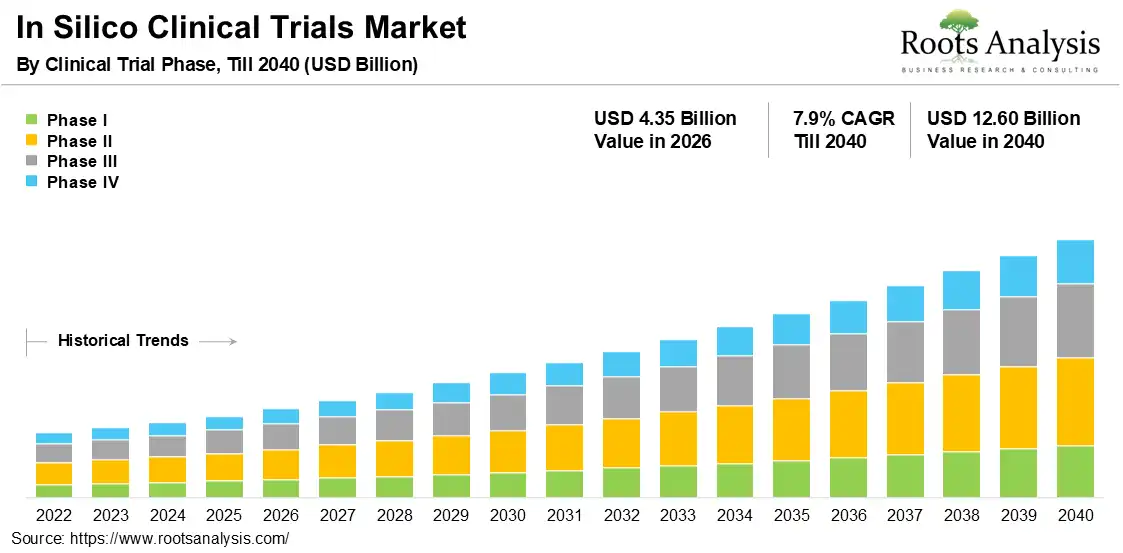
The global in silico clinical trials market is expected to rise from USD 4.35 billion in 2026 and is projected to reach USD 12.60 billion by 2040, growing at a CAGR of 7.9% over the forecast period 2026 to 2040, driven by regulatory adoption.
See What’s in the Full Report – Request Your Complimentary Insights!
Market Report: Key Takeaways
- Based on clinical trial phase, Phase II captures 34.0% market share in 2026, whereas Phase I registers a 9.1% CAGR through 2040, supported by early-dose optimization.
- Based on therapeutic area, oncology captures 42.0% market share in 2026, whereas neurology registers a 10.1% CAGR through 2040, driven by digital-twin adoption.
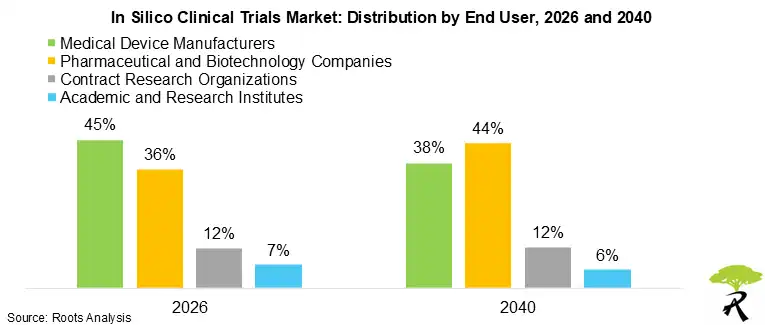
- Based on end user, medical device manufacturers capture 45.0% market share in 2026, whereas pharmaceutical and biotechnology companies register a 9.5% CAGR through 2040, supported by MIDD integration.
- Based on modeling methodology, PBPK and biopharmaceutics modeling capture 28.0% market share in 2026, whereas AI digital twins and virtual patients register a 12.5% CAGR through 2040, driven by individualized simulations.
- Based on geography, North America captures 43.0% market share in 2026, whereas Asia-Pacific registers a 10.1% CAGR through 2040, supported by regulatory modernization.
In Silico Clinical Trials Market Outlook
Regulatory acceptance and artificial intelligence are shifting simulation from specialist support into core clinical development. Earlier demand centered on physiologically based pharmacokinetic modeling and medical device computational modeling. Current buyers increasingly require clinical trial digital twins, synthetic control arms, and scenario optimization across multiple development stages. Phase II remains the largest trial phase at 34.0% in 2026, while trial design and scenario optimization hold 27.0%.
Growth now reflects rising development costs, recruitment constraints, and stronger policy support for human-relevant evidence. The United States Food and Drug Administration expanded computational modeling and computational toxicology under its first-year roadmap goals in April 2026. These policies reduce uncertainty for sponsors evaluating regulatory-grade biosimulation investments across development portfolios. Certara released Simcyp Version 25 in March 2026, adding virtual bioequivalence, population libraries, and regulatory-submission capabilities.
Through 2040, the in silico clinical trials market will sustain high growth at a 7.9% CAGR. Artificial intelligence digital twins will expand at 12.5%, while synthetic and external control arms will grow at 12.4%. In July 2026, Acumen Pharmaceuticals and Unlearn agreed to apply digital twins across two Alzheimer’s disease trial analyses. Adoption will broaden, although regulatory credibility and data quality will still shape commercial outcomes.
In Silico Clinical Trials Market Dynamics
In Silico Clinical Trials Market Drivers
Model-informed drug development now moves simulation earlier into dose selection, endpoint design, and population planning. Phase I will grow at 9.1% through 2040 as PBPK models support starting-dose and special-population decisions. Phase II holds 34.0% in 2026 because human data improves model calibration and virtual comparator credibility. These economics make regulatory-grade biosimulation valuable before sponsors commit capital to recruitment and pivotal development.
In Silico Clinical Trials Market Restraints
Model credibility remains the main restraint because regulators require transparent assumptions, qualified datasets, and documented uncertainty. Artificial intelligence models face added scrutiny when training populations differ from intended trial participants. The FDA’s January 2025 risk-based credibility framework signals that performance evidence must match each model’s regulatory context. Smaller vendors may struggle with validation costs, secure data access, and multidisciplinary regulatory expertise.
In Silico Clinical Trials Market Opportunities
Synthetic control arms create the strongest near-term opportunity where rare diseases and precision medicine limit recruitment. This workflow will grow at 12.4% through 2040, supported by richer longitudinal datasets and Bayesian trial methods. In October 2025, Friends of Cancer Research launched a pilot using eight historical trial and real-world sources. Providers that prove transportability can win high-value regulatory programs.
In Silico Clinical Trials Market Challenges
Interoperability and data quality will determine whether virtual patient simulation scales beyond isolated projects. Sponsors must connect clinical records, imaging, biomarkers, pharmacology, and device data without weakening provenance or privacy controls. Digital twins also require disease-specific validation across diverse populations and endpoints. Vendors competing across oncology, neurology, and cardiology must balance platform reuse with costly therapeutic customization and continuing model maintenance.
In Silico Clinical Trials Market Size Estimation Methodology
- As a starting point, the model assembled historical and current evidence from 18 credible secondary and industry sources. The review mapped annual market development from 2022 through 2026 without relying on any single published estimate. It also standardized the in silico clinical trials market across trial phase, therapeutic area, end user, methodology, workflow, and geography. Forecast inputs were normalized to prevent overlapping software, service, and modeling revenues.
- Moving forward, clinical trial databases and company platform disclosures were used to estimate addressable demand. The analysis tracked where PBPK, pharmacometrics, quantitative systems pharmacology, digital twins, synthetic controls, and device simulation enter development workflows. Trial-phase activity and therapeutic pipeline complexity helped weight demand across Phase I through Phase IV and major disease areas. Clinical database coverage also indicated recruitment intensity and endpoint complexity by indication.
- Building on this, regulatory submission counts, drug approval timelines, and formal guidance signals informed adoption assumptions. The framework considered FDA activity around model-informed drug development, Bayesian methods, artificial intelligence model credibility, computational toxicology, and human-relevant evidence. These signals adjusted adoption speed for regulatory-grade biosimulation, trial-waiver support, and external control arm analytics. Submission evidence reduced uncertainty around adoption timing in regulated workflows.
- Drawing upon these, company capabilities were classified by commercialization maturity, regulatory positioning, platform breadth, and therapeutic specialization. The assessment separated Tier 1 leaders, specialist providers, and emerging companies across software, services, infrastructure, and data-driven evidence. Partnership activity, product launches, and funding events provided additional evidence on competitive investment and market entry intensity.
- The projected value was then distributed using bottom-up segment shares and calibrated growth rates. Phase II, oncology, medical device manufacturers, PBPK modeling, trial design, and North America anchored the 2026 structure. Faster growth assumptions were applied to Phase I, neurology, pharmaceutical users, and artificial intelligence digital twins. Synthetic control arms and Asia-Pacific received separate uplifts based on documented adoption drivers.
- Finally, the annual forecast applied a consistent 7.9% compound growth path through 2040 and reconciled every segment to 100%. Scenario checks tested slower regulatory acceptance, weaker data interoperability, and faster digital-twin adoption. The final estimates were reviewed against historical progression, segment economics, vendor activity, and policy milestones. Regional development patterns provided a final check against overstating early commercialization.
In Silico Clinical Trials Market Share Insights
Market Share by Clinical Trial Phase
According to our analysis, phase II leads because sponsors possess human data that supports stronger calibration and defensible virtual comparator construction. Its expensive proof-of-concept decisions also encourage extensive scenario testing before pivotal investments. In May 2025, Unlearn reported Phase II ALS digital twins could reduce sample sizes by up to 18%.
Phase I grows fastest as PBPK models translate preclinical evidence into starting-dose and drug-interaction predictions. These tools increasingly address pediatric, pregnancy, lactation, renal, and hepatic populations without extensive dedicated studies. In April 2025, Certara expanded Simcyp with enhanced special-population modeling and parameter-prediction capabilities.
Market Share by End User
Dominant sub-segment: Medical device manufacturers lead because physics-based simulations already support design verification, safety evaluation, and regulatory evidence. Established credibility frameworks also encourage adoption across cardiovascular devices, implants, wearables, and surgical technologies. In February 2025, Dassault Systèmes expanded its AI-powered Living Heart virtual-twin initiative for medical-device applications.
Pharmaceutical and biotechnology companies grow fastest as MIDD becomes embedded across discovery, clinical development, and regulatory submissions. Their extensive longitudinal datasets enable broader PBPK, pharmacometric, QSP, digital-twin, and synthetic-control deployments. In July 2025, Certara expanded its clinical technology collaboration with Merck to improve clinical data workflows.
Want Information on Specific Region / Segment?
Regional Analysis: North America Leads the Market and Asia-Pacific is Likely to Register Higher CAGR
North America retains structural leadership through regulatory clarity, deep capital markets, extensive clinical datasets, and concentrated software expertise. Its pharmaceutical, biotechnology, medical-device, academic, and regulatory ecosystems support deployment from dose prediction through submission evidence. The FDA finalized ICH M15 principles covering MIDD planning, model evaluation, evidence documentation, and regulatory interactions. This framework strengthens confidence in regulatory-grade simulation and supports broader sponsor adoption.
Asia-Pacific will grow at 10.1% CAGR from 2026 to 2040. Asia-Pacific will expand through innovative-drug investment, larger development pipelines, expanding clinical infrastructure, and stronger digitalization. China, Japan, India, South Korea, and Australia are building local capabilities in pharmacometrics, PBPK, AI, and regulatory science. In October 2025, China’s NMPA introduced a 30-day clinical-trial review pathway for qualifying innovative drugs. Faster development pathways increase demand for modeling, scenario planning, dose optimization, and globally synchronized evidence packages.
Market Ecosystem Analysis
The scoped ecosystem contains 25 companies: six Tier 1 leaders, 12 specialists, and seven emerging entrants. Six leaders anchor most enterprise activity through regulatory software, clinical data, pharmacometrics, and multiphysics platforms. Acquisition-driven platform convergence dominates, evidenced by Synopsys completing Ansys and Altaris signing a Simulations Plus agreement. FDA support for computational alternatives shifts advantage toward qualified models, proprietary datasets, and regulator-ready workflows.
- Certara received EMA qualification for Simcyp in August 2025 across specified PBPK drug-interaction contexts. This raises validation barriers and strengthens DDI assessment, regulatory evidence generation, and clinical-study replacement.
- In June 2026, Simulations Plus signed a $375 million acquisition agreement with Altaris. The announced structure links molecular design, PBPK, pharmacometrics, and trial simulation within a proposed broader platform.
- Dassault Systèmes began testing customizable AI-powered Living Heart models in February 2025 for individual patients and populations. The models can generate thousands of virtual twins, strengthening cardiovascular device testing and regulatory evidence workflows.
- Synopsys completed its $35 billion Ansys acquisition in July 2025, combining system design with multiphysics simulation. The combination raises integration and scale barriers for FEops, Virtonomy, and smaller medical-device simulation specialists.
- Virtonomy reported over €5 million in Series A financing during February 2026 for digital-patient medical-device simulation.
- PrediSurge partnered with Incepto in June 2026 to embed vascular planning tools within existing clinical workflows. Together, these moves lower deployment friction while intensifying specialist competition in cardiovascular simulation.
- Medidata launched Protocol Optimization in May 2025, simulating patient burden, site performance, costs, and recruitment before enrollment. This extends its data advantage into trial design and pressures IQVIA, Phesi, and CRO analytics offerings.
- Sanofi Ventures made a strategic QuantHealth investment in October 2025 to expand patient-level simulations and digital twins. The alliance raises enterprise credibility and strengthens protocol optimization, treatment-response prediction, and synthetic evidence across therapeutic areas.
- InSilicoTrials joined Microsoft’s Pegasus program in June 2025, gaining Azure infrastructure and AI capabilities for platform scaling. Nova In Silico prospectively predicted Merck Phase III LDL-C results in November 2025 using its jinkö platform. These milestones strengthen cloud delivery and outcome validation, raising evidence expectations for emerging clinical-trial simulators. (MobiHealthNews)
Startup Companies and their Key Highlights
- QuantHealth
- Event type and funding context: Strategic investment; total funds raised reached $30 million.
- Month and year: October 2025.
- Strategic investor: Sanofi Ventures.
- Stated purpose: Expand patient-level simulations and digital-twin technologies for drug development.
- Market implication: This strengthens AI digital twins, protocol optimization, and treatment-response prediction across pharmaceutical and biotechnology end users.
- InSilicoTrials Technologies
- Event type and funding amount: CARDIOVERSE consortium participation under an ARPA-H contract valued at up to $30 million.
- Month and year: December 2025.
- Program lead and strategic partner: The Jackson Laboratory.
- Stated purpose: Develop AI-powered virtual hearts representing genetic, physiological, and demographic population diversity.
- Market implication: This accelerates cardiology safety prediction, virtual-patient modeling, patient stratification, and regulatory evidence generation.
- Virtonomy GmbH
- Event type and funding amount: Series A financing exceeding €5 million.
- Month and year: February 2026.
- Market implication: This expands European medical-device simulation capacity and raises intellectual-property barriers around virtual-patient platforms.
- PrediSurge
- Event type: Strategic clinical-workflow collaboration.
- Month and year: June 2026.
- Strategic partner: Incepto.
- Stated purpose: Integrate AI-based vascular intervention planning with hospital PACS systems and established physician workflows.
- Market implication: This lowers hospital integration friction for cardiovascular planning and patient-specific clinical decision support.
- Nova In Silico
- Event type: Prospective clinical-trial prediction validation.
- Month and year: November 2025.
- Stated purpose: Predict LDL-C outcomes from Merck’s Phase III CORALreef Lipids study before its public readout.
- Market implication: This strengthens cardiology efficacy prediction and validates prospective Phase III simulation against subsequently reported outcomes.
In Silico Clinical Trials Market Trends / Opportunities
AI Digital Twins Accelerating In Silico Clinical Trials Market Differentiation
Artificial intelligence digital twins will grow at 12.5% through 2040, faster than every other modeling methodology. Their market share rises from 10.0% in 2026 to 18.0% by 2040. In April 2025, Unlearn reported Parkinson’s digital twins could reduce Phase II control arms by up to 38%. Vendors with validated disease models can command stronger strategic positions.
Integrated planning workspaces are moving digital twins from specialist analyses into routine trial decisions. Unlearn launched TrialPioneer in January 2026, combining precedent review, historical benchmarks, and on-demand scenario simulations. This shift favors platforms that connect evidence review, protocol design, and participant-level prediction within one workflow.
External Control Evidence Expanding In Silico Clinical Trials Market Access
Synthetic and external control arms will expand at 12.4% through 2040 as recruitment constraints intensify. Their workflow share rises from 9.0% in 2026 to 16.0% by 2040. The FDA’s January 2026 Bayesian guidance addressed previous studies, real-world evidence, and external or nonconcurrent controls. Regulatory clarity expands commercial opportunities for evidence providers.
Historical data breadth now determines whether external controls can support regulatory-grade comparisons. Friends of Cancer Research launched an October 2025 pilot using eight trial and real-world data sources. Providers must prove data provenance, endpoint alignment, and population transportability. Strong data partnerships will increasingly separate scalable platforms from project-based competitors.
PBPK Maturity Sustaining Regulatory-Grade Biosimulation Leadership
Physiologically based pharmacokinetic and biopharmaceutics modeling holds 28.0% market share in 2026, the largest methodology position. Mature validation practices support dose selection, drug-interaction assessment, formulation development, and special-population analysis. In April 2025, Certara expanded Simcyp after supporting more than 120 FDA-approved novel drugs. Established regulatory records protect incumbent advantage despite slower growth.
Platform upgrades are extending PBPK value into virtual bioequivalence and more efficient submission workflows. Certara released Simcyp Version 25 in March 2026 with expanded population libraries and regulatory-submission capabilities. Buyers will favor providers that combine scientific depth, validated libraries, workflow automation, and experienced regulatory support.
Neurology and Asia-Pacific Growth Redirecting Commercial Investment
Neurology will grow at 10.1% through 2040 as digital twins address noisy endpoints and difficult recruitment. Its therapeutic share rises from 12.0% in 2026 to 16.0% by 2040. In July 2026, Acumen Pharmaceuticals and Unlearn agreed to analyze two Alzheimer’s disease trials using digital twins. Disease-specific evidence will attract partnerships and platform investment.
Asia-Pacific will also grow at 10.1% through 2040, lifting regional share from 18.0% to 24.0%. China’s NMPA introduced a 30-day review pathway for qualifying innovative drug trials in October 2025. Faster local development timelines increase demand for dose optimization, scenario planning, and synchronized evidence packages. Vendors need regional regulatory expertise and localized datasets.
Your Business is Unique – Why Shouldn’t Your Report Be?
Market Access Considerations
Regulatory Credibility and Documentation
Regulatory credibility determines whether simulation informs internal decisions or supports formal submissions. Providers must document model context, assumptions, validation evidence, uncertainty, and intended use across each program. The FDA’s January 2025 framework proposed risk-based credibility standards for artificial intelligence models used in drug and biological submissions. This requirement favors providers with audited processes and reusable submission templates. Vendors with established regulatory teams can commercialize faster, while newer entrants face longer validation cycles and higher evidence costs.
Qualified Clinical Data and Population Representativeness
Market access depends on secure, traceable datasets that match target populations, endpoints, and treatment settings. Digital twins and external controls lose value when historical records lack consistent measurements or representative patient diversity. Friends of Cancer Research launched an eight-source external-control pilot in October 2025 to test practical construction methods. Data licensing and governance costs can restrict smaller providers and delay partnerships. Companies controlling curated longitudinal data can scale efficiently and negotiate stronger partnerships with sponsors.
Validated Scientific Platforms and Therapeutic Expertise
Scientific validation creates a high entry barrier because each methodology requires specialized models, qualified libraries, and experienced users. PBPK platforms benefit from mature regulatory precedents, while neurology and oncology digital twins require disease-specific endpoints and biological assumptions. Certara reported in April 2025 that Simcyp had supported more than 120 FDA-approved novel drugs. Specialized scientific staff also raise delivery costs and limit rapid commercial expansion. Proven platforms therefore compete on evidence depth, not software features alone.
How Stakeholders Benefit from the Key Focus Areas of Our In Silico Clinical Trials Market Report
Regulatory support for human-relevant models and persistent recruitment constraints make in silico development commercially urgent. The report connects segment economics, technology maturity, policy direction, and competitive positioning. These findings support portfolio choices, investment screening, partnership planning, and regulatory operating decisions.
- Unmet Needs and Market Gaps in In Silico Clinical Trials Market: The report identifies gaps in representative datasets, model interoperability, therapeutic validation, and regulatory documentation. Strategy teams can see where synthetic controls, neurology digital twins, and special-population PBPK models face unmet demand. This evidence supports decisions on product roadmaps, capability acquisitions, and priority indications. It also distinguishes scalable gaps from costly custom-service opportunities.
- Funding and Venture Investment Opportunities in In Silico Clinical Trials Market: Funding analysis separates policy-backed infrastructure from company-level platform investment. Investors can assess the NIH’s March 2026 commitment exceeding USD 150 million for human-based research models. QuantHealth’s October 2025 strategic investment brought reported funding to USD 30 million. These signals support decisions on timing, technology focus, and commercialization risk.
- Technology Innovation and Adoption Trend: The report tracks adoption across PBPK, pharmacometrics, quantitative systems pharmacology, digital twins, synthetic controls, and device simulation. Technology leaders can compare mature regulatory-grade biosimulation against faster-growing artificial intelligence approaches. The analysis supports build, buy, or partner decisions for platform expansion. It also shows where workflow integration creates stronger customer retention than standalone modeling tools.
- In Silico Clinical Trials Market Competitive Landscape and Industry Analysis: The competitive analysis maps Tier 1 leaders, specialist providers, and emerging companies across software, services, infrastructure, and evidence generation. Corporate development teams can compare regulatory positioning, therapeutic focus, data assets, and platform breadth. This structure supports acquisition screening, competitor monitoring, and differentiation planning. It also reveals where established vendors retain advantages through validated libraries and submission experience.
- Mapping Strategic Partnerships and Ecosystem Synergies: The report shows how pharmaceutical sponsors, modeling vendors, data owners, and assay providers combine complementary capabilities. Partnership teams can evaluate the July 2026 Acumen Pharmaceuticals and Unlearn digital-twin collaboration in Alzheimer’s disease. This mapping supports partner selection, joint validation programs, and therapeutic expansion. It also identifies dependencies that can slow delivery or strengthen market access.
- In Silico Clinical Trials Market CAGR and Growth Trends: The report explains the 7.9% market CAGR through 2040 and the faster growth of selected segments. Planning teams can compare artificial intelligence digital twins at 12.5%, synthetic controls at 12.4%, and Asia-Pacific at 10.1%. This evidence supports revenue targets, regional investment, hiring plans, and product sequencing. Segment share shifts also clarify where current leadership may weaken despite absolute growth.
In Silico Clinical Trials Market: Scope of the Report
| Key Report Attributes | Details | |
| Forecast Period | Till 2040 | |
| Market Size 2026 | USD 4.35 Billion | |
| Market Size 2040 | USD 12.60 Billion | |
| CAGR (Till 2040) | 7.9% | |
| Segments Covered |
|
|
| Geographical Regions Covered |
|
|
| Key Sections Covered |
|
|
Market Segmentation
The In Silico Clinical Trials Market report presents an in-depth analysis, highlighting the capabilities of various stakeholders, based on different segments, such as clinical trial phase, therapeutic area, end user, modeling methodology, application or workflow stage, geographical regions, and leading players.
By Clinical Trial Phase
- Phase I
- Phase II
- Phase III
- Phase IV
By Therapeutic Area
- Oncology
- Cardiology
- Neurology
- Infectious Diseases
- Hematology
- Metabolic Disorders and Diabetes
- Other Therapeutic Areas
By End User
- Pharmaceutical and Biotechnology Companies
- Medical Device Manufacturers
- Contract Research Organizations
- Academic and Research Institutes
By Modeling Methodology
- Physiologically Based Pharmacokinetic and Biopharmaceutics Modeling
- Population Pharmacokinetic, Pharmacodynamic, and Pharmacometric Simulation
- Quantitative Systems Pharmacology and Mechanistic Disease Modeling
- Artificial Intelligence Digital Twins and Virtual Patients
- Synthetic-Data and External-Control Modeling
- Biomechanics, Finite-Element, and Computational-Fluid-Dynamics Simulation
By Application or Workflow Stage
- First-In-Human and Dose Prediction
- Trial Design and Scenario Optimization
- Patient Selection, Stratification, and Enrichment
- Synthetic or External Control-Arm Generation
- Safety, Efficacy, and Treatment-Response Prediction
- Regulatory Evidence Generation and Trial-Waiver Support
By Geographical Regions
- North America
- US
- Canada
- Mexico
- Rest of North America
- Europe
- Austria
- Belgium
- Denmark
- France
- Germany
- Ireland
- Italy
- Netherlands
- Norway
- Russia
- Spain
- Sweden
- Switzerland
- UK
- Rest of Europe
- Asia-Pacific
- China
- India
- Japan
- Singapore
- South Korea
- Rest of Asia-Pacific
- Latin America
- Argentina
- Brazil
- Chile
- Colombia
- Venezuela
- Rest of Latin America
- Middle East and Africa (MEA)
- Egypt
- Iran
- Iraq
- Israel
- Kuwait
- Saudi Arabia
- UAE
- Rest of MEA
- Rest of the World


