
Lowest Price Guaranteed
Slides
214
Last Updated
July 2026
View Count
14825
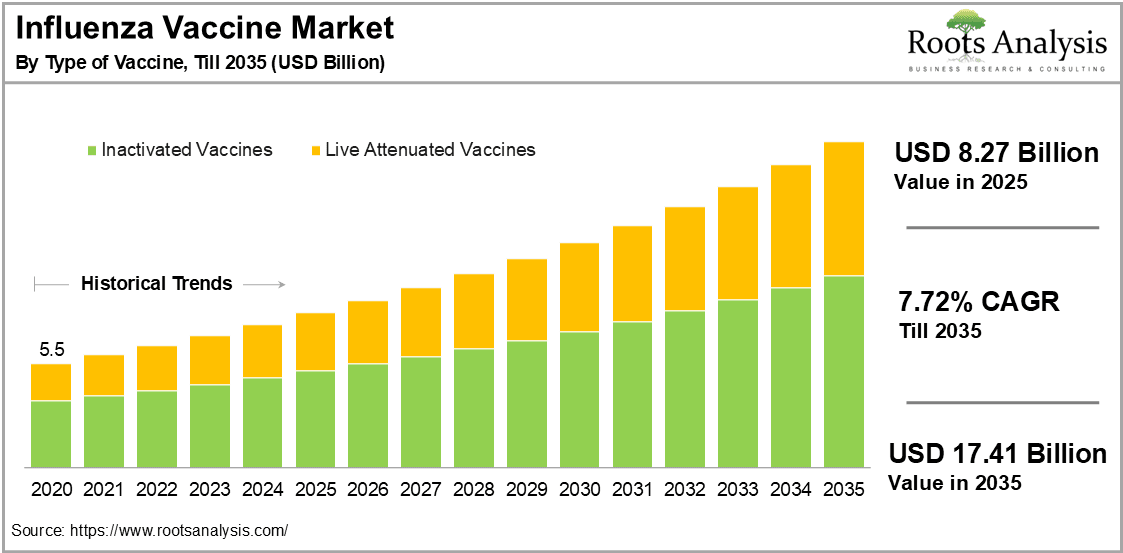
The influenza vaccine market size is projected to grow from USD 8.27 billion in 2025 to USD 17.41 billion by 2035, representing a CAGR of 7.72% during the forecast period till 2035.
To learn more about this report, request a free sample copy
The new research study consists of influenza vaccine market and trends analysis, detailed market forecast analysis, and provides actionable strategic recommendations.
Influenza, also known as flu, an acute respiratory infection spread by the influenza virus is a common viral infectious disease. According to WHO’s report, each year, seasonal influenza affects around a billion people and 3-5 million cases experience severe illness. Nearly 650,000 deaths are caused by respiratory conditions. It is important to note that in developing nations, 99% of influenza-related lower respiratory tract infection deaths occur in children under five. As an effect, with this growing number of influenza cases, the global influenza vaccine market is evolving exponentially.
The influenza vaccine is a flu shot that protects against infection by influenza viruses. Inactivated vaccines and live attenuated vaccines are the most popular vaccines approved by the Centers for Disease Control and Prevention and the World Health Organization which are widely used for all age groups of patients. By understanding the scenarios, government and healthcare organizations are running extensive vaccination campaigns to promote immunization and strengthen disease surveillance systems as it plays a critical role in detecting and preventing the spread of infectious diseases.
Pharmaceutical innovations are at the forefront of this shift, with new formulations designed to enhance vaccine efficacy against various influenza virus types. The latest vaccine efficacy studies provide compelling evidence of their effectiveness, underscoring the importance of widespread immunization in mitigating flu outbreaks.
Moreover, governments are providing funding and subsidies for the innovation of next-generation vaccines, procurement, and distribution. For instance, in January 2025, The US government allocated an additional $590 million to Moderna to expedite the development of its mRNA-based H5N1 avian influenza vaccine. This investment shows a commitment to leveraging mRNA technology for the rapid development of vaccines in response to a potential pandemic. Considering these factors, the market for influenza vaccine is expected to sprout out exceptionally driven by key driving factors and industry trends. However, increased production timelines and skepticism about vaccine efficiency on virus mutation are some barriers that need to be addressed to reach the market to its full potential growth during this forecast period.
The influenza vaccine market report presents an in-depth analysis of the various companies that are involved in offering influenza vaccines, across different segments, as defined in the table below:
| Key Report Attributes | Details | |
| Historical Trend | Since 2020 | |
| Forecast Period | Till 2035 | |
| Current Market Size | $ 8.27 Billion | |
| Market Size Value by 2035 | $ 17.41 Billion | |
| CAGR (Till 2035) | 7.72% | |
| Type of Vaccine |
|
|
| Type of Valency |
|
|
| Age Group |
|
|
| Type of Technology |
|
|
| Distribution Channel |
|
|
| Geographical Regions |
|
|
| Leading Market Players | ||
| PowerPoint Presentation (Complimentary) |
Available | |
| Customization Scope | 15% Free Customization | |
| Excel Data Packs (Complimentary) |
|
|
This segmentation highlights the variety of vaccines including inactivated vaccines and live attenuated vaccines. As per influenza vaccine market research, the inactivated vaccine segment has been driving the market growth with the maximum (~66%) of the market share and will likely hold this position till the forecast period. This can be attributed to the broad applicability and safety profile of the vaccine. Inactivated vaccines contain killed influenza viruses, which cannot cause infection but still stimulate an immune response. Consequently, these are approved for use in all age groups including high-risk populations, and are commonly recommended by CDC and WHO.
Besides this, the live attenuated vaccine segment gaining traction in the industry and is expected to expand at a higher (9.65%) CAGR in the forthcoming years. Live attenuated vaccines contain weakened life influenza viruses that can replicate in the nasal mucosa but do not cause illness. They are generally administered as a nasal spray. Therefore, owing to its variable efficacy, the segment will likely continue to grow.
The market for influenza vaccines features different types of valency including quadrivalent vaccines and trivalent vaccines. According to our influenza vaccine market analysis, the quadrivalent vaccines lead the segment and are estimated to occupy the highest (~63%) of the market share in terms of revenue by 2035. Quadrivalent vaccines offer protection against both lineage of influenza A and B which trivalent vaccines do not cover. This reduces the risk of mismatches between the vaccine and circulating strains, hence, widely being produced and boosting the quadrivalent influenza vaccine market growth. For instance, in March 2024, an India-based company, Cadila Pharmaceuticals launched a new influenza vaccine called Cadiflu Tetra, a quadrivalent influenza vaccine approved by the Drug Controller General of India. This vaccine targets four strains of influenza virus type A and B and offers better protection against the seasonal flu.
Furthermore, the trivalent vaccines protect against three influenza strains two influenza A strains (H1N1 and H3N2) and one influenza B strain. With a growing preference for quadrivalent over trivalent, the trivalent vaccine segment is expected to rise at a moderate (7.81%) growth rate in the upcoming decade.
Based on the age group, the adult segment is projected to drive the market growth with (~43%) of the current market share and will lead the segment by 2035. The high vaccination program for immunization and increasing awareness of the importance of influenza vaccination among healthy adults to prevent transmission to high-risk groups are the key driving factors of the segment’s growth.
Furthermore, the pediatric segment is poised to grow at a notable CAGR of (10.14%) due to being the critical demographic for influenza vaccination. Young children particularly, those under 5 years are at higher risk of severe influenza complications including pneumonia, thus, accelerating the market scope.
This segmentation of the global influenza vaccine market is fragmented into multiple types of technology such as cell-based production and egg-based production. According to our influenza vaccine market report, egg-based production is the dominating technology and is expected to hold (~65%) of the market share by 2035. This dominance can be attributed to the widespread use of the technology and being a traditional method of vaccine production. Also, this is considered a well-understood and proven technology and is cost-effective for large-scale production.
Meanwhile, the cell-based production technology segment is gaining traction in the industry and is likely to witness a (10.5%) growth rate during this forecast period. This technology uses mammalian cell cultures to grow the influenza virus which eliminates the need for eggs. The key advantages such as faster production timelines are fostering the segment’s growth.
On the basis of the type of distribution channel, hospital pharmacy has been dominating the segment and is anticipated to retain its position by capturing (~39%) of the market share by 2035. Hospitals and clinics are the primary vaccine distribution systems, particularly, for high-risk groups such as the elderly and children with chronic health conditions. As these vaccines are often administered directly by healthcare providers in these settings, thereby, soaring the growth of the influenza vaccine industry.
Moreover, retail pharmacies are emerging rapidly and are likely to rise at the fastest (11.58%) growth rate in the upcoming decade owing the convenience and wider accessibility. Retail pharmacies offer easier access to vaccines for the general public, thereby, advancing the market outlook.
This segment highlights the distribution of the influenza vaccine market across various geographical regions, such as North America, Europe, Asia, Latin America, the Middle East and North Africa, and the rest of the world. As per regional influenza vaccine market insights, North America is poised to capture the largest market (~47%) of the current market share and will dominate the industry till 2035. Additionally, Asia exhibits strong growth in the market and is estimated to rise at the fastest CAGR of (11.87%) during this projection timeframe. The perpetuated growth of the population in Asia generates substantial demand for vaccines. This is due to the fact that rapid urbanization in emerging nations in the region leads to higher density populations which facilitate the spread of infectious diseases similar to influenza, widening the influenza vaccine market outlook.
Apart from this, increasing healthcare expenditure, a rise in awareness of the importance of vaccination and risks associated with influenza multiply the growth of the industry in the region. As a result, governments and healthcare organizations in Asia are investing in vaccination programs to improve public health outcomes. For instance, in August 2024, Apollo Clini launched a nationwide vaccination campaign for seasonal flu prevention similar to monsoon illness. The organization provided vaccinations & treatment for several monsoon related diseases and illnesses across all 102 clinics.
The “Influenza Vaccine Market, Till-2035: Industry Trends and Global Forecasts” report features an extensive study of the current market landscape, market size and future opportunities within the influenza vaccine market, during the given forecast period. The market report highlights the efforts of several stakeholders involved in this rapidly emerging segment of the service providers industry. Key takeaways of the influenza vaccine market report are briefly discussed below.
The market has been evolving rapidly and is likely to continue to expand driven by the increasing prevalence of influenza around the world. Seasonal influenza outbreaks create a consistent demand for vaccines and create the potential for an influenza pandemic similar to H1N1 pandemic in 2009 which has heightened the need for effective vaccines. Therefore, vaccine manufacturing companies are continuing to driving the vaccine efficacy studies, inflating the market development. Along with this, public health initiatives and government support for pandemic preparedness is another major key driver in elevating the influenza vaccine market growth.
Government and public health organizations run widespread vaccination awareness campaigns, make global health policies, and flu season management program to promote immunization, advancing the market expansion. Furthermore, the development of next-generation vaccines such as cell-based and recombinant vaccines as well as mRNA technology has spurred interest in applying the technology to influenza vaccines and is anticipated to support the growth of the industry.
Presently several established global pharmaceutical companies, biotechnology firms, and a growing number of biotech startups are reshaping the competitive landscape of the seasonal influenza vaccine market. Prominent key players including Sanofi, GlaxoSmithKline, Seqirus, AstraZeneca, Pfizer, and many other influenza vaccine manufacturing companies drive market growth with their myriads of influenza vaccines, innovation, and R&D, strategies partnerships, and collaboration. Coupled with this, they are emphasizing regulatory approvals and global expansion which reinforce their market position. These brands are constantly striving to boost their competitive edge by innovating vaccine development technologies and improving vaccine efficacy further which help them secure significant market share.
The production of influenza vaccines is a long-term process that entails growing the virus in eggs or cell cultures which can take several months. The complexity in the development of vaccine research and regulatory compliance are the leading cause in expanding the timeline of vaccination development. This can make it difficult to respond quickly to emerging strains. Along with this, virus variability and vaccine efficacy which can vary from year to year, depending on how well vaccine strains match the circulating virus can lower the effectiveness of the vaccines. Therefore, increased production timelines and lower vaccine efficacy are some considerable challenges that need to be addressed to maintain the current growth of the market throughout this projection period.
In terms of revenue generation North America is projected to dominate the industry with (~47%) share of the market driven by advanced healthcare infrastructure development. The US and Canada boast a robust developed healthcare system with widespread access to medical services including flu vaccination programs. They represent a higher public awareness about the importance of influenza vaccination supported by huge public health campaigns and recommendation from health authorities.
Key industry players and their strong market position aid in the growth of the market in the region. For instance, in July 2024, GSK shipped its trivalent influenza vaccines to US healthcare providers and pharmacies for the 2024-25 flu season. These are the WHO-recommended B/Yamagata strains from seasonal flu vaccines, and the recommended strains for egg-based trivalent vaccines are outlined. Besides this, strong government support for vaccination through funding, and robust R&D capabilities with high healthcare expenditure are further solidifying the market dominance in the global marketplace.
Examples of key players involved in the market for influenza vaccine (which have also been captured in this market report, arranged in alphabetical order) include AstraZeneca (UK), Boehringer Ingelheim International (Germany), Bristol-Myers Squibb (US), F. Hoffmann-La Roche (Switzerland), GlaxoSmithKline (UK), Merck (US), Mylan NV (US), Novartis (Switzerland), OSIVAX (France), Pfizer (US), Sanofi (France), Sinovac (China), Shionogi (Japan), Viatris (US). This market report includes an easily searchable excel database of all the companies who have adopted the influenza vaccine market.
The market report presents an in-depth analysis, highlighting the capabilities of various companies engaged in this domain, across different segments. Amongst other elements, the market report includes:
At Roots Analysis, we genuinely care about your success and understand that your business requirements are unique. While our market research reports provide valuable insights, we recognize that they might not cover every aspect you need to make well-informed strategic decisions. To account for that, we offer 15% free report customization tailored to your specific needs. Whether you require additional quantitative analysis, qualitative insights, or any other information related to the influenza vaccine market, reach out us today at: support@rootsanalysis.com