


 Download Free Sample
 Buy Now
Market Size
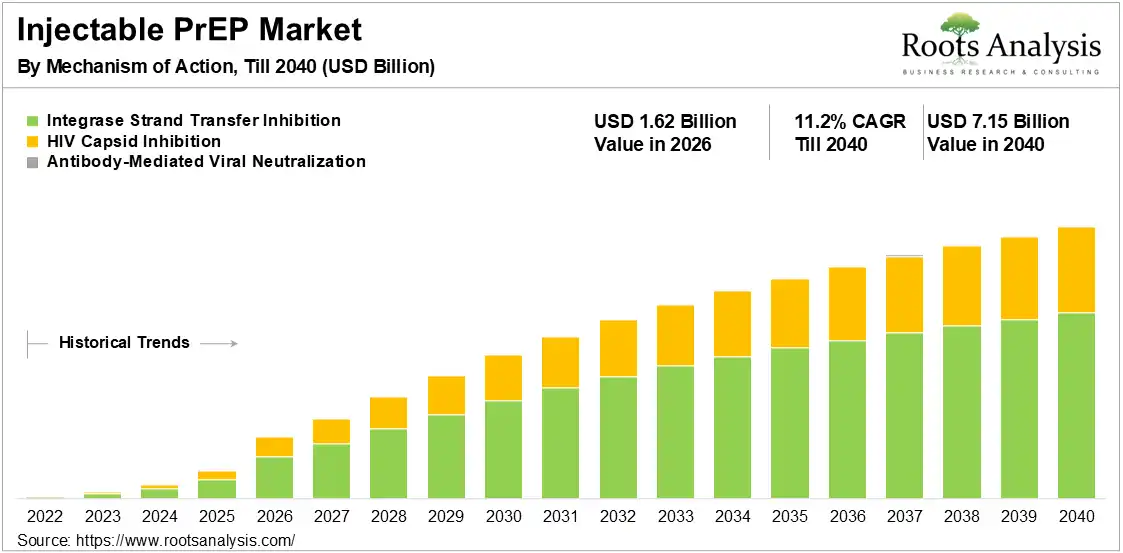
The global Injectable PrEP Market is expected to rise from USD 1.62 billion in 2026 and is projected to reach USD 7.15 billion by 2040, growing at a CAGR of 11.2% over the forecast period 2026 to 2040, driven by six-month dosing, reimbursement expansion, and generic access.
See What’s in the Full Report – Request Your Complimentary Insights!
Market Report: Key Takeaways
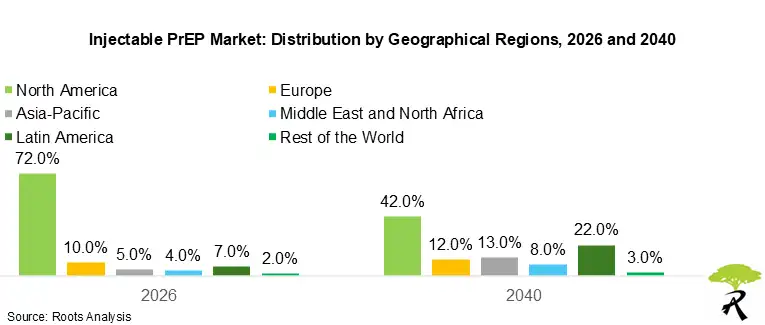
- Based on geography, North America captures 72.0% market share in 2026, whereas the Middle East and Africa register a 20.7% CAGR through 2040, supported by donor procurement and national rollouts.
- Based on mechanism of action, integrase strand transfer inhibition captures 68.0% market share in 2026, whereas HIV capsid inhibition registers a 16.4% CAGR through 2040, driven by six-month protection.
- Based on dosing frequency, bimonthly administration captures 68.0% market share in 2026, whereas semiannual administration registers a 16.6% CAGR through 2040, reducing visit and adherence burdens.
- Based on care setting, hospitals and specialist clinics capture 74.0% market share in 2026, whereas retail and community pharmacies register a 23.8% CAGR through 2040, supported by decentralized delivery.
- Based on funding and procurement model, private health-insurance reimbursement captures 52.0% market share in 2026, whereas donor-funded procurement registers a 15.6% CAGR through 2040, supported by multinational access agreements.
Injectable PrEP Market Outlook
Long-acting HIV prevention has shifted from a single bimonthly option toward competition between two approved injectable mechanisms globally. Apretude established clinic workflows around integrase inhibition, while Yeztugo introduced six-month capsid inhibition. Demand now reflects convenience, adherence support, reimbursement, and delivery capacity rather than product availability alone. Supply planning also depends on branded manufacturing, licensed generics, testing infrastructure, and trained administration sites.
Growth now comes from reduced dosing frequency, wider reimbursement, public procurement, and decentralized delivery through community sites. Six-month protection lowers visit burdens and gives prevention programs more capacity per trained provider. Policy support is also widening the addressable population and clarifying testing pathways. Gilead received United States approval for Yeztugo in June 2025. This established the first twice-yearly injectable PrEP option for eligible adults and adolescents.
Through 2040, the injectable PrEP market will remain high growth, but revenue concentration will gradually move beyond North American branded sales. Semiannual dosing, donor procurement, pharmacy delivery, and licensed generics will reshape regional and channel economics. Unitaid announced a September 2025 agreement targeting generic lenacapavir at about USD 40 per person annually from 2027. Long-term expansion therefore depends on affordable supply, reliable testing, and country-level implementation.
Injectable PrEP Market Dynamics
Injectable PrEP Market Drivers
Six-month protection, reimbursement expansion, and public procurement will sustain an 11.2% market CAGR through 2040. HIV capsid inhibition will grow at 16.4% outpacing integrase inhibition as fewer annual visits improve convenience and program capacity. WHO guidance also supports rapid diagnostic testing and community delivery. These changes expand demand beyond specialist clinics and strengthen long-acting HIV prevention as a distinct procurement category.
Injectable PrEP Market Restraints
Testing, administration, and reimbursement complexity will limit adoption where prevention systems remain fragmented. Hospitals and specialist clinics hold 74.0% of 2026 revenue because they already manage prescribing, inventory, follow-up, and payer navigation. Branded pricing and coverage variability can delay starts, particularly outside funded programs. Each injection schedule also requires reliable HIV testing, trained staff, appointment tracking, and product availability.
Injectable PrEP Market Opportunities
Decentralized delivery creates the clearest opportunity for faster injectable PrEP market growth. Retail and community pharmacies will expand at 23.8% CAGR, while mobile and outreach clinics will grow at 20.3%. South Africa launched national lenacapavir delivery through mobile-clinic services in June 2026. Providers that combine testing, administration, and follow-up can reach users beyond specialist HIV centers.
Injectable PrEP Market Challenges
Country approvals, affordable supply, and dependable procurement remain the main challenges. Originator brands hold 99.4% of 2026 revenue, while licensed generics start from only 0.5%. Generic lenacapavir is planned for 120 lower-income markets starting in 2027 at about USD 40 per person annually. Commercial success will depend on timely approvals, manufacturing readiness, demand forecasting, and coordinated funding commitments.
Injectable PrEP Market Size Estimation Methodology
- As a starting point, the model defines the global injectable PrEP market around approved and investigational long-acting prevention products. Historical values use product launch timing, reported Apretude and Yeztugo sales, current full-year guidance, and verified annual market estimates. Oral PrEP and injectable HIV treatment revenues remain outside scope unless they directly inform access, manufacturing, reimbursement, or delivery assumptions.
- Moving forward, the analysis separates revenue by mechanism, dosing frequency, care setting, funding model, commercialization status, and geography. Product characteristics anchor the initial allocation, including bimonthly integrase inhibition and semiannual capsid inhibition. Provider workflows, testing requirements, insurance coverage, public procurement, and licensed generic status then determine how revenue distributes across channels and buyer groups.
- Building on this, regional shares draw on regulatory approval timelines, reimbursement decisions, national rollout starts, donor access agreements, and reported program initiations. North America receives the largest 2026 share because both approved mechanisms entered the United States early. Faster long-term growth in the Middle East and Africa reflects funded introductions, mobile delivery, and larger planned initiation volumes.
- Drawing upon these, each segment receives a distinct growth rate based on dosing convenience, delivery capacity, procurement support, and competitive entry. Semiannual administration grows faster than bimonthly dosing because two annual visits reduce adherence and provider burdens. Pharmacy, mobile-clinic, donor-funded, and licensed-generic segments receive higher rates where verified policies and access agreements support sustained expansion.
- The projected value was then calculated through an annual forecast curve that produces an 11.2% CAGR from 2026 through 2040. The model allows faster expansion during product launches, reimbursement additions, and early national rollouts. Growth moderates as branded markets mature. Generics and decentralized delivery contribute a meaningfully larger share of incremental demand after their planned scale-up.
- Finally, the forecast undergoes reconciliation, and sensitivity checks across market totals, segment shares, and annual growth paths globally. Each segmentation table must equal 100%, while weighted sub-segment growth must remain consistent with the overall injectable PrEP market trajectory. Upside and downside cases test approval timing, generic readiness, funding continuity, insurance coverage, testing capacity, and the speed of community delivery adoption.
Injectable PrEP Market Share Insights
Market Share by Mechanism of Action
According to our analysis, integrase strand transfer inhibition leads because Apretude established prescribing routines before competing injectable options entered. Specialist clinics already understand its bimonthly administration, testing, inventory, and reimbursement workflows. ViiV Healthcare reported implementation evidence across American and Brazilian settings in March 2025.
On the contrary, HIV capsid inhibition will grow fastest because six-month protection reduces visit frequency and adherence burden. Regulatory approval and global recommendations opened commercial and public procurement pathways. Gilead announced the first United States approval in June 2025.
Market Share by Commercialization Status
Originator-branded products dominate because Apretude and lenacapavir brands currently generate nearly all injectable PrEP revenue. Regulatory approvals, commercial supply, and provider training remain centered on their developers. Gilead announced Yeztugo’s United States approval in June 2025.
Voluntarily licensed generics will grow fastest after planned 2027 launches materially reduce annual treatment costs. Multiple suppliers and broad territorial licenses will support high-volume public procurement.
Want Information on Specific Region / Segment?
Regional Analysis: North America Leads the Market and Middle East and Africa is Likely to Register Higher CAGR
Presently, North America holds 72.0% market share in 2026 and leads because the United States launched both commercially important injectable PrEP mechanisms before most markets. Mature specialty clinics, commercial insurance, manufacturer support, and higher branded pricing reinforce revenue concentration.
On the contrary, Middle East and Africa will grow fastest as donor procurement accelerates national product introductions. High unmet prevention need, policy support, and primary-care integration will expand localized demand.
Market Ecosystem Analysis
The 20-company ecosystem contains eight Tier 1 leaders, seven specialists, and five emerging long-acting injectable platform developers. However, Gilead Sciences and ViiV Healthcare control current branded injectable PrEP commercialization. Market consolidation follows an IP-controlled network model, where originators retain branded rights while delegating manufacturing and lower-income-market supply. Donor-backed procurement and $40 generic pricing are shifting competition from premium pricing toward regulatory speed, manufacturing scale, and supply reliability.
Competitive advantage increasingly depends on combining longer dosing intervals with reimbursement access, scalable sterile production, and dependable community-level distribution.
- In June 2025, Gilead secured FDA approval for Yeztugo, establishing the first semiannual injectable PrEP product. The approval introduced capsid inhibition as a commercial alternative to ViiV’s bimonthly integrase inhibitor.
- In July 2025, Gilead finalized at-cost supply for up to two million people over three years. This strengthens semiannual PrEP within donor-funded procurement and high-incidence African markets.
- In March 2025, Quebec became Canada’s first province to publicly reimburse Apretude. Public coverage strengthens ViiV Healthcare’s position across specialist clinics and provincially funded prevention programs.
- In October 2025, NICE recommended Apretude for patients unable to use daily oral PrEP. The decision protects ViiV’s bimonthly segment through payer-supported specialist sexual-health delivery.
- In September 2025, Dr. Reddy’s Laboratories’ partnered with Unitaid, CHAI, and Wits RHI. The agreement targets generic lenacapavir at $40 annually across 120 lower-income markets from 2027.
- In September 2025, Hetero entered a Gates Foundation partnership supported by upfront funding and volume guarantees. The partnership also targets approximately $40 annually for generic lenacapavir.
- In July 2025, Aurobindo Pharma was selected to manufacture and supply long-acting cabotegravir across 133 countries. The expanded remit strengthens its injectable antiretroviral manufacturing capabilities and enlarges its accessible geographic footprint.
- In January 2026, Becton, Dickinson and Company invested $110 million to expand prefillable syringe production in Nebraska. The investment added Neopak glass-syringe capacity and supported 1 mL and 2.25 mL formats.
- In October 2025, West launched its Synchrony prefillable syringe system. The verified single-supplier platform combines performance data, regulatory documentation, and flexible supply arrangements.
- In January 2025, SCHOTT Pharma launched a next-generation polymer prefillable syringe system. The platform uses existing filling lines and reduces additional conversion investment for pharmaceutical manufacturers.
- In April 2025, Gerresheimer launched silicone-oil- and PFAS-free ready-to-fill syringe systems with Injecto. The supply-and-license agreement secured long-term access to patented plunger-stopper technology.
Startup Companies and their Key Highlights
- Camurus AB
- Event type and amount: Collaboration and licensing agreement, with up to $870 million in potential milestone payments.
- Month and year: June 2025.
- Eli Lilly and Company.
- Stated purpose: Develop and commercialize long-acting incretin products using FluidCrystal technology.
- Market implication: The agreement validates major-pharma demand for configurable injectable depot platforms and strengthens platform-licensing competition.
- Nanexa AB
- Event type and amount: License and option agreement, including $3 million upfront and up to $500 million in milestones.
- Month and year: December 2025.
- Strategic partner: Moderna, Inc.
- Stated purpose: Evaluate PharmaShell technology across one licensed compound and options covering four additional compounds.
- Market implication: The agreement funds controlled-release validation across advanced biologics and strengthens the emerging formulation-platform segment.
- InnoCore Pharmaceuticals
- Event type: Long-acting injectable formulation-development contract with a returning Top 10 global pharmaceutical company.
- Month and year: September 2025.
- Stated purpose: Formulate complex peptide and biologic APIs using InnoCore’s biodegradable SynBiosys polymer platform.
- Market implication: The contract strengthens in-situ depot expertise for complex biologics and investigational long-acting injectable formulations.
- MedinCell
- Event type and amount: Global equity offering raising €42.9 million.
- Month and year: February 2025.
- Participating investors: Adage Capital Partners, Invus, Polar Capital, Wellington Management, Mirova, Syquant Capital, and SITAM Belgique.
- Stated purpose: Expand BEPO technology into new molecules and indications while strengthening licensing opportunities and financial flexibility.
- Market implication: The financing increases resources available for bioresorbable depot development and additional long-acting injectable partnerships.
Injectable PrEP Market Trends / Opportunities
Semiannual Capsid Inhibition Reshaping Injectable PrEP Market Share
Semiannual capsid inhibition is moving competitive advantage toward products that reduce annual clinic visits. Gilead secured United States approval for Yeztugo in June 2025, creating the first twice-yearly injectable prevention option. This dosing profile supports faster uptake, and shifts share from established bimonthly administration.
Global policy alignment is strengthening the commercial case for six-month protection. WHO recommended injectable lenacapavir in July 2025 and supported rapid diagnostic approaches for long-acting delivery. National guidelines can now translate clinical convenience into procurement decisions, provider training, and broader market access.
Community Delivery Expanding Injectable PrEP Market Reach and Channel Competition
Pharmacy and community delivery are reducing dependence on specialist HIV clinics. WHO included pharmacy and community options in its July 2025 implementation guidance. Retail and community pharmacies consequently carry the fastest care-setting CAGR, creating new channel partnerships and increasing competition for administration capacity.
Mobile delivery is becoming a practical route for national scale-up in high-burden markets. South Africa launched lenacapavir through mobile-clinic services in June 2026. This model reduces travel and appointment barriers, favoring suppliers and service networks that can integrate testing, inventory, administration, and follow-up.
Generic Licensing Compressing Costs and Shifting Procurement Power
Voluntary licensing is preparing the market for a major shift from branded to public-procurement economics. Unitaid, CHAI, Wits RHI, and Dr. Reddy’s announced a September 2025 agreement targeting about USD 40 per person annually from 2027. Lower pricing will expand eligible volumes and intensify supplier competition.
Local manufacturing policy is emerging as a strategic response to import dependence and regional supply risk. South Africa began identifying a domestic lenacapavir manufacturer with Unitaid and the United States Pharmacopeia in March 2026. Successful localization could improve supply security and strengthen regional bargaining power.
Public Reimbursement and Donor Commitments Accelerating Regional Commercialization
Public reimbursement is converting regulatory approval into routine commercial access across Europe. France authorized and fully reimbursed Apretude, with availability beginning March 2, 2026. Coverage removes a major affordability barrier and rewards companies that complete country-specific health-technology, pricing, and distribution processes.
Large donor commitments are creating predictable demand before generic supply reaches full scale. The United States and the Global Fund expanded their access goal in April 2026. It targets three million people by 2028 across additional countries. Volume-backed programs lower launch risk and improve procurement visibility for manufacturers and delivery partners.
Your Business is Unique – Why Shouldn’t Your Report Be?
Market Access Considerations
Coordinated Regulatory Review and Country Authorization
Country authorization speed determines when suppliers can convert global evidence into local demand. Zambia and Zimbabwe approved lenacapavir through the WHO Collaborative Registration Procedure in December 2025. They completed reviews in 12 and 18 working days. Companies that align dossiers with coordinated review pathways can enter faster. Fragmented national processes delay procurement, training, and launch sequencing across regional markets. This sequencing also influences donor allocations and early relationships with ministries, clinics, and national procurement agencies.
HIV Testing and Injection Delivery Capacity
Reliable HIV testing and injection capacity directly constrain commercial scale. Gilead outlined testing at initiation and each six-month Yeztugo injection in September 2025. Providers need trained staff, appointment tracking, inventory controls, and clear follow-up pathways. Suppliers that support these workflows can broaden adoption beyond specialist clinics, while weak delivery infrastructure limits demand regardless of product availability. Community pharmacies and mobile clinics require comparable controls before they can absorb meaningful administration volumes consistently.
Public and Private Reimbursement Pathways
Reimbursement decisions determine whether regulatory approval produces sustained patient access. NICE recommended long acting cabotegravir in October 2025 for eligible people in England and Wales who cannot use oral PrEP. Positive coverage supports routine NHS use, while delayed payer decisions restrict prescribing. Competitive positioning therefore depends on country-specific evidence, pricing strategy, assistance programs, and the ability to navigate public and private reimbursement systems. Coverage breadth also affects forecastable volumes and provider willingness to build dedicated injection services.
Generic Licensing and Manufacturing Readiness
Licensed manufacturing and procurement commitments shape price, volume, and geographic reach. Gilead selected six generic manufacturers for 120 resource-limited countries. A September 2025 agreement targeted annual lenacapavir pricing near USD 40 from 2027. Originators retain branded-market advantages, but licensed suppliers can compete through cost and scale. Manufacturing readiness, approval timing, and tender access will determine which companies capture public-sector demand. Long-term contracts can improve capacity planning and reduce supply uncertainty for national programs.
How Stakeholders Benefit from the Key Focus Areas of Our Injectable PrEP Market Report
Six-month dosing, reimbursement expansion, donor procurement, and generic licensing are changing injectable HIV prevention economics. This report connects those shifts with segment growth, access requirements, competitive positioning, and delivery infrastructure decisions.
- Unmet Needs and Market Gaps in the Injectable PrEP Market: The report identifies gaps in testing capacity, specialist access, pharmacy readiness, mobile delivery, and affordable supply. Health-system planners can compare where demand exists against where administration infrastructure remains limited. Commercial teams can use regional shares and care-setting growth rates to prioritize countries, channels, and service models. These findings support decisions on market entry, provider support, and access-program design.
- Funding and Venture Investment Opportunities in the Injectable PrEP Market: The analysis separates government procurement, donor funding, private insurance, and self-pay demand. Investors and corporate development teams can assess why donor-funded procurement grows faster than private reimbursement through 2040. It also highlights opportunities around licensed generics, sterile manufacturing, testing workflows, and decentralized administration. These insights support capital allocation, partnership screening, and risk assessment.
- Technology Innovation and Adoption Trends: The report tracks adoption across integrase inhibition, capsid inhibition, antibody-mediated approaches, and long-acting delivery platforms. Research and technology leaders can see why semiannual dosing gains share while bimonthly administration remains commercially important. Care-setting forecasts show where pharmacy and mobile models may expand administration capacity. This evidence supports portfolio planning, formulation strategy, and delivery-technology investment.
- Injectable PrEP Market Competitive Landscape and Industry Analysis: The competitive analysis distinguishes approved originators, licensed generic manufacturers, packaging suppliers, CDMOs, and proprietary depot-platform developers. Strategy teams can compare the near-term dominance of Apretude and Yeztugo with the expected rise of generics. The report also maps share changes by mechanism, dosing, and commercialization status. These comparisons support positioning, competitor monitoring, and market-entry timing.
- Mapping Strategic Partnerships and Ecosystem Synergies: The ecosystem mapping explains how originators, generic licensees, donors, procurement bodies, clinics, pharmacies, and manufacturing partners interact. Business development teams can identify where access agreements, local production, or delivery partnerships remove specific scaling barriers. The analysis clarifies which relationships influence approval, price, supply, and patient initiation volumes. This supports partner selection, negotiation priorities, and route-to-market planning.
- Injectable PrEP Market CAGR and Growth Trends: The forecast quantifies an 11.2% market CAGR through 2040 and compares growth across every major segment. Financial planners can identify faster trajectories in capsid inhibition, semiannual dosing, pharmacies, donor procurement, generics, and the Middle East and Africa. Share tables also reveal which established segments lose relative weight despite continued growth. These metrics support revenue planning, scenario analysis, and portfolio prioritization.
Injectable PrEP Market: Scope of the Report
| Key Report Attributes | Details | |
| Forecast Period | Till 2040 | |
| Market Size 2026 | USD 1.62 Billion | |
| Market Size 2040 | USD 7.15 Billion | |
| CAGR (Till 2040) | 11.2% | |
| Segments Covered |
|
|
| Geographical Regions Covered |
|
|
| Key Sections Covered |
|
|
Market Segmentation
The Injectable PrEP Market report presents an in-depth analysis, highlighting the capabilities of various stakeholders, based on different segments, such as mechanism of action, dosing frequency, care setting, funding and procurement model, commercialization status, geographical regions, and leading players.
By Mechanism of Action
- Integrase Strand Transfer Inhibition
- HIV Capsid Inhibition
- Antibody-Mediated Viral Neutralization
By Dosing Frequency
- Bimonthly Administration
- Semiannual Administration
- Other Investigational Long-Acting Frequencies
By Care Setting
- Hospitals and SPECIALIST HIV or Sexual-Health Clinics
- Primary-Care and Community Health Centers
- Retail and Community Pharmacies
- Mobile and Outreach Clinics
By Funding and Procurement Model
- Government and Public-Health Procurement
- Donor-Funded Procurement
- Private Health-Insurance Reimbursement
- Self-Pay and Private Purchase
By Commercialization Status
- Originator-Branded Products
- Voluntarily Licensed Generic Products
- Investigational Pipeline Products
By Geographical Regions
- North America
- US
- Canada
- Mexico
- Rest of North America
- Europe
- Austria
- Belgium
- Denmark
- France
- Germany
- Ireland
- Italy
- Netherlands
- Norway
- Russia
- Spain
- Sweden
- Switzerland
- UK
- Rest of Europe
- Asia-Pacific
- China
- India
- Japan
- Singapore
- South Korea
- Rest of Asia-Pacific
- Latin America
- Argentina
- Brazil
- Chile
- Colombia
- Venezuela
- Rest of Latin America
- Middle East and Africa (MEA)
- Egypt
- Iran
- Iraq
- Israel
- Kuwait
- Saudi Arabia
- UAE
- Rest of MEA
- Rest of the World


