
Lowest Price Guaranteed
Slides
231
Last Updated
September 2025
View Count
11641
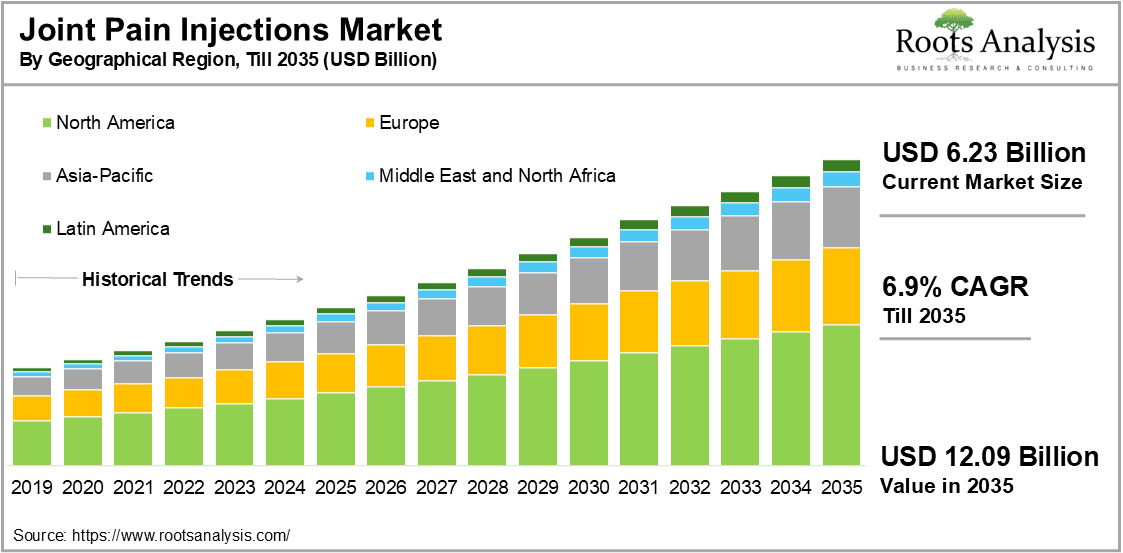
The global joint pain injections market, valued at USD 5.75 billion in 2024, is projected to reach USD 6.23 billion in 2025 and USD 12.09 billion by 2035, representing a CAGR of 6.9% during the forecast period.
 |
To learn more about this report, request a free sample copy
Given the growing cases of joint pain, there is a rapid increase in the demand for proactive chronic pain management injections to offer instant relief to the patients. Notably, joint pain is getting common among geriatric population as joints, ligaments and tendons wear down or start degenerating with age. As per the report of the World Health Organization, osteoarthritis is getting more prevalent among aged people (nearly 70% of people, about 55 years of age). Among these, nearly 60% of the population with osteoarthritis are women. Moreover, people specifically athletes and individual with joint injury may also suffer from joint pain.
In addition to osteoarthritis, people with obesity are at greater risk of having osteoarthritis and joint pain as excess body weight creates immense pressure and stress on the knee joints, resulting into ligaments damage. According to the World Obesity Federation, over one billion people in the world are living with obesity. Among these, over 880 million are adults, 159 million are children and adolescents (aged 5-19 years).
Thus, rising risk of joint pain associated with osteoarthritis has necessitated the demand for advanced medications that aid in managing pain and inflammation without undergoing surgical treatments. Joint injections in this context emerge as potential pain-relieving treatment for the patients who required immediate treatment (instead of systematic medication). Notably, joint pain injections are specifically designed to manage pain and inflammation occur due to overuse injuries, osteoarthritis, bursitis and tendinitis.
It is important to highlight here that healthcare professionals including orthopedics, pain managing physicians and rheumatologists are also supporting joint pain injections for managing pains in patients. Additionally, the growing demand for minimal invasive solutions for pain management has further heightened the demand for joint pain injections.
Notably, the increasing innovations in joint pain injections, such as platelet rich plasma and hyaluronic acid to stimulate healing and repair damaged joint tissues are likely to augment the demand for such injection-based treatment. Considering the ongoing demand, several industrial stakeholders are currently increasing their research and development efforts for providing novel joint pain injections.
However, the key focus of the industrial players is on cost effectiveness, addition of nanoparticles for targeted delivery and effective anti-osteoarthritis injections for managing pain. For instance, in September 2024, Sun Pharma and Moebius Medical announced that its MM-II (Large Liposomes of DPPC and DPMC) received granted Fast Track Designation from the FDA to treat osteoarthritis knee pain. The accelerated grant of joint pain injections has catered the attention of industrial leaders to make strategic initiatives including investments, collaborations and partnerships in this domain.
It is important to highlight here that in March 2024, Wahington University (St. Louis) researchers received award of around USD 31 million from Advanced Research Projects Agency for Health. The award has been provided for the development of a single-injection treatment that promotes tissue regeneration and restores joints of patients. Considering the ongoing investments and initiatives in this field, we believe that the global joint pain injections market will grow steadily during the forecast period.
The new research report provides invaluable information on the leading players who are presently active across different segments of the joint pain injections industry as mentioned in the table below.
| Key Report Attributes | Details | |
| Historical Trend | Since 2019 | |
| Forecast Period | Till 2035 | |
| Current Market Size | $6.23 billion | |
| Market Size 2035 | $12.09 billion | |
| CAGR (Till 2035) | ~6.9% | |
| Type of Injection |
|
|
| Type of Product |
|
|
| Type of Joint |
|
|
| Type of Distribution Channel |
|
|
| End User |
|
|
| Geographical Region |
|
|
| Key Companies Profiled |
|
|
| PowerPoint Presentation (Complimentary) |
Available | |
| Customization Scope | 15% Free Customization | |
| Excel Data Packs (Complimentary) |
Available | |
One of the key objectives of the joint pain injections market report was to estimate the current market size, opportunity and the market growth potential, over the forecast period, till 2035. We have provided informed estimates on the likely evolution of the market for the forecast period.
Additionally, the market report features the likely distribution of the current and forecasted opportunity within the market distributed across various segments such as type of injection (corticosteroid injections, hyaluronic acid injections, platelet rich plasma injections, and other products), type of product (pre-filled injections and vials), type of joint (knee& ankle joints, hip joints, hand & wrist joints, and other joints), type of distribution channel (hospital pharmacies, retail pharmacies, and online pharmacies), end user (hospitals, clinics and other end users), geographical region (North America, Europe, Asia-Pacific, Middle East and North Africa, and Latin America) and leading players.
To account for the uncertainties associated with the development of joint pain injections and to add robustness to our model, we have provided three market forecast scenarios, portraying the conservative, base and optimistic tracks of the market’s evolution.
All actual figures have been sourced and analyzed from publicly available information forums and primary research discussions. Financial figures mentioned in this market research report are in USD, unless otherwise specified.
Based on the type of injection, the global joint pain injections market is segmented into corticosteroid injections, hyaluronic acid injections, platelet rich plasma injections, and other products. According to our market study, currently, hyaluronic acid injections account for the largest share (65%) of the market. Hyaluronic acid acts as a lubricant within the joints, it significantly improves mobility, reduces inflammation, alleviates pain and enhances functionality of the joints.
It is important to highlight here that corticosteroid injections also hold a significant share of the market driven by their higher effectiveness in reducing pain and inflammation associated with joint disorders. Corticosteroid helps to lower down the prostaglandin level to get relief from tenderness and stiffness in joints that are damaged due to osteoarthritis. Furthermore, the corticosteroid offers long-lasting effect with single dosage of injection and shows minimal side effects, making it highly preferrable option for managing joint pain.
However, in the long run, platelet rich plasma injections will show lucrative growth potential and are likely to grow at a higher CAGR during the forecast period. This can be attributed to the growing research on platelet rich plasma injections for repairing damaged tissues, ligaments and tendons surrounding joints.
This segment highlights the distribution of global joint pain injections market based on the type of product into pre-filled injections and vials. According to our projection, pre-filled injections are preferred for the treatment of joint pain associated with arthritis. It is important to highlight here that this segment will continue to remain dominant and is likely to grow at a higher CAGR due to the growing demand for single-use subcutaneous injections in pre-filled form to deliver accurate dose.
The global market is distributed across different types of joints, such as knee joints, hip joints, hand & wrist joints, and other joints. Among these, currently knee & ankle joints segment accounts for the highest joint pain injections market share (nearly 55%). This can be attributed to the fact that with age there is a high risk of knee osteoarthritis and obesity has further contributed to the high incidence of osteoarthritis. Driven by the rising incidence of knee joints osteoarthritis, the demand for joint pain injections has significantly increased, which is anticipated to be a key factor for the highest share of this segment. It is important to highlight here that the hip joints segment is expected to grow at a higher CAGR during the forecast period. This can be attributed to the rising incidence of hip joint pain conditions in patients with osteoarthritis patients.
This segment highlights the distribution of global market across different distribution channels, such as hospital pharmacies, retail pharmacies, and online pharmacies. It is worth mentioning here that currently retail pharmacies hold the highest joint pain injections market size (with a share of nearly 45%). This dominance is likely to be the result of ease of accessibility and high supply demand of joint pain injections.
However, during the upcoming years, we believe online pharmacies segment is likely to grow at a substantial CAGR during the forecast period. This lucrative growth potential is due to the supportive regulatory guidelines to sale prescribed joint pain injections online in developed countries and rising shift towards online purchases of drugs due to affordability.
Based on the end user, the global joint pain injections market is distributed into hospitals, clinics and other end users. Currently, the hospitals segment occupies the major share of the market and is likely to remain dominant during the projected period. This dominance is due to the fact that the patients with osteoarthritis and joint pain issues prefer expert healthcare practitioners for dosage delivery. Furthermore, healthcare professionals offer proper monitoring to patients during drug delivery to enhance patient outcomes. Moreover, the rising patient pool with joint issues has further supported the growth of this segment. Driven by the ongoing preferences, this segment will continue to grow at a higher CAGR during the forecast period.
Based on the geographical region, the global market is distributed into North America, Europe, Asia-Pacific, Middle East and North Africa, and Latin America. According to our joint pain injections market analysis, North America is currently dominating the market with the highest share of 46%. Several factors such as the high prevalence rate of osteoarthritis and increasing demand for minimal invasive treatment for pain management has contributed to the highest share of North America. Additionally, the growing initiatives of government organizations to raise awareness about pain management injections for joint pain has further supported the growth of this segment during the forecast period.
It is worth noting here that the market for joint pain injections in Asia-Pacific is anticipated to register the highest CAGR during the forecast period. This can be attributed to the growing geriatric population with osteoarthritis and musculoskeletal conditions in countries such as India, China and Japan.
The “Global Joint Pain Injections Market: Industry Trends and Global Forecasts, till 2035” market report features an extensive study of the current market landscape, market size and future opportunity within the joint pain injections industry, during the given forecast period. The market report highlights the efforts of several stakeholders involved in this rapidly emerging segment of the service providers industry. Key takeaways of the data analysis are briefly discussed below.
Currently, the global joint pain injections market features a wide array of well-established players and new entrants who are presently across different segments of the industry. The leading players, research universities and government organizations are taking strategic initiatives to drive innovations and develop innovative injection solutions to repair damage ligaments in joints.
It is important to highlight here that in December 2024, MSK Doctors are focused on treating patients of knee arthritis with polyacrylamide hydrogel. It’s a form of synthetic hydrogel (an alternative to hyaluronic acid) shown significant outcome in patients during trials. This strategic initiative toward using synthetic hydrogel instead of hyaluronic acid has catered the attention of industrial players to develop more novel pain management injections. Overall, the market for joint pain management will remain competitive, featuring the presence of several small, mid-sized and large companies.
The global market for joint pain injections is likely to be propelled by the growing incidence of joint discomfort and osteoarthritis in geriatric population. It is important to highlight here that osteoarthritis results in joint pain, redness, stiffness and reduced physical activities. In severe cases, osteoarthritis also results in joint degeneration and progress to rheumatoid arthritis that further affects hands and feet. Additionally, the high requirement of joint pain injections to get relief from pain generated through torn ligaments, joint injuries and joint discomfort has further fueled the demand of such medications. Moreover, the rise of musculoskeletal issues among geriatric population is contributing to the high demand for joint pain injections.
Despite high demand, there are several challenges that may hinder market progress during the projected period. Some of the notable challenges includes availability of alternative treatments, such as physical therapies (through pain management devices) and surgical treatment to get permanent relief may limit the adoption of joint pain injections. Furthermore, joint pain injections have shown limited effectiveness or short-term relief which may impact the adoption rate during the projected period.
In addition, the high cost of joint pain injections has further restricted their adoption among the people for managing pain. For instance, the cost of corticosteroid injections is between USD 100-300 per injection and hyaluronic acid injection cost ranged from USD 300-USD 1000 per injection, whereas the cost of platelet rich plasma injections ranged from USD 500- USD 2,500 per injection. The significant high cost may limit the adoption of joint pain injections.
Some of the latest trends that are likely to drive market growth at a steady rate during the forecast period include growing demand for minimal invasive pain management solutions and technological innovations. It is worth noting that patients with osteoarthritis and musculoskeletal injuries are demanding minimal invasive treatment that require shorter hospital stays and fewer recovery times. The growing demand for minimal invasive treatments has fueled the requirement of joint pain injections as they are easy to administer, have shorter recovery time and does not require long hospital stays.
Furthermore, growing technological innovations and injection therapies with higher efficacy, safety and long-term relief has further bolstered the growth of this market during the projected period. It is important to highlight here that the recent research published in February 2024 showed that the injection pazopanib (encapsulated with nanoparticles), a long-acting drug, has shown efficacy in alleviating osteoarthritis pain and treat cartilage damage in just single intra-articular injections. As more industrial players and researchers continue to expand their research on novel treatments and technologies, we believe that the joint pain injections market will remain progressive during the projected period.
Currently, the global joint pain injections market is valued at USD 6.23 billion and is poised to reach USD 12.09 billion, representing a higher CAGR of 6.9% during the forecast period. This lucrative growth is primarily due to the high demand for minimal invasive treatment for joint pain management. In order to provide advanced pain management solutions, several industrial players are forging contracts, collaborations and partnership agreements. For instance, in January 2024, Bioventus agreed nationwide contract with Aetna™ Medicare advantage plans. Under this plan the plan members will have access to DUROLANE (single-injection hyaluronic acid-based joint fluid treatment) for treating knee osteoarthritis pain. Similarly, several industrial leaders are leveraging partnerships to drive innovation in the industry to fulfil the growing demand for injections to get relief from pain associated with osteoarthritis.
Examples of key players engaged in this domain (which have also been captured in this report) include Anika Therapeutics, AbbVie, Arthrex, Bayer, Bioventus, Chugai Pharmaceuticals, Emcyte, Ferring, Eli Lilly, Johnson & Johnson, Lifecore Biomedical, Merck, Novartis, OrthogenRx (acquired by Avanos Medical), Pacira BioSciences (Flexion), Pfizer, Sanofi, Stryker, Takeda Pharmaceuticals, and Zimmer Biomet Holdings. This market report includes an easily searchable excel database of all the companies focusing on the development of joint pain injections.
Several recent developments have taken place in the joint pain injections industry. We have outlined some of these recent initiatives below.