
Lowest Price Guaranteed
Pages
225
Last Updated
September 2026
View Count
18361
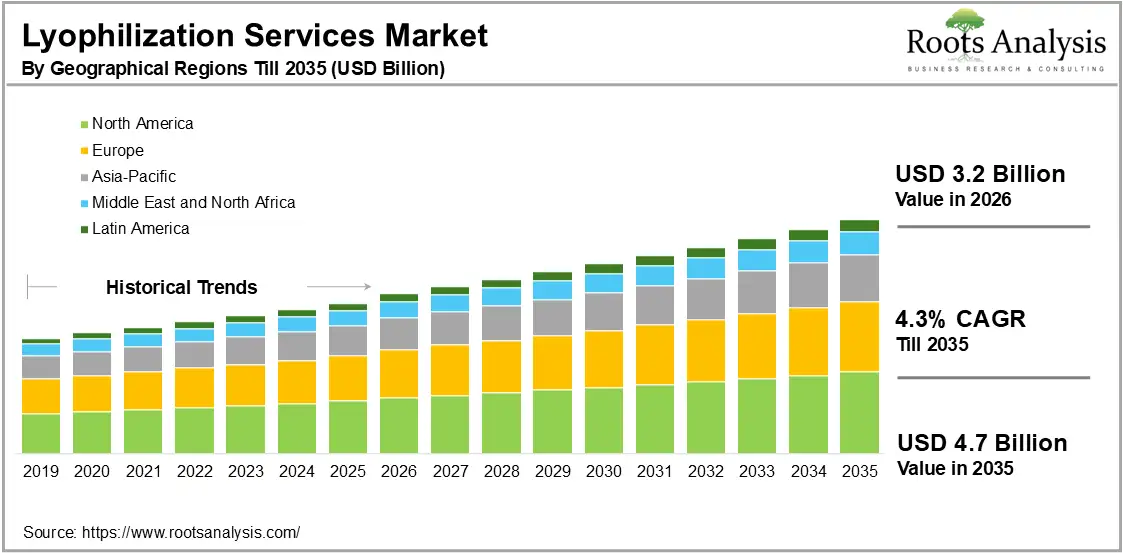
The global lyophilization services market, valued at USD 3.0 billion in 2025, is projected to reach USD 3.2 billion in 2026 and USD 4.7 billion by 2035, with a 4.3% CAGR during the forecast period 2026 to 2035.
 |
To learn more about this report, request a free sample copy
The new market study report provides information on industry trends, market insight, competitive landscape, value chain analysis, product distribution, opportunities, and future forecast.
Lyophilization is a process of drug stabilization by removing excessive solvents such as water and freeze-drying without changing chemical characteristics. The process is applicable to stabilize biological samples, thermally unstable drugs, and vaccines, allowing preservation for long term. Lyophilization involves various equipment such as lab freeze dryers, non-sterile freeze dryers, and sterilizable lyophilizers. In recent years, there has been growing approval for different types of biologics, including cell therapies, gene therapy, monoclonal antibodies, recombinant proteins, and vaccines. Biologics are in great demand owing to several advantages offered such as target specificity, small molecules, high efficacy and safety profile. Since biologics are derived from live organisms, they are prone to damage due to changes in the external environment such as temperature, pH, light, and oxygen.
Furthermore, biologics can also get contaminated with microorganisms - it can be challenging to store and transport these therapeutics with a conventional method. Pharmaceutical Spray Drying complements these formulation approaches by converting liquid feeds into engineered powders with controlled particle and stability characteristics. Lyophilization emerges as a safe and convenient freeze-drying method to stabilize these biologics by removing excess water without altering its chemical properties. It is worth noting here that nearly 50% of the therapeutics received approval from regulatory agencies are injectables. Out of these, around one-third of the biopharmaceutical candidates are lyophilized to allow storage for a long time.
The growing necessity of lyophilization for biologics has underscored the requirement for lyophilization equipment. However, the installation of in-house lyophilization equipment and operational infrastructure can be expensive, specifically for small pharmaceutical companies. In addition, the lyophilization process is complex and requires skilled personnel to handle operations, which enhances the overall capital investment. Driven by operational challenges and high investment, several biologics manufacturers are also outsourcing their lyophilization services. Contract manufacturing organizations provide equipment and service support along with technological expertise to meet the growing demand for lyophilized drugs.
In order to streamline the lyophilization process and meet the rising necessity for outsourcing services, several lyophilization services providers are entering into strategic partnerships to enhance their capabilities. In May 2024, Millrock Technology (a prominent freeze-drying solutions provider) partnered with LyoWare (a high-tech startup commercializing the latest automated microwave heating technologies manufactured at Purdue University). The partnership has been done directly behind LyoWave licensing the intellectual property through the Innovates Office of Technology Commercialization of Purdue University. Owing to the ongoing partnerships and growing approval for biologics therapeutics, we believe the market will grow at a steady rate during the forecast period.
The market research report covers an in-depth analysis of the lyophilization services industry across various segments mentioned below.
| Key Report Attributes | Details | |
| Historical Trends | Since 2019 | |
| Forecast Period | Till 2035 | |
| Market Size in 2035 | USD 4.7 billion | |
| CAGR | ~ 4.3% | |
| Distribution by Types of Biologics Lyophilized |
|
|
| Distribution by Type of Primary Packaging System |
|
|
| Key Regions Covered |
|
|
| Key Companies Profiled |
|
|
| Customization Scope | 15% Free Customization Option | |
| Excel Data Packs (Complimentary) |
|
|
One of the key objectives of this market report is to provide a detailed market forecast analysis in order to estimate the existing market size and future opportunities for the lyophilization services market for biopharmaceuticals in the forecast period. We have provided an informed estimate on the likely evolution of the market over the forecast period, till 2035.
The market report features a detailed forecast of the overall lyophilization services market for biopharmaceuticals, wherein both the current and upcoming opportunity is segmented across [A] type of biologic lyophilized (antibodies, cell and gene therapies, vaccines and other biologics), [B] type of primary packaging system (vials, syringes, cartridges, ampoules and others) and [C] key geographies (North America, Europe, Asia Pacific, Middle East and North Africa, and Latin America).
In order to account for future uncertainties and add robustness to our model, we have provided three market forecast scenarios, namely conservative, base, and optimistic scenarios, representing different tracks of the industry's growth.
The opinions and insights presented in the market report were also influenced by discussions held with senior stakeholders in the industry. The market research report features detailed transcripts of interviews held with the following individuals:
Based on the type of biologics lyophilized, the market is bifurcated into antibodies, cell and gene therapies, vaccines, and other biologics. According to our projection, antibodies market segment holds the largest share of the market and are poised to capture 52% of the overall revenue share by 2035. Driven by the increasing demand for target-specific drugs for the treatment of a broad range of diseases, the antibodies segment is likely to expand at a higher CAGR of 7% during the forecast period.
The global lyophilization services market has been segmented into vials, syringes, cartridges, ampoules, and others. In terms of revenue share, the vials will hold a significant share (82%) by 2035. The highest revenue share of this segment can be attributed to the fact that vials are the most preferable option for the primary packaging system for the storage and transportation of biologics. Driven by the increasing demand for automated drug delivery injections and prefilled syringes, the market for syringes are likely to grow at a higher CAGR of 6.7% during the forecast period.
Based on the key geographical region, the market is distributed into North America, Europe, Asia-Pacific, Latin America and Middle East and North Africa. According to our projection, North America stands to hold the largest share (34.2%) by 2035. In Asia-Pacific, the lyophilization services market is expected to grow at a CAGR of 7.3% during the forecast period.
The “Lyophilization Services Market for Biopharmaceuticals (2nd Edition): Industry Trends and Global Forecasts, till 2035” market report features an extensive study of the current market landscape, market size, market forecast and future opportunities for the companies involved in offering lyophilization services for biopharmaceuticals. The market research report features an in-depth analysis of the key drivers and trends.
Currently, the market landscape features over 105 lyophilization service providers who claim to have technical expertise, equipment, and platforms to offer lyophilization services for different types of biotherapeutics, such as antibodies, proteins, nucleic acids, and cell / gene therapies. Overall, the lyophilization services market is highly fragmented, witnessing the presence of new entrants and established players who offer lyophilization services for a variety of operations. In order to leverage its competitive edge, several lyophilization service providers are anticipated to expand their product portfolio, aiming to meet client's requirements.
One of the key market drivers propelling growth in this industry is growing preferences for biologics and vaccines to target a broad range of diseases. It is worth noting here that biologics, including monoclonal antibodies, recombinant proteins, and cell / gene therapies, are less stable in comparison to other therapeutic drugs. These biopharmaceuticals easily degrade due to chemical and physical changes. In order to achieve high stability, biologics developers are shifting to lyophilization services providers, which are anticipated to be a major growth driver in this market. Lyophilization techniques and equipment such as freeze dryers and non-sterile freeze dryers have been adopted at a large scale in pharmaceutical companies, which is further estimated to grow the requirement for advanced lyophilization services.
In addition, several market leaders are accelerating their research for lyophilization technology advancements and innovations to improve working efficiency and achieve process control during the drying process. Latest technologies, such as continuous freeze-drying systems and automated lyophilization systems, are encouraging industrial leaders to adopt these technologies and meet the customized lyophilization services requirements of clients. Driven by the increasing demand for biopharmaceuticals and technological advancements, the lyophilization services market is projected to grow at a steady rate.
The development of high-tech automated lyophilization equipment requires huge capital investment, which becomes a primary restraining factor for small businesses. Furthermore, lyophilization devices and equipment require continuous maintenance, and operational complexity can deter small businesses from adopting these innovative lyophilization techniques on a large scale. Additionally, the lack of skilled personnel to operate lyophilization equipment can be a significant challenge for the service provider in the upcoming years. Competition from alternative technologies such as vacuum drying and spray drying are generally preferred by small pharmaceutical companies to lyophilize drugs due to faster processing time and lower cost. The competition from low-cost lyophilization technologies may limit the growth of the lyophilization services market.
Given the growing preferences for personalized medicine and targeted therapies, there is high demand for lyophilization processes to achieve higher stability. Targeted therapies, such as cell therapies, require a tailored lyophilization process that helps to maintain drug efficacy and viability for the long term. However, installation of specialized lyophilization equipment in in-house operational units can be expensive. As a result, several biologics developers shifted to outsourcing lyophilization services from contract manufacturing organizations. Outsourcing of lyophilization services can offer several benefits, such as high-tech lyophilization equipment support, skilled personnel, cost reduction, and operational efficiency to meet the growing demand for lyophilized drugs.
Some of the key factors shaping the lyophilization services industry are increasing requirements for controlled nucleation in lyophilization. Nucleation is a process in which atoms and molecules interact with each other to form new structures or crystalline solids. The formation of small clusters of atoms and molecules can affect the physical stability of pharmacokinetics or APIs. It is worth highlighting here that a lack of controlled nucleation in lyophilization can adversely impact therapeutic drug uniformity, which further reduces overall therapeutic efficacy. Considering the aforementioned challenges, there is a high demand for controlled nucleation technology in lyophilization that enables the uniform formation of ice crystals within vials at a minimal degree of supercooling. The requirement of controlled nucleation technology is positively impacting the lyophilization services market; it is expected to be a growth factor for driving the industry during the forecast period.
Driven by the increasing demand for lyophilization services, several market leaders enter into partnerships aiming to enhance service expansion and product portfolio. For Instance, in June 2024, CryoDry (experts in drying technology) announced their partnership with Pfeiffer Vacuum, committing to deliver unique lyophilization solutions to the freeze-drying services providing community globally through the extensive distributor network. In addition to collaborations, various market players or service providers are currently expanding their technologies and installing new equipment to meet the future requirements of lyophilization.
In this context, In May 2024, PCI Pharma Services (one of the leading contract development and manufacturing organizations started the installation of new advanced equipment featuring state-of-the-art large-scale isolator filling lines and twin lyophilizers. This biopharma global outsourcing services provider made around USD 100 million of capital investment to expand capabilities represented by the biologics fill finish manufacturing market, including sterile filling and lyophilization services for biologics. The growing partnerships between key players are anticipated to offer enormous opportunities to provide innovative lyophilization solutions, which are expected to drive growth in the industry during the forecast period.
Examples of key companies engaged in the lyophilization services industry (which have also been profiled in this market report; the complete list of companies is available in the full report) include Baxter BioPharma Solutions, CordenPharma, Coriolis Pharma, Curia, Emergent BioSolutions, LSNE Contract Manufacturing, Lyophilization Technology, Northway Biotech, ProJect Pharmaceutics and Vetter Pharma. This lyophilization services market report includes an easily searchable excel database of all the companies providing lyophilization services for biopharmaceutical products, worldwide.
Amongst other elements, the research report includes:
Several recent developments have taken place in the field of lyophilization services. We have outlined some of these recent initiatives below. These developments, even if they took place post the release of our market report, substantiate the overall market trends that have been outlined in our analysis.