
Lowest Price Guaranteed
Slides
206
Last Updated
July 2026
View Count
12445
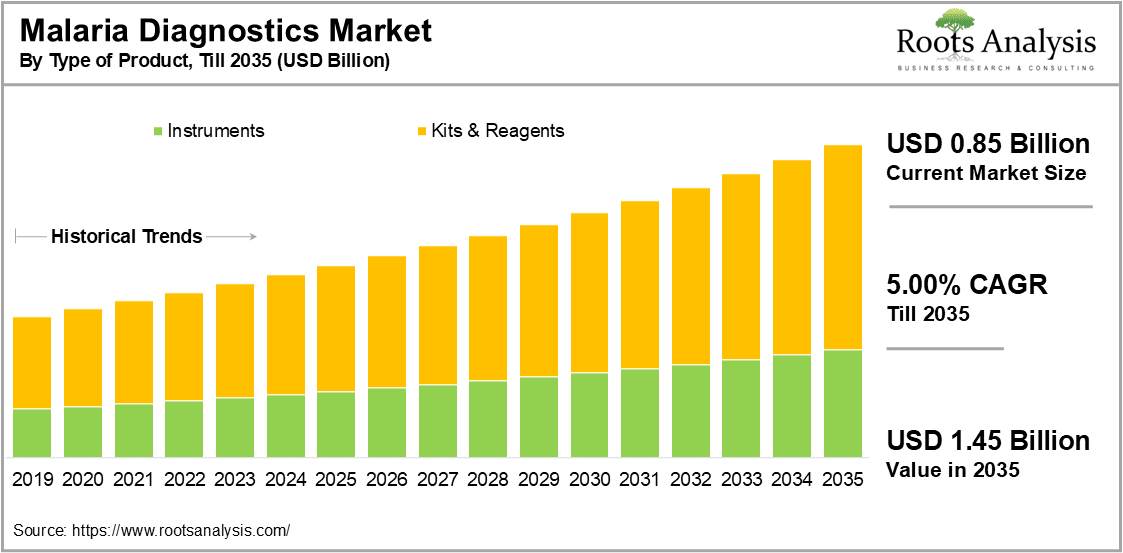
The global malaria diagnostics market size is valued at USD 0.85 billion in 2024 and is projected to reach USD 1.45 billion by 2035, representing a CAGR of 5.0% during the forecast period.
 |
To learn more about this report, request a free sample copy
Given the rapid rise of malaria cases across the globe, malaria diagnostics have become increasingly vital for early detection and treatment of patients. Malaria is a form of parasitic disease that gets transmitted into the human upon the bite by infected female anopheles’ mosquito. These parasites primarily enter into the liver and upon maturation, it enters into the bloodstream to infect the red blood cells. Some of the common symptoms include fever, weakness, vomiting and headache. Over the years, with the rise in parasite resistance and changing climatic conditions, the cases of malaria have significantly increased. Malaria is most prevalent in tropical and sub-tropical countries (including East Africa, Sub Saharan Africa and Asia Pacific) particularly due to favorable environmental conditions that support the development of malarial parasites.
As per the World Health Organization (WHO) report, in 2022, nearly 6,08,000 people died due to malaria and 249 million new cases were reported in 2022. Of these, 94% cases were identified in the African region. In order to mitigate the growing concern of malaria, WHO has recommended early parasite-based diagnosis in suspected patients in order to deliver appropriate treatment.
Owing to the rising need for advanced diagnostic tools, several stakeholders are focusing on the development of malaria rapid diagnostic tests that enable early detection and offer real-time results to initiate the treatment process. It is worth noting that technological advancements in malaria diagnostics have played an important role in enhancing disease detection. For instance, advanced molecular diagnostic techniques, such as nucleic acid amplification tests, Loop-Mediated Isothermal Amplification (LAMP) offer enhanced sensitivity for faster detection of malaria. In addition, several researchers are emphasizing breakthrough innovations for initiating point-of-care diagnosis that enable accurate and quick identification of malaria parasites in patients.
It is worth mentioning that the quick diagnosis is crucial to prevent the severe form of malaria, known as cerebral malaria, which especially affects children up to five years of age. In February 2024, the researchers at Rice University have developed Microfluidic-point-of-care (mPOC) immunoassay test for diagnosing malaria in 15 minutes. This device supports the quantification of malarial parasite biomarker, Plasmodium falciparum histidine-rich protein 2 (PfHRP2) inside the blood, thereby making it a potential tool for diagnosing asymptomatic malaria. In addition to technological advancements, government and non-government organizations are taking strategic initiatives to mitigate the increasing risk of malaria in Sub Saharan Africa, East Africa and Asian region. It is important to highlight here that on World Malaria Day 2024, the WHO joined the RBM partnership to End Malaria, a global platform comprising of various organizations, in order to support elimination of malaria.
Also, the industry stakeholders are engaged in offering various proprietary detection tests. For example, Premier Medical offers three qualitative screening in-vitro diagnostics tests for malaria, namely, First Response® Malaria Antigen P.falciparum (HRP2) card test, First Response® Malaria Ag pLDH/HRP2 combo test card and First Response® Malaria Ag.P.f./P.v. card test. As per Nancy Kapila, Associate at Roots Analysis, “Considering the collective efforts of the stakeholders and ongoing diagnostic technological innovations, we are led to believe that malaria diagnostics market will grow at a steady pace during the forecast period, offering opportunities for industry stakeholders to actively participate in the field.”
The market study report provides an overview of the companies who are currently engaged in the industry across various segments as mentioned in the table below.
| Key Report Attributes | Details | |
| Historical Trend | Since 2019 | |
| Forecast Period | Till 2035 | |
| Market Size 2035 | $1.45 Billion | |
| CAGR (Till 2035) | 5.00% | |
| Type of Product |
|
|
| Type of Technology |
|
|
| End Users |
|
|
| Geographical Regions |
|
|
| Key Companies Profiled |
|
|
| PowerPoint Presentation (Complimentary) |
Available | |
| Customization Scope | 15% Free Customization | |
| Excel Data Packs (Complimentary) |
Available | |
One of the key objectives of the market report was to estimate the current market value, opportunity and the market growth potential, over the forecast period, till 2035. We have provided informed estimates on the likely evolution of the market for the forecast period.
The malaria diagnostics market analysis also features the likely distribution of the current and forecasted opportunity within the market across various segments, such as distribution type of product (instruments and kits & reagents), type of technology (molecular diagnostic tests (conventional PCR and modernized PCR), microscopy and rapid diagnostic tests), end users (hospitals & clinics, diagnostic centers and academic & research institutes), geographical regions (North America, Europe, Asia Pacific, Middle East and North Africa, and Latin America) and leading players. In order to account for future uncertainties associated with some of the key parameters and to add robustness to our model, we have provided three market forecast scenarios, namely conservative, base, and optimistic scenarios, representing different tracks of industry’s evolution.
All actual figures have been sourced and analyzed from publicly available information forums and primary research discussions. The financial figures mentioned in this market report are in USD, unless otherwise specified.
Based on the type of product, the global market for malaria diagnostics is segmented into instruments, and kits & reagents. According to our projections, currently kits & reagents segment occupies the largest share (66%) of the market. This dominance is due to the significant advancements in diagnostic technologies for the development of rapid and accurate diagnostic kits and reagents for detecting malaria. These ongoing innovations help in the early detection and treatment of malaria with a higher efficiency rate. Additionally, the increasing burden of malaria across the globe has further necessitated the demand for accurate and accessible malaria diagnostic solutions. Driven by the ongoing demand for advanced reliable diagnostics kits and reagents, this segment will continue to grow at a steady rate during the forecast period.
This segment highlights the distribution of global market across various types of technology, such as molecular diagnostic tests, microscopy and rapid diagnostic tests. Among these, rapid diagnostic tests segment accounts for the largest malaria diagnostics market share (68%). Rapid diagnostic tests have played a crucial role in early diagnosis of malaria and treatment planning. Furthermore, the growing adoption of rapid diagnostics test by hospitals for quick and efficient results has further become a key factor of its high share. According to the WHO World Malaria Report 2022, 413 million rapid diagnostic tests were sold in 2021. Of these, UNICEF alone has been procuring 10-11 million malaria rapid diagnostic tests annually since 2011.
However, it is important to highlight here that molecular diagnostic tests will show substantial growth potential and are anticipated to grow at a higher CAGR during the forecast period. This can be attributed to the fact that molecular diagnostic solutions, such as polymerase chain reaction, and nucleic acid amplification tests offer higher specificity and sensitivity. These molecular diagnostics serve as a valuable tool for the detection of Plasmodium species and low parasite levels in the blood.
The global malaria diagnostics market has been segments across various end users, such as hospitals & clinics, diagnostic centers and academic & research institutes. Currently, hospitals & clinics segment holds the largest share (65%) of the overall market. This dominance is primarily due to the increasing focus of hospitals on rapid malaria diagnostic technologies for early diagnosis and treatment planning. Furthermore, hospitals have a large pool of malaria patients which require early diagnosis and treatment to get rid of the infection.
However, in the long run, diagnostic centers will grow at a significant CAGR during the forecast period. This can be attributed to the rising burden of malaria across the globe and rising awareness about early detection of malaria. Additionally, the diagnostic centers offer advanced diagnostic technologies for the detection of malaria. It is important to highlight here that several government organizations are also supporting diagnostic centers for early diagnosis, which further contributed to the higher growth potential of this segment during the forecast period.
The global market value is distributed across different geographical regions, such as North America, Europe, Asia Pacific, Middle East and North Africa, and Latin America. According to our projection, presently Middle East Africa and North Africa hold 90% of the overall malaria diagnostics market share. This can be attributed to the rising prevalence of malaria in African region. According to the report of World Health Organization, in 2022, nearly 94% cases (amounting to 233 million cases) and 95% deaths (amounting to 5,80,000 people) due to malaria has been reported in this region. Government organizations have taken strategic initiatives, such as National Malaria Elimination Programme to overcome the growing burden of malaria.
However, it is important to highlight here that the Asia Pacific market is anticipated to grow at a higher CAGR during the forecast period. This exponential growth is driven by the increasing initiatives by the government organizations of Asian countries, including India, Myanmar and Indonesia for controlling malaria. It is important to highlight here that the efforts made by the government organizations have achieved success in reducing malaria transmission, improving healthcare infrastructure for delivering appropriate treatment. Furthermore, increasing efforts for the development of care-based surveillance systems and advanced diagnostic testing solutions have contributed to the growth of this region in Asian region.
As per Saima Wazed, World Health Organization Regional Director for South-East Asia, “by leveraging digital technology, we can better understand the diverse health needs of populations, collect and analyze data and monitor progress in real-time, enabling us to identify and address health inequities through both proven interventions and innovation in service delivery.”
The market research report also features an in-depth analysis, highlighting the capabilities of various industry stakeholders engaged in this market. The market report highlights the efforts of several stakeholders engaged in this market segment of various domains. Key takeaways of the market analysis are briefly discussed below.
The market for malaria diagnostics is highly competitive, featuring the presence of several well-established players and new entrants. These companies are focusing on the latest innovations for the development of molecular diagnostic technologies and rapid diagnostic technologies. It is important to highlight here that several small players are working on technological advancements for addressing the challenges of malaria diagnostics in developing regions. In June 2024, Korean startup Noul announced initiation of a malaria diagnosis project, along with Kenya Medical Research Institute (KMRI) and US Centers for Disease Control and Prevention (CDC). Through this project, an AI based digital pathology platform, miLab™ MAL, will be used to diagnose malaria in patients residing in Kisumu and Siaya (regions in East Africa). The results using this digital microscopy tool will be compared to rapid diagnostic tests and local microscopy. Another company working on AI powered pathology for malaria diagnostic is Spain based Aiscope.
As the industry players continue to increase R&D efforts and advance the diagnostic technology, we believe that the malaria diagnostics market will remain competitive during the projected period.
The increasing burden of malaria in tropical and subtropical countries, such as East Africa, Sub Saharan Africa, Asia and Pacific market are the key drivers. It is important to highlight here that according to the report of World Health Organization, in African region, children under the age of 5 years accounted for around 78% of the overall malaria deaths in the region. Driven by the growing incidence of malaria, several government and non-government organizations are supporting diagnostic and pharmaceutical companies for the development of advanced diagnostic solutions and efficient treatment. It is important to highlight here that World Health Organization also supports rapid diagnostic tests for suspected malaria patients, which further bolstered the growth of this market during the forecast period.
The market for malaria diagnostics is experiencing several challenges that hinder the growth during the forecast period. Some of the potential challenges are developing drug resistant and cost-effective malaria diagnostic tests. Moreover, the occurrence of false positive results hamper the accurate detection. It is interesting to highlight here that malarial parasites are developing drug resistance towards antimalarial drug that create challenges in diagnosis and treatment designing. Furthermore, the high sensitivity of malaria diagnostics tests may create false positive signs, ensuring accuracy and reliability with high sensitivity tests may create difficulties in accurate diagnostics. In addition, the high cost of advanced malaria diagnosing test may limit the widespread adoption of diagnostics technology.
The global market is witnessing an upward trajectory owing to the rising awareness of early detection of malaria and increasing technological innovations. It is interesting to note here that several industry stakeholders are focusing on point of care diagnostics and advanced molecular technologies that aid early detection even with low parasite density. For instance, in March 2024, the South African Medical Research Council signed a Memorandum of Agreement with Thermo Fisher Scientific in order to establish Center of Excellence and training programme for life science and molecular sciences domain in South Africa. Herein, the primary aim is to address the challenges faced by this continent in upskilling laboratory personnels specifically in the latest molecular diagnostic technologies that are used for detecting a wide range of diseases including malaria.
Another startup MariTest is working on development of a bloodless, automated malaria testing device that uses AI and advanced sensor technology to detect hemozoin, which is a byproduct of a biochemical reaction on getting malaria infection. Moreover, the industry leaders are actively taking strategic initiatives to support the development of rapid malaria diagnostic testing solutions. These factors have collectively contributed to the malaria diagnostics market growth during the forecast period.
The global market is currently valued at USD 0.85 billion and is projected to reach USD 1.45 billion market value by 2035. Driven by the growing demand for advanced rapid malaria diagnostics solutions, the market is expected to grow at a CAGR of 5.0% during the forecast period. Across various geographies, companies have been focused on identifying and developing various diagnostic tools to diagnose malaria effectively and accurately. In September 2024, QIAGEN announced the expansion of partnership with Bio-Manguinhos / Fiocruz, in order to launch advanced PCR-based molecular screening platform for the detection of malaria, HIV, Hepatitis B and C. This is aimed to support the national screening programs in Brazil.
Examples of key pharmaceutical companies engaged in the development of malaria diagnostic tests (which have also been profiled in this market report; the complete list of malaria diagnostics companies is available in the full report) include Access Bio, Abbott Laboratories, Beckman Coulter, BioMérieux, Bio Rad Laboratories, Cepheid, Danaher Corporation, FUJIFILM, GenMark Diagnostics, Hologic, Illumina, Meridian Bioscience, Qiagen, Roche, Siemens Healthineers, Sysmex, Thermo Fisher Scientific and Trinity Biotech. This market report includes an easily searchable excel database of all the companies developing malaria diagnostics worldwide.
Several recent developments have taken place in the field of malaria diagnostics. We have outlined some of these recent initiatives below.