
Lowest Price Guaranteed
Pages
199
Last Updated
August 2026
View Count
33339
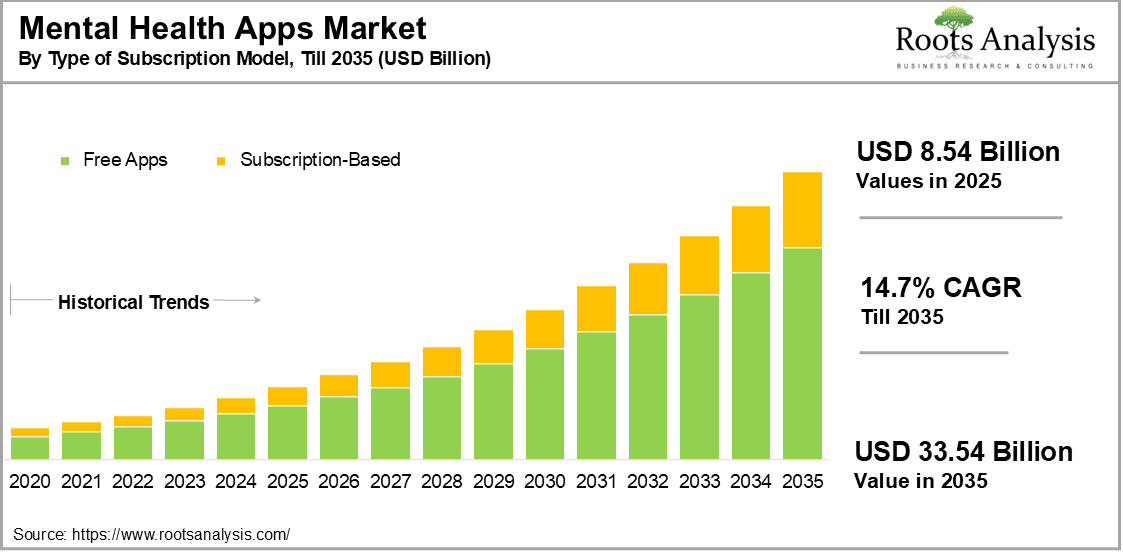
The global mental health apps market size, valued at USD 7.22 billion in 2024, is projected to reach USD 8.54 billion in 2025 and USD 33.54 billion by 2035, representing a CAGR of 14.7% during the forecast period.
 |
To learn more about this report, request a free sample copy
With a sedentary and stressful lifestyle, there is a surge in the demand for dynamic solutions to manage mental well-being. As per the statistics published in National Institute of Mental Health, nearly 20 million adults have at least one major depressive episode in the US. Mental health has been a major concern as it significantly impacts the physical and social development of an individual.
In order to mitigate the growing concern, mental health applications have been widely adopted by healthcare practitioners and patients for managing mental well-being. It is a form of digital health application that offers a comprehensive set of tools, such as mood tracking, meditation guides, mind relaxation exercises and therapies.
These mental health applications are easily accessible and allow people to address stigma associated with mind, such as depressive disorders and anxiety. Moreover, patients can directly access healthcare providers for virtual consultation through these applications for proactive counseling. Considering the significances and rising preferences for personalized care, mental health apps are gaining momentum, which is likely to maintain competitiveness in the market. Across related applications, psychedelic drugs are being evaluated within supervised treatment pathways for psychiatric and neurological conditions.
Owing to ongoing demand, several industrial players and government organizations are focusing on strategic initiatives, followed by latest app launch, customizing therapies sessions and advanced features for managing mental well-being. For instance, in October 2024, Tele MANAS app launched by Indian government to offer stress management tools, self-care strategics and direct access to mental healthcare professionals.
Similarly in October 2024, FWD Life Insurance (FWD Philippines) introduced “Mind Strength Support Program” to address the growing requirement for mental health support in Philippines. This comprehensive approach focus on emotional, mental and financial wellbeing along with free online Mind Strength Assessment to gain insight about mental health status. Driven by the growing initiatives, we believe that mental health apps market is expected to grow at a steady rate during the forecast period.
The market report provides comprehensive information on mental health app developers who are currently active across various segments of the industry as mentioned in the table below.
| Key Report Attributes | Details | |
| Historical Trend | Since 2020 | |
| Forecast Period | Till 2035 | |
| Market Size 2025 | USD 8.54 Billion | |
| Market Size 2035 | USD 33.54 Billion | |
| CAGR (Till 2035) | 14.7% | |
| Type of Platform |
|
|
| Type of Subscription Model |
|
|
| Type of Accessibility and Engagement |
|
|
| Application Area |
|
|
| End User |
|
|
| Geographical Regions |
|
|
|
Key Companies Profiled |
|
|
| PowerPoint Presentation (Complimentary) |
Available | |
| Customization Scope | 15% Free Customization | |
| Excel Data Packs (Complimentary) |
Available | |
One of the key objectives of the mental health apps market report was to estimate the current size, opportunity, and the market growth potential, over the forecast period, till 2035. We have provided informed estimates on the likely evolution of the market for the forecast period.
The market analysis report also features the likely distribution of the current and forecasted opportunity within the market across various segments, such as type of platform (Android, iOS and others), type of subscription model (free apps and subscription-based), type of accessibility and engagement (mobile apps, web-based apps, and gamified apps), application area (depression and anxiety management, meditation management, stress management, wellness management and other application areas), end user (healthcare providers, homecare settings, and other end users), geographical regions (North America, Europe, Asia-Pacific, Middle East and North Africa, and Latin America) and leading players.
In order to account for future uncertainties associated with some of the key parameters and to add robustness to our model, we have provided three mental health apps market forecast scenarios, namely conservative, base, and optimistic scenarios, representing different tracks of industry’s evolution.
All actual figures have been sourced and analyzed from publicly available information forums and primary research discussions. The financial figures mentioned in this market report are in USD, unless otherwise specified.
Based on the type of platform, the global market is segmented into Android, iOS and others. According to our mental health apps market report, presently iOS segment is dominating the industry by holding 52% share of the market. This can be attributed to the increasing users of iOS and availability of mental health supportive features for instant access to insightful analysis and resources for mental health management.
However, android segment is likely to grow at a higher CAGR during the forecast period. This lucrative growth is primarily due to the expensive healthcare application support on android based smartphones. Moreover, the growing adoption of smartphone based mobile health applications and telehealth services is likely to bolster its demand in the future.
The global market is distributed across different types of subscription models, such as free apps and subscription-based. According to our mental health app market analysis, currently, the free apps segment accounts for the highest share (nearly 75%) of the market. This can be attributed to the fact that free apps subscription models are highly beneficial for patients with limited income or those who cannot afford the subscription packages.
However, it is worth noting that subscription-based models are likely to register a higher CAGR during the forecast period. This is likely to be the fact that subscription-based model encourages consistent engagement and access to a broad range of mental health applications for long term mental health management. Additionally, access to advanced features and instant consultation has further contributed to the highest growth of this segment over the forecast period.
This segment highlights the distribution of global mental health apps market size across different types of accessibility and engagement, such as mobile apps, web-based apps, and gamified apps. According to our report, the present mobile apps segment accounts for the highest share of the market. This can be attributed to the easy to navigate interface, broader accessibility and quick installation of a wide range of mobile health applications.
Moreover, mobile application are easy to use by adults and geriatric population, which further contributed to the highest share of this segment. Owing to the preferences of simple to use mobile apps, this segment will continue to grow at a steady CAGR during the forecast period.
Based on the application area, the global market is segmented into depression and anxiety management, meditation management, stress management, wellness management and other application areas. According to our mental health apps market analysis, presently depression and anxiety management segment accounts for the highest share (36%) of the market. This can be attributed to the growing adoption of mental health applications to manage depression and anxiety by patients. Moreover, mental health applications provide access to a wide range of mental health exercises and therapies along with online sessions with the experts that aid in management depression and anxiety.
It is important to highlight here that the stress management segment is likely to grow at a higher CAGR during the forecast period. This can be attributed to the increasing adoption of mental health applications for managing stress associated with disorders. For instance, Headspace is one of the popular apps that has been adopted across corporate industry for managing stress in employees.
On the basis of end users, the global market is distributed across healthcare providers, homecare settings, and other end users. According to our mental health apps market report, currently the homecare settings segment occupies the highest share (58%) of the market. This can be attributed to the rising demand for point of care home healthcare solutions and remote care facilities for managing mental health conditions. Owing to the increasing demand for personalized care, this segment will continue to grow at a higher CAGR during the forecast period.
Based on geographical regions, the global market is distributed across different regions, such as North America, Europe, Asia-Pacific, Middle East and North Africa, and Latin America. According to our mental health apps market size, currently the North America region is dominating the market by holding 44% share of the overall market. This can be attributed to the growing preferences for digital health applications and telehealth services. Moreover, the rising incidence of anxiety and depression in this region has necessitated the adoption of mental health apps for prolong management.
The “Mental Health Apps Market: Industry Trends and Global Forecasts, till 2035” market report features an extensive study of the current market landscape, market size, market share, market growth, market trends, market value, market forecast, market outlook, statistics, and future opportunities for mental health app developers. The market research report lays emphasis on the mental health apps and software products that are being developed. Key takeaways of the market report are briefly discussed below.
The current market landscape of mental health apps is immensely competitive, featuring the presence of several small, mid-sized and large industrial players. Majority of the industrial players are focusing on adding exclusive features in mental health applications to help patients manage stress and depression at home. In order to leverage the competitive edge, several industrial players are launching the latest products and entering into partnerships to strengthen their product portfolio.
For instance, in September 2024, Amazon forged a partnership with Talkspace to add a mental health provider to its health conditions program without additional cost in order to help customers with virtual care benefits. Similarly, numerous other market players are undertaking strategic initiatives, which are expected to maintain a competitive edge in the market over the forecasted period.
With rising awareness of mental health issues, there has been a surge in the demand for mental health management solutions, which is expected to be a key driver for the market. Additionally, the changing lifestyle and stress conditions has further underscored the demand for digital health applications that helps in reducing stress level.
Moreover, several government organizations are encouraging campaigns and strategic initiatives to promote mental health wellbeing, which is further expected to drive the adoption of digital health applications for mental wellbeing.
Some of the potential challenges that may hinder market progress include data privacy and security concerns. Notably, mental health apps require data transmission from different networks, which raises the concern of breaching patient’s sensitive information. In order to mitigate the data privacy concerns, industrial players are required to implement advanced security measures.
Currently, the mental health application users are increasingly preferring personalized apps that can be tailored to meet individual conditions. Thus, the heightened demand for personalized apps is creating enormous opportunities for industrial players. Additionally, the integration of teletherapy services with mental health apps is one of the core trends of the market that is expected to drive the industry during the forecast period. Furthermore, the growing focus on holistic wellness features, such as mindfulness exercises and sleep tracking is other notable trends of the market.
A number of companies have also developed AI powered mental health apps. Once such developer is Feeling Good App, which also raised USD 8 million in funding in August 2024. A few mental health apps are also evaluating generative AI to improve their chatbots. For example, Yana, a Mexico based mental health platform developer, uses generative AI. The developer expanded into the US market in August 2024.
Currently, the global mental health apps industry size is estimated to be valued at USD 8.54 billion in 2025 and is projected to reach 33.54 billion by 2035, representing a CAGR of 14.7% during the forecast period. Driven by the growing demand for mental health apps, several industrial players are leveraging partnerships and collaborations. In September 2024, UC San Diego Health and San Diego County entered into the partnership during Board of Supervisors to expand behavioral healthcare services at East Campus Medical center to serve patients require mental health management solutions.
Examples of key players engaged in this domain (which have also been captured in this report) include Bearable, BetterHelp, BetterSleep, Calm, Fabulous, Headspace, Happify, MoodMission, Mindscape, MindShift, MoodKit, Sanvello Health (Acquired by AbleTo), Talkspace, Woebot and Youper. This market report includes an easily searchable excel database of all the companies focusing on the development of mental health apps.
The market report presents an in-depth analysis, highlighting the capabilities of various companies engaged in this domain across different segments. Amongst other elements, the market report includes:
Several recent developments have taken place in the field of mental health apps. We have outlined some of these recent initiatives below.