
Lowest Price Guaranteed
Pages
196
Last Updated
August 2025
View Count
11486
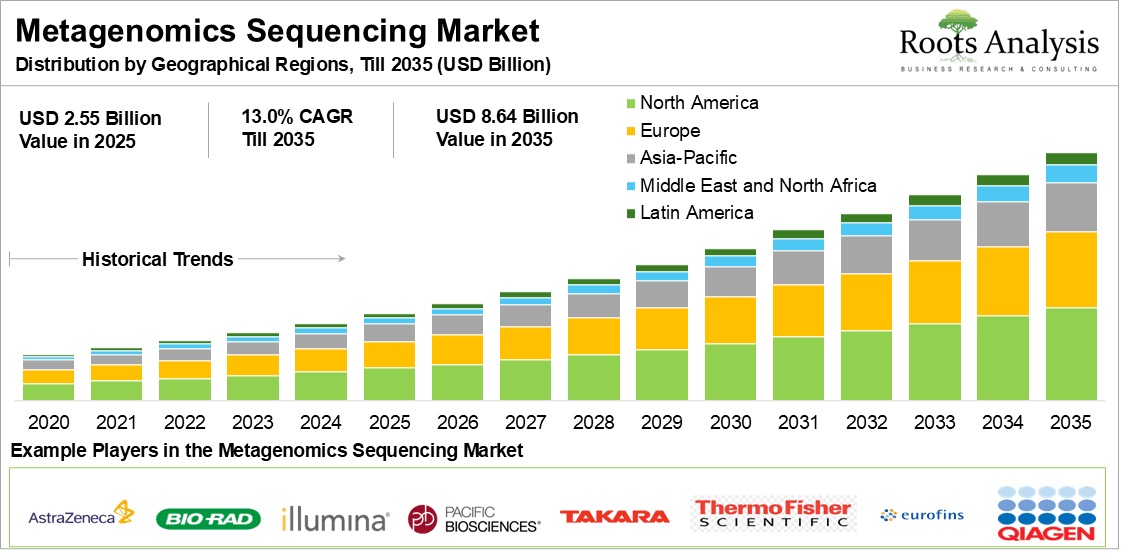
The metagenomic sequencing market size is estimated to grow from USD 2.20 billion in 2024 to USD 2.55 billion in 2025 and USD 8.63 billion by 2035, representing a CAGR of 13.0% during the forecast period.
 |
To learn more about this report, request a free sample copy
Metagenomics sequencing refers to the study of genetic materials found in environmental samples, including microbial community, and human DNA samples. The market for metagenomics sequencing has gained substantial traction due to the increasing usage for disease studies and drug development. It is worth mentioning that healthcare industry is witnessing a massive burden of chronic diseases, genetic diseases and infectious diseases. With availability of metagenomics sequencing technologies, clinicians are able to identify the root cause of disease by studying whole genome sequencing, function and molecular pattern.
Furthermore, metagenomics sequencing helps in brief study of microbial profiles that cause infectious diseases. The information collected through metagenomics sequencing technologies helps to develop a tailored drugs to target diseases. Notably, the capabilities of recognizing genome profiles has revolutionized the healthcare industry, enabling them in designing a customized approach to deal with the growing concern of diseases.
Beyond disease studies, metagenomics sequencing has been widely adopted in cancer research, ecology studies, drug discovery, virology and environmental applications. Furthermore, the rapid progress towards genomic research and availability of advanced sequencing technologies, such as PCR, shotgun sequencing, metagenomics next generation sequencing has further contributed to the growth of this industry.
Considering the opportunities in this field, many market players are accelerating their innovations, investments, partnerships and acquisition. For instance, in April 2025, Metabolon launched an advanced microbiome research solution that integrated bioinformatics tools and metagenomics sequencings with a new microbiome metabolite panel to create microbiome research toolkit.
Furthermore, the industrial players are focusing on integrating advanced analytical tools and artificial intelligence technology with metagenomics sequencing. These initiatives along with growing research on genomics is likely to maintain a long term competitiveness in metagenomics sequencing market.
| Key Report Attributes | Details | |
| Historical Trend | Since 2020 | |
| Forecast Period | Till 2035 | |
| Market Size 2025 | USD 2.55 Billion | |
| Market Size 2035 | USD 8.64 Billion | |
| CAGR (Till 2035) | 13.0% | |
One of the key objectives of the metagenomic sequencing market report was to estimate the current size, opportunity, and the market growth potential, over the forecast period, till 2035. We have provided informed estimates on the likely evolution of the market for the forecast period.
The global market analysis also features the likely distribution of the current and forecasted opportunity within the market across various segments, such as type of offering, type of workflow, type of technology, application area, end users, geographical regions and leading players.
In order to account for future uncertainties associated with some of the key parameters and to add robustness to our model, we have provided three metagenomic sequencing market forecast scenarios, namely conservative, base, and optimistic scenarios, representing different tracks of industry’s evolution.
With increasing research on genomics to study infection diseases and drug discovery, the demand for metagenomics sequencing technologies has significantly increased. Furthermore, the industrial players are leveraging the competitive edge to develop novel technologies for metagenomic sequencing. The future of this market will be focused on next-generation metagenomics sequencing technologies.
Several recent developments in the field of metagenomics sequencing industry have occurred, and we outline some of these below.
The market report provides comprehensive information on metagenomics sequencing instruments and service providers who are currently active across various segments of the industry as mentioned in the table below.
| Market Segmentations | Details | |
| Type of Offering |
|
|
| Type of Workflow |
|
|
| Type of Technology |
|
|
| Application Area |
|
|
| End User |
|
|
| Geographical Regions |
|
|
| Market In North America |
|
|
| Market In Europe |
|
|
| Market in Asia-Pacific |
|
|
| Market in Middle East and North Africa |
|
|
| Market in Latin America |
|
|
Metagenomics sequencing industry is rapidly evolving and continues to grow at a steady pace. We at Roche consistently working on innovating next generation sequencing technologies, said Mark Kokoris, Head of Roche's SBX Technology.
“Solving the signal-to-noise challenge is a key efficiency driver for the technology. With this capability we can flexibly operate across a range of throughput scales using the same sequencing system, which provides a significant advantage to users,” said Mark Kokoris, Head of Roche's SBX Technology.
| Report Deliverables | Details | |
| Excel Data Packs (Complimentary) |
Available | |
| Key Metagenomics Sequencing Companies Profiled |
|
|
| PowerPoint Presentation (Complimentary) |
Available | |
| Customization Scope | 15% Free Customization | |
The “Metagenomic Sequencing Market: Industry Trends and Global Forecasts, till 2035” market report features an extensive study of the current market landscape, market size, market share, market growth, market trends, market value, market forecast, market outlook, statistics, and future opportunities future opportunities within the metagenomics sequencing industry, during the forecast period.
The current market landscape is highly competitive, featuring the presence of several small, mid-sized and large industrial players. Majority of the industrial players, such as Delve Bio, Pfizer, QIAGEN, and Thermo Fisher Scientific, are aiming for technological innovations.
For instance, in April 2025, Delve Bio (pioneer of metagenomic next-generation sequencing technologies) announced to share its groundbreaking mNGS test (Delve Detect) at the 2025 America Academy of Neurology Annual Meeting today in San Diego. Dele’s mNGS technology poses the ability to identify over 68,000 pathogens within a single test, offering high yielding capabilities and ability to diagnose meningitis and encephalitis. With continuous efforts for the development of novel technologies, we believe that the metagenomics sequencing market will remain competitive over the forecasted period.
In 2025, North America dominates the global metagenomic sequencing market, accounting for 40% of the revenue share. This dominance is likely to remain unchanged during the forecast period. The presence of well-established industrial players, growing research on genomics and expanding government funding on metagenomics to support the development of personalized medicine are some key growth factors. Notably, regions, specifically United States is the key spot where industrial players are focusing on innovations, and technology adaptation to accelerate disease diagnosis and treatment planning.
In Europe, the market for metagenomics sequencing holds a substantial share. Notably, research organizations established in countries, such as United Kingdom, Germany and France are the are focusing on microbiome research and adopting metagenomics sequencing technologies to identify infectious disease. Furthermore, robust support from regulatory agencies, such as the European Medicines Agency (EMA) will further support the market growth in this region.
In Asia-Pacific, the metagenomic sequencing market is likely to register a higher CAGR during the forecast period. This expansion is driven by the rising incidence of infectious diseases and increasing research on genomics. Asian countries, such as India, Japan, and China are significantly supporting genomic research to expand its application.
The global healthcare sector is experiencing a severe burden of patients with infectious diseases. According to the statistics published in Centers for Disease Control and Prevention, nearly 9.2 million cases of typhoid fever and around 3.8 million cases of paratyphoid fever are reported every year. Metagenomics sequencing in this instance helps with microbial genome analysis, human gut health and microbiome to develop tailored therapies.
Additionally, the growing research on genomics research to understand disease causing genes and alteration in gene function has further necessitated the demand for advanced sequencing technologies. Moreover, metagenomics sequencing is widely adopted by the pharmaceutical companies for AI in drug discovery and development, which is further expected to be a key driver for the market.
The market for metagenomics sequencing may experience several challenges, such as high cost, and stringent regulatory guidelines. Many research organizations and pharmaceutical companies, specifically with limited budget may experience challenges in utilizing cutting-edge next-generation sequencing technologies. For instance, Thermo Fisher Scientific’s Ion GeneStudio S5 Series kits may range from USD 8,260 to USD 10,250 per run or per test. Thus, high costs may limit their adoption across research laboratories and pharmaceutical industries.
Furthermore, stringent guidelines for approval and complexity of sequencing technologies may create challenges in the adoption. Moreover, lack of skilled personnel to operate sequencing technologies may hinder market progress.
The market for metagenomics sequencing is continually evolving driven by the growing application across various healthcare applications, such as identification of pathogens. Moreover, industrial players are aiming for integrating AI technology with next-generation sequencing platform technologies to achieve high throughput, accuracy and overall performance. In addition, the focus on single-cell metagenomics to study gene function and interaction within single cells is a key trend of this market. Furthermore, industrial players are focusing on metagenomics data standardization to enhance data security during data sharing, and metagenomics analysis across various applications.
The market report presents an in-depth analysis, highlighting the capabilities of various stakeholders in the metagenomics sequencing industry, across different geographies. Amongst other elements, the market report includes:
Metagenomics sequencing is expanding rapidly driven by the increasing demand for personalized medicine and technological innovations to identify novel biomolecules for targeting diseases. Another significant factor that is driving this industry includes adoption of next generation sequencing technologies, expanding funding on genomic research.