


 Download Free Sample
 Buy Now
Market Size
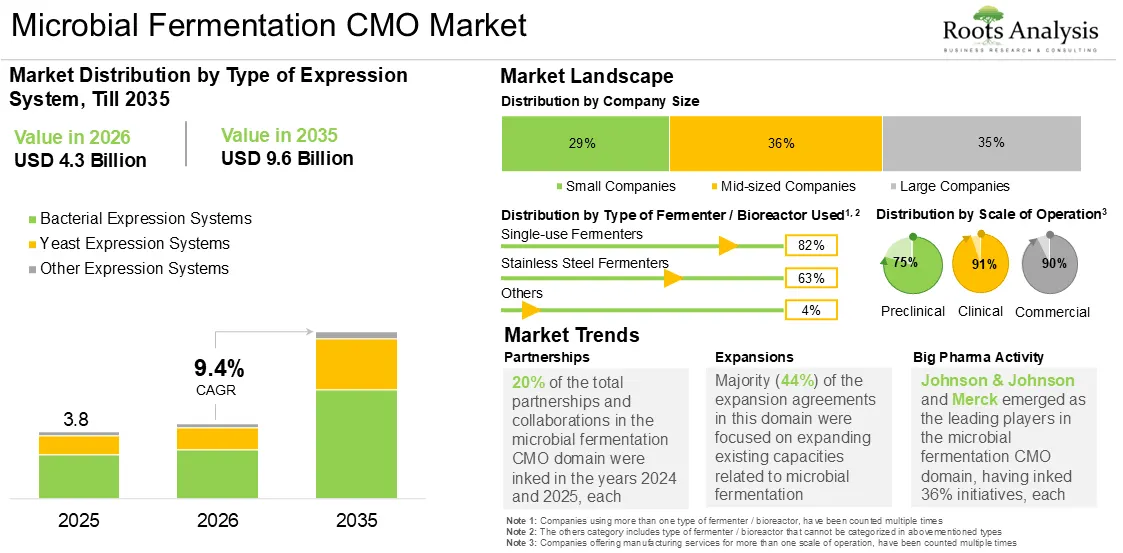
The global microbial fermentation CMO market, valued at USD 3.8 billion in 2025, is projected to reach USD 4.3 billion in 2026 and USD 9.6 billion by 2035, with a CAGR of 9.4% during the forecast period 2026 to 2035.
See What’s in the Full Report – Request Your Complimentary Insights!
Market Report: Key Takeaways
- The increased extent of outsourcing by large pharma companies, along with rising need for biopharmaceuticals and personalized medicine, is driving the demand for microbial fermentation CMO operations.
- In terms of type of expression system, the bacterial expression system secures ~65% of the overall revenue share. This is due to their cost-effectiveness, rapid scalability, and ease of use in producing recombinant proteins and biologics.
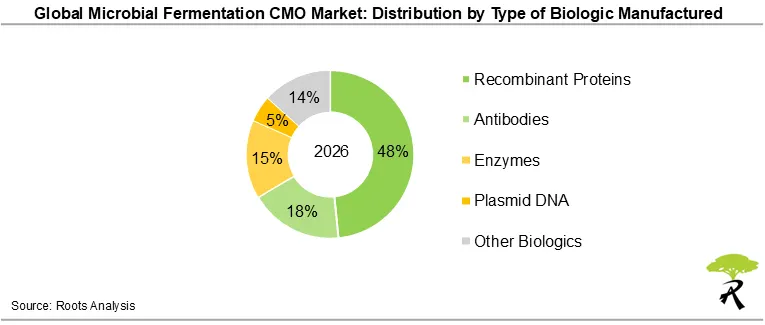
- In terms of the type of biologics manufactured, recombinant proteins capture the highest share (~50%) of the market; this is due to their dominance in treating several diseases, along with their high-volume production efficiency and versatility across several biopharma applications.
- With respect to company size, the large and very large companies dominate the current market (~80%) due to their established presence and known expertise in the market.
Your Business is Unique – Why Shouldn’t Your Report Be?
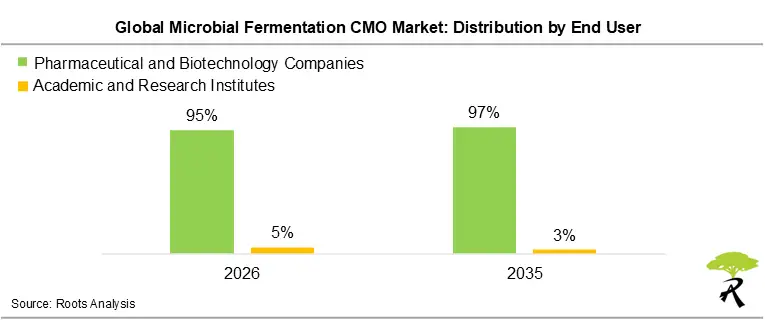
- Based on the end user, pharmaceutical and biotechnology companies capture largest microbial fermentation CMO market share (~95%). This surge in demand is due to their heavy reliance on outsourced microbial production for biologics amid surging biopharma demand.
- In terms of key geographical regions, Asia-Pacific holds around 40% of the market share; this is due to the fact that the number of manufacturing facilities in this region is relatively higher when compared to other regions.
Market Overview
Manufacturing of biotherapeutics, such as proteins, peptides, antibodies, enzymes and hormones require an appropriate expression system in order to maintain efficiency and yield. Notably, for this purpose, several types of microbes have been identified as a versatile biomolecule expression system. This can be due to the robustness of these microbial cell lines (compared to cells of higher eukaryotes), rendering them a popular choice for biopharmaceutical manufacturing.
Presently, there are a number of traditional and innovative microbial expression systems / platforms, based on bacteria, fungi and yeast, which are used for manufacturing a variety of conventional and complex biologics. Smaller biologics, such as immunocytokines, growth factors, plasmid DNA, nucleic acids, single-domain antibodies, peptibodies and non-glycosylated antibody fragments, can easily be developed in microbial expression systems.
Although biopharmaceuticals offer significant profit margins and have been proven to be effective in treating a myriad of diseases, these products are generally known to be associated with high costs of development and complex manufacturing protocols. Therefore, for biologic developers to keep up with the growing demand for such products, outsourcing has become a popular operating model in this market space.
With the increasing popularity of alternatives to traditional antibodies, along with outsourcing becoming increasingly accepted as a viable and beneficial business model within this field, the global microbial fermentation CMO market is likely to witness remarkable growth during the forecast period.
Top Microbial Fermentation CMOs / Key Players
| Company Name | Headquarters | Notable Strengths & Specialties | Recent Developments (2025-2026) |
| Lonza Group AG | Switzerland | Large-scale bacterial and yeast fermentation (up to 15,000L), complex biologics, recombinant proteins, regulatory expertise | Expanded mid-scale microbial facilities in Visp and strong track record in commercial microbial manufacturing |
| WuXi Biologics | China | High-capacity microbial production, E. coli and yeast systems, plasmid DNA and recombinant proteins, EffiX platform | New Chengdu microbial plant (15,000L fermenter) structural completion; supports 128+ molecules |
| FUJIFILM Diosynth Biotechnologies | USA | Microbial hosts (E. coli, P. pastoris, S. cerevisiae), difficult-to-express proteins, process development to commercial | Significant UK microbial facility expansions |
| AGC Biologics | USA | Microbial fermentation for proteins and plasmids, flexible scales (up to 3,000L+), cost-efficient scale-up | Strong focus on microbial CDMO services across multiple sites; expertise in perfusion & specialized biologics |
| BIOVECTRA | Canada | Specialized microbial fermentation, synthetic chemistry integration, biologics and APIs | Partnership with Revolution Biomanufacturing (Nov 2025) for mRNA optimization; capacity enhancements |
| Evonik Industries | Germany | Downstream fermentation processing, peptides, enzymes, broad microbial capabilities | EUR 80 million investment (Apr 2026) for downstream fermentation capacity in Slovakia |
| Avid Bioservices | USA | Microbial-derived biologics, flexible manufacturing | Key player in CMO rankings for microbial services |
| Eurofins Scientific | Luxembourg | Analytical & manufacturing support, recombinant proteins | Established microbial CMO capabilities |
Recent Developments
- In April 2026, Evonik (Germany) announced an investment of EUR 80 million in order to expand its downstream fermentation capacity.
- In November 2025, BioVectra (Canada) forged a partnership with Revolution Biomanufacturing (US) in order to optimize untranslated regions (UTRs) and codon usage, thereby enhancing mRNA stability and translational efficiency.
- In October 2025, Ajinomoto Bio-Pharma Services (California) entered into a partnership agreement with Olon (Italy) to provide drug substance manufacturing services through former company’s microbial CORYNEX® peptide and protein manufacturing platform and latter's large-scale microbial fermentation capabilities.
- In June 2025, WuXi Biologics announced the opening of a new microbial production plant located in Chengdu, China.
Microbial Fermentation CMO Market Trends
- Partnership and Collaborations: Contract manufacturers engaged in this domain have forged several partnerships with other stakeholders to enhance their portfolios, significantly influencing innovation and global reach. Notably, manufacturing agreements emerged as the most (17%) popular type of partnership model adopted by players in this domain. This is due to the incessant efforts of players to further advance the development of their biologic product offerings, across different development phases.
- Microbial Fermentation CMOs Expanding their Global Reach: In recent years, the microbial fermentation CMO industry has shown a notable increase in the number of players expanding their facilities in order to increase their global reach and / or gain additional expertise. A prime example of this trend is Bora Pharmaceuticals announcing the expansion of its facility to 100,000 square feet with an investment of USD 210 million.
Industry Experts on Microbial fermentation CMO Market
Discussions with multiple stakeholders in this domain influenced the opinions and insights presented in this study. The market report includes detailed transcripts of interviews conducted with the following individuals:
- Chief Executive Officer and Managing Director, Mid-sized Company, India
- Vice President of Sales and Marketing, Large Company, Italy
- Vice President of Business Development, Small Company, Canada
- Business Development and Marketing Manager, Mid-sized Company, Spain
- Business Development Manager, Very Large Company, Germany
- Business Development Manager, Small Company, Spain
- Former Vice President, Sales and Business Development, Small Company, US
- Former General Manager, Business Development, Mid-sized Company, Australia
Microbial fermentation CMO domain will mark a turning point in the coming future. Patricia De La Madrid, Business Development and Marketing Manager, 53Biologics, “In the microbial fermentation domain, there are several unmet needs that present opportunities for advancement. One key area is the need for improved scalability and efficiency in fermentation processes. Many current methods have limitations in scale-up, which can hinder production capacity and increase costs. Additionally, there is a growing demand for more sustainable and environmentally friendly fermentation practices. Developing microbial fermentation processes that use renewable feedstocks, reduce energy consumption, and minimize waste generation is essential for meeting sustainability goals and regulatory requirements.”
Market Drivers
- Rising Demand for Biopharmaceuticals: The escalating demand for biologics creates a prime opportunity for contract manufacturers. Pharmaceutical and biotech companies are developing a huge number of new therapies, particularly in high-growth areas including oncology, immunology and rare disorders. However, most firms lack specialized facilities, equipment, and expertise to produce them in-house due to high costs and technical complexity. This capacity gap prompts them to outsource their operations to CMOs.
- Cost Efficiency and Flexibility in Time-to-Market: CMOs provide operational flexibility by optimizing the overall fermentation processes across various scales and handling unforeseen challenges more effectively. Further, the outsourcing of microbial fermentation operations significantly helps companies to reduce the overall cost associated with drug manufacturing, thereby allowing them to focus their resources on research and development of products.
Pay Only for What You Need – The Best Way to Optimize
Paradigm Shift Towards Cell-free Enzymatic Platforms
One very recent and innovative development in the microbial fermentation CMO market is the accelerating shift towards cell-free enzymatic platforms. Cell-free systems comprise isolated enzymes, cofactors, and extracts, allowing for accelerated metabolic engineering and product synthesis, without relying on living cells (though they can complement synthetic microbial consortia in hybrid setups). Notably, this technique also helps in circumventing limitations of traditional microbial fermentation techniques, such as metabolic burden, toxicity from intermediates, and unpredictable gene regulation.
Further, cell-free protein synthesis has enabled the development of biosensors, which are helpful in detecting impurities by converting biological signals into measurable outputs.One such example is ROSALIND (RNA Output Sensors Activated by Ligand Induction) platform, developed by a team at Northwestern University. This platform uses in vitro transcription reactions regulated by allosteric transcription factors to detect environmental contaminants such as metals, antibiotics, and small molecules.
Market Segmentation Analysis
Manufacturing in Bacterial Expression Systems is Most Widely Outsourced to Contract Manufacturing Organizations
- In 2026, bacterial expression systems hold ~65% of the overall market share. This is primarily due to their rapid growth, high-density cultivation, and cost effectiveness.
- In future, yeast expression systems are likely to have high microbial fermentation CMO market growth during the forecast period.
Pharmaceutical and Biotechnology Companies Lead the Microbial Fermentation CMO Market
- According to the microbial fermentation CMO market forecast, pharmaceutical and biotechnology companies generate ~95% of the overall market revenue. Further, the market for pharmaceutical and biotechnology companies is expected to grow at a higher CAGR of 9.5% during the forecast period.
- This growth is primarily due to the increasing demand for biopharmaceuticals manufactured using microbial expression systems. Further, pharmaceutical and biotech companies significantly benefit from outsourcing to CMOs as they provide access to specialized infrastructure and regulatory expertise.
Market Regional Insights
Asia-Pacific Dominates the Microbial Fermentation CMO Domain
Asia-Pacific is dominating the market for microbial fermentation CMO domain, securing ~40% of the overall revenue share. This is due to the presence of affordable labor and raw materials, along with lower facility construction costs within the region.
China Microbial Fermentation CMO Market
China dominates the microbial fermentation CMO market, driven by the government-backed investments, world-class infrastructure, and specialized expertise in innovative biomanufacturing products and services. Examples of players based in this region include 3Sbio, Asymchem, OBiO Tech and WuXi Biologics
Adoption of Microbial Fermentation Contract Manufacturing Services in Asia-Pacific
Asia-Pacific is the fastest growing region, as per our microbial fermentation CMO market analysis. Notably, rapid expansion of microbial fermentation capacities in countries like China and South Korea accompanied by the widespread adoption of advanced manufacturing technologies is driving the growth of market in these countries.
Microbial Fermentation CMO Market: Scope of the Report
| Key Report Attributes | Details | |
| Historical Trend | Since 2022 | |
| Forecast Period | Till 2035 | |
| Market Size 2026 | USD 4.3 Billion | |
| Market Size 2035 | USD 9.6 Billion | |
| CAGR (Till 2035) | 9.4% | |
| Key Players Profiled |
|
|
| Segments Covered |
|
|
| Excel Data Packs (Complimentary) |
|
|
| PowerPoint Presentation (Complimentary) |
|
|
| Customization Scope |
|
|
Market Segments
Based on the research, we have segmented the Microbial Fermentation CMO Market Report into type of expression system, type of biologic manufactured, company size, end user and key geographical regions.
By Type of Expression System
- Bacterial Expression Systems
- Yeast Expression Systems
- Other Expression Systems
By Type of Biologic Manufactured
- Recombinant Proteins
- Enzymes
- Plasmid DNA
- Antibodies
- Other Biologics
By Company Size
- Small Companies
- Mid-sized Companies
- Large and Very Large Companies
By End User
- Pharmaceutical and Biotechnology Companies
- Academic and Research Institutes
By Key Geographical Regions
- North America
- US
- Canada
- Puerto Rico
- Europe
- Germany
- UK
- France
- Spain
- Italy
- Rest of Europe
- Asia-Pacific
- China
- South Korea
- Japan
- Singapore
- Rest of Asia-Pacific
- Rest of the World
- Israel
- Argentina
- Africa


