


 Download Free Sample
 Buy Now
Market Size
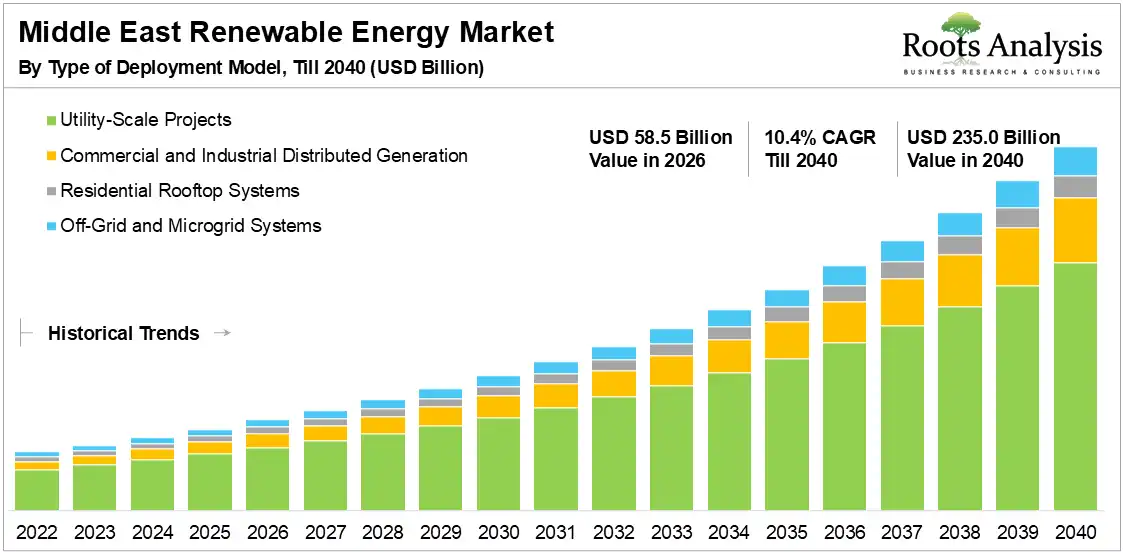
The Middle East renewable energy market reached USD 58.5 billion in 2026 and is projected to grow to USD 235.0 billion by 2040, registering a CAGR of 10.4% over the forecast period 2026 to 2040, driven by utility-scale solar procurement, grid storage, and national diversification programs.
See What’s in the Full Report – Request Your Complimentary Insights!
Market Report: Key Takeaways
- Based on technology / energy source, solar energy captures 66.0% market share in 2026, whereas wind energy registers a 12.3% CAGR through 2040, driven by Saudi and Egyptian wind procurement.
- Based on application, electricity generation captures 83.0% market share in 2026, whereas transportation registers a 14.5% CAGR through 2040, driven by EV charging and clean-fuel infrastructure.
- Based on deployment model, utility-scale projects captures 70.0% market share in 2026, whereas commercial and industrial distributed generation registers a 12.4% CAGR through 2040, driven by capex-light BOOT adoption.
- Based on project / asset model, independent power producer projects captures 48.0% market share in 2026, whereas corporate power purchase agreements registers a 13.5% CAGR through 2040, driven by large-user decarbonization demand.
- Based on end user, utilities captures 62.0% market share in 2026, whereas industrial registers an 11.7% CAGR through 2040, driven by factory decarbonization and storage-backed self-supply.
Middle East Renewable Energy Market Outlook
Solar-led procurement has moved the Middle East renewable energy market from pilot capacity toward bankable gigawatt-scale delivery. Utilities still anchor demand, with 62.0% share in 2026, but commercial and industrial distributed generation gains share through 2040. Solar Energy holds 66.0% share in 2026 because high irradiation, IPP structures, and low-cost finance support large projects. Wind Energy grows faster as Saudi and Egyptian procurement diversifies the near-term power mix.
National programs now convert decarbonization targets into contracted solar, wind, storage, and green hydrogen assets. Saudi Arabia’s National Renewable Energy Program drives repeated tender rounds, while Oman’s self-generation and direct-sale policy opens non-utility routes for private buyers. In January 2026, Masdar and ENGIE reached financial close on the 1.5 GW Khazna Solar PV IPP in Abu Dhabi. The deal strengthened utility-scale project finance confidence among lenders and developers.
Through 2040, the market stays high-growth as storage, corporate PPAs, and industrial decarbonization expand beyond utility procurement. Corporate Power Purchase Agreements grow at 13.5% CAGR, while Transportation grows at 14.5% CAGR through electric vehicle charging and clean-fuel infrastructure. In October 2025, Masdar and EWEC broke ground on a 5.2 GW solar-plus-storage project built for 1 GW baseload renewable power. The project signals stronger dispatchability economics for renewables.
Middle East Renewable Energy Market Size Estimation Methodology
- As a starting point, the Middle East renewable energy market baseline used the consensus of multiple credible secondary sources. The estimate prioritized Middle East-only monetary values and regional capacity benchmarks. Broader Middle East and Africa totals received lower weight because they included African generation markets. Narrow low estimates received less influence when they conflicted with verified 2025 and 2026 project activity.
- Moving forward, the forecast reconciled capacity data, utility procurement awards, PPA announcements, and project finance closures. Solar PV, wind, storage, and green hydrogen examples shaped the near-term buildout curve. The model also used annual deployment logic to avoid overstating projects before financial close. Large awards received timing adjustments when procurement status differed from commercial operation.
- Building on this, segment shares were anchored to technology, end-user, application, deployment, asset model, and country patterns. Solar Energy led the technology base at 66.0% share in 2026, while Wind Energy received the highest technology CAGR. Utilities led end users because national buyers award bankable long-term contracts. Industrial and commercial segments gained share where BOOT models, PPAs, and storage reduced upfront capital barriers.
- Drawing upon these, country weights covered Saudi Arabia, the United Arab Emirates, Egypt, Oman, Jordan, and Rest of Middle East. Saudi Arabia received the largest 2026 share because its procurement rounds, sovereign capital, and Vision 2030 localization deepen the ecosystem. Oman received the fastest regional CAGR because its smaller base adds storage-linked utility projects. Country assumptions also considered policy openness to self-generation, direct sale, and corporate procurement.
- The projected value was then, extended through 2040 using a 10.4% CAGR derived from the consensus forecast curve. The model assigned higher growth to Corporate Power Purchase Agreements, Industrial demand, Transportation, and C&I Distributed Generation. Hydropower and residential rooftop systems received lower share trends because regional expansion concentrates on solar, wind, storage, and utility procurement. The long-term curve also reflected grid modernization needs and solar-plus-storage dispatchability.
- Finally, the forecast was tested against recent dated developments, including green bonds, financial closes, procurement rounds, and solar-plus-storage milestones. Each example had to match a verified full URL from the research inputs. Items without dated confirmation were excluded, which reduced hallucination risk and kept the methodology suitable for publication. This validation step linked quantitative shares with real developer, offtaker, and financing behavior.
Middle East Renewable Energy Market Share Insights
Market Share by Type of Energy Source
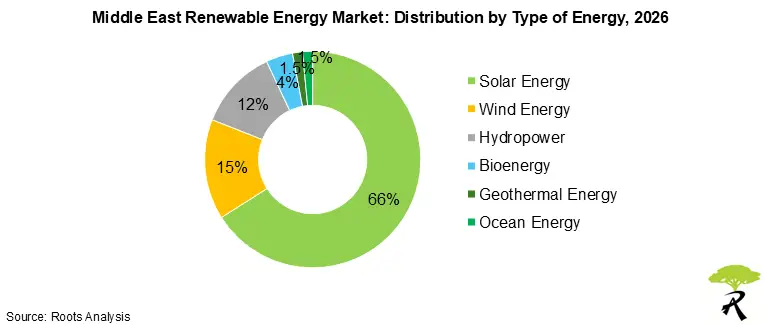
According to our market report, solar energy holds the largest share (66%) in 2026. Solar Energy leads because the region has abundant irradiation, bankable IPP structures, and low-cost project finance. In January 2026, Masdar and ENGIE reached financial close for the 1.5 GW Khazna Solar PV project in Abu Dhabi.
While solar energy dominates the market, wind energy is likely to grow at a CAGR of 12.3% through 2040. Wind Energy will grow fastest as Saudi Arabia and Egypt move beyond solar-led procurement. In July 2025, PIF said ACWA Power, Badeel, and SAPCO signed PPAs for two Saudi wind plants totaling 3,000 MW.
Market Share by Type of Project / Asset Model
According to our analysis, independent power producer projects segment dominates the market, accounting for 48% of the market share in 2026. Independent Power Producer Projects lead because sovereign offtakers support project finance and grid-scale delivery. In July 2025, ACWA Power, Badeel, and SAPCO announced PPAs for seven Saudi renewable IPP projects totaling 15 GW.
Conversely, the corporate power purchase agreements segment will grow at a CAGR of 13.5% during the forecast period 2026-2040. Corporate Power Purchase Agreements will grow fastest as large users seek price certainty and carbon reduction. In March 2025, Emerge partnered with Tanmiah Food Company for a solar plant serving an agricultural processing facility.
Want Information on Specific Region / Segment?
Regional Analysis: Saudi Arabia Leads the Market and Oman Grow at Higher CAGR
Based on our regional analysis, Saudi Arabia captures 38.0% share in 2026. Its dominance reflects large procurement rounds, sovereign capital, low-cost land, and integrated utility offtake. In July 2025, PIF announced approximately USD 8.3 billion for 15,000 MW of new renewable projects.
On the other hand, Oman registers a 12.4% CAGR from 2026 to 2040. Growth will benefit from policy support, storage-linked procurement, and rising demand localization. In September 2025, the Ibri III project added a 500 MW solar PV and 100 MWh BESS pathway.
Market Ecosystem Analysis
Middle East Renewable Energy Market Competitive Landscape
Commercial control concentrates among eight developer or IPP platforms, such as Masdar, ACWA Power, ENGIE, EDF power solutions, TotalEnergies, Aljomaih, Nesma and AMEA Power. The broader roster ties into 13 Tier 1 leaders, six specialists and six emerging entrants across utility-scale and distributed markets. Saudi Arabia’s July 2025 15 GW PPA package and October 2025 4.5 GW awards confirm procurement-led concentration. Vertical integration now dominates, driven by government procurement and dispatchable-clean-power requirements that reward financing, BESS, EPC and localized supply.
Established Players and Their Key Initiatives
Established players are increasingly adopting aggressive co-investment and co-development models. A prime example is Saudi Arabia's ACWA Power, which has established its position as a dominant regional developer by securing deep cross-border financial and technical backing, including a 49% stake acquisition by China's state-owned Silk Road Fund. This strategic alignment highlights a broader regional trend, the deepening integration of Chinese engineering, procurement, and construction (EPC) contractors and manufacturing supply chains into major Gulf Cooperation Council (GCC) clean energy deployments.
In addition, the regional energy transition is anchored by several multi-billion-dollar megaprojects and strategic policy initiatives:
- Gigawatt-Scale Solar Parks: The development of massive, record-breaking utility installations remains a primary focus. Prominent projects include the rolling expansions of the Mohammed bin Rashid Al Maktoum Solar Park in Dubai and Saudi Arabia's massive utility-scale deployments managed under the Public Investment Fund (PIF) renewables pipeline.
- Green Hydrogen and Export Ecosystems: Countries like Oman, Saudi Arabia, and the UAE are actively leveraging their geographic and infrastructure advantages to build complete industrial-scale green hydrogen export ecosystems. Notable legacy frameworks, such as Abu Dhabi's integrated hydrogen and carbon capture initiatives via Masdar, have evolved into expansive regional green hydrogen clusters aimed at international export markets.
- Grid Interconnection and Modernization: Substantial capital is being directed toward reinforcing cross-border high-voltage direct current (HVDC) grid interconnections within the GCC. This is paired with localized energy storage integration to manage the baseload variability of rapidly expanding solar and wind assets.
Startup Companies and their Key Highlights
The competitive landscape for clean technology and renewable energy startups in the Middle East has transitioned from isolated pilot programs to a heavily incentivized, venture-backed industrial tier. Agile regional startups are capturing high-margin niches in artificial intelligence-driven grid optimization, localized commercial and industrial (C&I) solar, and decentralized energy storage system (BESS) software. The market is structurally defined by massive, state-sponsored corporate venture capital (CVC) funds and accelerator ecosystems, such as the Hub71 ecosystem in Abu Dhabi and the King Abdullah University of Science and Technology (KAUST) Innovation Ventures in Saudi Arabia.
- Sovereign-Backed Green VC Funds: Major regional investment funds are earmarking dedicated capital for early-stage cleantech. Entities like the UAE's RWE Energy Transition Investments and specialized regional funds are actively deploying seed and Series A capital into startups focused on solar hardware efficiency, direct air carbon capture, and decentralized grid software.
- AI-Driven Grid Integration and Asset Management: With the rapid influx of intermittent solar power into the regional baseload, early-stage companies are rolling out predictive AI platforms. These systems analyze real-time meteorological data and load demand to maximize utility-scale solar asset operations, protect infrastructure, and minimize storage degradation.
Middle East Renewable Energy Market Trends
Corporate PPA and C&I Distributed Generation Growth Opening Non-Utility Revenue Pools
- Commercial offtake is expanding because large users want price certainty and carbon reduction without owning assets. In March 2025, Emerge partnered with Tanmiah Food Company for a solar plant serving an agricultural processing facility. Corporate PPA developers can build recurring revenue outside sovereign procurement cycles.
- Industrial distributed generation is gaining share because BOOT models reduce upfront capital needs for factories. In May 2025, Emerge and Turbotim signed a Ras Al Khaimah solar and BESS agreement for industrial facilities. The model favors platforms with balance-sheet capacity, operations teams, and storage integration skills.
Wind Procurement Diversification Expanding Non-Solar Equipment Competition
- Wind Energy is gaining momentum because Saudi Arabia and Egypt are expanding beyond solar-led procurement. In July 2025, Saudi Arabia signed the PPA for the 700 MW Yanbu wind energy project. The project sits under the National Renewable Energy Program. Turbine OEMs and wind developers can compete in a market previously led by solar EPC scale.
- Larger wind awards are improving regional supplier visibility because procurement now covers multi-gigawatt portfolios. In July 2025, ACWA Power, Badeel, and SAPCO signed PPAs covering five solar projects and two wind projects totaling 15 GW. Portfolio awards favor firms that can manage technology mix, site risk, and financing.
Middle East Renewable Energy Market Procurement Scale Creating Country-Level Winners
- Saudi procurement scale is reshaping regional market share because large awards create repeatable pipelines for developers and suppliers. In July 2025, ACWA Power, Badeel, and SAPCO announced PPAs for seven Saudi renewable IPP projects totaling 15 GW. Localized execution will influence module, EPC, turbine, and storage supplier positioning.
- Oman is accelerating from a smaller base because policy and hydrogen-linked demand add new procurement routes. In April 2025, Hydrom launched the third auction round for green hydrogen projects in Duqm. Developers with renewable generation, storage, and hydrogen infrastructure capabilities can enter earlier in Oman’s growth cycle.
Your Business is Unique – Why Shouldn’t Your Report Be?
Market Access Considerations
Bankable PPA and Sovereign Offtake Access
Long-term utility PPAs determine which developers can scale because lenders need stable offtake and predictable payment structures. Saudi Arabia’s National Renewable Energy Program and UAE IPP projects favor sponsors with tariff discipline, equity capacity, and procurement experience. Smaller developers can enter through consortium roles, but they rarely control gigawatt projects without bankable financing partners and proven EPC delivery. This access pattern protects Tier 1 leaders and raises the cost of late entry into utility-scale procurement.
Grid Interconnection and Storage Readiness
Grid access increasingly decides project timing because solar capacity now depends on transmission, dispatchability, and reserve management. Solar-plus-storage procurement raises the technical threshold for developers, inverters, battery suppliers, and control-system providers. Firms with integrated PV, BESS, grid studies, and operations capability can commercialize faster. Solar-only bidders face weaker positioning in baseload renewable tenders. Interconnection delays can also shift revenue timing, financing costs, and commercial operation assumptions. These requirements influence commissioning schedules and warranty exposure.
Self-Generation and Direct-Sale Policy Navigation
Oman’s self-generation and direct-sale policy creates an access route outside traditional utility procurement. The policy supports on-site solar leasing, direct sale, and private renewable supply. Developers still need customer contracts, site permits, interconnection approvals, and billing structures. C&I platforms gain advantage when they can package financing, permitting, engineering, and operations into one offer for industrial buyers. Clear rules improve bankability for private offtake contracts, while policy literacy directly shapes customer acquisition speed across more sites.
Local Execution and Technology Supply Chain Qualification
Procurement scale favors suppliers that can meet localization, delivery, and warranty expectations across renewable technology categories. These categories include modules, trackers, inverters, batteries, and turbines. Vision 2030 localization and large Saudi renewable awards increase pressure on foreign OEMs to align with regional partners. Developers with qualified EPC networks, after-sales service, and bankable equipment warranties gain stronger competitive positioning than price-only vendors. Qualification strength can decide shortlist access before tariff competition begins and improve lifecycle service margins.
How Stakeholders Benefit from the Key Focus Areas of Our Middle East Renewable Energy Market Report
National diversification, peak-load growth, and net-zero commitments make renewable procurement a commercial priority across the region. The report supports choices on country prioritization, technology mix, partner selection, and entry timing. It connects market growth with procurement behavior, financing signals, and technology adoption.
- Unmet Needs and Market Gaps in Middle East Renewable Energy Market: The report identifies gaps in dispatchable renewable supply, C&I financing models, and grid-ready storage integration. Corporate planning teams can use these gaps to choose between utility-scale bids, distributed generation, and storage-backed offers. The analysis supports decisions on where unmet demand can convert into defensible revenue. It also clarifies which access barriers delay project conversion.
- Funding and Venture Investment Opportunities in Middle East Renewable Energy Market: The report maps funding signals across green bonds, financial closes, PPAs, and hydrogen-linked project activity. Capital allocation teams can compare Saudi scale, UAE solar-plus-storage depth, and Oman’s smaller-base acceleration. The findings support decisions on platform investments, project finance exposure, and supplier expansion. They also help screen opportunities against procurement maturity.
- Technology Innovation and Adoption Trends: The report tracks how solar PV, wind, BESS, trackers, inverters, and hydrogen corridors shift adoption curves. Engineering and product teams can see which technologies gain share and which segments lose relevance. The analysis supports roadmap decisions for storage integration, grid services, and utility-scale renewable solutions. It also highlights where dispatchability creates technology differentiation.
- Middle East Renewable Energy Market Competitive Landscape and Industry Analysis: The report compares Tier 1 developers, specialist suppliers, distributed-energy platforms, EPC players, and emerging microgrid firms. Commercial teams can assess where Masdar, ACWA Power, EDF power solutions, ENGIE, and Jinko-linked roles shape procurement. The findings support account targeting, competitor benchmarking, and positioning for tenders. They also show where partner roles influence bid credibility.
- Mapping Strategic Partnerships and Ecosystem Synergies: The report shows how developers, OEMs, storage providers, EPC firms, offtakers, and public buyers combine capabilities. Partnership teams can identify where consortium models improve financeability, technology qualification, and project delivery. The analysis supports decisions on local partnerships, supplier alliances, and corporate PPA channel development. It also identifies synergy gaps across financing and execution.
- Middle East Renewable Energy Market CAGR and Growth Trends: The report explains how the 10.4% CAGR links to segment-level growth. It covers wind, C&I distributed generation, corporate PPAs, and transportation. Finance, operating, and procurement teams can use these growth rates to prioritize countries and technologies. The findings support resource allocation, market-entry timing, and long-term capacity planning.
Middle East Renewable Energy Market: Scope of the Report
| Key Report Attributes | Details | |
| Forecast Period | Till 2040 | |
| Market Size 2026 | USD 58.5 Billion | |
| Market Size 2040 | USD 235.0 Billion | |
| CAGR (Till 2040) | 10.4% | |
| Segments Covered |
|
|
| Countries Covered |
|
|
| Key Sections Covered |
|
|
Market Segmentation
The Middle East renewable energy market report presents an in-depth analysis, highlighting the capabilities of various stakeholders, based on different segments, such as energy source, deployment model, project / asset model, application, end user, geographical regions, and leading players.
By Energy Source
- Solar Energy
- Wind Energy
- Hydropower
- Bioenergy
- Geothermal Energy
- Ocean Energy
By Deployment Model
- Utility-Scale Projects
- Commercial and Industrial Distributed Generation
- Residential Rooftop Systems
- Off-Grid and Microgrid Systems
By Project / Asset Model
- Independent Power Producer Projects
- Corporate Power Purchase Agreements
- Government Renewable Procurement Projects
- On-Site Solar Leasing
- Self-Generation and Direct Sale
By Application
- Electricity Generation
- Heating and Cooling
- Transportation
- Industrial Processes
By End User
- Utilities
- Commercial
- Industrial
- Residential


