
Lowest Price Guaranteed
Pages
231
Last Updated
July 2026
View Count
13541
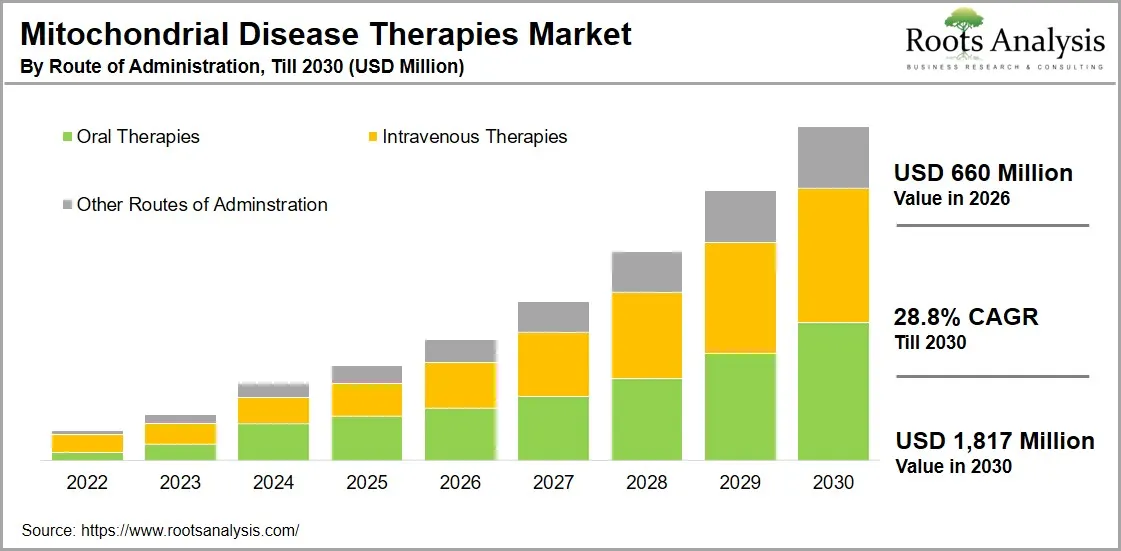
The mitochondrial disease therapies market, valued at USD 518 million in 2025 to reach USD 660 million in 2026 and USD 1,817 million by 2030, with a higher CAGR of 28.8% during the forecast period, 2026 to 2030.
To learn more about this report, request a free sample copy
Mitochondrial diseases are characterized by chronic, genetic and progressive medical symptoms that arise due to inherited or spontaneous mutations in mitochondrial DNA (a small, circular, double-stranded with ~16,500 base pairs that exists outside of the nucleus), or in some cases, nuclear DNA, which adversely alter the function of mitochondria. Such clinical conditions are rare and are known to affect multiple parts of the body, including neurons and nerves, kidneys, heart, liver, eyes, ears, and pancreas.
It is worth highlighting that over 300 mutations have been identified and are associated with various mitochondrial diseases. Examples of diseases that are caused due to mutations in mitochondrial DNA include Leber's hereditary optic neuropathy (LHON), Leigh syndrome, mitochondrial DNA depletion syndrome, mitochondrial encephalomyopathy, lactic acidosis, and stroke-like episodes (MELAS), and myoclonic epilepsy with ragged red fibers (MERRF).
 |
 |
 |
In the US, mitochondrial diseases are known to annually affect 1 in 5,000 individuals. It is also estimated that 1,000-4,000 children are born with a mitochondrial disease every year, in the same region. Primary mitochondrial diseases are usually difficult to diagnose. In many cases, clinicians and medical professionals are compelled to use the term possible mitochondrial disease, indicating that based on the presenting symptoms they suspect a patient to be suffering from a mitochondrial disease. However, they are unable to confirm the condition via genetic diagnosis. Such instances are further complicated by the aforementioned uncertainty, leading to delays in treatment and subsequent deterioration in the patient’s quality of life.
Currently, several industry stakeholders are engaged in efforts to develop disease modifying interventions for treating different mitochondrial diseases, in addition to drug / therapy candidates that offer symptomatic relief. There are several non-profit organizations that have been established across the globe to support individuals suspected / diagnosed with mitochondrial diseases and also fund research / clinical studies being conducted for treatment of such conditions. In the coming years, the mitochondrial disease therapies market is anticipated to witness a significant market growth as more novel therapy solutions are approved by regulatory authorities and enter the market.
Examples of key companies engaged in mitochondrial disease therapeutics market (which have also been profiled in this market report; the complete list of companies is available in the full report) include NeuroVive Pharmaceutical, Ixchel Pharma, Stealth BioTherapeutics, Santhera Pharmaceuticals, GenSight Biologics, BioElectron Technology and Reata Pharmaceuticals. This market report includes an easily searchable excel database of all the companies developing therapies for mitochondrial diseases, worldwide.
Several recent developments have taken place in mitochondrial disease therapeutics market. We have outlined some of these recent initiatives below. These developments, even if they took place post the release of our market report, substantiate the overall market trends that have been outlined in our analysis.
The "Mitochondrial Disease Therapies Market: Industry Trends and Global Forecasts, till 2030" report features an extensive study of the current market landscape, market size, market share, market growth, market trends, market value, market forecast, market outlook, statistics and future opportunities of the mitochondrial disease therapies market. It features an in-depth analysis, highlighting the capabilities of stakeholder companies / organizations engaged in mitochondrial disease therapies market.
 |
 |
 |
In addition to other elements, the market research report includes:
The key objective of mitochondrial disease therapies market report is to provide a detailed market analysis in order to estimate the existing market size, market share, market growth, market trends, market value, market forecast, market outlook, statistics and future opportunity for mitochondrial disease therapies market during the forecast period. Based on multiple parameters, such as disease prevalence, anticipated adoption of the forecasted therapies and the likely selling price of such therapeutic products, we have provided informed estimates on the evolution of the market for the forecast period, till 2030. The market report also features the likely distribution of the current and forecasted opportunity across [A] different target indications (Leigh syndrome, LHON, MELAS, mitochondrial DNA depletion syndrome, mitochondrial myopathy and others), [B] type of therapy (combination and monotherapy), [C] route of administration (oral, intravenous, and others) and [D] key geographical regions (the US, EU5 and rest of the world). In order to account for future uncertainties and to add robustness to our model, we have provided three market forecast scenarios, namely conservative, base and optimistic scenarios, representing different tracks of the industry’s growth.
 |
 |
All actual figures have been sourced and analyzed from publicly available information forums. Financial figures mentioned in this market research report are in USD, unless otherwise specified.