


 Download Free Sample
 Buy Now
Market Size
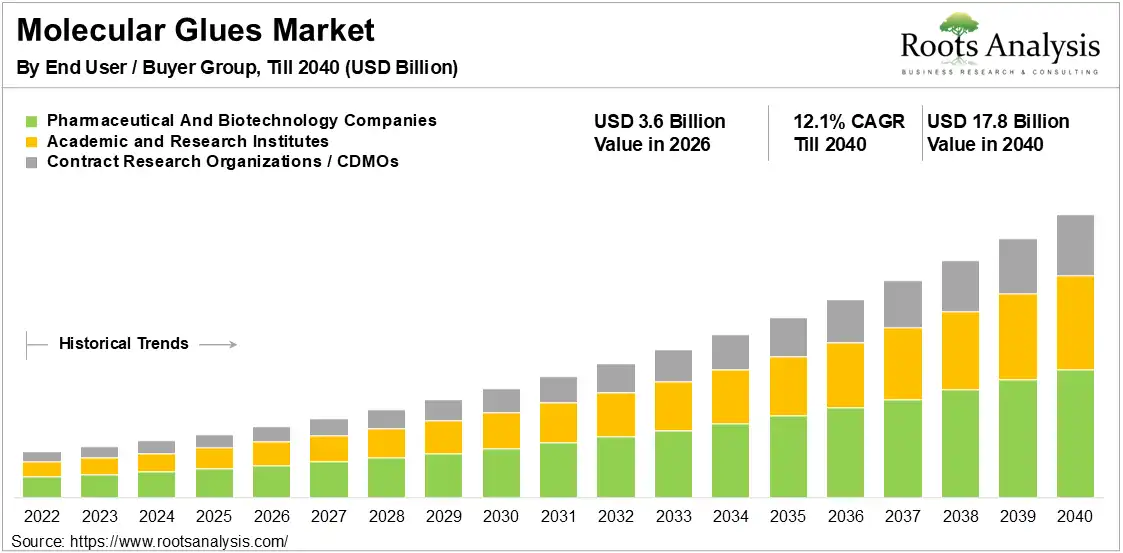
The global molecular glues market is expected to rise from USD 3.6 billion in 2026 and is projected to reach USD 17.8 billion by 2040, growing at a CAGR of 12.1% over the forecast period 2026 to 2040, driven by validated CRBN biology, broader E3 ligase recruitment, and AI-enabled degrader discovery.
See What’s in the Full Report – Request Your Complimentary Insights!
Market Report: Key Takeaways
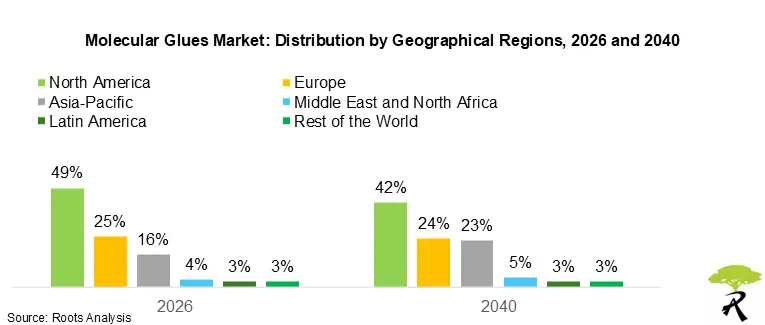
- Based on geography, North America captures 49.0% market share in 2026, whereas Asia-Pacific registers a 15.0% CAGR through 2040, driven by China-led clinical localization.
- Based on target protein / neosubstrate, IKZF1 / IKZF3 captures 44.0% market share in 2026, whereas BRD9 registers a 17.8% CAGR through 2040, driven by non-CRBN degrader validation.
- Based on therapeutic application, oncology captures 72.0% market share in 2026, whereas neurology / neurodegeneration registers a 17.8% CAGR through 2040, driven by brain-penetrant degrader programs.
- Based on discovery / enabling technology, proteomics and neosubstrate discovery captures 19.0% market share in 2026, whereas AI / ML and computational design register a 15.7% CAGR through 2040, driven by rational degrader design.
- Based on ligase / presenter system, Cereblon / CRBN captures 61.0% market share in 2026, whereas DCAF16 registers a 20.0% CAGR through 2040, driven by oral non-CRBN glue progress.
Molecular Glues Market Outlook
CRBN validation is shifting the molecular glues market from serendipitous discovery toward targeted protein degradation pipelines. Earlier activity centered on IKZF1 and IKZF3 biology, while current demand now spans RBM39, BRD9, BCL6, STAT3, and CDK2. Supply constraints sit in neosubstrate discovery, ternary-complex confidence, and E3 ligase selection. Oncology remains the primary demand pool, but immunology, neurology, and rare-disease programs now expand buyer interest from pharmaceutical buyers.
Clinical regulation now drives growth because IND clearance separates platform claims from drug-development readiness. FDA familiarity with CELMoD biology supports CRBN programs, while non-CRBN assets need stronger translational evidence, safety packages, and dose rationale. In June 2026, Amphista announced FDA IND clearance for AMX-883, its BRD9 targeted glue degrader for acute myeloid leukemia. That milestone strengthens confidence in DCAF16-mediated clinical entry and regulatory pathfinding.
Through 2040, the market remains high growth as AI / ML design, proteomics, and non-CRBN ligases diversify pipelines. Overall CAGR reaches 12.1%, while BRD9, DCAF16, and neurology-oriented programs grow faster than CRBN incumbents. In August 2025, Proxygen and EPFL launched an AI-driven molecular glue discovery collaboration. The long-term outlook stays positive, but commercialization depends on reproducible degradation, clinical selectivity, and partnerable discovery platforms with differentiated ligase access across regions.
Molecular Glues Market Dynamics
Molecular Glues Market Drivers
Validated CRBN biology anchors demand because IKZF1 / IKZF3 still captures 44.0% share in 2026. Pharma buyers see clearer approval paths where CELMoD evidence, hematology endpoints, and oral dosing already align. In May 2026, Bristol Myers Squibb reported Phase 3 SUCCESSOR-2 data for mezigdomide in relapsed or refractory multiple myeloma. That evidence keeps CRBN programs commercially bankable for late-stage investment.
Molecular Glues Market Restraints
Neosubstrate uncertainty restrains adoption because discovery programs still require proteomics, structural biology, and cellular proximity confirmation. Discovery and preclinical stages together hold 59.0% share in 2026, showing limited clinical conversion today. Platform owners must prove degradation selectivity, ternary-complex formation, and tissue exposure before large licensing deals. These hurdles raise screening costs and slow movement beyond oncology-focused molecular glue degraders into broader immunology or neurology pipelines.
Molecular Glues Market Opportunities
Non-CRBN ligase expansion creates the strongest opportunity because DCAF16 grows at 20.0% CAGR through 2040. BRD9 programs also gain share as targeted glue chemistry moves beyond cereblon modulators. In June 2026, Novartis expanded its Orionis collaboration with USD 40 million upfront and up to USD 1.4 billion in milestones. That deal confirms appetite for platform depth and differentiated ligase biology.
Molecular Glues Market Challenges
Regulatory translation remains challenging because non-CRBN glues need target-specific toxicology, dose justification, and biomarker strategy. China trial inclusion adds opportunity but also requires NMPA readiness and localized execution. In November 2025, SEED Therapeutics received China NMPA IND clearance for ST-01156, enabling Chinese sites in a global expansion study. Sponsors must align global protocol design with regional evidence needs early.
Molecular Glues Market Size Estimation Methodology
- As a starting point, the molecular glues market baseline used normalized industry data across targeted protein degradation, molecular glue degraders, and induced proximity therapeutics. Narrow platform-only views and overly broad oncology-drug scopes were excluded. The retained benchmarks were aligned to 2026 demand indicators without repeating absolute market-size figures. This created a cleaner base for molecular glues market forecast work.
- Moving forward, the model mapped clinical trial databases, drug approval timelines, and regulatory submission counts across CRBN, DCAF16, FBXO22, and RBM39 programs. Phase I, Phase II, Phase III, and marketed-stage shares were weighted against observed pipeline maturity. Programs with visible IND movement received higher near-term conversion probability. Assets tied to oral dosing or oncology expansion cohorts received stronger commercialization weight.
- Building on this, segment shares were assigned using target protein, therapeutic application, ligase system, and discovery technology evidence. IKZF1 / IKZF3 received the largest 2026 weight because CELMoD biology remains commercially validated. BRD9, CDK2, STAT3, and DCAF16 gained higher long-term weights because non-CRBN biology expands addressable targets. Neurology and immunology weights rose as brain-penetrant and inflammation programs matured.
- Drawing upon these, technology adoption curves were calibrated with proteomics, AI / ML design, structural biology, and ternary-complex modeling inputs. Proteomics and neosubstrate discovery received the largest 2026 technology share. AI / ML and computational design was assigned a higher CAGR because platforms are moving discovery from screening-heavy workflows toward rational design. Structural biology inputs helped test whether ternary-complex claims could translate into selective degradation.
- The projected value was then distributed across regions using clinical localization, biotech financing, regulatory entry, and partnership activity. North America received the highest 2026 share because FDA familiarity, oncology pipelines, and licensing capacity remain concentrated there. Asia-Pacific received the fastest growth rate because China IND activity supports regional trial expansion. Europe retained a strong position through platform science, academic collaborations, and specialized discovery companies.
- Finally, the forecast was stress-tested against patent filing volumes, financing rounds, platform collaborations, and large-pharma option structures. Scenario checks tested slower clinical conversion, faster AI adoption, and wider non-CRBN ligase use. The final CAGR reflects high growth with clinical, regulatory, and platform-validation risk still embedded. Sensitivity checks kept discovery-stage enthusiasm from overstating near-term commercial revenue.
Molecular Glues Market Share Insights
Market Share by Therapeutic Application
According to our analysis, oncology leads because hematologic malignancies and solid tumors hold the deepest translational evidence. In January 2025, AbbVie and Neomorph announced a collaboration for molecular glue degraders across oncology and immunology.
Neurology / neurodegeneration will grow fastest as brain-penetrant degrader programs mature. In May 2026, SEED described ST-01156 as an oral, brain-penetrant RBM39 degrader in a Phase 1 oncology study.
Market Share by Discovery / Enabling Technology
Proteomics and neosubstrate discovery lead because target identification remains the core technical bottleneck. In October 2025, ICR and NEOsphere announced a collaboration using high-throughput proteomics for molecular glue discovery.
AI / ML and computational design will grow fastest as rational discovery replaces serendipitous screening. In March 2025, Monte Rosa highlighted AI-guided chemistry, structural biology, and proteomics within its QuEEN discovery engine.
Want Information on Specific Region / Segment?
Regional Analysis: North America Leads the Market and Asia-Pacific is Likely to Register Higher CAGR
Presently, North America holds 49.0% market share in 2026 leading through deep biotech financing, dense oncology pipelines, FDA familiarity, and major pharmaceutical licensing capacity. In June 2026, Amphista announced FDA IND clearance for AMX-883, supporting continued North American regulatory momentum.
On the contrary, Asia-Pacific registers a 15.0% CAGR from 2026 to 2040. Growth will reflect China trial inclusion, domestic biotech financing, and regional demand for localized oncology innovation. In November 2025, SEED Therapeutics received China NMPA IND clearance for ST-01156, enabling Chinese sites in a global expansion study.
Market Ecosystem Analysis
Across the 23-company scope, four Tier 1 leaders anchor the bulk of visible commercial activity, while 13 specialists and six emerging entrants supply discovery optionality. The dominant consolidation dynamic is platform convergence through large-pharma licensing, where Roche, Novartis, Gilead, Lilly, and Genentech buy access to specialized glue discovery engines. The primary commercial force reshaping behavior is the move from serendipitous CRBN glues toward rational, target-first, AI-enabled, and non-CRBN ligase systems. Competitive advantage is shifting toward companies that combine clinical assets, ternary-complex biology, ligase diversity, and partner-ready discovery platforms.
- C4 Therapeutics and Roche expanded their long-term collaboration in April 2026 through a degrader-antibody conjugate agreement covering two oncology targets, with an option for a third. This raises barriers for smaller degrader-antibody conjugate developers because Roche controls downstream preclinical, clinical, and commercialization execution. It strengthens the oncology application segment and extends molecular glue utility beyond oral small molecules into targeted delivery formats.
- Kymera Therapeutics secured Gilead’s option exercise for KT-200 in April 2026, triggering a $45 million milestone for an oral CDK2 molecular glue degrader. The move validates CDK2 as a commercially fundable neosubstrate class and pressures CDK inhibitor competitors in breast cancer and solid tumors. It strengthens the CDK2 target-protein segment and the preclinical-to-IND pipeline segment.
- Orionis Biosciences and Roche’s Genentech formed a second molecular glue collaboration in May 2025, focused on small-molecule monovalent glues for cancer. Genentech paid $105 million upfront, while Orionis retained discovery and optimization responsibilities before later-stage Genentech development. This reinforces oncology as the most monetized application and raises the partnering benchmark for emerging monovalent-glue platforms.
- Bristol Myers Squibb reported Phase 3 EXCALIBER-RRMM data in September 2025 for iberdomide, a CELMoD, in relapsed or refractory multiple myeloma. The result reinforces BMS’ lead in CRBN-directed IKZF1 / IKZF3 degradation and keeps multiple myeloma as the most mature commercial application. It pressures emerging CRBN glue developers to show differentiation beyond standard hematology endpoints.
- Monte Rosa Therapeutics signed a September 2025 Novartis collaboration worth up to $5.7 billion for immune-mediated diseases. The agreement gives Novartis access to one undisclosed discovery target and options for two additional immunology programs. This shifts competitive attention from oncology-only glues into immunology and inflammation, strengthening the AI / ML design and immune-mediated disease segments.
- SEED Therapeutics completed a $30 million Series A-3 financing in September 2025 alongside FDA clearance for its RBM39 degrader IND. Its RITE3 platform and ST-01156 program move rational molecular glue discovery into clinical oncology. This strengthens the RBM39 target segment and pressures discovery-only peers to demonstrate regulatory translation.
- Amphista Therapeutics presented February 2026 data showing Eclipsys-enabled Targeted Glues recruiting DCAF16, FBXO22, and DCAF11. The company also highlighted AMX-883, a DCAF16-dependent BRD9 degrader for AML, and degrader-antibody conjugate compatibility. This strengthens the non-CRBN ligase, BRD9, and AML application segments while raising structural-biology requirements for competitors.
- Proxygen launched an August 2025 collaboration with EPFL to combine high-throughput screening with AI and structural modeling. The collaboration targets prediction and validation of neosubstrate-ligase interactions and chemical matter that induces targeted degradation. This strengthens the AI / ML, ternary-complex modeling, and proteomics-adjacent discovery segments.
- Magnet Biomedicine entered a February 2025 Lilly collaboration for oncology molecular glues using its TrueGlue platform. The deal included up to $40 million in upfront, near-term payments, and equity investment, plus more than $1.25 billion in potential milestones. This validates rational presenter-protein selection and strengthens oncology discovery against difficult-to-drug targets.
Startup Companies and their Key Highlights
- Neomorph
- Event type and funding amount: $100 million Series B financing
- Month and year: April 2026
- Lead investor or strategic partner name: Deerfield Management
- Stated purpose of the event: Support the Phase 1/2 NEO-811 trial in clear cell renal cell carcinoma and advance the broader molecular glue degrader pipeline.
- Market implication: Accelerates clinical-stage oncology molecular glues and strengthens the clear cell renal cell carcinoma sub-segment through ARNT / HIF-1ß degradation.
- Degron Therapeutics
- Event type and funding amount: $40 million Series A extension
- Month and year: May 2026
- Lead investor or strategic partner name: LAPAM CAPITAL
- Stated purpose of the event: Advance the lead HuR molecular glue degrader, progress two immunology programs toward IND, and expand GlueXplorer.
- Market implication: Accelerates the solid-tumor and immunology pipeline segments while adding clinical momentum for HuR, an RNA-binding protein target.
- TRIANA Biomedicines
- Event type and funding amount: Oversubscribed $120 million Series B financing
- Month and year: December 2025
- Lead investor or strategic partner name: Ascenta Capital and Bessemer Venture Partners
- Stated purpose of the event: Advance TRI-611, an ALK-targeted molecular glue degrader, to clinical proof of concept in ALK+ NSCLC.
- Market implication: Accelerates oncology molecular glues for genomically defined lung cancer and strengthens target-first discovery competition.
- Rapafusyn Pharmaceuticals
- Event type and funding amount: Over-subscribed $44 million Series A financing
- Month and year: September 2025
- Lead investor or strategic partner name: BioTrack Capital and Yonjin Capital joined the Series A round.
- Stated purpose of the event: Advance a non-degrading molecular glue pipeline across oncology, immunology, renal, and pain disease areas.
- Market implication: Expands the market beyond degrader-only glues and strengthens the FKBP12 / non-degradative glue modality segment.
- Ternary Therapeutics
- Event type and funding amount: €4.1 million, £3.6 million seed round
- Month and year: March 2026
- Lead investor or strategic partner name: daphni
- Stated purpose of the event: Scale an AI platform for molecular glue design using physics-informed modeling and laboratory validation.
- Market implication: Accelerates AI / ML and computational design for inflammatory and neuroinflammatory disease applications.
Molecular Glues Market Trends / Opportunities
CRBN Clinical Validation Extending Molecular Glues Market Commercial Runway
CRBN biology keeps molecular glue degraders commercially credible because IKZF1 / IKZF3 holds 44.0% share in 2026. Bristol Myers Squibb reported positive Phase 3 mezigdomide results in March 2026. The program links oral dosing, myeloma endpoints, and CELMoD lineage in one mature clinical path. This sustains investor confidence in clinically familiar degrader mechanisms and late-stage licensing comparables.
Oncology remains the dominant application because hematologic malignancies and solid tumors carry the deepest translational evidence. AbbVie and Neomorph announced a January 2025 collaboration across oncology and immunology molecular glue degraders. The collaboration shows how large pharma uses platform partnerships to extend target access. This keeps partnering focused on assets with clear clinical prioritization and platform breadth.
Non-CRBN Ligase Expansion Creating Differentiated Molecular Glues Market Positions
Non-CRBN recruitment is becoming a competitive filter because DCAF16 grows faster than all listed ligase systems. Amphista disclosed AMX-883 as an orally bioavailable DCAF16-dependent BRD9 degrader in April 2026. BRD9 also doubles its share by 2040 within target protein segmentation. This position novel ligase access as a defensible platform advantage for differentiated oncology entry.
FBXO22-mediated TEAD degradation broadens the field beyond CRBN and VHL dependency. Amphista disclosed first details of its TEAD Targeted Glue program in September 2025. The mechanism supports interest in presenter systems beyond the most crowded ligase routes. This widens licensing interest toward target-class optionality and specialized discovery portfolios.
AI and Proteomics Platforms Turning Discovery Infrastructure into Partnerable Assets
AI-enabled design is gaining commercial weight because rational workflows reduce dependence on serendipitous phenotypic screening. Ternary Therapeutics raised EUR 4.1 million in March 2026 to scale its AI-designed molecular glue platform. AI / ML and computational design reach 25.0% technology share by 2040. This makes computational discovery capability a fundable platform thesis for early-stage investors.
Proteomics remains essential because neosubstrate discovery determines whether a glue has actionable biology. ICR and NEOsphere announced an October 2025 collaboration using high-throughput proteomics for molecular glue discovery. Proteomics and neosubstrate discovery lead technology share in 2026. This pushes discovery partners toward evidence-rich, assay-integrated service models for repeatable target validation.
Expert-led platform positioning is replacing serendipity narratives with precision-design language. XtalPi convened molecular-glue discovery experts in January 2026 and highlighted its AI-driven XGlue platform. This strengthens demand for partners that can combine computation, automation, and experimental validation.
Your Business is Unique – Why Shouldn’t Your Report Be?
Market Access Considerations
FDA and NMPA IND Readiness
Regulatory entry now shapes who can compete because molecular glue programs must show target selectivity, exposure, and safety before clinical expansion. FDA IND clearance supports global credibility, while NMPA clearance enables China site inclusion and regional enrollment. Amphista gained FDA IND clearance for AMX-883 in June 2026. This favors companies with regulatory-ready translational packages, early biomarker plans, and trial sites prepared for targeted degrader protocols. Late entrants face longer evidence-building cycles globally.
Clinical Proof and Biomarker Evidence
Clinical proof gates access because payers, partners, and trial investigators need evidence beyond degradation in cells. CELMoD programs set a higher bar for response durability, progression endpoints, and oral dosing in myeloma. Bristol Myers Squibb reported Phase 3 mezigdomide results in relapsed or refractory multiple myeloma in March 2026. Programs without strong biomarkers face slower partner diligence, weaker differentiation, and tougher clinical positioning against familiar oncology regimens. Expansion cohorts must prove clear target relevance.
Proteomics and Neosubstrate Validation Capacity
Proteomics access determines scaling speed because neosubstrate discovery remains the core bottleneck in molecular glue development. High-throughput proteomics supports target discovery, mechanism confirmation, lead optimization, and off-target risk management. ICR and NEOsphere announced an October 2025 collaboration to discover molecular glue degrader therapeutics. Companies lacking integrated assays rely more heavily on specialized partners, which can raise costs and slow repeatable program generation. This makes assay depth a commercial access barrier for smaller discovery companies.
Milestone-Heavy Partnership Economics
Partnership economics shape market access because platform owners often need large-pharma capital, chemistry support, and development infrastructure. Upfront payments validate near-term confidence, while milestones reward later clinical progression and portfolio breadth. Novartis expanded its Orionis collaboration in June 2026 with USD 40 million upfront and up to USD 1.4 billion in milestones. This favors differentiated platforms with multiple target options, repeatable discovery workflows, and credible partner execution capacity. Weak exclusivity reduces negotiating power during diligence cycles.
How Stakeholders Benefit from the Key Focus Areas of Our Molecular Glues Market Report
Undruggable-target demand makes molecular glue degraders commercially urgent across oncology, immunology, and emerging neurology programs. The report links target biology, ligase access, discovery technology, and regional regulation to investment and portfolio decisions. It also separates clinically validated CRBN pathways from higher-risk non-CRBN opportunities.
- Unmet Needs and Market Gaps in Molecular Glues Market: The report identifies where CRBN dependence, neosubstrate uncertainty, and limited clinical conversion leave open white spaces. Portfolio heads can compare IKZF1 / IKZF3 maturity with BRD9, STAT3, CDK2, and RBM39 upside. This supports target selection, indication prioritization, and partner screening. It also highlights gaps in neurology, immunology, and rare-disease translation.
- Funding and Venture Investment Opportunities in Molecular Glues Market: The report tracks financing signals across Degron Therapeutics, SEED Therapeutics, Rapafusyn Pharmaceuticals, and Ternary Therapeutics. Capital allocators can separate clinical-stage degrader progress from platform-only discovery stories. This supports valuation screening, venture pipeline mapping, and diligence on AI-designed molecular glue discovery. It also flags where milestone-heavy partnerships validate platform depth.
- Technology Innovation and Adoption Trends: The report compares proteomics, structural biology, AI / ML design, biochemical assays, and ternary-complex modeling. Platform teams can see why proteomics leads current technology share while AI / ML grows fastest through 2040. This supports build, buy, or partner decisions for discovery infrastructure. It also clarifies where automation and computational design can shorten discovery cycles.
- Molecular Glues Market Competitive Landscape and Industry Analysis: The report maps Bristol Myers Squibb, Roche, C4 Therapeutics, Monte Rosa, Neomorph, SEED Therapeutics, Kymera, Orionis, and Proxygen. Commercial teams can compare Tier 1 leaders with specialist platform companies and emerging startups. This supports account prioritization, competitive monitoring, and market-entry planning. It also shows which companies own differentiated ligase or presenter-protein access.
- Mapping Strategic Partnerships and Ecosystem Synergies: The report links large-pharma licensing, academic proteomics collaboration, and AI platform partnerships into one ecosystem view. Business development teams can identify where Novartis, Lilly, Roche, ICR, NEOsphere, and EPFL activity points toward demand. This supports outreach targeting, alliance scouting, and co-development discussions. It also helps prioritize partners with complementary assays, targets, or clinical infrastructure.
- Molecular Glues Market CAGR and Growth Trends: The report explains why the overall CAGR reaches 12.1% while DCAF16, BRD9, and neurology grow faster. Finance and strategy teams can compare dominant 2026 segments with faster-growing 2040 positions. This supports segment prioritization, revenue scenario planning, and long-range portfolio allocation. It also clarifies where high growth still carries clinical and regulatory risk.
Molecular Glues Market: Scope of the Report
| Key Report Attributes | Details | |
| Forecast Period | Till 2040 | |
| Market Size 2026 | USD 3.6 Billion | |
| Market Size 2040 | USD 17.8 Billion | |
| CAGR (Till 2040) | 12.1% | |
| Segments Covered |
|
|
| Geographical Regions Covered |
|
|
| Key Sections Covered |
|
|
Market Segmentation
The Molecular Glues Market report presents an in-depth analysis, highlighting the capabilities of various stakeholders, based on different segments, such as target protein / neosubstrate, therapeutic application, discovery / enabling technology, ligase / presenter system, pipeline development stage, end user / buyer group, geographical regions, and leading players.
By Target Protein / Neosubstrate
- IKZF1 / IKZF3
- GSPT1
- RBM39
- BRD9
- BCL6
- STAT3
- CDK2
- Others
By Therapeutic Application
- Oncology
- Neurology / Neurodegeneration
- Immunology and Inflammation
- Infectious Diseases
- Genetic and Rare Diseases
- Others
By Discovery / Enabling Technology
- Phenotypic Screening
- DNA-Encoded Library Screening
- Proteomics and Neosubstrate Discovery
- Structural Biology / Cryo-EM
- AI / ML and Computational Design
- Biochemical and Cellular Proximity Assays
- Ternary-Complex Modeling
By Ligase / Presenter System
- Cereblon / CRBN
- DCAF16
- DCAF11
- FBXO22
- VHL
- FKBP12
- Other E3 Ligases or Presenter Proteins
By Pipeline Development Stage
- Discovery
- Preclinical
- Phase I
- Phase II
- Phase III
- Marketed / Approved
By End User / Buyer Group
- Pharmaceutical And Biotechnology Companies
- Academic and Research Institutes
- Contract Research Organizations / CDMOs
By Geographical Regions
- North America
- US
- Canada
- Mexico
- Rest of North America
- Europe
- Austria
- Belgium
- Denmark
- France
- Germany
- Ireland
- Italy
- Netherlands
- Norway
- Russia
- Spain
- Sweden
- Switzerland
- UK
- Rest of Europe
- Asia-Pacific
- China
- India
- Japan
- Singapore
- South Korea
- Rest of Asia-Pacific
- Latin America
- Argentina
- Brazil
- Chile
- Colombia
- Venezuela
- Rest of Latin America
- Middle East and Africa (MEA)
- Egypt
- Iran
- Iraq
- Israel
- Kuwait
- Saudi Arabia
- UAE
- Rest of MEA
- Rest of the World


