
Lowest Price Guaranteed
Slides
210
Last Updated
July 2026
View Count
12116
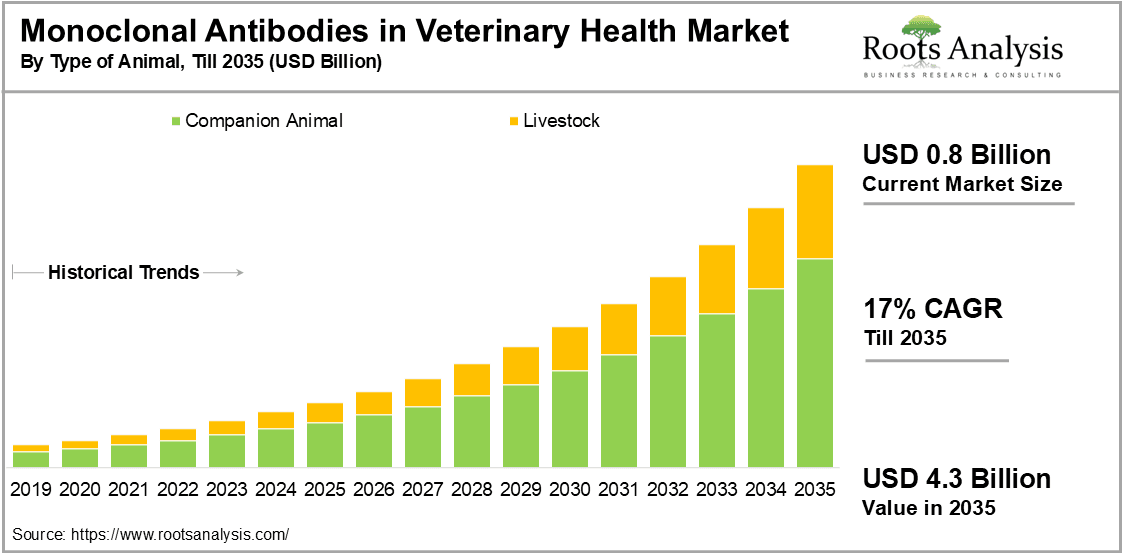
The global monoclonal antibodies in veterinary health market is estimated to grow from USD 0.8 billion in 2024 to USD 4.3 billion by 2035, representing a higher CAGR of 17% during the forecast period.
 |
To learn more about this report, request a free sample copy
In recent years, the growing incidence of chronic conditions such as arthritis, cancer, osteoporosis, and skin allergies in animals has created a burden on veterinarians to find appropriate treatment. According to the report of the American Veterinary Medical Association, nearly 1 out of 4 dogs are estimated to have neoplasia (a form of cancer). The increasing incidence of cancer in companion animals, particularly in dogs, has underscored the requirement of advanced therapeutics to eradicate cancerous cells and help animals’ live quality lives. In this context, mAbs emerge as a potential chronic disease management solution in animals and help them live a quality life. Monoclonal antibodies (mAbs) are a form of antibody developed from cell lineage with defined target specificity. These molecules possess the ability to mimic immune responses for targeting diseases such as infectious diseases, autoimmune disorders, and cancer. In addition to chronic disease management, monoclonal antibodies have also been used for the prevention of infectious diseases like feline leukemia virus and parvovirus in animals.
It is worth highlighting here that the growing necessity of target-specific therapies has caught the attention of various industry leaders who are currently increasing research on monoclonal antibodies to target a broad range of diseases. For instance, in May 2023, Zoetis received approval for Librela™ (bedinvetmab injection) from the US FDA for managing pain associated with osteoarthritis. Moreover, in May 2023, Elanco announced the conditionally approved canine parvovirus monoclonal antibody by the USDA to treat animals with canine parvovirus. The growing approval from the regulatory authorities brings lucrative opportunities for drug developers to make considerable investments in this field and enhance their research on monoclonal antibodies. Driven by the growing incidence of chronic diseases and the rising interest of industry stakeholders, we believe that the monoclonal antibodies in the veterinary health market will grow at a steady pace during the forecast period.
The market report features an in-depth analysis of various companies that are active in the development of monoclonal antibodies for animals across different segments, as defined in the table below.
| Key Report Attributes | Details | |
| Historical Trend | Since 2019 | |
| Forecast Period | Till 2035 | |
| Market Size 2035 | USD 4.3 billion | |
| Market CAGR | ~17% | |
| Type of Animal |
|
|
| Application Area |
|
|
| Distribution by End User |
|
|
| Key Geographical Region |
|
|
| Key Companies Profiled |
|
|
| PowerPoint Presentation (Complimentary) |
Available | |
| Customization Scope | 15% Free Customization | |
| Excel Data Packs (Complimentary) |
|
|
The key objective of this monoclonal antibodies in the veterinary health market report was to estimate the current market size, value, trends, opportunities, and future growth potential during the projected period. Based on multiple parameters, like adoption trends, evolutions, rising demand, research, and validation, we have provided an informed estimate of the market evolution during the forecast period till 2032. The research report on the global market also highlights the likely distribution of the current and future opportunities for the market leaders active across various segments such as type of animals, application, end user, and geographical region. In order to account for future uncertainties associated with some of the key parameters and to add robustness to our model, we have provided three market forecast scenarios, namely conservative, base, and optimistic scenarios, representing different tracks of the industry's evolution.
All actual figures have been sourced and analyzed from publicly available information forums and primary research discussions. Financial figures mentioned in this market report are in USD unless otherwise specified.
Based on the type of animals, the monoclonal antibodies in the veterinary health market is segmented into companion animals and livestock. Presently, companion animals account for the largest share, capturing 69% of the overall revenue share in 2024. The highest share can be attributed to the growing concern about chronic diseases in companion animals such as dogs, cats, and horses. Furthermore, the increasing expenditure by pet owners on their companion animals to maintain their health is likely to be the major reason for the largest share.
On the basis of application, the monoclonal antibodies in veterinary health market is segmented into dermatology, pain and other application area. According to our projection, dermatology occupies 56% of the overall revenue share of the market in 2024. The largest share can be attributed to the growing concern of atopic dermatitis along with other skin diseases in animals. It is worth highlighting here that the pain management segment accounts for the second-highest share of the market. This can be attributed to the growing research on monoclonal antibodies for pain management that results from chronic disease conditions.
Based on the end user, the global market is segmented into veterinary hospitals and other end users. According to our projection, veterinary hospitals currently hold 70% of the monoclonal antibodies in veterinary health market share in 2024. This can be attributed to the fact that veterinary hospitals are considered to be the primary providers of medical care for animals. Furthermore, veterinary hospitals also handle complex treatments and provide advanced therapeutics, including monoclonal antibody-based therapies to the animals.
On the basis of key geographies, the monoclonal antibodies in veterinary health market is distributed into North America, Europe, Asia-Pacific, Latin America, Middle East and North Africa, and the rest of the world. According to our market study, North America accounts for the largest share, capturing 44% of overall revenue share in 2024. The growth can be attributed to the government's growing initiatives and the rising adoption of pet insurance in this region. Additionally, the increasing initiatives of key industry leaders for the development of novel monoclonal antibody therapies are a significant reason for the highest growth share in the market. However, in the long run, the Asia-Pacific market is likely to grow at a higher CAGR during the forecast period. This is primarily due to the rise in pet adoption in this region. As per Allianz Global Investors, 60% of citizens in this region have a pet at home.
The “Monoclonal Antibodies in Veterinary Health Market: Industry Trends and Global Forecast, till 2032” the market report features a detailed study of the current market landscape, market size, market forecast and future opportunities for the drug developers. Further, the market research report underlines an in-depth analysis, highlighting the capabilities of stakeholders engaged in the market.
Currently, the market landscape features the presence of various well-established and new entrants with required expertise for the development of monoclonal antibodies for treating animals. In order to leverage competitive edge, various industrial players have entered into partnerships, collaborations and acquisition deals with the aim of strengthening their research efforts. Furthermore, it is worth noting here that the majority of these players are focusing on product portfolio expansion and taking strategic initiatives to develop therapeutics for targeting wide range of disease indications. Overall, the market seems highly competitive, featuring the presence of small, medium size and large companies who are also emphasizing technological advancements to deliver target specific therapeutics developed with monoclonal antibodies.
There are several growth drivers that are propelling the monoclonal antibodies in veterinary hospital market growth. Some of the significant factors include rising pet ownership and the growing incidence of chronic diseases such as cancer, osteoporosis, and arthritis in animals. Furthermore, increasing pet ownership and willingness to spend on the health of their pets, which covers advanced therapeutic treatments for managing chronic diseases, are the key drivers of the market. According to the preliminary results from 2024 American Veterinary Medical Association survey, 59.8 million households in the US own pet dogs and 42.1 million households own a pet cat. These numbers have been consistently increasing from 1991. Additionally, as per the American Pet Products Association, $32 billion was spent on pet supplies and OTC medicines in 2023.
It is worth highlighting here that according to the report of the North American Pet Health Insurance Association, in 2024, the industry will surpass USD 4 billion for the very first time, driven by the rising expenditure on health insurance by pet owners. Therefore, rising spending on companion animals for healthcare facilities is anticipated to be a significant growth driver of the market.
Although the monoclonal antibodies in veterinary health market is growing at a steady pace, there are several challenges that need to be addressed for widespread adoption of these therapies. One of the significant challenges is the high cost associated with monoclonal antibody therapies manufacturing. Furthermore, there are limited monoclonal antibody therapies available that have received approval from the FDA. It is worth noting here that the development of target-specific monoclonal antibodies can be challenging due to significant differences in the immune response of animals. In addition, regulatory hurdles for the approval of therapies may create a barrier to the acceptance and adoption of therapies on a large scale.
Presently, the researchers continue to research monoclonal antibodies to expand the therapeutic applications of mAbs beyond cancer in veterinary medicine. It is interesting to highlight here that technological advancements such as genetic engineering technology, genome editing technology, and others enhance understanding of the immune system and genetic variation among animals. The growing understanding of genome profiling helps researchers in tailoring mAbs therapies to meet individual animal requirements. In addition to technological advancements, rising partnerships between industrial leaders bring significant opportunities for drug developers to accelerate research on monoclonal antibodies for animals.
Examples of the leading companies engaged in development of monoclonal antibodies for animals (the complete list of the players active in the industry has been listed in the complete market report) include Boehringer Ingelheim GmbH, Elanco, Indian Immunologicals, Merck, Virbac, and Zoetis. This market report includes an easily searchable excel database of all the companies providing monoclonal antibodies in veterinary health, worldwide.
Several recent developments have taken place in the field of monoclonal antibodies in veterinary health. We have outlined some of these recent initiatives below. These developments, even if they took place post the release of our market report, substantiate the overall market trends that have been outlined in our analysis.