


 Download Free Sample
 Buy Now
Market Size
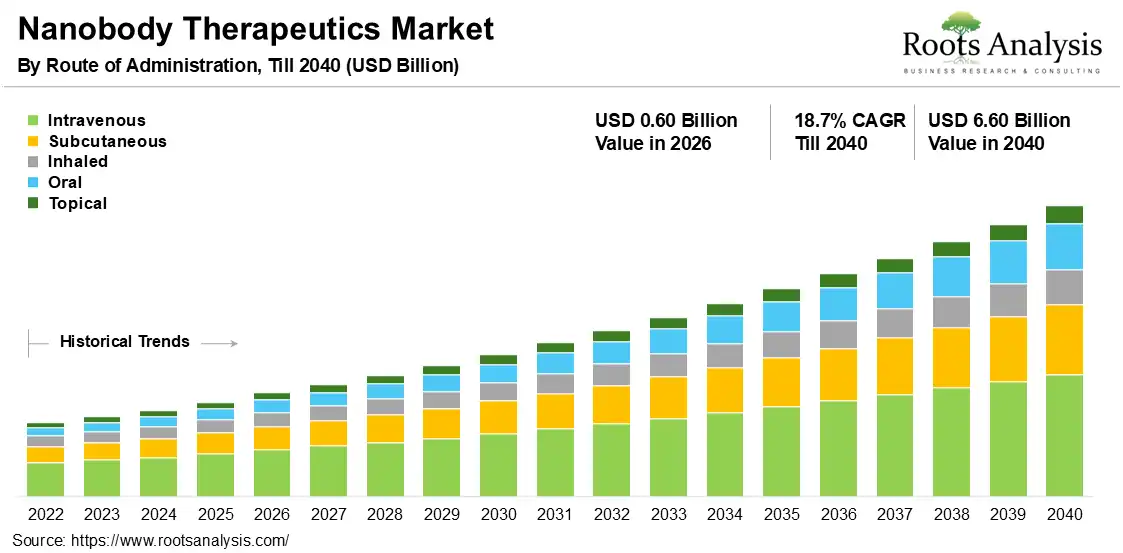
The global nanobody therapeutics market reached USD 0.60 billion in 2026 and is projected to reach USD 6.60 billion by 2040, growing at a CAGR of 18.7% over the forecast period 2026 to 2040, driven by multi-specific pipeline expansion and localized delivery.
See What's in the Full Report – Request Your Complimentary Insights!
Market Report: Key Takeaways
- Based on molecular format, bivalent nanobodies capture 40.0% market share in 2026, whereas bispecific nanobodies register a 24.7% CAGR through 2040, supported by dual-pathway targeting.
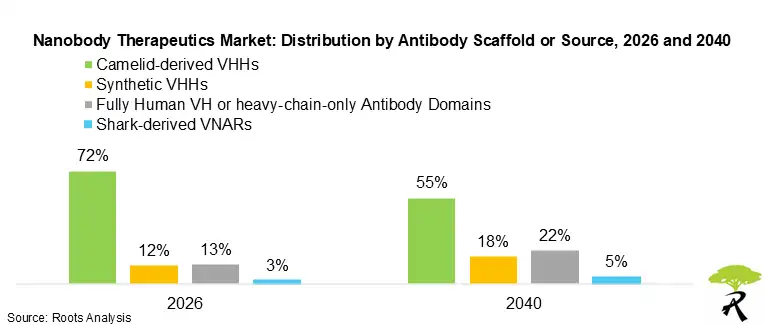
- Based on antibody scaffold or source, camelid-derived VHHs capture 72.0% market share in 2026, whereas fully human VH domains register a 23.2% CAGR through 2040, supported by reduced humanization requirements.
- Based on therapeutic area, hematological disorders capture 52.0% market share in 2026, whereas oncology registers a 24.7% CAGR through 2040, reflecting expanding multi-specific and tumor-targeted pipelines.
- Based on route of administration, subcutaneous delivery captures 72.0% market share in 2026, whereas inhaled delivery registers a 34.1% CAGR through 2040, supported by localized respiratory treatment.
- Based on geography, North America captures 40.0% market share in 2026, whereas Asia-Pacific registers a 21.7% CAGR through 2040, supported by regulatory reform and localized development.
Nanobody Therapeutics Market Outlook
Compact single-domain formats are shifting the nanobody therapeutics market from one-product validation toward diversified clinical and discovery pipelines. Earlier revenues depended heavily on bivalent hematology products and camelid-derived VHHs. Current demand increasingly favors bispecific, multivalent, fully human, inhaled, and tumor-targeted constructs. This transition is broadening addressable indications while raising requirements for library quality, developability testing, manufacturing control, and clinical differentiation across crowded biologic categories globally.
Growth now comes from multi-specific engineering, localized delivery, and faster regional development pathways. China's 30-working-day review route for eligible innovative-drug trials can shorten entry timelines for biological products and synchronized global studies. In March 2026, Novamab received Chinese Phase II approval for inhaled anti-IL-4Rα VHH candidate LQ036 in chronic obstructive pulmonary disease. These factors support broader respiratory and Asia-Pacific pipelines with clearer development incentives and investment visibility.
Through 2040, the market will remain high-growth as oncology, immunology, inhaled delivery, and fully human VH platforms gain share. Bispecific nanobodies will expand at 24.7% CAGR, while inhaled products will grow at 34.1%. In October 2025, Harbour BioMed launched a generative-AI heavy-chain-only antibody model combining sequence generation, computational screening, and laboratory validation. Commercial outcomes will still depend on clinical proof, access, and scalable manufacturing across regions.
Nanobody Therapeutics Market Dynamics
Nanobody Therapeutics Market Drivers
Multi-specific design is accelerating demand because compact VHH domains can combine complementary targets without conventional antibody bulk. Bispecific nanobodies will grow at 24.7% CAGR through 2040, while oncology will match that pace. Sanofi's lunsekimig program shows how dual TSLP and IL-13 targeting can expand respiratory pipelines. Fully human VH platforms also reduce humanization work, helping developers shorten engineering cycles and differentiate crowded immunology and oncology portfolios.
Nanobody Therapeutics Market Restraints
Clinical inconsistency remains a major restraint because promising mechanisms still face endpoint variability and indication-specific trial risk. MoonLake's VELA-1 study met its primary endpoint, while VELA-2 did not after a higher-than-expected placebo response in September 2025. Pipeline removals also expose portfolio risk, as Sanofi dropped SAR445611 and SAR444200 in January 2025. These outcomes can delay licensing, reduce valuations, and increase capital requirements before commercialization.
Nanobody Therapeutics Market Opportunities
Localized delivery creates a major opportunity by placing compact biologics closer to diseased tissues while limiting systemic exposure. Inhaled nanobody biologics will grow at 34.1% CAGR through 2040, outpacing every route analyzed. In March 2026, Novamab received Chinese Phase II approval for inhaled LQ036 in chronic obstructive pulmonary disease. Developers with formulation, device, and respiratory-trial capabilities can build stronger positions in underserved airway diseases.
Nanobody Therapeutics Market Challenges
Manufacturing and market access challenges increase as developers move from simple VHH products toward multivalent, fusion, and conjugated structures. Each added domain can affect expression yield, stability, aggregation, potency, and comparability. Subcutaneous products currently hold 72.0% share, creating a high convenience benchmark for newer formats. Companies must also fund specialist trials, regulatory submissions, and scalable production before they can compete with established biologics and validated Nanobody platforms.
Nanobody Therapeutics Market Size Estimation Methodology
- As a starting point, the model defined the nanobody therapeutics market around therapeutic VHH, VH, heavy-chain-only, and VNAR products. It excluded generic Fab and scFv programs unless they formed part of a relevant single-domain platform. This boundary reduced double counting between drug revenues, discovery services, diagnostic products, research reagents, and broader antibody-engineering activity.
- Moving forward, the base-year range was tested against multiple credible secondary sources and the commercial contribution of approved products. Analysts reviewed drug approval timelines, company product status, therapeutic indications, pricing exposure, and regional availability. Outlying estimates tied to service-only definitions or unusually broad single-domain antibody coverage were removed before selecting the central 2026 baseline.
- Building on this, the forecast mapped clinical trial databases, company pipelines, and regulatory submission counts by molecular format, scaffold, therapeutic area, and administration route. Programs were weighted by development stage, clinical evidence, probability of progression, and expected launch timing. Greater weight was assigned to late-stage assets, approved products, and platforms supported by repeat partnerships or validated manufacturing capabilities.
- Drawing upon these, segment growth rates reflected adoption curves for bispecific, multivalent, fully human, inhaled, oral, and tumor-targeted formats. The model also considered patent filing volumes, platform licensing activity, clinical readouts, manufacturing readiness, and discovery-library expansion. These indicators distinguished commercially validated segments from promising categories that still face formulation, scale-up, clinical, or regulatory uncertainty.
- The projected value was then distributed across North America, Europe, Asia-Pacific, Latin America, the Middle East and Africa, and the Rest of the World. Regional assumptions incorporated drug approval timelines, innovative-trial review pathways, biologics infrastructure, specialist treatment access, reimbursement conditions, and localized development capacity. Faster expansion was assigned where policy reform and domestic platform development could improve clinical speed and commercialization.
- Finally, annual values were reconciled with an 18.7% overall CAGR and checked against segment totals for every forecast year. Sensitivity tests varied launch timing, clinical attrition, adoption speed, outsourcing penetration, and regional access. The nanobody therapeutics market forecast retained gradual growth moderation after major pipeline commercialization, preventing early-stage platform enthusiasm from overstating long-term revenue conversion.
Nanobody Therapeutics Market Share Insights
Market Share by Antibody Scaffold or Source
According to our analysis, camelid-derived VHHs lead through approved-product precedents, mature humanization methods, extensive libraries, and scalable recombinant manufacturing. In September 2025, Sanofi reported positive Phase IIa results for brivekimig, a dual-target Nanobody VHH addressing TNF and OX40L.
Fully human VH domains will gain adoption by reducing humanization requirements and supporting compact multispecific therapeutic architectures. In August 2025, researchers published Phase I CB307 findings, supporting the clinical feasibility of a trispecific, fully human Humabody construct.
Market Share by End User
Pharmaceutical and biotechnology companies lead because clinical development requires significant capital, regulatory expertise, manufacturing control, and global commercialization capabilities. In April 2025, Sanofi expanded lunsekimig's respiratory program through new asthma data and additional planned clinical studies.
Contract research and development organizations will benefit as smaller developers outsource library design, screening, engineering, and developability assessment. In May 2026, Alloy Therapeutics and the Institute for Protein Innovation partnered to develop scalable VHH libraries for multispecific discovery.
Want Information on Specific Region / Segment?
Regional Analysis: North America Leads the Market and Asia-Pacific is Likely to Register Higher CAGR
North America holds 40.0% market share in 2026. North America leads through advanced biologics infrastructure, substantial venture capital, specialist treatment networks, and extensive regulatory experience. The region also hosts numerous clinical programs targeting inflammatory diseases, oncology, respiratory disorders, and rare hematological conditions. In May 2026, MoonLake completed a positive final pre-BLA meeting with the US FDA for Nanobody candidate sonelokimab. The company plans its hidradenitis suppurativa submission for September 2026, strengthening the region's late-stage development pipeline.
Asia-Pacific will expand at a 21.7% CAGR from 2026 to 2040. Asia-Pacific will gain share through faster regulatory pathways, expanding clinical infrastructure, localized biologics manufacturing, and growing access to advanced therapies. China and Japan already provide commercial anchors, while regional developers are advancing inhaled and subcutaneous single-domain therapeutics. In September 2025, China's National Medical Products Administration introduced a 30-working-day review pathway for eligible innovative-drug clinical trials. The policy supports biological products, synchronized global development, and multicenter clinical studies.
Market Ecosystem Analysis
Five Tier 1 organizations hold the broadest commercial reach across marketed therapies, scaled discovery services, and integrated manufacturing. Thirteen Tier 2 specialists and five emerging companies compete through disease-focused pipelines, novel scaffolds, and specialized discovery capabilities. Platform convergence dominates consolidation as companies combine fully human libraries, multi-specific engineering, preclinical development, and manufacturing through licensing alliances. Competitive advantage is shifting from library ownership toward clinical validation, differentiated administration, developability, and seamless discovery-to-manufacturing progression.
- In December 2025, Sanofi gained FDA approval for Cablivi in patients aged 12 years and older. The pediatric expansion strengthens Sanofi's hematology position and increases specialty-clinic demand. It also raises regulatory evidence requirements for competing VHH programs targeting rare hematological disorders.
- In October 2025, MoonLake disclosed mixed Phase 3 VELA results for subcutaneous sonelokimab in hidradenitis suppurativa. VELA-1 met both statistical analyses, while VELA-2 missed one composite analysis amid higher placebo responses. These findings validate subcutaneous nanobody activity while raising differentiation pressure against established full-length immunology biologics.
- In March 2025, Novamab completed Phase IIa testing of inhaled LQ036, an IL-4R alpha VHH for asthma. The milestone lowers administration barriers for respiratory biologics and intensifies competition around pulmonary delivery and localized exposure. It strengthens the inhaled route within immunology and inflammatory disease applications.
- In March 2025, Harbour BioMed entered an AstraZeneca licensing collaboration covering early-stage multispecific antibody discovery. The agreement raises partnership and data-scale barriers for smaller heavy-chain platforms lacking major-pharma validation. It strengthens fully human HCAb formats across oncology, immunology, and Asia-Pacific discovery operations.
- In March 2026, Biocytogen licensed its RenNano platform to Taisho for internal fully human heavy-chain antibody discovery. Taisho thereby extends beyond marketed Nanozora into proprietary discovery supporting bispecifics, ADCs, and in vivo CAR-T. The agreement pressures platform vendors to combine in vivo diversity, developability, and flexible licensing structures.
- In May 2026, Alloy Therapeutics integrated IPI's synthetic humanized VHH libraries into its antibody discovery infrastructure. This convergence lowers customer access barriers while pressuring standalone library providers without downstream engineering services. It strengthens synthetic VHH inputs for bispecific and multispecific oncology or immunology programs.
- In June 2025, Isogenica and Charles River combined synthetic VHH discovery with downstream drug development services. The network lowers handoff friction and pressures independent library vendors unable to support candidate selection. It strengthens synthetic VHH services for pharmaceutical and biotechnology end users.
- In September 2025, Abkyu signed a VHH discovery collaboration with Jeevan valued at up to USD 200 million. Dedicated platform access and downstream engineering raise specialization barriers around difficult targets and precise product profiles. The alliance strengthens camelid VHH discovery and ADC development for Crohn's disease and colorectal cancer.
- In July 2025, Leveragen accepted strategic investment from Propeller Bio while granting access to fully human VH-only mice. The model reduces dependence on camelid immunization and synthetic libraries, intensifying competition among antibody-source platforms. It supports bispecifics, ADCs, CAR-T therapies, and mRNA-encoded antibodies for North American developers.
Startup Companies and their Key Highlights
- Cortalix
- Event type and funding amount: EUR 1 million investment and financing package
- Month and year: March 2025
- Investor: Future Tech Ventures
- Stated purpose: Accelerate development and commercialization of single-domain antibody technology
- Market implication: Strengthens European capabilities for VHH-enabled PET imaging, radiotherapy, and CAR-T applications.
- Abkyu
- Event type and funding amount: VHH discovery collaboration valued at up to USD 200 million
- Month and year: September 2025
- Strategic partner: Jeevan Therapeutics
- Stated purpose: Provide dedicated VHH discovery access and downstream engineering against Jeevan's primary therapeutic target
- Market implication: Accelerates camelid-derived VHH and ADC programs addressing Crohn's disease recurrence and colorectal cancer.
- Leveragen
- Event type: Strategic collaboration supported by strategic investment
- Month and year: July 2025
- Strategic partner: Propeller Bio
- Stated purpose: Expand platform development and provide access to fully human VH-only mouse models
- Market implication: Accelerates fully human VH development for bispecifics, ADCs, CAR-T therapies, and mRNA-encoded antibodies.
- Shanghai Novamab Biopharmaceuticals
- Event type: Completion of Phase IIa proof-of-concept testing
- Month and year: March 2025
- Stated purpose: Evaluate inhaled IL-4R alpha VHH LQ036 in patients with moderate-to-severe asthma
- Market implication: Advances inhaled nanobody delivery and strengthens respiratory immunology development within Asia-Pacific.
- Elasmogen
- Event type: Preclinical data presentation for ELN28
- Month and year: May 2025
- Stated purpose: Demonstrate a bifunctional soloMER conjugate targeting TNF-alpha and JAK at inflammatory sites
- Market implication: Advances shark-derived VNAR conjugates and strengthens fusion-format development for inflammatory diseases.
Nanobody Therapeutics Market Trends / Opportunities
Multispecific Nanobody Engineering Expanding Addressable Biology and Competitive Differentiation
Compact VHH domains allow developers to combine several mechanisms within structures smaller than many conventional multispecific antibodies. Bispecific nanobodies will grow at 24.7% CAGR, while multivalent formats will expand at 20.8%. In April 2026, Sanofi reported positive Phase II results for lunsekimig, a five-fragment bispecific VHH targeting TSLP and IL-13. Successful programs can compete through pathway breadth rather than single-target potency alone.
New discovery libraries are widening access to complex multispecific architectures. In May 2026, Alloy Therapeutics and the Institute for Protein Innovation announced humanized VHH libraries for bispecific, multispecific, and other next-generation antibody programs. Scalable library access can lower early discovery barriers and shift value toward screening quality, developability, and downstream execution.
Fully Human Heavy-Chain Platforms Reducing Engineering Burden and Increasing Licensing Value
Fully human VH and heavy-chain-only domains will grow at 23.2% CAGR through 2040. These platforms can reduce humanization work and support compact multispecific products with fewer sequence-modification steps. In March 2026, Biocytogen granted Taisho Pharmaceutical access to its RenNano fully human heavy-chain-only platform for internal therapeutic discovery. Platform owners can monetize technology through licensing while retaining internal pipeline options.
Computational design is becoming more closely integrated with wet-laboratory validation. In October 2025, Harbour BioMed launched a generative-AI heavy-chain-only antibody model covering sequence generation, computational screening, and laboratory testing. Companies combining proprietary training data with experimental validation can shorten candidate-selection cycles and strengthen partnership positioning.
Localized Nanobody Delivery Creating New Respiratory and Patient-Convenience Markets
Inhaled delivery will grow at 34.1% CAGR, compared with 16.4% for the currently dominant subcutaneous route. Local administration can increase respiratory-tissue exposure while reducing systemic dosing requirements. In March 2026, Novamab received Chinese Phase II approval for inhaled LQ036 in chronic obstructive pulmonary disease. Respiratory specialists with formulation and device expertise can establish defensible positions beyond conventional injectable biologics.
Subcutaneous delivery still controls 72.0% of the 2026 market because it combines proven clinical use with lower infusion-center dependence. In December 2025, Alphamab Oncology received another FDA orphan designation for subcutaneous PD-L1 single-domain antibody envafolimab. New entrants must match established convenience while proving that alternative routes offer meaningful efficacy, safety, or adherence benefits.
Outsourced VHH Discovery Increasing Specialist Participation and Partnership Competition
Contract research and development organizations will grow at 25.6% CAGR as smaller companies outsource immunization, library construction, screening, engineering, and developability assessment. In June 2026, Abkyu and Synap Biotech entered a multi-target agreement using Abkyu's VHH discovery engine. Specialist providers can capture more value by linking discovery services with candidate optimization and milestone-based economics.
Platform partnerships increasingly include larger downstream payments rather than simple fee-for-service contracts. In September 2025, Abkyu and Jeevan Therapeutics announced a VHH discovery collaboration valued at up to USD 200 million. Providers with differentiated libraries and repeatable discovery performance can negotiate stronger economics and deeper program participation.
Your Business is Unique – Why Shouldn't Your Report Be?
Market Access Considerations
Clinical Validation and Endpoint Reliability
Nanobody programs require indication-specific clinical evidence that separates molecular promise from reproducible patient benefit. MoonLake's September 2025 VELA results showed this constraint when VELA-1 met its primary endpoint but VELA-2 did not following a higher-than-expected placebo response. Divergent outcomes can delay submissions, weaken licensing terms, and require additional capital. Companies with rigorous trial design and clear responder strategies can protect development speed and competitive credibility.
Regulatory Pathway Selection and Regional Sequencing
Regulatory speed varies by geography, making launch sequencing a material access decision. China's 30-working-day review pathway for eligible innovative-drug clinical trials supports biological products, synchronized global programs, and multicenter studies. Faster review can enable regional developers to enter trials earlier and generate locally relevant evidence. Companies that coordinate Chinese, Japanese, European, and North American submissions can improve capital efficiency while reducing delays between regional development stages.
Manufacturing Control for Complex Single-Domain Formats
Manufacturing access depends on more than producing a small recombinant domain. Bispecific, multivalent, fusion, and conjugated products require control over expression yield, folding, aggregation, potency, purification, and comparability. GenScript ProBio, WuXi Biologics, and Eurogentec address discovery-to-manufacturing requirements within the documented ecosystem. Developers with integrated manufacturing plans can scale faster, while programs lacking early developability work may face expensive redesigns before clinical or commercial production.
How Stakeholders Benefit from the Key Focus Areas of Our Nanobody Therapeutics Market Report
An 18.7% market CAGR, multispecific pipeline expansion, and localized delivery make nanobody therapeutics commercially urgent. The report connects clinical progress, platform adoption, regional access, and competitive activity to strategic, investment, and technology decisions.
- Unmet Needs and Market Gaps in Nanobody Therapeutics Market: The report identifies gaps where compact single-domain structures can address limitations in tissue penetration, treatment convenience, or pathway coverage. It compares underserved respiratory, oncology, neurological, and metabolic opportunities against established hematology and immunology positions. Portfolio planners can use this analysis to select indications with strong biological fit and lower direct competition. The findings support target selection, indication prioritization, and product-positioning decisions.
- Funding and Venture Investment Opportunities in Nanobody Therapeutics Market: The analysis maps capital opportunities across fully human platforms, multispecific constructs, inhaled products, and outsourced VHH discovery. It also separates platform value from asset-specific clinical risk, including inconsistent trial outcomes and discontinued programs. Investment teams can use these signals to assess whether value sits in proprietary libraries, clinical candidates, licensing economics, or manufacturing capabilities. This supports due diligence, valuation, and portfolio-allocation decisions.
- Technology Innovation and Adoption Trends: The report tracks adoption across bispecific, multivalent, fusion, fully human VH, inhaled, oral, and VNAR-derived technologies. It quantifies which formats gain share and which established categories lose relative importance through 2040. Research and development leaders can compare internal capabilities against emerging engineering and delivery requirements. The analysis supports platform investment, licensing, build-versus-partner, and technical-resource decisions.
- Nanobody Therapeutics Market Competitive Landscape and Industry Analysis: The competitive review separates global pharmaceutical leaders, specialized platform companies, contract development providers, and emerging VHH or VNAR developers. It explains how approved-product experience, clinical depth, library quality, and manufacturing integration influence competitive strength. Corporate strategy teams can identify crowded positions and capability gaps before entering specific segments. The findings support benchmarking, acquisition screening, differentiation, and market-entry planning.
- Mapping Strategic Partnerships and Ecosystem Synergies: The ecosystem analysis tracks discovery agreements, platform licensing, library collaborations, options, and milestone-based development structures. It shows where pharmaceutical companies depend on specialist providers for immunization, screening, engineering, developability, or manufacturing. Business development teams can identify partners whose capabilities complement internal pipelines. This supports alliance targeting, licensing strategy, outsourcing selection, and negotiation of program economics.
- Nanobody Therapeutics Market CAGR and Growth Trends: The report links the 18.7% overall CAGR with segment-level growth across formats, scaffolds, therapeutic areas, routes, end users, and regions. It highlights inhaled delivery at 34.1%, contract research and development organizations at 25.6%, and bispecific nanobodies at 24.7%. Commercial and financial planners can distinguish structural growth from temporary pipeline activity. The forecast supports revenue planning, resource allocation, regional expansion, and long-term scenario development.
Nanobody Therapeutics Market: Scope of the Report
| Key Report Attributes | Details | |
| Forecast Period | Till 2040 | |
| Market Size 2026 | USD 0.60 Billion | |
| Market Size 2040 | USD 6.60 Billion | |
| CAGR (Till 2040) | 18.7% | |
| Segments Covered |
|
|
| Geographical Regions Covered |
|
|
| Key Sections Covered |
|
|
Market Segmentation
The nanobody therapeutics market report presents an in-depth analysis, highlighting the capabilities of various stakeholders, based on different segments, such as molecular format, antibody scaffold or source, therapeutic area, route of administration, end user, geographical regions, and leading players.
By Molecular Format
- Monovalent Nanobodies
- Bivalent Nanobodies
- Bispecific Nanobodies
- Biparatopic Nanobodies
- Multivalent Nanobodies
- Fusion Nanobodies
By Antibody Scaffold or Source
- Camelid-derived VHHs
- Synthetic VHHs
- Fully Human VH or Heavy-Chain-Only Antibody Domains
- Shark-Derived VNARs
By Therapeutic Area
- Oncology
- Immunology and Inflammatory Diseases
- Infectious Diseases
- Neurological Disorders
- Hematological Disorders
- Metabolic and Endocrine Diseases
- Other Therapeutic Areas
By Route of Administration
- Intravenous
- Subcutaneous
- Inhaled
- Oral
- Topical
By End User
- Pharmaceutical and Biotechnology Companies
- Hospitals and Specialty Clinics
- Contract Research and Development Organizations
- Academic and Research Institutes
By Geographical Regions
- North America
- US
- Canada
- Mexico
- Rest of North America
- Europe
- Austria
- Belgium
- Denmark
- France
- Germany
- Ireland
- Italy
- Netherlands
- Norway
- Russia
- Spain
- Sweden
- Switzerland
- UK
- Rest of Europe
- Asia-Pacific
- China
- India
- Japan
- Singapore
- South Korea
- Rest of Asia-Pacific
- Latin America
- Argentina
- Brazil
- Chile
- Colombia
- Venezuela
- Rest of Latin America
- Middle East and Africa (MEA)
- Egypt
- Iran
- Iraq
- Israel
- Kuwait
- Saudi Arabia
- UAE
- Rest of MEA
- Rest of the World


