Natural Skin Care Market
Natural Skin Care Market: Industry Trends and Global Forecast, Till 2035- Distribution by Type of Product (Skin Care Creams & Lotions, Face Masks, Serums & Oils, Body Care Products, Exfoliators, and Sun Care Products), Type of Ingredient (Organic Ingredients, Botanical Extracts, Vitamins & Antioxidants, Essential Oils, Fruit Acids, and Herbal Ingredients), Type of Skin, Application Area, Distribution Channel, End User, Geographical Regions, and Leading Players
-
Lowest Price Guaranteed
-
Pages
199 -
Last Updated
July 2025 -
View Count
10024 -
Natural Skin Care Market Overview
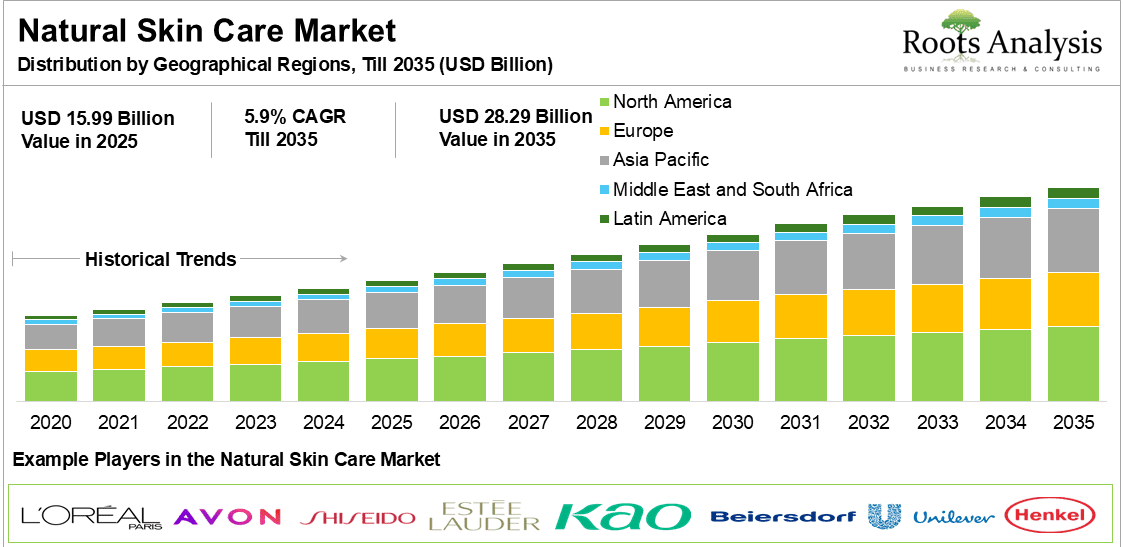
The global natural skin care market size, valued at USD 14.93 billion in 2024, is projected to reach USD 15.99 billion in 2025 and USD 28.29 billion by 2035, representing a CAGR of 5.9% during the forecast period.
 |
To learn more about this report, request a free sample copy
Natural Skin Care Market: In Summary
- The growing skin issues such as allergies, dryness, and itchiness due to prolonged use of synthetic chemical based products has led to a significant shift towards natural and organic skin care products.
- Companies, like Weleda (Switzerland), Loreal (France), Herbivore Botanicals (Washington), Origins (New York), True Botanicals (California) are encouraging partnerships to develop natural ingredient based skin care solutions, which is expected to offer enormous opportunities for investment in this industry..
- In terms of region, North America holds 35% share of the natural skin care market, and the trend of dominance is likely to remain unchanged in this region due to the factors, such as growing demand for organic skin care products among millennial population, and social media influence to achieve celebrity like skin.
- Face masks and serums & oils segments are likely to show exponential growth, registering higher CAGR during the forecast period.
Botanical extracts for natural skin care products will continue to gain traction in the future. This is potentially due to the fact that botanical extracts of plants, such as aloe vera are rich in antioxidants and mineral components which makes them highly beneficial for skin nourishment.
The natural skin care industry is tremendously growing and is likely to remain progressive during the upcoming years. This substantial growth is supported by the rising consumer awareness about natural ingredients, celebrity endorsement and growing focus on self-care. Notably, natural skin care range, such as serums, creams, moisturizers and makeup essential is widely adopted by youth and people of age group above 30 years. One of the primary reasons for a trajectory shift towards natural products is growing awareness about harmful effects of chemical based skincare products.
Additionally, the growing skin care issues, such as allergies due to prolonged use of synthetic chemical based products or relying on non-invasive aesthetic treatment have led to a significant shift towards natural and organic skin care products. Moreover, consumers are more focused on sustainability, eco-friendly and prioritizing health, which further supports the growth of organic skin care product market.
With increasing preferences of natural and organic skincare products, global leaders, such as Weleda, Loreal, Herbivore Botanicals, Origins, True Botanicals and more are strengthening their product range. For instance, in March 2025, Lifebuoy (UK) launched a new range of premium bodywashes, and soaps made with naturally derived functional actives and using plant-based technologies. This skin care range target skin concerns, such as oily skin, acne, dull skin, acne prone skin, and hyper-pigmentation. Similar to global market players, several startup companies are encouraging the development of skin care range with plant-based ingredients, such as chemical-free body lotion for eczema-prone skin, which is expected to drive the natural skin care market during the forecast period.
Natural Skin Care Market: Report Attributes
| Key Report Attributes | Details | |
| Historical Trend | Since 2020 | |
| Forecast Period | Till 2035 | |
| Market Size 2025 | USD 15.99 Billion | |
| Market Size 2035 | USD 28.29 Billion | |
| CAGR (Till 2035) | 5.9% | |
One of the key objectives of the natural skin care market report was to estimate the current size, opportunity, and the market growth potential, over the forecast period, till 2035. We have provided informed estimates on the likely evolution of the market for the forecast period.
The global natural skin care market report also features the likely distribution of the current and forecasted opportunity within the market across various segments, such as type of product, type of ingredient, type of skin, application area, distribution channel, end user, geographical regions, and leading players.
In order to account for future uncertainties associated with some of the key parameters and to add robustness to our model, we have provided three market forecast scenarios, namely conservative, base, and optimistic scenarios, representing different tracks of industry’s evolution.
Skin care is gaining popularity due to the hype of social media and willingness to spend fortune on nature-based products. The market's future lies in the intersection of personalization, sustainability, and scientific validation, where natural ingredients are enhanced through technology to deliver measurable benefits while maintaining environmental responsibility.
Recent Developments in Natural Skin Care Market
Several recent developments in the field of the natural skin care industry have occurred, and we outlined some of these below.
- In May 2025, New Beauty launched Old School Rituals’ Almond, Olive & Coco Priming BB Cream. This multitasker cream is made with 95% natural-origin ingredients to suit all skin types. This vegan silicone-free formula offers radiant glow and deeply hydrates skin.
- In April 2025, Ananya Birla director of Aditya Birla Group announced to enter into beauty and personal care market to meet with evolving consumer preferences for natural, innovative, and premium products.
- In April 2025, TRI-K Industries (US) debut into the natural skin care industry with three innovative actives that are designed to address skin hydration, hair density and skin brightening. TRI-K launched DensiFoll made with 99% natural sources, such as hydrolized rice protein, and stem / leaf / flower extract of Malva Sylvestris to improve hair thickness.
- In April 2025, I’m From (US) launched a new Black Rice Toner for oil and sensitive skin types. This tone controls sebum production, antioxidant protection and balanced hydration.
Natural Skin Care Market Segmentation Insights
The market report provides comprehensive information on natural skin care industrial players who are currently active across various segments of the industry as mentioned in the table below.
Natural Skin Care Market: Market Segmentation
| Market Segmentations | Details | |
| Type of Product |
|
|
| Type of Ingredient |
|
|
| Type of Skin |
|
|
| Application Area |
|
|
| Distribution Channel |
|
|
| End User |
|
|
| Geographical Regions |
|
|
| Market in North America |
|
|
| Market in Europe |
|
|
| Market in Asia-Pacific |
|
|
| Market in Middle East and North Africa |
|
|
| Market in Latin America |
|
|
Industry Experts on Natural Skin Care Products Market
With a significant shift towards clean and natural beauty products, the natural skin care industry continues to grow steadily. Market players are continually launching new products made with natural extracts and oils.
Josie Maran, Founder of Josie Maran Cosmetics in one of her interviews mentioned that argan oil is a beauty mainstay now, but when she debuted her little bottle of the stuff in 2007, it was the start of a skin-care revolution. In future, the demand for naturally derived oil to maintain radiant will be high and market will grow at a unprecedented rate.
Natural Skin Care Market Share Insights
Market Share by Type of Product: Skin Care Cream & Lotions Holds the Highest Share
- This segment covers a broad range of products, such as skin care creams & lotions, face masks, serums & oils, body care products, exfoliators, and sun care products. Currently, skin care creams & lotions hold 45% share of the natural skin care market. Natural essence and botanical extract based skin care creams & lotions are increasingly adopted to treat fine lines, wrinkles and achieve glow. This growing popularity of natural ingredient based creams and lotions are the solid reasons for highest share.
- It is worth noting that face masks and serums & oils segments are likely to show exponential growth, registering higher CAGR during the forecast period. Natural ingredient based serums and masks are in huge demand to treat hyperpigmentation, uneven skin tone and dark spots. Hence, these segments are likely to grow substantially in the future.
Market Share by Type of Ingredient: Botanical Extracts Holds the Largest Share
- The global market is segmented based on the type of ingredients into organic ingredients, botanical extracts, vitamins & antioxidants, essential oils, fruit acids, and herbal ingredients. According to our natural skin care market forecast, botanical extracts segment is dominating the market. This dominance is due to the fact that botanical extract-based skincare products are highly adopted due to its skin soothing properties.
- Notably, the botanical extracts like aloe vera gel, chamomile oil, and rosemary extract are rich in antioxidants and essential minerals such as magnesium and zinc, which helps to improve skin radiance naturally. Owing to its skin nourishing properties, these botanical extracts based skincare products are gaining popularity among people.
- In the future, organic ingredients segment is likely to grow at a higher CAGR during the forecast period. This is potentially due to the growing shift towards 100% cruelty-free anti-aging serum for mature skin and eco-friendly skin care products.
Market Share by Type of Skin: Dry Skin Segment is Dominating the Market
- Based on the skin type, the global market is segmented into dry skin, oily skin, sensitive skin, normal skin, and combination skin. Among these, the dry skin segment holds the highest share of the market. This is primarily due to the inherent need for intensive nourishment and timely hydration to prevent issues like flakiness and tightness, which are common concerns for individuals with dry skin.
- Consequently, consumers are increasingly seeking natural skincare ranges formulated with key ingredients, such as jojoba oil, shea butter, and avocado oil, as these provide the deep, sustained nourishment crucial for alleviating dryness and maintaining skin health. Thus, growing shift towards natural skincare range for skin hydration is anticipated to be the key reason for highest share of this segment.
- Notably, in the coming years sensitive skin segment is anticipated to grow a higher CAGR during the forecast period. This is likely to be the result of sensitive skin based consumer is highly cautious in selecting skin care products. They demand more natural ingredient based products to prevent hypoallergic conditions. Industrial players are continually preparing advanced skin care formulations by using natural ingredients for sensitive skin type, which is expected to offer lucrative opportunities in this segment.
Market Share by Application Area: Face Care Segment Holds Largest Share
- Based on the application area, the global market is segmented into face care, body care, and hand & foot care. According to the natural skin care market report, presently face care segment holds the largest share. This is essentially due to the heightened demand for natural skin care products, such as face care formulations that are specifically designed to address visible signs of aging like fine lines and wrinkles, while also providing deep nourishment and improving overall skin radiance and texture.
- Notably, the accelerating adoption of natural ingredient-based face serums, toners, skin cleansers, exfoliators, and organic moisturizers, particularly organic moisturizers for acne-prone skin, is poised to drive this segment at a significantly higher CAGR throughout the forecast period. This surge is fueled by heightened consumer awareness regarding the benefits of chemical-free formulations, coupled with a growing preference for holistic and sustainable beauty solutions
Market Share by Distribution Channel: Super Markets / Hyper Markets Occupies Highest Share
- The global market is further segmented across distribution channels, such as online retail, offline retail, supermarkets / hypermarkets, specialty stores, and pharmacies & drugstores. Presently, supermarkets / hypermarkets segment is dominating by holding maximum natural skin care market share. Supermarkets and hypermarkets offer direct pathways to purchase skin care products. Moreover, their ability to provide a broad range of products in one accessible location facilitates quick comparison and fosters a sense of trust and familiarity, significantly contributing to the highest share of super markets / hyper markets segment.
- In the future, the online retail segment is likely to register a higher CAGR during the forecast period. Online purchase is convenient and integration of AI with online platforms helps to find the right skincare solution based on skin analysis, which further expected to rise its popularity among global population.
Market Share by End User: Women Segment is Holding Highest Share
- Based on the end user, the global market is segmented into men and women. According to the natural skin care market analysis, women segment holds the highest share. Women are the primary consumer of natural skin care products to maintain youthful skin.
- It is worth mentioning that, the rising awareness about consequences of chemical based skin care products and benefits of natural remedies for hyperpigmentation on face have further fueled the demand of natural skin care products among women. Therefore, this segment is likely to grow at a higher CAGR during the forecast period.
Market Share by Geographical Regions: North America is Dominating the Market
- The global market for natural skin care has been distributed across North America, Europe, Asia-Pacific, Middle East and North Africa, and Latin America. Presently, North America holds 35% share of the market, and the trend of dominance is likely to remain unchanged in this region. Several factors, such as celebrity endorsement, rising disposable income and growing awareness among youth about natural skin care products benefits have fueled the market growth in this region.
- Asia-Pacific’s natural skin care market is expected to grow at a higher CAGR during the forecast period. Several factors, including rapid urbanization that influence young population to maintain youthful radiance, the growing appeal of natural products, and the continued embrace of traditional beauty solutions. Furthermore, Asian countries, such as China, Japan and India are known for ayurveda based skin care regime which is continually pulling attention of the global population.
Natural Skin Care Market: Report Deliverables
| Report Deliverables | Details | |
| Excel Data Packs (Complimentary) |
Available | |
| Key Natural Skin Care Products Manufacturers Profiled |
|
|
| PowerPoint Presentation (Complimentary) |
Available | |
| Customization Scope | 15% Free Customization | |
Natural Skin Care Market Major Takeaways
The “Natural Skin Care Market Report: Industry Trends and Global Forecasts, till 2035” market report features an extensive study of the current market landscape, market size, market share, market growth, market trends, market value, market forecast, market outlook, statistics, and future opportunities for natural skin care industrial players. The market research report lays emphasis on the natural skin care products that are being developed. Key takeaways of the market report are briefly discussed below.
Natural Skin Care Market Competitive Landscape
Based on current scenario, the natural skin care market is witnessing massive competition from well-established and new entrants. Key manufacturers of the industry are focusing on the development of sustainable and 100% nature ingredient based skin care range including serums, cleansers, toners, moisturizers and lotions. In order to meet ongoing demand, several industrial players are leveraging partnerships and collaborations.
For instance, in March 2025, Weleda (Switzerland) partnered with Princess Madeleine to co-develop minLen, a skin care brand for children and adults. This collaboration will focus on the skincare products, made with natural ingredients.
Natural Skin Care Market Size Analysis: Which Segment is Dominating the Market?
In 2025, the natural skin care market size is valued at USD 15.99 billion in 2025 and poised to reach USD 28.29 billion by 2035. This significant industry transformation is driven by the high demand for plant-based and chemical-free skin care products. In terms of products, skin care creams and moisturizers are dominating the market. This lucrative growth is due to the high adoption of creams and moisturizers to maintain radiant glow and treat aging signs.
Market Drivers: What are the Major Natural Skin Care Market Drivers?
Some of the notable drivers that are propelling market growth are listed below.
- Rising consumer awareness about the harmful consequences of chemical based skin care products has bolstered the demand for natural skin care products. This awareness extends to understanding the long-term benefits of organic ingredient-based items, prompting customers to seek out natural skin care products.
- Rising environmental concerns are significantly driving product demand, as consumers increasingly prioritize sustainability in their purchasing decisions. The growing demand for organic and vegan cosmetics, such as vegan sunscreen for oily skin, is pushing manufacturers to become creative with plant-based and biodegradable ingredients.
Market Challenges: What are the Major Challenges in Natural Skin Care Products Market?
Despite growing demand, the natural skin care industry is witnessing several challenges that are listed below.
- Greenwashing or availability of counterfeit products may create challenges for the industrial players. Notably, some natural skin care products manufacturers may falsely claim to provide natural, organic, or eco-friendly skin care products without genuine adherence to such standards, it creates confusion among consumers. Once consumers realize they have been misled, they lose trust not only in the specific greenwashing brand but potentially in the entire natural segment. This makes it harder for genuinely ethical and natural brands to distinguish themselves and gain consumer loyalty.
- Supply chain disruption and manufacturing of natural ingredients based skin care products while maintaining quality standards can create significant challenges for the market players. For instance, drought conditions in some regions which produce lavender or tea tree oil significantly reduce crop yields. Therefore, it can lead to a shortage and exponential increase in raw material costs. Similarly, floods can destroy harvests of aloe vera or chamomile, impacting availability and consistency.
Market Trends: What are the key Natural Skin Care Market Trends?
Some of the notable organic skin care market trends that are shaping industrial growth are listed below.
- The organic skin care industry players are leveraging technological advancement with AI formulation platforms that enable real-time customization of natural cosmetics based on genetic and skin microbiome data. Furthermore, the integration of smart skin devices and AI-based apps helps to monitor skin health in real time, so natural skin care products manufacturers can adjust skin care formulas according to the condition of the skin.
- Production innovation with green technology or quantum computing is likely to be a key trend in the natural skin care industry. Notably, green sourcing materials like lab-cultured botanicals and sustainable harvesting practices are becoming standard industry approaches to develop natural skin care solutions.
Natural Skin Care Market Report Coverage
The market report presents an in-depth analysis, highlighting the capabilities of various stakeholders in the natural skin care industry, across different geographies. Amongst other elements, the market report includes:
- An Infographic Executive Summary
- Market Landscape of Natural Skin Care Product Developers
- Competitive Landscape
- Porter’s Five Forces Analysis
- Company Competitiveness Analysis
- Company Profiles
- Recent Developments
- Market Opportunity Analysis
- Adjacent Market Analysis
- Market Impact Analysis
- Market Forecast Analysis
From the Author’s Desk
Author’s View on Natural Skin Care Market
The natural skin care market represents one of the most dynamic and promising segments within the global beauty industry, characterized by robust growth potential and fundamental shifts in consumer behavior toward sustainability and health consciousness. The convergence of technological innovation, environmental awareness, and personalized beauty solutions positions this market for sustained expansion beyond traditional growth projections.
From an analytical perspective, the market's trajectory suggests a paradigm shift from conventional chemical-based formulations toward scientifically backed natural anti-aging cream for sensitive skin and other products that deliver comparable or superior results. The integration of artificial intelligence, biotechnology, and sustainable sourcing practices is creating unprecedented natural skin care market opportunities for industrial players to develop innovative skin care solutions.
Glossary
- Natural Skin Care: This refers to the products, and skincare solutions derived from natural, plant-based, and organic ingredients.
- Clean Beauty: These are products formulated without potentially harmful ingredients like paraben-free moisturizer for combination skin, sulfate-free hair cleanser, and synthetic fragrances, emphasizing safety and transparency.
- Organic Certification: Official verification that products meet specific standards for organic ingredient sourcing and manufacturing processes.
- Greenwashing: The practice of making misleading claims about environmental benefits to appeal to eco-conscious consumers.
- Plant-Based Actives: Biologically active compounds derived from plants that provide specific skincare benefits.