
Lowest Price Guaranteed
Pages
224
Last Updated
July 2026
View Count
5722
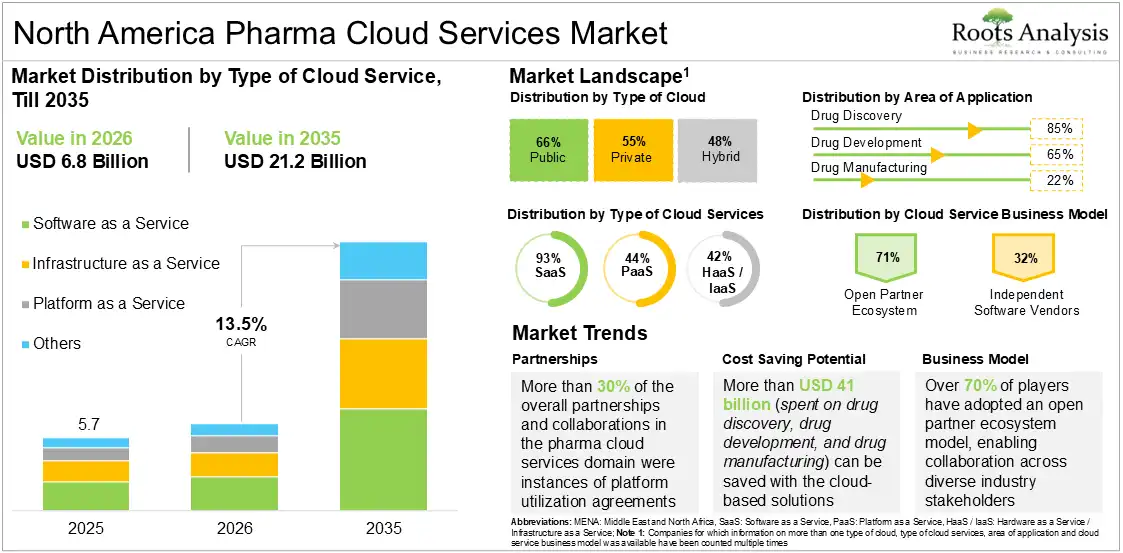
The North America pharma cloud services market, valued at USD 5.7 billion in 2025, is projected to reach USD 6.8 billion in 2026 and USD 21.2 billion by 2035, representing a CAGR of 13.5% during the forecast period from 2026 to 2035.
To learn more about this report, request a free sample copy
The pharmaceutical industry is undergoing a steady digital transformation, driven by the need to manage growing volumes of complex data across research, development, clinical operations, manufacturing, and commercialization. In this evolving landscape, cloud computing has emerged as a critical infrastructure layer, enabling secure data storage, seamless collaboration, advanced analytics, and faster information exchange across geographically dispersed teams.
While healthcare and pharmaceutical organizations were initially cautious in adopting cloud technologies due to concerns around data privacy, security, and regulatory compliance, the availability of compliant cloud environments has significantly improved confidence in their use. This is particularly evident in North America, where a mature healthcare IT ecosystem, strong regulatory frameworks, and the presence of leading pharmaceutical and biotechnology companies have created a favorable environment for cloud adoption.
As pharmaceutical companies generate large volumes of genomic, clinical, imaging, real-world, and manufacturing data, traditional IT systems are becoming increasingly inadequate to support modern R&D requirements. Cloud-based platforms address this gap by offering scalable computing power, flexible storage, and advanced data processing capabilities.
Further, in drug discovery, these platforms allow researchers to analyze large and diverse datasets more efficiently, supporting faster target identification, lead optimization, and candidate selection. As pharmaceutical companies integrate artificial intelligence and machine learning into early-stage research, cloud computing is becoming a key enabler of data-driven drug discovery.
The role of cloud computing becomes even more significant as drug candidates move from discovery into development. Clinical development involves multiple stakeholders, large patient datasets, complex trial designs, and stringent documentation requirements. Cloud-based solutions help streamline these processes by supporting clinical trial management, decentralized trial models, predictive analytics, pharmacovigilance, regulatory submissions, and real-time collaboration between sponsors, contract research organizations, investigators, and regulators.
In North America, where clinical trial activity is high and regulatory expectations are well-defined, pharmaceutical companies are increasingly adopting cloud platforms to improve trial efficiency, strengthen compliance readiness, and accelerate decision-making across development programs. Beyond R&D and clinical development, cloud technologies are also becoming increasingly important in pharmaceutical manufacturing and supply chain management.
The industry continues to face pressure to improve transparency, ensure product quality, support precision medicine, reduce inefficiencies, and strengthen resilience across complex global supply networks. Cloud-based systems enable better visibility into manufacturing operations, quality control processes, inventory movement, serialization, and supplier coordination. For North American pharmaceutical companies, these capabilities are particularly valuable as they seek to modernize legacy infrastructure, enhance compliance with stringent quality standards, and build more agile manufacturing ecosystems.
The growing relevance of cloud computing is also reflected in the strategies of leading pharmaceutical companies. Organizations such as Pfizer, Novartis, and AstraZeneca have increasingly leveraged platforms such as AWS and Microsoft Azure to support data management, AI-enabled research, clinical workflows, and enterprise-wide digital transformation. These initiatives demonstrate that cloud adoption is no longer limited to basic IT modernization; it is becoming a strategic priority for improving innovation capacity, operational efficiency, and time-to-market.
As AI integration, cybersecurity frameworks, multi-cloud deployment, and regulatory-grade data platforms continue to advance, the pharma cloud services market in North America is expected to witness sustained growth during the forecast period.
| Application Area | Cloud Service Requirement | Representative Companies / Platforms | Market Relevance |
| Drug Discovery & Computational Biology | Scalable compute, AI models, molecular simulation, biological foundation models | AWS, Google Cloud, Microsoft Azure, NVIDIA BioNeMo, Databricks | Demand is increasing as pharmaceutical companies use cloud and AI platforms to accelerate early-stage discovery and reduce experimentation cycles. |
| Clinical Trial Operations | eClinical platforms, trial data capture, RTSM, site management, clinical analytics | Oracle Clinical One, Veeva Vault Clinical, Salesforce Life Sciences Cloud, Medidata, IQVIA | Clinical development remains one of the largest pharma cloud use cases due to the need for faster, decentralized, and data-driven trials. Oracle Clinical One supports trial data collection and RTSM workflows. (Oracle) |
| Regulatory & Quality Management | Document control, audit trails, validation, submission readiness, quality workflows | Veeva Vault, Oracle Life Sciences, Microsoft Azure, AWS, IBM | Regulated cloud adoption is driven by the need to manage GxP workflows, content, validation and compliance documentation across distributed teams. |
| Commercial & HCP Engagement | CRM, omnichannel engagement, content approval, field force enablement, patient services | Salesforce Life Sciences Cloud, Veeva Vault CRM, IQVIA OCE, Microsoft Dynamics 365 | Salesforce and IQVIA expanded their partnership to combine IQVIA OCE innovations with Salesforce Life Sciences Cloud for life sciences engagement. (IQVIA) |
| Real-World Evidence & Data Analytics | Secure data platforms, clean rooms, analytics, data sharing, AI / ML | Snowflake, Databricks, IQVIA, Google Cloud, AWS | Snowflake and Databricks are relevant because pharma companies increasingly need governed data platforms for real-world data, analytics and AI workloads. (Snowflake) |
Based on the research, we have segmented the North America Pharma Cloud Services Market into area of application, type of cloud service, type of cloud and end user.
By Area of Application
By Type of Cloud Service
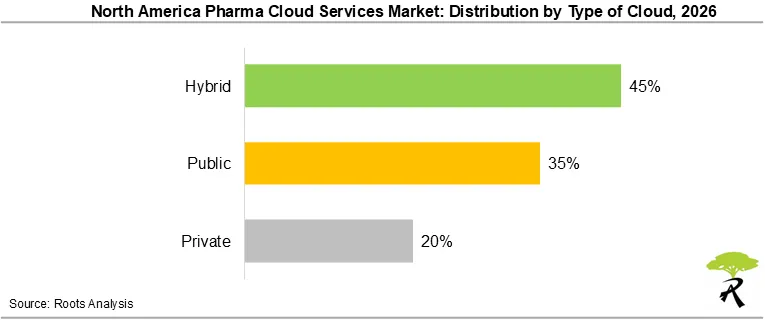
By Type of Cloud
By End User
The market growth is fueled by various factors, including the rising adoption of virtual clinical trials, which rely on secure, scalable cloud infrastructure to enable remote patient participation. Further, the integration of AI in pharma cloud software also accelerates drug discovery, optimizes clinical trial management, and improves operational efficiency across development and manufacturing processes. Moreover, increasing regulatory requirements for data management and compliance is further prompting pharma companies to adopt cloud solutions that offer validated, secure environments. The market is also supported by demand for scalable, cost-effective Software as a Service (SaaS) applications that improve clinical data management, pharmacovigilance, manufacturing, and commercial operations.
Discussions with multiple stakeholders in this domain influenced the opinions and insights presented in this study. The market report includes transcripts of the following discussions:
In addition, the market report includes transcripts from the following third-party discussions:
The North America pharma cloud services market is expected to remain growth-oriented, supported by AI adoption, regulatory-grade cloud platforms, and modernization of R&D, clinical, and manufacturing workflows.
Suketu Shah (MD, Soham ERP), stated that, "Pharma companies are using modern technologies like the Internet of Things (IoT), Cognitive Science, AI/ML, blockchain and RPA in unison, with cloud as the foundation. This is helping pharma companies accelerate production while minimizing mistakes and errors, offering radical improvements in distribution and supply chain management."
| Key Report Attribute | Details | |
| Historical Trend | Since 2021 | |
| Forecast Period | Till 2035 | |
| Market Size 2026 | $ 6.8 Billion | |
| Market Size 2035 | $ 21.2 Billion | |
| CAGR (Till 2035) | 13.5% | |
| Segments Covered |
|
|
| Key Players Profiled |
|
|
| PowerPoint Presentation (Complimentary) |
Available | |
| Customization Scope | 15% Free Customization | |
| Excel Data Packs (Complimentary) |
Available | |