


 Download Free Sample
 Buy Now
Market Size
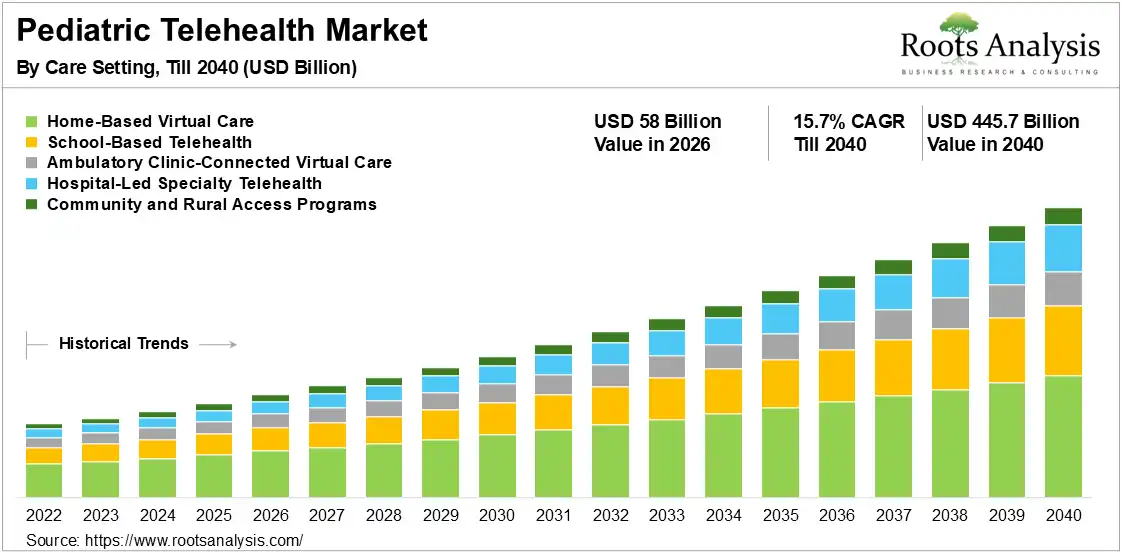
The global pediatric telehealth market is expected to rise from USD 58.0 billion in 2026 to reach USD 445.7 billion by 2040, growing at a CAGR of 15.7% over the forecast period 2026 to 2040, driven by rising child-focused virtual access, behavioral health demand and remote monitoring adoption.
See What’s in the Full Report – Request Your Complimentary Insights!
Market Report: Key Takeaways
- Based on Offering, Services capture 55.0% market share in 2026, whereas Software registers a 17.5% CAGR through 2040, driven by AI-enabled workflow expansion.
- Based on Delivery / Interaction Mode, Audiovisual / video visits capture 46.0% market share in 2026, whereas Remote patient monitoring registers a 22.4% CAGR through 2040, driven by connected pediatric exams.
- Based on Service Type, Teleconsultation captures 35.0% market share in 2026, whereas Telebehavioral health / telepsychiatry registers a 20.2% CAGR through 2040, driven by youth mental health demand.
- Based on Disease / Clinical Area, General pediatrics captures 32.0% market share in 2026, whereas Behavioral health registers a 19.4% CAGR through 2040, driven by school and family access needs.
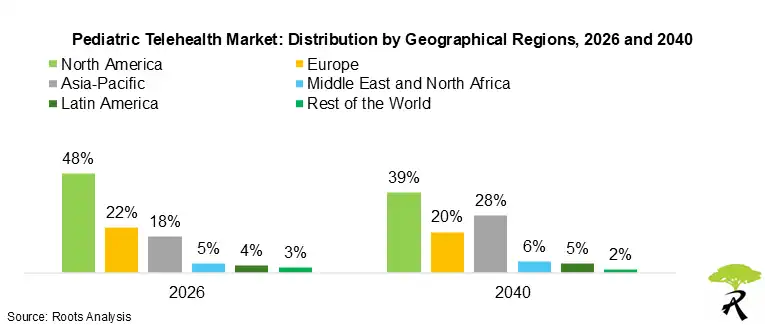
- Based on Geography, North America captures 48.0% market share in 2026, whereas Asia-Pacific registers a 19.4% CAGR through 2040, driven by digital health infrastructure expansion.
Pediatric Telehealth Market Outlook
Pediatric virtual care has moved from episodic video visits into an access layer across schools, homes, hospitals and parent-led triage. The pediatric telehealth market now reflects demand for behavioral health, urgent care, specialty consults, secure messaging and pediatric remote patient monitoring. Video visits still hold the largest 2026 delivery share. Remote patient monitoring grows fastest, at 22.4% CAGR through 2040. This shift makes connected care a central growth engine.
Growth now comes from youth mental health shortages, faster pediatric access demand and policy-backed school programs. HRSA announced supplemental funding in August 2025 for Pediatric Mental Health Care Access award recipients. The program supports pediatric mental health consultation and access programs. Cartwheel also expanded school-based mental health capacity with Maricopa County in May 2026, targeting 50,000 students. These examples show procurement moving closer to schools.
Through 2040, the market remains high-growth but shifts toward software-enabled workflows, school-based care and connected exams. Telebehavioral health grows at 20.2% CAGR, while school-based telehealth grows at 22.1% CAGR. TytoCare’s April 2026 FDA De Novo classification for AI-powered eardrum analysis shows remote exams moving beyond video-only care. The long-term outlook favors integrated pediatric access models over standalone visit platforms and generic telemedicine coverage models.
Pediatric Telehealth Market Dynamics
Pediatric Telehealth Market Drivers
Youth mental health demand now anchors pediatric telehealth market growth more than convenience-only urgent care. Telebehavioral health grows at 20.2% CAGR through 2040. Schools and school districts grow at 21.0% CAGR among end users. HRSA’s Pediatric Mental Health Care Access funding supports consultation capacity and reduces child psychiatrist scarcity. It also strengthens school-based pediatric telepsychiatry pathways for underserved families and rural districts.
Pediatric Telehealth Market Restraints
Clinical appropriateness limits telehealth penetration because pediatric diagnosis often needs examination, caregiver observation and escalation protocols. Audio-only visits lose share from 20.0% in 2026 to 13.0% in 2040. This shows lower durability than video, portal interactions and remote patient monitoring. Hardware remains smaller because connected exam kits add device costs, training needs and workflow friction for pediatric practices and caregivers.
Pediatric Telehealth Market Opportunities
School-based telehealth creates the clearest access expansion because districts aggregate demand and reduce parent scheduling barriers. The care setting grows at 22.1% CAGR through 2040. Schools therefore become the fastest-growing pediatric virtual care channel and a priority distribution route for specialized vendors. Maricopa County contracted with Cartwheel in May 2026 to expand school-based mental health telehealth, targeting 50,000 students.
Pediatric Telehealth Market Challenges
Competitive differentiation remains difficult because large platforms, children’s hospitals, school-health specialists and pediatric startups now overlap. Teladoc Health, Amwell, MDLIVE and Amazon One Medical compete against Hazel Health, Cartwheel, Blueberry Pediatrics and Summer Health. Buyers must compare EHR integration, pediatric credentialing, behavioral health capacity, asynchronous messaging, device support and payer contracting. Those criteria shape scaling across home, clinic and school settings.
Pediatric Telehealth Market Size Estimation Methodology
- As a starting point, the forecast team normalized the pediatric telehealth market around child-focused virtual care use cases, not generic adult telemedicine. Inputs covered services, software, hardware, audiovisual visits, audio-only care, asynchronous messaging, patient portals and remote patient monitoring. Low-scope platform-only estimates were excluded because they undercount hospital, school and payer-funded care delivery. The model used only the verified research inputs supplied for this report.
- Moving forward, published market-size ranges were reconciled against 2023, 2024, 2026 and 2033 industry data. The model used the 2026 base year as the current anchor and extended annual values through 2040. Outlier estimates were removed when their scope excluded services, school-based telehealth or pediatric behavioral health. This step kept the pediatric telehealth market forecast aligned with full-service care delivery.
- Building on this, segment shares were built from recurring publisher taxonomies and product-level evidence across pediatric clinics, hospitals, schools, payers and caregivers. The model separated delivery mode from service type to avoid double counting video visits, remote patient monitoring and telebehavioral health. It also treated school-based telehealth as a care setting rather than only an end-user group. That structure supports cleaner pediatric telehealth market share analysis.
- Drawing upon these, growth rates were stress-tested against specific demand indicators. These included school-district procurement, payer-backed access programs, funding rounds, FDA regulatory submissions and virtual urgent care launches. Examples such as Cartwheel, Hazel Health, Amazon One Medical, TytoCare, Little Otter and Clarity Pediatrics helped calibrate adoption speed. These signals supported higher growth for school-based care, behavioral health and connected remote exams. They also reduced reliance on broad telemedicine assumptions.
- The projected value was then calculated using a consensus annual growth path rather than a single-source estimate. Segment CAGR values were derived from each sub-segment’s 2026 and 2040 share movement against the total market curve. This approach allowed audiovisual visits to lose share while still growing in absolute demand. It also showed why remote patient monitoring gains share as connected exams mature.
- Finally, the forecast was reviewed for internal consistency across regional outlook, end-user demand and technology adoption. North America remained the 2026 leader because of reimbursement maturity, children’s hospital networks and school-health procurement. Asia-Pacific received the highest regional CAGR because digital health infrastructure expansion supports broader pediatric virtual care access. The final model checked whether regional, end-user and technology trends moved in the same direction.
Pediatric Telehealth Market Share Insights
Market Share by Offering
According to our analysis, services lead because parents buy access, triage, prescriptions and clinician capacity before platform tooling. In October 2025, Amazon One Medical introduced pay-per-visit healthcare for children aged 2 to 11.
Software will grow faster as AI triage, asynchronous workflows and device interpretation move into care pathways. In April 2026, TytoCare secured FDA De Novo classification for AI-powered eardrum analysis.
Market Share by Disease / Clinical Area
General pediatrics leads because routine pediatric access creates the largest base of repeat virtual interactions. In October 2025, Amazon One Medical covered pink eye, lice, skin issues, asthma renewals and EpiPen renewals.
Behavioral health will grow faster as school districts and families adopt virtual-first access models. In September 2025, Brightline expanded pediatric, teen and parental mental health care in New York.
Want Information on Specific Region / Segment?
Regional Analysis: North America Leads the Market and Asia-Pacific is Likely to Register Higher CAGR
Presently, North America holds 48.0% market share in 2026. It leads through reimbursement maturity, children’s hospital networks, virtual care vendors and payer-backed school-health channels. U.S. policy also supports telehealth access through home-based and behavioral health flexibilities. In March 2025, NCDHHS and Hazel Health expanded virtual mental health services for K-12 students.
On the contrary, Asia-Pacific registers a 19.4% CAGR from 2026 to 2040. Growth will come from digital public health investment, urban-rural access gaps and rising family demand for convenient pediatric care. In May 2026, Victoria Health embedded virtual care as a default specialist-care reform when appropriate.
Market Ecosystem Analysis
The scoped pediatric telehealth ecosystem has seven Tier 1 leaders, ten specialists, and eight emerging entrants competing across care access, school health, behavioral care, chronic care, devices, and workflow infrastructure. Commercial activity concentrates around broad virtual-care, EHR, retail, and video platforms, while specialists defend use-case depth in schools, mental health, remote examination, and pediatric urgent care. The dominant consolidation dynamic is platform convergence, reinforced by hardware-software bundling and payer or school-district procurement. Competitive advantage is shifting from simple video access to pediatric-specific care pathways that combine diagnosis, documentation, reimbursement, referral capture, and family engagement.
- Teladoc Health and TytoCare announced in November 2025 that TytoCare would integrate with Teladoc’s Primary360 and 24/7 Care programs. The bundle moves lung, ear, throat, heart, skin, temperature, and asthma-related assessments into home-based virtual care. It raises the hardware-data barrier for video-only platforms and strengthens home-based urgent care, remote monitoring, and chronic care.
- eClinicalWorks announced in April 2025 that Pediatrica Health Group selected its cloud EHR, healow, and Sunoh.ai across locations. The package embeds televisits, AI documentation, patient engagement, and payment tools inside pediatric practice workflows. It strengthens ambulatory clinic-connected virtual care and pressures standalone vendors lacking EHR-native documentation.
- Amazon One Medical launched pay-per-visit pediatric telehealth in October 2025 for children ages 2 to 11. The service offered message visits from $29 and video visits from $49, without insurance or membership. This pressures pediatric urgent-care startups on price and strengthens direct-to-parent video and asynchronous care.
- MDLIVE said in October 2025 that it offered pediatrics, urgent care, therapy, psychiatry, dermatology, and asynchronous E-Treatment. The Evernorth channel gives MDLIVE payer-scale distribution across 62 million served people. This strengthens virtual urgent care, behavioral health, employer channels, and payer-sponsored pediatric teleconsultation.
- My Pediatric Doctor launched a national 24/7 urgent pediatric telehealth platform in March 2026. The service covered all 50 states, Guam, and Puerto Rico, with strategic positioning for payers and health systems. This lowers geographic access barriers and strengthens home-based pediatric urgent care.
- Hazel Health became a Virginia Department of Education-approved vendor in August 2025 for school-based telehealth services. The approval lets districts procure Hazel through a state contract for mental and physical health access. This strengthens school-based telehealth and raises procurement barriers for direct-to-consumer entrants.
- Cartwheel Care disclosed in August 2025 that it secured $35 million from a $44 million funding round. The company delivers virtual therapy, psychiatry, and care coordination through schools and families. This increases scale pressure in school mental health and strengthens telebehavioral health pathways.
- Brightline opened its first in-person pediatric mental health clinic in Brooklyn in April 2025. Bend Health was acquired by Lyra Health in July 2025 to expand pediatric and neurodiversity services. Together, these moves pressure virtual-only mental health providers to add acuity management, testing, psychiatry, and employer reach.
Startup Companies and their Key Highlights
- Cartwheel Care
- Event type and funding amount: $35 million disclosed from a $44 million funding round.
- Month and year: August 2025.
- Market implication: Accelerates school-based pediatric mental health, virtual therapy, psychiatry, and care coordination.
- Little Otter
- Event type and funding amount: $9.5 million strategic funding round.
- Month and year: February 2025.
- Stated purpose of the event: Expand state coverage and advance AI-driven family mental health care.
- Market implication: Strengthens virtual pediatric behavioral health, whole-family care, AI triage, and Medicaid or commercial coverage.
- Clarity Pediatrics
- Event type and funding amount: $14.5 million Series A funding.
- Month and year: December 2025.
- Lead investor or strategic partner name: Jackson Square Ventures.
- Stated purpose of the event: Launch pediatric obesity services, develop the virtual clinic platform, and expand geographically.
- Market implication: Accelerates pediatric chronic care across ADHD, anxiety, obesity, Medicaid, and commercial insurance populations.
- My Pediatric Doctor
- Event type and funding amount: National launch of a 24/7 urgent pediatric telehealth platform.
- Month and year: March 2026.
- Stated purpose of the event: Provide national pediatrician-on-demand access and support health system and payer integration.
- Market implication: Accelerates direct-to-parent pediatric urgent care across all US states and select territories.
- Bluebird Kids Health
- Event type and funding amount: $31.5 million Series A funding.
- Month and year: March 2025.
- Lead investor or strategic partner name: F-Prime and .406 Ventures.
- Stated purpose of the event: Build value-based pediatric clinics in underserved areas and accept all insurance types.
- Market implication: Accelerates hybrid pediatric primary care, Medicaid access, commercial payer contracting, and after-hours virtual support.
- Bend Health
- Event type and funding amount: Acquisition by Lyra Health.
- Month and year: July 2025.
- Lead investor or strategic partner name: Lyra Health.
- Stated purpose of the event: Strengthen pediatric, neurodiversity, and higher-acuity behavioral health capabilities.
- Market implication: Accelerates employer-sponsored pediatric behavioral health, virtual intensive outpatient care, and family-centered mental health support.
Pediatric Telehealth Market Trends / Opportunities
School-Based Mental Health Networks Driving Pediatric Telehealth Market Procurement
School districts now act as pediatric access buyers because they centralize student demand and reduce family scheduling barriers. NCDHHS partnered with Hazel Health in March 2025 to provide virtual mental health services for K-12 students across North Carolina. This shift favors platforms with district contracting capacity and child mental health networks.
Payer-backed school access is turning pediatric telepsychiatry into a scaled channel rather than a niche service. UnitedHealthcare expanded its Hazel Health collaboration in September 2025. It offered school-based virtual mental health access for up to one million students. This strengthens payer influence over pediatric telehealth platform selection.
Connected Remote Exams Expanding Pediatric Telehealth Market Competition Beyond Video Visits
Remote examination technology is changing pediatric telehealth from conversation-based triage into data-supported diagnosis. TytoCare secured FDA De Novo classification in April 2026 for AI-powered eardrum analysis linked to connected otoscopy. This creates a stronger competitive moat for platforms that combine hardware, software and clinician workflows.
Pediatric remote patient monitoring gains share because connected exams can reduce unnecessary urgent care follow-up. Kiddo Health and TytoCare sit in the ecosystem as connected care and home diagnostic technology providers. The commercial implication is clearer differentiation for vendors that support pediatric-specific data capture, not only video infrastructure.
Consumer Urgent Care Platforms Compressing Pediatric Telehealth Pricing and Distribution
Direct-to-consumer pediatric urgent care is pushing the market toward faster, lower-friction access models. Amazon One Medical launched pay-per-visit pediatric telehealth in October 2025 for children aged two to eleven. This raises competitive pressure on pediatric clinics and virtual care vendors that still depend on membership-only access.
National coverage models are widening the addressable base for virtual pediatric urgent care. My Pediatric Doctor launched a national 24/7 pediatric telehealth platform in March 2026. The service covered all 50 US states, Guam and Puerto Rico. This increases competition for payer and health-system integration opportunities.
Family Behavioral Health Partnerships Converting Navigation Platforms Into Pediatric Care Channels
Benefits and navigation platforms are adding pediatric telehealth partners to capture family demand earlier. Carrot partnered with Blueberry Pediatrics in February 2026 to add on-demand pediatric telehealth to its family-building platform. This expands distribution for pediatric startups through adjacent family-health channels.
Funding signals show investor interest in child and family behavioral health models with virtual delivery. Little Otter gained growth funding in September 2025 to expand virtual mental health care for children and families. This supports consolidation potential across pediatric behavioral health, parent coaching and school-based access.
Your Business is Unique – Why Shouldn’t Your Report Be?
Market Access Considerations
School-District Procurement and Vendor Approval
School access depends on procurement credibility, student privacy processes and district onboarding capacity. Hazel Health’s Virginia-approved vendor status and Chicago Public Schools partnership show how approved-vendor pathways shape commercialization speed. Vendors supporting school workflows, parent consent, behavioral health staffing and district reporting gain faster access. General telemedicine platforms focused on home visits face slower institutional adoption. This factor makes institutional trust a core entry barrier for new market entrants.
Pediatric Mental Health Program Funding
Behavioral health access depends on reimbursement, grant funding and payer participation because provider shortages limit cash-pay scaling. HRSA’s Pediatric Mental Health Care Access program supports consultation capacity, while UnitedHealthcare’s Hazel Health collaboration shows payer-funded school access can aggregate demand. Platforms with child psychiatrists, therapists, school referral workflows and outcomes reporting gain stronger positioning than urgent-care-only providers competing for episodic visits. Funding visibility also supports longer provider network planning.
Clinical Validation for Connected Pediatric Exams
Remote examination products face higher access barriers because pediatric diagnosis requires reliable data capture and clinician confidence. TytoCare’s FDA De Novo classification for AI-powered eardrum analysis gives connected otoscopy a stronger evidence position than basic video assessment. Vendors with pediatric-specific hardware, AI interpretation and escalation protocols can compete beyond commodity video visits. Respiratory, ear and follow-up workflows create the clearest use cases. Validation also supports payer and provider adoption.
EHR, Portal and HIPAA-Enabled Workflow Integration
Health systems and pediatric clinics need telehealth tools that fit patient portals, EHR scheduling and compliant communications. Epic’s MyChart virtual visit capabilities, eClinicalWorks televisits and Zoom’s HIPAA-enabled healthcare infrastructure show the importance of workflow integration. Platforms without scheduling, documentation, secure messaging and referral connectivity face slower enterprise adoption. They also carry higher implementation and training burden and weaker renewal prospects among health-system buyers. Integration protects incumbent platform share over time in enterprise accounts.
How Stakeholders Benefit from the Key Focus Areas of Our Pediatric Telehealth Market Report
Youth mental health demand, school access programs and connected remote exams now make pediatric virtual care commercially urgent. The report supports decisions on segment prioritization, technology investment, partnership targeting and market entry timing.
- Unmet Needs and Market Gaps in Pediatric Telehealth Market: The report identifies where pediatric access gaps remain largest across behavioral health, school-based care, remote exams and chronic care. Teams deciding care expansion can compare fast-growing segments against slower areas such as audio-only visits. This supports decisions on which pediatric telehealth services need new capacity, partners or product redesign.
- Funding and Venture Investment Opportunities in Pediatric Telehealth Market: The report tracks funding signals around Cartwheel, Little Otter and Clarity Pediatrics to show where capital is flowing. Teams evaluating investment themes can separate school-based behavioral health from broader urgent care models. This supports screening decisions around virtual pediatric mental health, chronic care and family support platforms.
- Technology Innovation and Adoption Trends: The report maps how software, remote patient monitoring, AI-enabled pediatric virtual care and secure messaging gain share through 2040. Product teams can evaluate whether video visits alone remain enough for future competition. This supports roadmap decisions around connected otoscopy, asynchronous pediatric care messaging, patient portals and home diagnostic telehealth kits.
- Pediatric Telehealth Market Competitive Landscape and Industry Analysis: The report compares enterprise platforms, pediatric urgent care providers, school-health specialists, behavioral health vendors and infrastructure suppliers. Teams shaping competitive positioning can benchmark Teladoc Health, Amwell, MDLIVE, Amazon One Medical, Hazel Health, Cartwheel and Blueberry Pediatrics. This supports decisions on differentiation, sales targeting and partnership gaps.
- Mapping Strategic Partnerships and Ecosystem Synergies: The report shows how payers, schools, benefits platforms and pediatric specialists create market access channels. Teams building commercial alliances can evaluate examples such as Carrot with Blueberry Pediatrics and UnitedHealthcare with Hazel Health. This supports decisions on whether to prioritize payer distribution, school procurement or family-health platform partnerships.
- Pediatric Telehealth Market CAGR and Growth Trends: The report explains why the overall market grows at 15.7% CAGR through 2040. Remote patient monitoring, telebehavioral health and school-based care grow faster. Teams setting budgets can compare segment share gains against operational complexity and access constraints. This supports decisions on where to allocate capital, product teams and business development effort.
Pediatric Telehealth Market: Scope of the Report
| Key Report Attributes | Details | |
| Forecast Period | Till 2040 | |
| Market Size 2026 | USD 58.0 Billion | |
| Market Size 2040 | USD 445.7 Billion | |
| CAGR (Till 2040) | 15.7% | |
| Segments Covered |
|
|
| Geographical Regions Covered |
|
|
| Key Sections Covered |
|
|
Market Segmentation
The Pediatric Telehealth Market report presents an in-depth analysis, highlighting the capabilities of various stakeholders, based on different segments, such as offering, delivery / interaction mode, service type, disease / clinical area, end user, care setting, geographical regions, and leading players.
By Offering
- Services
- Software
- Hardware
By Delivery / Interaction Mode
- Audiovisual / Video Visits
- Audio-Only Visits
- Store-And-Forward / Asynchronous Care
- Patient Portal and Secure Messaging Interactions
- Remote Patient Monitoring
By Service Type
- Teleconsultation
- Virtual Urgent Care
- Remote Patient Monitoring
- Telebehavioral Health / Telepsychiatry
- Virtual Specialty Consults
- Chronic Care Management
- Care Coordination and Triage
By Disease / Clinical Area
- General Pediatrics
- Behavioral Health
- Respiratory Conditions and Asthma
- Dermatology and Skin Conditions
- Diabetes and Endocrinology
- Developmental and Neurobehavioral Conditions
- Rare and Genetic Diseases
- Others
By End User
- Hospitals and Health Systems
- Pediatric Clinics and Physician Groups
- Patients, Parents and Caregivers
- Payers and Employers
- Schools and School Districts
- Government and Public Health Agencies
By Care Setting
- Home-Based Virtual Care
- School-Based Telehealth
- Ambulatory Clinic-Connected Virtual Care
- Hospital-Led Specialty Telehealth
- Community and Rural Access Programs
By Geographical Regions
- North America
- US
- Canada
- Mexico
- Rest of North America
- Europe
- Austria
- Belgium
- Denmark
- France
- Germany
- Ireland
- Italy
- Netherlands
- Norway
- Russia
- Spain
- Sweden
- Switzerland
- UK
- Rest of Europe
- Asia-Pacific
- China
- India
- Japan
- Singapore
- South Korea
- Rest of Asia-Pacific
- Latin America
- Argentina
- Brazil
- Chile
- Colombia
- Venezuela
- Rest of Latin America
- Middle East and Africa (MEA)
- Egypt
- Iran
- Iraq
- Israel
- Kuwait
- Saudi Arabia
- UAE
- Rest of MEA
- Rest of the World


