


 Download Free Sample
 Buy Now
Market Size
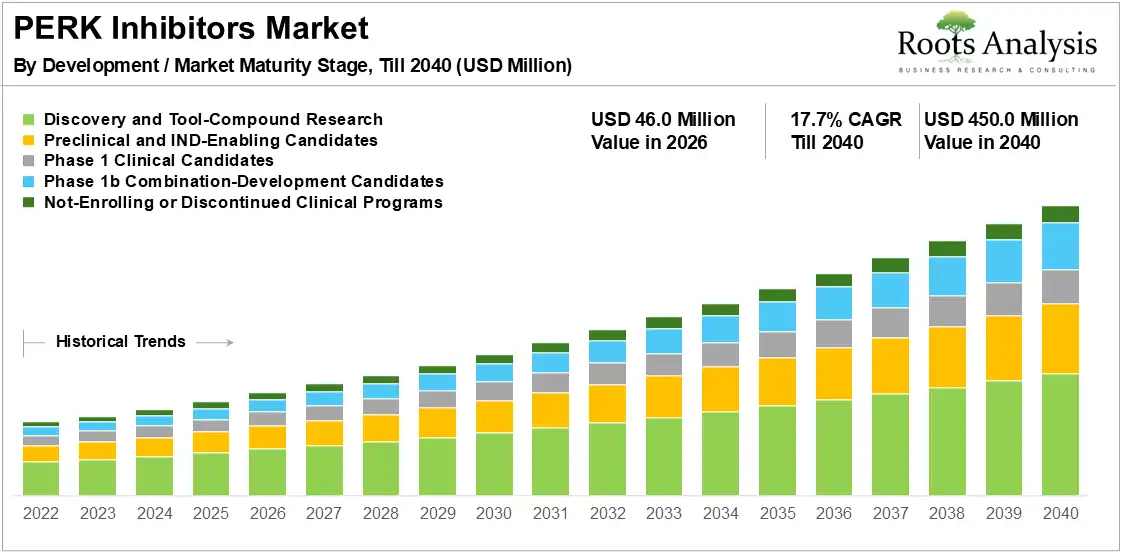
The global PERK inhibitors market is envisaged to rise from USD 46.0 million in 2026 and is projected to reach USD 450.0 million by 2040, growing at a CAGR of 17.7% over the forecast period 2026 to 2040, driven by Phase 1b oncology combination development and research-enablement demand.
See What’s in the Full Report – Request Your Complimentary Insights!
Market Report: Key Takeaways
- Based on product / offering type, therapeutic drug candidates is both the dominant and fastest-growing category, holding 34.0% share in 2026 and expanding at 21.3% CAGR through 2040, driven by oncology pipeline value.
- Based on development / market maturity stage, discovery and tool-compound research captures 30.0% market share in 2026, whereas Phase 1b combination-development candidates register a 27.8% CAGR through 2040, driven by combination trial scaling.
- Based on application area, solid-tumor oncology is both the dominant and fastest-growing category, holding 36.0% share in 2026 and expanding at 20.5% CAGR through 2040, driven by stress-adapted tumor targeting.
- Based on mechanistic positioning, direct PERK / EIF2AK3 kinase inhibition captures 46.0% market share in 2026, whereas dual PERK / GCN2 stress-kinase inhibition registers a 21.6% CAGR through 2040, driven by ISR redundancy targeting.
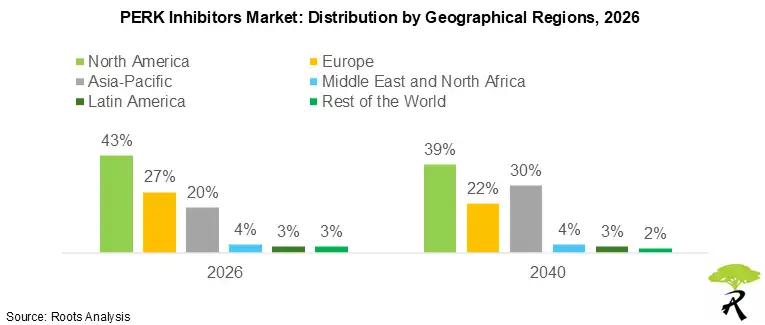
- Based on geography, North America captures 43.0% market share in 2026, whereas Asia-Pacific registers a 21.2% CAGR through 2040, driven by oncology licensing momentum.
PERK Inhibitors Market Outlook
The PERK inhibitors market has moved from reagent-led ER-stress research toward clinical oncology optionality. Therapeutic candidates now capture 34.0% of 2026 value, while discovery tools still hold 30.0% across maturity stages. Demand shifted as HC-5404, NMS-03597812, and APL-045 gave sponsors clearer routes beyond GSK2606414 and GSK2656157 tool-compound studies. Supply remains narrow because no approved PERK inhibitor has created a commercial treatment benchmark or reimbursement reference.
Current growth comes from oncology combination economics, translational biomarker demand, and policy-backed cancer infrastructure. North America leads with 43.0% share in 2026, supported by NIH-linked translational programs and FDA oncology guidance maturity. In April 2025, NCI updated Cancer Moonshot progress across research projects, programs, consortia, and data infrastructure. In November 2025, AVEO Oncology and HiberCell agreed to develop HC-5404 with FOTIVDA for renal cell carcinoma.
Through 2040, the market will remain high-growth, expanding at 17.7% CAGR as Phase 1b combinations gain share. Phase 1b combination-development candidates will grow at 27.8% CAGR, outpacing discovery-stage revenue. In December 2025, BioWorld reported Apollo AP45 disclosed new EIF2AK3 / PERK inhibitors for potential cancer applications. Long-term competition will favor sponsors linking oral molecules, biomarker panels, kinase selectivity, and combination rights across stress-adapted tumors and resistant oncology settings.
PERK Inhibitors Market Dynamics
PERK Inhibitors Market Drivers
Clinical oncology translation drives market growth because therapeutic drug candidates hold 34.0% share in 2026 and is likely to reach 52.0% by 2040. HC-5404, NMS-03597812, and APL-045 moved PERK inhibition beyond research catalogs into pipeline valuation. Oral dosing strengthens adoption because HC-5404-FU and NMS-03597812 both carry orally bioavailable positioning in NCI definitions. Biomarker readouts, including p-PERK and eIF2α pathway signals, support dose selection and combination decisions.
PERK Inhibitors Market Restraints
Safety uncertainty constrains PERK inhibitors because the pathway controls ER-stress adaptation in normal tissues and tumors. No approved PERK inhibitor gives developers a proven therapeutic index, label framework, or reimbursement comparator. The 2026 market still assigns 30.0% share to discovery and tool-compound research, showing commercial immaturity. Discontinued or not enrolling programs retain 14.0% maturity-stage share, which keeps diligence focused on toxicity, selectivity, and translational validity.
PERK Inhibitors Market Opportunities
Combination development creates the clearest value pool because Phase 1b combination-development candidates will grow at 27.8% CAGR through 2040. Anti-angiogenic pressure can increase tumor stress signaling, which makes PERK inhibition commercially relevant in renal cell carcinoma. In November 2025, AVEO Oncology and HiberCell agreed to develop HC-5404 with FOTIVDA, initially focused on renal cell carcinoma. That structure supports milestone-based partnering and indication expansion.
PERK Inhibitors Market Challenges
Competitive differentiation remains difficult because direct PERK / EIF2AK3 inhibition already holds 46.0% mechanistic share in 2026. Developers must separate selective PERK blockade from broader ISR modulation, dual PERK / GCN2 targeting, and downstream UPR approaches. Assay comparability also matters because radiometric kinase assays, fluorescent assays, and phospho-PERK biomarker readouts can produce different confidence levels. Sponsors that lack paired pharmacodynamic and safety packages will face slower partnering reviews.
PERK Inhibitors Market Size Estimation Methodology
- As a starting point, the PERK inhibitors market forecast used clinical trial databases to separate therapeutic assets from research reagents. NCI drug definitions added route, mechanism, and antineoplastic positioning for HC-5404-FU and NMS-03597812. APL-045 formed the verified preclinical base through AACR disclosure. GSK2606414 and GSK2656157 were treated as research-use demand, not approved-drug revenue.
- Moving forward, the model mapped each verified asset to maturity stages across discovery, preclinical, Phase 1, and Phase 1b development. Clinical trial status, drug approval timelines, and sponsor disclosures set the probability-weighting logic. This step prevented preclinical disclosures from receiving the same value as clinical-stage combination rights. Not enrolling or discontinued programs received lower commercial weight because they reduce near-term licensing confidence.
- Building on this, product and service pools were split across therapeutic candidates, research-use compounds, recombinant EIF2AK3 proteins, and kinase screening services. Biomarker readouts and gene-modulation tools were modeled as separate research-enablement streams. Supplier catalogs from Merck KGaA / Sigma-Aldrich, Thermo Fisher Scientific, Eurofins Discovery, Reaction Biology, and BPS Bioscience validated availability. Each pool received different price intensity because pipeline rights carry higher value than laboratory procurement.
- Drawing upon these, regional shares used clinical-site depth, oncology capital access, NIH-linked infrastructure, Asia-Pacific licensing momentum, and supplier availability. North America retained the largest 2026 position because clinical oncology infrastructure supports early stress-pathway trials. Asia-Pacific received the highest long-term CAGR because China-linked oncology licensing signals stronger pipeline export potential. The Innovent and Pfizer collaboration supported that regional acceleration signal.
- The projected value was then narrowed against adjacent kinase inhibitor and oncology kinase inhibitor industry data. Broad approved-drug markets were discounted because PERK lacks commercial approvals and remains clinically early. BRAF and KRAS inhibitor analogs helped bracket upside, while mutation-defined approved-product growth was excluded. That exclusion kept the forecast aligned with PERK-specific clinical and research-enablement activity.
- Finally, segment CAGRs were stress-tested against patent filing volumes, regulatory submission counts, partnership activity, and dated scientific publications. The strongest uplift went to Phase 1b combinations, therapeutic drug candidates, small oral molecules, solid-tumor oncology, and dual PERK / GCN2 positioning. Research-use small molecules, recombinant proteins, and radiometric assays retained revenue but lost share. The final forecast preserves a research-enablement base while allowing clinical milestones to reshape market share.
PERK Inhibitors Market Share Insights
Market Share by Product / Offering Type
According to our analysis, therapeutic drug candidates lead because clinical-stage assets command higher value than reagent sales. Sponsors also price pipeline rights around oncology exclusivity, biomarker strategy, and combination potential. In November 2025, AVEO Oncology and HiberCell announced a development and option agreement for HC-5404, a first-in-human PERK inhibitor.
Further, therapeutic drug candidates will also grow fastest as Phase 1b combinations convert discovery value into clinical optionality. Growth will come from RCC, gastric cancer, and other stress-adapted tumor settings.
Market Share by Application Area
According to our analysis, solid-tumor oncology leads because PERK biology fits hypoxia, nutrient stress, angiogenesis, and treatment resistance. Oncology also offers deeper clinical-site infrastructure and stronger partnering economics.
Further, solid-tumor oncology will also grow fastest as biomarker-led combinations widen the addressable tumor pool. Demand will rise where anti-angiogenic pressure activates adaptive stress pathways. In April 2025, Scientific Reports published PERK inhibition evidence in ovarian cancer cell lines.
Want Information on Specific Region / Segment?
Regional Analysis: North America Leads the Market and Asia-Pacific is Likely to Register Higher CAGR
Presently, North America holds 43.0% share in 2026. It leads through clinical-trial depth, oncology capital access, NIH-linked translational infrastructure, and USFDA oncology guidance maturity. In April 2025, NCI updated Cancer Moonshot progress, covering research projects, programs, consortia, and data infrastructure.
Further, Asia-Pacific registers a 21.2% CAGR from 2026 to 2040. Growth will come from China-led licensing, faster oncology trial globalization, and domestic small-molecule development capacity. In May 2026, Innovent and Pfizer signed a major oncology collaboration, highlighting Asia-Pacific’s expanding pipeline-export role.
Market Ecosystem Analysis
Within the 24-company scope, three clinical actors control most verifiable therapeutic news flow: HiberCell, AVEO, and Nerviano. Four Tier 1 leaders anchor research enablement, while 13 Tier 2 specialists and seven emerging entrants fill niche clinical, assay, and reagent roles. The dominant consolidation dynamic is option-to-license clinical partnering, with RCC combination development now reshaping PERK sponsor behavior. Competitive advantage is shifting toward programs pairing PERK modulation with oncology regimens, kinase assays, and phospho-PERK biomarker readouts.
- HiberCell and AVEO entered a November 2025 development-and-option agreement for HC-5404 with AVEO’s FOTIVDA in RCC. This pressures standalone PERK programs to prove combination value, not only direct kinase selectivity. It strengthens Phase 1b combination-development, anti-angiogenic pairing, and solid-tumor segments.
- BioPharma APAC reported in November 2025 that HC-5404 would be explored with tivozanib in RCC. This shifts buyer attention toward PERK inhibition with approved VEGFR-TKI therapy. It raises differentiation pressure on preclinical PERK entrants without combination-ready oncology partners.
- Nerviano’s NMS-03597812 trial listing was updated in October 2025 as active-recruiting Phase 1 in relapsed/refractory AML. This strengthens hematologic oncology and dual stress-kinase positioning versus solid-tumor-only PERK narratives. It also raises clinical-site execution barriers for smaller sponsors.
- Cayman Chemical updated a kinase-screening library insert in October 2025 that lists GSK2606414 as a PERK-targeted compound. This strengthens the tool-compound and kinase-library segments for discovery buyers. It pressures smaller catalog suppliers to document target coverage and screening relevance more clearly.
- Tocris gained publication-level usage validation in May 2025 through a Cell Reports study using Tocris-supplied GSK2606414. APExBIO gained similar publication-use evidence in November 2025 through a Wiley study using GSK2606414. These citations strengthen research-use small-molecule inhibitor demand beyond oncology into general ER-stress biology.,
PERK Inhibitors Market Trends / Opportunities
PERK Inhibitors Market Shift from Tool Compounds to Clinical Combinations Raising Partnering Value
Clinical combination development is shifting value from catalogs toward sponsor-controlled oncology assets. In November 2025, AVEO Oncology and HiberCell agreed to develop HC-5404 alone and with FOTIVDA for renal cell carcinoma (https://www.aveooncology.com/aveo-oncology-an-lg-chem-company-and-hibercell-enter-into-an-exclusive-development-and-option-agreement-for-first-in-human-compound/). This move makes combination rights, milestone terms, and indication sequencing central competitive variables.
Therapeutic candidates are gaining share because clinical assets carry higher option value than reagent sales. The same HC-5404 agreement moved a first-in-human PERK inhibitor toward Phase 1b development with anti-angiogenic therapy (https://www.prnewswire.com/news-releases/aveo-oncology-an-lg-chem-company-and-hibercell-enter-into-an-exclusive-development-and-option-agreement-for-first-in-human-compound-302603732.html). This supports premium valuation for oral molecules with combination-ready safety packages.
PERK Inhibitors Market EIF2AK3 Pipeline Disclosure Expanding Preclinical Competition
Preclinical disclosure is widening the competitive field beyond HC-5404 and NMS-03597812. In December 2025, BioWorld reported Apollo AP45 disclosed new EIF2AK3 / PERK inhibitors for potential cancer applications. This increases scouting pressure for differentiated chemistry before clinical proof emerges.
Selective kinase positioning is becoming a commercial filter for early assets. In April 2025, Cancer Research published the AACR abstract for APL-045, a selective PERK inhibitor targeting ER-stress pathways in cancer. This gives developers a clearer benchmark for potency, selectivity, and cancer-focused translational packages.
Dual ISR Targeting and Tumor-Stress Biology Broadening Mechanistic Competition
ISR redundancy is pushing developers to evaluate dual stress-kinase inhibition alongside direct PERK blockade. In September 2025, BioWorld reported Hanmi patent disclosure of heterocyclic derivatives acting as GCN2, HRI, PKR, and PERK inhibitors. This could pressure single-target programs to prove cleaner safety or stronger efficacy.
Tumor stress biology is expanding beyond renal cell carcinoma into additional oncology models. In April 2025, Scientific Reports published data showing miR-204-5p-mediated PERK inhibition suppressed ovarian cancer cell growth through the eIF2α / ATF4 / CHOP pathway. This supports broader tumor prioritization, but it also raises biomarker-selection complexity.
Research-Enablement Demand Preserving Supplier Revenue While Therapeutic Share Expands
Research-use compounds still anchor mechanistic validation while clinical programs mature. In October 2025, bioRxiv reported PERK inhibition rewired translational and CMGC protein phosphorylation using GSK2606414 as a pharmacologic inhibitor. This sustains demand for tool compounds, kinase assays, and phospho-pathway readouts.
Non-oncology studies preserve a long-tail reagent market despite therapeutic oncology concentration. In May 2025, BioWorld reported GSK-2656157 reversed asbestos-induced pulmonary fibrosis in mouse models. This keeps respiratory fibrosis researchers’ relevant buyers, even as oncology captures most late-period value.
Your Business is Unique – Why Shouldn’t Your Report Be?
Market Access Considerations
Clinical Safety and First-in-Human Evidence Thresholds
Clinical access depends on proving that PERK blockade can control tumor stress without unacceptable normal-tissue toxicity. No approved PERK inhibitor gives developers a label precedent, so Phase 1 and Phase 1b datasets carry unusual weight. HiberCell states HC-5404 completed Phase I in solid tumors, making safety translation a core entry screen. Programs lacking oral exposure, dose rationale, and p-PERK pathway evidence will scale slower. They will also negotiate weaker option terms during oncology partnering reviews.
Combination Rights and Indication Sequencing
Commercial access increasingly depends on control of combination rights, especially in renal cell carcinoma and anti-angiogenic regimens. The AVEO and HiberCell agreement links HC-5404 with FOTIVDA, creating a market behavior where value depends on partner-owned targeted therapy infrastructure. This narrows entry for standalone discovery groups because sponsors must fund drug supply, trial design, biomarker planning, and combination safety work. Companies with aligned oncology franchises can sequence indications faster and defend preferred trial settings.
Biomarker and Assay Infrastructure
Technical access requires validated kinase assays, recombinant EIF2AK3 proteins, and pathway readouts that connect target engagement with tumor response. Eurofins Discovery, Reaction Biology, Thermo Fisher Scientific, and BPS Bioscience support screening and protein workflows. Cell Signaling Technology, Abcam, and Novus support antibody-based pathway confirmation. Developers with paired p-PERK, eIF2α, ATF4, and CHOP readouts can move faster from hit validation to partner diligence. These packages also support clinical dose refinement, patient-enrichment planning, and regulatory evidence packages.
Regional Clinical Infrastructure and Policy Support
Geographic access favors markets with oncology trial density, translational funding, and clear regulatory coordination. North America holds 43.0% 2026 share because NIH-linked infrastructure and FDA oncology guidance maturity reduce early clinical friction. In April 2025, NCI updated Cancer Moonshot progress across research projects, programs, consortia, and data infrastructure. Asia-Pacific grows faster as China-linked oncology licensing expands pipeline-export options, trial globalization, and domestic small-molecule development capacity. Partner availability strengthens later-stage commercialization routes and regional launch planning.
How Stakeholders Benefit from the Key Focus Areas of Our PERK Inhibitors Market Report
PERK inhibition matters now because stress-adapted tumors, oral kinase chemistry, and Phase 1b combination economics are converging. The report connects pipeline maturity, assay infrastructure, and regional trial capacity to strategic, investment, and technology decisions.
- Unmet Needs and Market Gaps in PERK Inhibitors Market: The report identifies gaps created by the absence of an approved PERK inhibitor, including missing label precedent and uncertain therapeutic index. Clinical development heads can use this evidence to prioritize safety packages, biomarker strategy, and tumor-selection criteria. The analysis separates oncology-ready opportunities from laboratory-only demand. It also flags where discontinued or not-enrolling programs weaken near-term confidence.
- Funding and Venture Investment Opportunities in PERK Inhibitors Market: The report highlights the fastest value migration points in the market. Phase 1b combinations grow at 27.8% CAGR, while therapeutic drug candidates expand at 21.3% CAGR. Investment teams can use these signals to compare preclinical chemistry, option structures, and oncology indication fit. This supports decisions on licensing, venture allocation, and milestone risk.
- Technology Innovation and Adoption Trends: The report tracks how oral small molecules, dual PERK / GCN2 inhibition, fluorescent kinase assays, and phospho-PERK biomarkers change adoption curves. Research and development leaders can use these insights to choose assay formats and translational endpoints. The analysis clarifies which technologies gain share and which reagent categories lose relative weight. It links assay choices to partner diligence, dose refinement, and patient-enrichment planning.
- PERK Inhibitors Market Competitive Landscape and Industry Analysis: The report maps HiberCell, AVEO Oncology, Nerviano Medical Sciences, Apollo Therapeutics, and major reagent suppliers by role and tier. Corporate planning teams can use this view to benchmark clinical ownership against assay and reagent control. This supports prioritization of partner targets, competitor monitoring, and portfolio positioning. Supplier mapping also shows which companies influence research-enablement procurement before therapeutic approvals.
- Mapping Strategic Partnerships and Ecosystem Synergies: The report shows how combination rights, clinical-site access, and supplier infrastructure shape ecosystem leverage. Business development teams can assess why AVEO and HiberCell linked HC-5404 with FOTIVDA in November 2025. This supports negotiation of option rights, co-development scope, and indication sequencing. The ecosystem view helps identify which alliances can convert kinase biology into trial-ready oncology programs.
- PERK Inhibitors Market CAGR and Growth Trends: The report explains why the market grows at 17.7% CAGR through 2040 while segment shares shift toward oncology assets. Forecast users can compare North America's 2026 leadership with Asia-Pacific's 21.2% CAGR. This supports decisions on launch geography, clinical expansion, and regional partnership timing. The forecast also separates high-growth clinical segments from slower research-tool categories.
PERK Inhibitors Market: Scope of the Report
| Key Report Attributes | Details | |
| Forecast Period | Till 2040 | |
| Market Size 2026 | USD 46.0 Million | |
| Market Size 2040 | USD 450.0 Million | |
| CAGR (Till 2040) | 17.7% | |
| Segments Covered |
|
|
| Geographical Regions Covered |
|
|
| Key Sections Covered |
|
|
Market Segmentation
The PERK inhibitors market report presents an in-depth analysis, highlighting the capabilities of various stakeholders, based on different segments such as, product / offering type, development / market maturity stage, application area, mechanistic positioning, end user / buyer type, research format / assay modality, geographical regions, and leading players.
By Product / Offering Type
- Therapeutic Drug Candidates
- Research-Use Small-Molecule Inhibitors
- Recombinant PERK / EIF2AK3 Proteins
- Kinase Screening and Profiling Services
- Biomarker Antibodies and Pathway Readouts
- Gene-Silencing and Gene-Editing Research Tools
By Development / Market Maturity Stage
- Discovery and Tool-Compound Research
- Preclinical and IND-Enabling Candidates
- Phase 1 Clinical Candidates
- Phase 1b Combination-Development Candidates
- Not-Enrolling or Discontinued Clinical Programs
By Application Area
- Solid-Tumor Oncology
- Hematologic Oncology
- Respiratory Fibrosis Research
- Metabolic and Endocrine Disease Research
- Neurodegenerative and Cognitive-Disease Research
- General ER-Stress / Unfolded-Protein-Response Biology
By Mechanistic Positioning
- Direct PERK / EIF2AK3 Kinase Inhibition
- Dual PERK / GCN2 Stress-Kinase Inhibition
- PERK-Mediated UPR / ISR Downstream Modulation
- PERK Inhibition with Anti-Angiogenic Therapy
- PERK Inhibition with Immune-Checkpoint Therapy
By End User / Buyer Type
- Biopharmaceutical Companies
- Academic and Government Research Institutes
- Cancer Centers and Clinical Trial Sites
- Contract Research Organizations
- Reagents and Assay Suppliers
- Specialty Distributors and Laboratory Procurement Channels
By Research Format / Assay Modality
- Orally Bioavailable Small Molecules
- Cell-Permeable Tool Compounds
- Recombinant Kinase Proteins
- Radiometric Kinase Assays
- Fluorescent / ADP-Based Kinase Assays
- Western Blot, IHC, ELISA, and Phospho-PERK Biomarker Readouts
By Geographical Regions
- North America
- US
- Canada
- Mexico
- Rest of North America
- Europe
- Austria
- Belgium
- Denmark
- France
- Germany
- Ireland
- Italy
- Netherlands
- Norway
- Russia
- Spain
- Sweden
- Switzerland
- UK
- Rest of Europe
- Asia-Pacific
- Australia
- China
- India
- Japan
- New-Zealand
- Singapore
- South Korea
- Rest of Asia-Pacific
- Latin America
- Argentina
- Brazil
- Chile
- Colombia
- Venezuela
- Rest of Latin America
- Middle East and Africa (MEA)
- Egypt
- Iran
- Iraq
- Israel
- Kuwait
- Saudi Arabia
- UAE
- Rest of MEA
- Rest of the World


