


 Download Free Sample
 Buy Now
Market Size
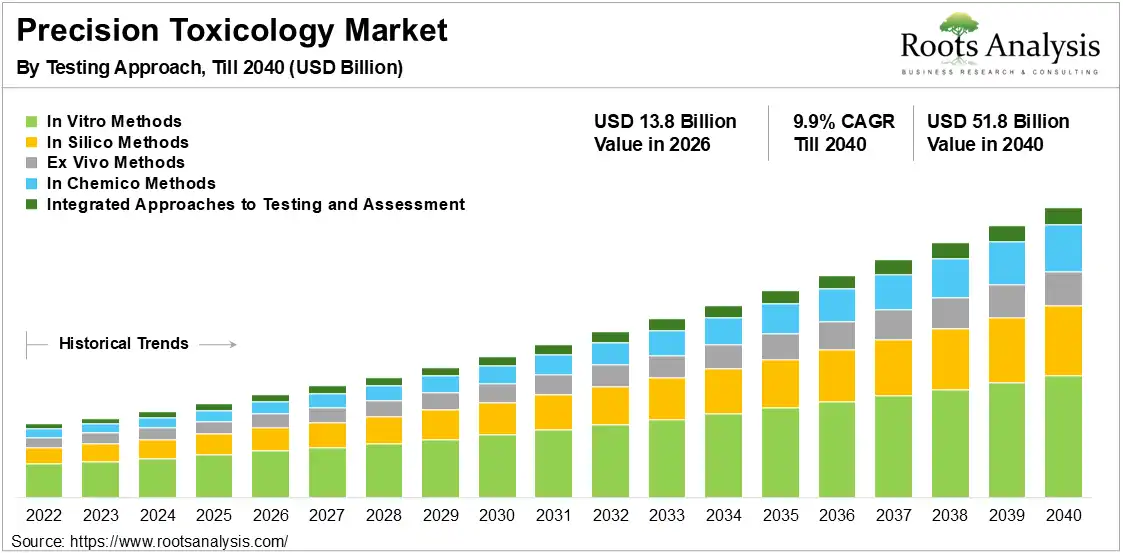
The global precision toxicology market reached USD 13.8 billion in 2026 and is projected to reach USD 51.8 billion by 2040, growing at a CAGR of 9.9% over the forecast period 2026 to 2040, driven by regulatory adoption of human-relevant methods.
See What's in the Full Report – Request Your Complimentary Insights!
Market Report: Key Takeaways
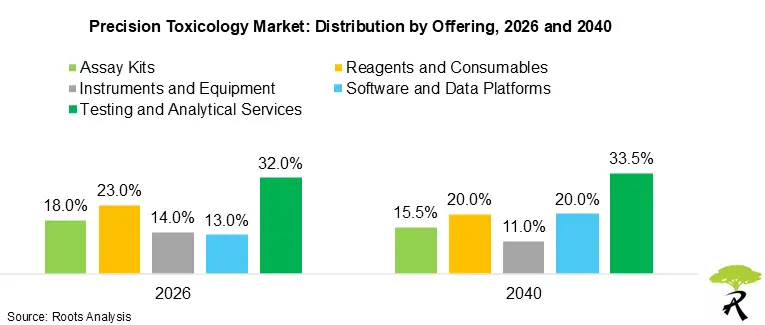
- Based on offering, testing and analytical services capture 32.0% market share in 2026, whereas software and data platforms register a 13.3% CAGR through 2040, as complex workflows increasingly require integrated analytics.
- Based on testing approach, in vitro methods capture 55.0% market share in 2026, whereas integrated approaches to testing and assessment register a 14.0% CAGR through 2040, as regulators favor combined evidence.
- Based on technology platform, two-dimensional and three-dimensional cell-based systems capture 32.0% market share in 2026, whereas organ-on-chip and microphysiological systems register a 15.0% CAGR through 2040, as automation removes adoption barriers.
- Based on toxicity endpoint, hepatotoxicity captures 24.0% market share in 2026, whereas developmental and reproductive toxicity registers an 11.5% CAGR through 2040, as human developmental models improve translation.
- Based on end user, pharmaceutical and biotechnology companies capture 43.0% market share in 2026, whereas contract research organizations and testing laboratories register an 11.7% CAGR through 2040, as sponsors outsource specialist capabilities.
Precision Toxicology Market Outlook
Precision toxicology is shifting from isolated laboratory assays toward integrated, human-relevant evidence systems. In vitro methods still hold 55.0% of testing-approach demand in 2026, supported by mature workflows and broad regulatory familiarity. Yet software, organ-on-chip platforms, toxicogenomics, and mechanistic modeling increasingly connect exposure, biology, and clinical relevance. This transition reduces dependence on single endpoints and creates demand for validated services, interoperable data, and specialist regulatory interpretation.
Regulatory action now converts scientific interest into purchasing urgency across the precision toxicology market. The FDA and UK authorities are creating clearer routes for new approach methodologies, while public funding supports enabling infrastructure. In June 2026, VeriSIM Life formalized an FDA research collaboration to evaluate BIOiSIM for mechanistic drug-induced liver injury prediction. Such programs reward platforms that combine predictive performance with transparent validation and submission-ready evidence.
Through 2040, the market will remain high-growth as integrated testing approaches expand at 14.0% CAGR and organ-on-chip systems grow at 15.0%. Automation will improve throughput, while software will connect omics, imaging, exposure, and mechanistic models across safety decisions. In June 2025, Emulate launched AVA to process 96 Organ-Chip samples with automated imaging. Long-term winners will pair physiological relevance with reproducibility, scale, and regulatory usability for broad adoption.
Precision Toxicology Market Dynamics
Precision Toxicology Market Drivers
Regulatory support and outsourcing demand are expanding the precision toxicology market. Integrated approaches to testing and assessment will grow at 14.0% CAGR through 2040, while contract research organizations will expand at 11.7%. Sponsors increasingly need validated workflows, specialist laboratories, and submission-ready documentation. FDA support for artificial intelligence models, organoids, organ-on-chip systems, and in vitro human evidence strengthens purchasing confidence across drug development programs.
Precision Toxicology Market Restraints
Validation requirements remain the main restraint on faster commercial adoption. The FDA's draft framework expects developers to show reliability, relevance, and defined contexts of use for new approach methodologies. Cross-laboratory reproducibility becomes difficult when tissue sources, perfusion conditions, imaging settings, and model endpoints vary. Vendors must fund comparative studies and regulatory documentation before customers can replace established animal or conventional assay packages at scale.
Precision Toxicology Market Opportunities
Public funding and regulatory alignment create strong opportunities for scalable human-relevant platforms. Organ-on-chip systems will grow at 15.0% CAGR, while software and data platforms will expand at 13.3% through 2040. In November 2025, the UK committed £75 million to organ-on-chip systems, artificial intelligence models, and 3D-bioprinted tissues. Suppliers can use this investment cycle to build validated infrastructure and partnerships.
Precision Toxicology Market Challenges
Data integration and evidence comparability remain critical market challenges. Precision toxicology workflows combine omics, imaging, exposure, mechanistic models, and multiple human tissue systems. Each layer introduces different quality controls, metadata requirements, and interpretation risks. In April 2026, the FDA reported work on an artificial intelligence toxicity-prediction tool and a database of acceptable methodologies. Competitive advantage will depend on transparent models and auditable evidence chains.
Precision Toxicology Market Size Estimation Methodology
- As a starting point, the forecast anchored the precision toxicology market to adjacent in vitro, predictive, computational, and organ-on-chip benchmarks. Analysts reconciled historical values from 2022 through 2026 across multiple credible secondary sources. They excluded benchmarks that measured only one narrow assay class or lacked comparable geographic coverage. Historical growth paths established the base range before segment-specific adjustments.
- Moving forward, the model mapped company portfolios across assay kits, consumables, instruments, software, services, and human-relevant platforms. Portfolio breadth, commercialization maturity, regulatory reach, and customer coverage informed competitive weighting. This step separated established laboratory demand from emerging organ-on-chip, toxicogenomics, and mechanistic modeling revenue pools. Vendor roles also indicated where revenue accrued through products, licenses, or outsourced studies.
- Building on this, analysts quantified adoption using regulatory milestones, platform launches, service-capacity expansions, and public funding commitments. FDA and UK actions received higher weighting because they directly influence acceptable evidence and submission behavior. Technology launches helped estimate when automation, throughput, and workflow simplicity could expand addressable demand. Funding programs signaled whether laboratories could absorb validation and infrastructure costs.
- Drawing upon these, the team allocated 2026 shares across testing approach, technology platform, toxicity endpoint, end user, and geography. Existing laboratory infrastructure supported higher shares for in vitro methods and cell-based systems. Faster growth assumptions favored integrated testing, software, organ-on-chip systems, developmental toxicity, specialist laboratories, and Asia-Pacific. Endpoint weighting reflected model maturity, regulatory scrutiny, and drug-development attrition patterns.
- The projected value was then calculated through segment-level growth rates rather than one uniform market multiplier. Each sub-segment received a CAGR reflecting regulatory acceptance, workflow maturity, outsourcing intensity, automation potential, and replacement barriers. Annual values were reconciled so every segment and regional total matched the consolidated forecast. Share changes were checked against the direction of documented launches, collaborations, and capacity additions.
- Finally, analysts tested the forecast against conservative, base, and accelerated adoption conditions. Sensitivity checks varied validation timelines, regulatory uptake, service outsourcing, public investment, and platform scalability. The final curve preserved the 9.9% CAGR and captured gains for software, integrated approaches, and microphysiological systems. It also captured faster expansion for contract laboratories and Asia-Pacific, while annual totals remained consistent through 2040.
Precision Toxicology Market Share Insights
Market Share by Offering
According to our analysis, testing services lead because sponsors need specialist laboratories, validated workflows, and regulatory documentation across increasingly complex endpoints. Shared infrastructure also improves equipment utilization and lowers the fixed cost of advanced models. In August 2025, Labcorp expanded its Wisconsin laboratory to increase comprehensive preclinical testing capacity.
Software will grow fastest as AI models connect chemical, exposure, omics, and human-response evidence. Scalable analytics reduce marginal processing costs while supporting integrated, context-specific regulatory decisions. In April 2025, Certara launched Non-Animal Navigator with AI-enabled biosimulation and strategic guidance.
Market Share by Testing Approach
In vitro methods lead through mature cell-assay infrastructure, standardized consumables, accessible automation, and longstanding regulatory familiarity. Their lower cost and broad endpoint coverage sustain routine screening volumes across multiple industries. In November 2025, InSphero acquired DOPPL and Gri3D technology, broadening scalable 3D safety-testing workflows.
Integrated approaches to testing and assessment. Integrated approaches will grow fastest because regulators increasingly favor evidence combining exposure, mechanistic, computational, and laboratory data. This integration reduces uncertainty when no single method fully captures systemic toxicity. In April 2025, Certara launched a solution combining AI biosimulation and strategic NAM integration.
Want Information on Specific Region / Segment?
Regional Analysis: North America Leads the Market and Asia-Pacific is Likely to Register Higher CAGR
North America holds 42.0% share in 2026. North America leads through mature laboratories, strong capital access, established vendors, and direct regulatory engagement. The region also concentrates pharmaceutical research budgets, computational toxicology capabilities, and specialized CRO infrastructure. In April 2025, the FDA announced immediate encouragement of NAM data within applicable investigational drug submissions.
Asia-Pacific will grow at a 12.4% CAGR from 2026 to 2040. Asia-Pacific will grow fastest as biopharmaceutical pipelines, domestic platforms, and regional CRO networks expand. Standards development and localized manufacturing will improve confidence, accessibility, and workflow consistency. In October 2025, China's National Standardization Administration registered national terminology guidance for organs-on-chips.
Market Ecosystem Analysis
Eight Tier 1 leaders anchor commercial activity across this 22-company set, above nine specialists and five emerging entrants. Acquisition-driven platform convergence dominates, with InSphero adding imaging capabilities while Charles River embeds specialist NAM assays into outsourced programs. FDA's April 2025 roadmap now rewards human-relevant evidence, directly favoring organ-chip, organoid, cell-based, and computational toxicology platforms. Competitive advantage is shifting toward integrated workflows combining mechanistic biology, automation, analytics, and regulator-ready validation.
- In October 2025, Charles River and Toxys opened ReproTracker access for developmental and reproductive toxicity programs.
- In April 2025, CN Bio partnered with Pharmaron to validate PhysioMimix and integrate organ-chip tools into its R&D platform.
- In May 2025, Simulations Plus released DILIsym 11 with pediatric representation and a new T-cell injury model.
- In June 2025, Lhasa updated Derek Nexus and Sarah Nexus with probability scoring and revised nitrosamine workflows.
- In June 2025, Emulate introduced AVA, combining 96 Organ-Chip samples, automated imaging, and an integrated incubator.
- In June 2025, InSphero and Hesperos combined scalable spheroids with multi-tissue systems across screening and functional assessment.
- In May 2026, InSphero acquired PhenoVista, adding high-content imaging, phenotypic analysis, and expanded United States operations.
Startup Companies and their Key Highlights
- Ignota Labs
- Event type and funding amount: Seed financing, USD 6.9 million
- Month and year: March 2025
- Lead investors: Montage Ventures and AIX Ventures
- Stated purpose: Acquire distressed drug assets and advance a PDE9A inhibitor toward early Alzheimer's trials
- Market implication: The financing strengthens AI-led toxicity diagnosis, drug rescue, and mechanistic safety modeling for failed clinical assets.
- Vivodyne
- Event type and funding amount: Series A financing, USD 40 million
- Month and year: May 2025
- Lead investor: Khosla Ventures
- Stated purpose: Scale robotic human-tissue testing and establish a fully automated laboratory in South San Francisco
- Market implication: The investment expands high-throughput organotypic testing, human-derived safety data, and AI-supported preclinical analysis in North America.
- Dynamic42 GmbH
- Event type: Exclusive United States distribution partnership
- Month and year: April 2025
- Strategic partner: Ohio Lumex
- Stated purpose: Distribute Dynamic42's organ-on-chip technology through Ohio Lumex's United States network
- Market implication: The partnership lowers regional purchasing barriers for immune-competent organ-chip systems and expands North American commercial access.
- Hesperos, Inc.
- Event type: Strategic microphysiological-systems collaboration
- Month and year: June 2025
- Strategic partner: InSphero AG
- Stated purpose: Provide integrated solutions spanning early screening, functional assessment, toxicity analysis, and PK/PD prediction
- Market implication: The collaboration accelerates multi-organ toxicology services by connecting scalable screening models with complex functional human systems.
Precision Toxicology Market Trends / Opportunities
Regulatory Acceptance Expanding Precision Toxicology Market Access
Regulatory validation is becoming a commercial gate rather than a distant scientific objective. In March 2026, the FDA released draft guidance for validating and submitting new approach methodologies in nonclinical safety assessment. Vendors with defined contexts of use and auditable evidence will enter regulated workflows faster during commercialization.
Early regulatory engagement can reduce development risk for platform suppliers and sponsors. In March 2026, the UK medicines regulator opened an advice route for replacing animal data in Module 4 submissions. Companies that support submission planning can differentiate beyond assay performance alone in regulated programs.
Automated Organ-on-Chip Systems Improving Precision Toxicology Market Economics
Automation is converting organ-on-chip toxicology from specialist experimentation into scalable screening infrastructure. In June 2025, Emulate launched AVA to process 96 Organ-Chip samples with automated imaging. Higher throughput improves laboratory utilization and expands competitive access to repeat-dose and mechanistic studies at scale.
Simplified system design is lowering operational barriers for laboratories without extensive microfluidics expertise. In October 2025, CN Bio launched PhysioMimix Core as an all-in-one organ-on-chip system for scalable human-relevant studies. Easier deployment strengthens platform sales and broadens service-provider adoption across customer segments.
Mechanistic Artificial Intelligence Strengthening Precision Toxicology Market Differentiation
Mechanistic artificial intelligence is moving from exploratory prediction toward regulator-linked evaluation. In June 2026, VeriSIM Life formalized an FDA collaboration to assess BIOiSIM for drug-induced liver injury prediction. Regulatory exposure can strengthen customer confidence and improve positioning in hepatotoxicity workflows during vendor selection.
Integrated software is becoming essential as sponsors combine exposure, omics, imaging, and human-response evidence. In April 2025, Certara launched Non-Animal Navigator with artificial intelligence-enabled biosimulation and strategic guidance. Providers that connect models with regulatory strategy can capture higher-value recurring software and advisory revenue over time.
Standardized Human Models Shifting Procurement Toward Platform Ecosystems
Portfolio consolidation is creating broader, standardized human-model ecosystems for pharmaceutical buyers. In November 2025, InSphero acquired DOPPL and Gri3D technology to expand scalable 3D safety-testing workflows. Broader model coverage supports cross-endpoint purchasing and raises competitive pressure on single-model specialists in procurement.
Industry coordination is addressing the standardization gap that slows procurement and regulatory confidence. In February 2025, MIMETAS and partners launched the International Association for Microphysiological Systems. Shared terminology and acceptance efforts can shorten sales cycles and improve interoperability across diverse customer portfolios.
Your Business is Unique – Why Shouldn't Your Report Be?
Market Access Considerations
Regulatory Validation and Defined Contexts of Use
Regulatory validation determines whether a platform can enter drug-development submissions or remain a research tool. The FDA's draft NAM framework emphasizes reliability, relevance, and defined contexts of use. Developers must fund comparative studies, documentation, and regulator engagement before broad commercialization. Companies that package scientific performance with submission strategy can shorten customer qualification cycles and defend premium pricing against less documented alternatives. That capability also improves win rates for complex, multi-endpoint safety programs over time.
Cross-Laboratory Reproducibility and Standardization
Cross-laboratory reproducibility shapes procurement because sponsors need consistent results across sites, programs, and outsourcing partners. Tissue sourcing, perfusion conditions, imaging settings, and endpoint definitions can change model outputs. MIMETAS and partners launched the International Association for Microphysiological Systems in February 2025 to advance standardization and regulatory acceptance. Vendors that support transferable protocols and shared terminology can scale faster through pharmaceutical and contract laboratory networks. Standardized workflows also reduce onboarding costs across large, multi-site customer networks.
Throughput Economics and Workflow Scalability
Throughput economics determine whether advanced human models can move from specialist studies into routine screening. Automated imaging, simplified fluidics, and standardized plates reduce labor intensity and increase instrument utilization. Emulate launched AVA in June 2025 to process 96 Organ-Chip samples with automated imaging. Suppliers that lower per-study costs can reach broader customer segments and compete more effectively with established in vitro workflows. This cost position directly affects purchasing frequency, study volume, and service margins.
How Stakeholders Benefit from the Key Focus Areas of Our Precision Toxicology Market Report
Regulatory pressure to reduce animal testing now makes human-relevant safety evidence commercially urgent. This report connects market growth, platform adoption, competitive positioning, and access barriers to support capital allocation and technology planning.
- Unmet Needs and Market Gaps in Precision Toxicology Market: The report identifies gaps in cross-laboratory reproducibility, developmental toxicity models, interoperable software, and submission-ready evidence. Research and development leaders can compare these gaps against their internal pipeline risks. The analysis supports decisions on whether to build capabilities, license platforms, or outsource specialist studies. It also highlights where unmet needs may support differentiated product development in under-served endpoints.
- Funding and Venture Investment Opportunities in Precision Toxicology Market: The funding analysis tracks public investment, regulatory programs, and commercialization signals across organ-on-chip, artificial intelligence, and 3D tissue platforms. Investment committees can assess which technologies have policy support and scalable demand. The UK's £75 million commitment provides a concrete infrastructure signal. These insights support portfolio selection, diligence priorities, and timing decisions across funding cycles.
- Technology Innovation and Adoption Trends: The technology assessment compares mature cell-based systems with faster-growing software, integrated testing, and microphysiological platforms. Technology executives can evaluate adoption curves, workflow complexity, and automation requirements. The report shows organ-on-chip systems growing at 15.0% CAGR through 2040. This evidence supports platform roadmaps, partnership choices, and laboratory investment planning.
- Precision Toxicology Market Competitive Landscape and Industry Analysis: The competitive analysis maps Tier 1 leaders, specialist providers, and emerging platform developers by role and commercialization maturity. Corporate strategy teams can identify crowded categories and defensible capability gaps. The report distinguishes broad service providers from focused software, tissue-model, and organ-chip companies. This structure supports positioning, acquisition screening, and market-entry decisions across adjacent segments.
- Mapping Strategic Partnerships and Ecosystem Synergies: The partnership analysis connects regulators, platform developers, pharmaceutical sponsors, and industry alliances across validated recent activity. Business development directors can identify partners that add regulatory access, model breadth, or commercialization reach. Collaborations involving VeriSIM Life and MIMETAS show distinct ecosystem strategies. The mapping supports alliance targeting and partner-prioritization decisions across priority accounts.
- Precision Toxicology Market CAGR and Growth Trends: The growth analysis explains the 9.9% overall CAGR through segment and regional adoption patterns. Finance and planning teams can see why integrated testing, software, contract laboratories, and Asia-Pacific gain share. The report separates durable structural growth from slower legacy categories. These comparisons support revenue planning, resource allocation, and long-range scenario development.
Precision Toxicology Market: Scope of the Report
| Key Report Attributes | Details | |
| Forecast Period | Till 2040 | |
| Market Size 2026 | USD 13.8 Billion | |
| Market Size 2040 | USD 51.8 Billion | |
| CAGR (Till 2040) | 9.9% | |
| Segments Covered |
|
|
| Geographical Regions Covered |
|
|
| Key Sections Covered |
|
|
Market Segmentation
The Precision Toxicology Market report presents an in-depth analysis, highlighting the capabilities of various stakeholders, based on different segments, such as offering, testing approach, technology platform, toxicity endpoint, end user, geographical regions, and leading players.
By Offering
- Assay Kits
- Reagents and Consumables
- Instruments and Equipment
- Software and Data Platforms
- Testing and Analytical Services
By Testing Approach
- In Vitro Methods
- In Silico Methods
- Ex Vivo Methods
- In Chemico Methods
- Integrated Approaches to Testing and Assessment
By Technology Platform
- Two-Dimensional and Three-Dimensional Cell-Based Systems
- High-Throughput and High-Content Screening
- Omics and Toxicogenomics
- Organoids and Organotypic Models
- Organ-On-Chip and Microphysiological Systems
- Artificial Intelligence and Mechanistic Modeling
By Toxicity Endpoint
- Hepatotoxicity
- Cardiotoxicity
- Nephrotoxicity
- Neurotoxicity
- Genotoxicity
- Immunotoxicity
- Developmental and Reproductive Toxicity
- Skin and Ocular Toxicity
By End User
- Pharmaceutical and Biotechnology Companies
- Contract Research Organizations and Testing Laboratories
- Academic and Research Institutes
- Government, Regulatory, and Public-Health Laboratories
- Chemical, Cosmetics, Food, and Consumer-Product Manufacturers
By Geographical Regions
- North America
- US
- Canada
- Mexico
- Rest of North America
- Europe
- Austria
- Belgium
- Denmark
- France
- Germany
- Ireland
- Italy
- Netherlands
- Norway
- Russia
- Spain
- Sweden
- Switzerland
- UK
- Rest of Europe
- Asia-Pacific
- China
- India
- Japan
- Singapore
- South Korea
- Rest of Asia-Pacific
- Latin America
- Argentina
- Brazil
- Chile
- Colombia
- Venezuela
- Rest of Latin America
- Middle East and Africa (MEA)
- Egypt
- Iran
- Iraq
- Israel
- Kuwait
- Saudi Arabia
- UAE
- Rest of MEA
- Rest of the World


