Prescription DTx Market by Application (Diabetes and Metabolic Disorders, Obesity and Weight Management, Cardiovascular Diseases and Hypertension, Mental and Behavioral Health Disorders, Neurological Disorders, Respiratory Disorders, Musculoskeletal and Chronic Pain Disorders, and Others), Offering, Technology, Business Model / Sales Channel, End User, Prescription / Regulatory Access Type, Geographical Regions, and Leading Players – Trends and Forecasts, 2026-2040
Market Size
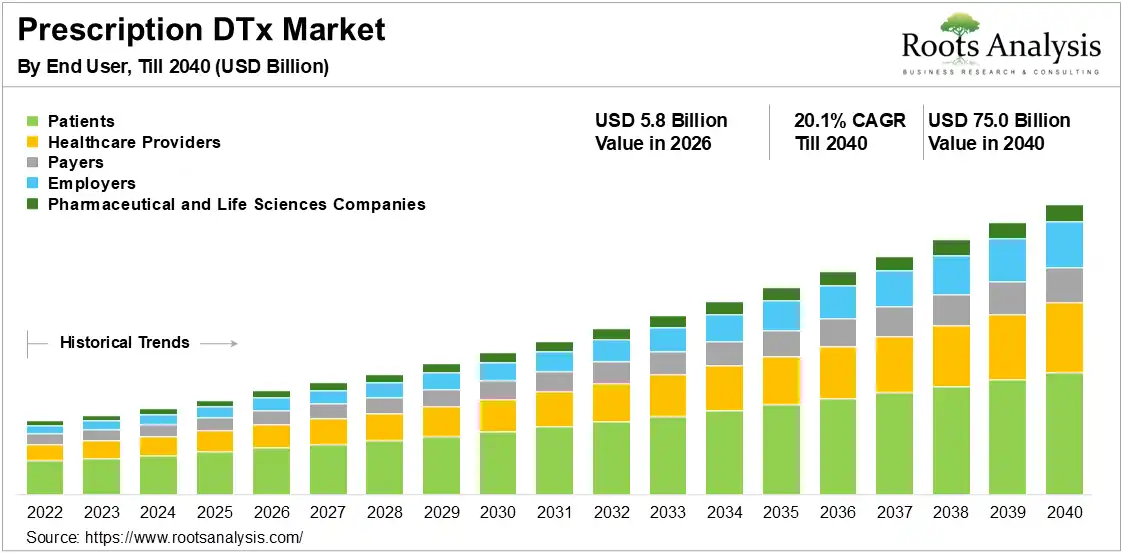
The global prescription DTx market is expected to rise from USD 5.8 billion in 2026 to reach USD 75.0 billion by 2040, growing at a CAGR of 20.1% over the forecast period 2026 to 2040, driven by reimbursement pathways, FDA-cleared software therapies, and chronic-care digitization.
See What’s in the Full Report – Request Your Complimentary Insights!
Market Report: Key Takeaways
- Based on geography, North America captures 44.0% market share in 2026, whereas Asia-Pacific registers a 23.0% CAGR through 2040, driven by localized reimbursement and regulatory pathways.
- Based on application, diabetes and metabolic disorders capture 28.0% market share in 2026, whereas obesity and weight management registers a 23.3% CAGR through 2040, driven by GLP-1-linked adherence demand.
- Based on offering, therapeutic software applications capture 47.0% market share in 2026, whereas connected devices and sensors register a 22.0% CAGR through 2040, driven by passive monitoring and adherence data.
- Based on technology, cognitive behavioral therapy-based digital therapeutics capture 31.0% market share in 2026, whereas artificial intelligence and machine learning-enabled therapeutics register a 25.4% CAGR through 2040, driven by adaptive personalization.
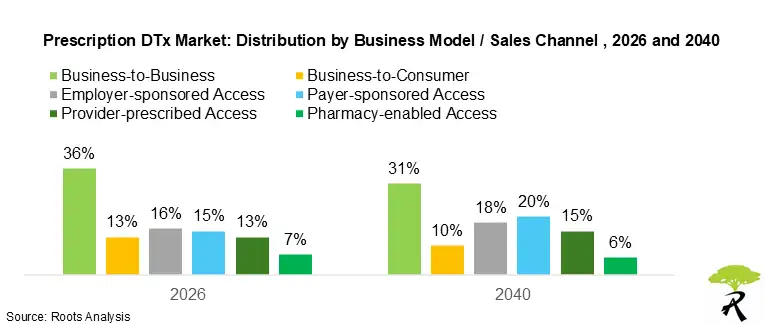
- Based on business model / sales channel, business-to-business captures 36.0% market share in 2026, whereas payer-sponsored access registers a 22.6% CAGR through 2040, driven by coverage decisions and benefit integration.
Prescription DTx Market Outlook
Prescription digital therapeutics have moved from pilot apps into regulated software tied to prescriptions, coverage, and clinical evidence. The prescription DTx market now reflects FDA-authorized prescription digital therapeutics, DiGA-style reimbursement, and clinician-prescribed therapeutic software. Earlier demand centered on diabetes coaching and remote support. Current demand concentrates on migraine, mental health, pain, hypertension, and regulated software as medical device therapeutics. Supply now favors developers that can produce clinical evidence, regulatory submissions, and payer-ready outcomes data.
Growth now comes from clearer regulatory access, chronic-care pressure, employer benefit design, and payer demand for scalable non-drug interventions. In April 2025, Click Therapeutics received FDA authorization for CT-132 as a prescription digital therapeutic for episodic migraine prevention. The May 2025 Access to Prescription Digital Therapeutics Act signaled policy momentum for Medicare coverage of FDA-cleared prescription digital therapeutics. These policy signals reduce buyer uncertainty and support broader benefit design.
Through 2040, the market will remain high-growth as AI-enabled therapeutics, immersive VR programs, and sensor-connected interventions expand. In August 2025, FDA cleared AppliedVR’s RelieVRx Pico G3 prescription-use immersive VR system for chronic lower back pain. Asia-Pacific, payer-sponsored access, and government-reimbursed applications will gain share. Commercialization will depend on evidence depth, reimbursement execution, and provider workflow integration. Competitive advantage will favor platforms that pair clinical validation with low-friction prescribing.
Prescription DTx Market Dynamics
Prescription DTx Market Drivers
FDA-authorized prescription digital therapeutics and payer-covered access now drive adoption beyond wellness use cases. The market will grow at 20.1% CAGR through 2040, supported by chronic disease burden, clinician-prescribed therapeutic software, and remote care demand. Diabetes and metabolic disorders hold 28.0% share in 2026. Mental and behavioral health disorders reach 25.0% by 2040 as CBT-based software, migraine programs, and digital mental health treatments scale.
Prescription DTx Market Restraints
Reimbursement uncertainty still slows commercialization because FDA clearance does not automatically create coverage, coding, or formulary access. Prescription-only digital therapeutics hold 35.0% share in 2026, yet payer-covered digital therapeutics hold only 16.0%. Developers must fund evidence generation, provider onboarding, cybersecurity controls, and clinical integration before recurring reimbursement matures. Smaller companies face higher risk when product validation precedes broad revenue and payer contracting.
Prescription DTx Market Opportunities
Payer-sponsored access creates the clearest near-term expansion path as coverage decisions reduce patient friction and improve utilization. Payer-sponsored access will rise from 15.0% share in 2026 to 20.0% by 2040, with 22.6% CAGR. In February 2025, Highmark made Swing Therapeutics’ FDA-cleared Stanza treatment for fibromyalgia symptoms available through insurance coverage. This model supports faster commercialization for clinically validated therapies.
Prescription DTx Market Challenges
Clinical workflow integration remains difficult because providers must prescribe, monitor, and document software therapy inside busy care pathways. Therapeutic software applications hold 47.0% share in 2026, but connected devices, analytics, and implementation services require stronger interoperability. Evidence expectations also differ across FDA-cleared digital therapeutics, DiGA-style applications, and investigational digital therapeutics. Companies that cannot align regulatory claims, outcomes data, and reimbursement files will scale slowly.
Prescription DTx Market Size Estimation Methodology
- As a starting point, the prescription DTx market forecast used prescription-specific industry data as the anchor. Broader digital therapeutics estimates served only as boundary checks because they include wellness, care-management, and non-prescription software. The baseline also considered FDA-authorized prescription digital therapeutics, DiGA-style applications, and investigational digital therapeutics as separate access categories. This structure kept the prescription digital therapeutics industry forecast focused on reimbursable and clinically regulated demand.
- Moving forward, the model mapped verified company activity across leading and specialist developers from the supplied company database. Product pages, regulatory submission counts, FDA clearance activity, and prescription-use claims separated regulated therapeutic software from general health apps. This step reduced overstatement risk in prescription digital therapeutics market size assumptions and improved company-level comparability.
- Building on this, application shares were tested against chronic-care fit, clinical workflow readiness, and payer relevance. Diabetes and metabolic disorders led the 2026 base because remote self-management and data-linked coaching already support chronic care. Mental health, obesity, cardiovascular, neurological, pain, and respiratory applications were adjusted using product clearances, payer coverage signals, and clinical trial databases. Disease areas with stronger prescription pathways received higher confidence weights.
- Drawing upon these, technology shares were assigned through evidence type, delivery model, and adoption friction. CBT-based digital therapeutics led the base because insomnia, anxiety, depression, fibromyalgia, migraine, and pain programs use structured behavioral protocols. AI-enabled, immersive VR, wearable-connected, and cloud-based therapies received higher growth where personalization or passive data improved commercial utility.
- The projected value was then allocated across geography, offering, business model, end user, and prescription or regulatory access type. North America received the largest 2026 share because FDA pathways, venture funding, employer channels, and payer pilots remain deepest. Asia-Pacific received the fastest growth because Japan, South Korea, and China are formalizing SaMD and digital therapeutics pathways.
- Finally, the forecast was stress-tested against recent developments, policy signals, reimbursement behavior, and product-stage maturity. The review weighted post-January 2025 events such as FDA clearances, payer coverage, strategic investments, acquisitions, and commercialization transfers. Faster CAGRs for AI-enabled therapeutics, payer-sponsored access, and government-reimbursed applications were reconciled with the overall 20.1% CAGR. Sensitivity checks also tested slower reimbursement conversion and delayed provider adoption.
Prescription DTx Market Share Insights
Market Share by Application
According to our analysis, diabetes and metabolic disorders lead because self-management, coaching, and glucose-linked data flows already fit remote chronic care. Example, DarioHealth, September 2025: five employer cardiometabolic contracts covered 107,000 lives.
Obesity and weight management will outpace the market as GLP-1 access creates demand for digital adherence support. Example, DarioHealth, January 2025: the company added prescribing capability to its GLP-1 solution.
Market Share by Business Model / Sales Channel
Dominant sub-segment: Business-to-business leads because employers, pharma partners, and health systems can buy access before broad reimbursement matures. Example, Dassault Systèmes and Click Therapeutics, March 2025: the partnership expanded DTx beyond clinical trials.
Payer-sponsored access will grow fastest as coverage decisions reduce patient friction and improve commercialization. Example, Highmark and Swing Therapeutics, February 2025: Highmark reimbursed Stanza by prescription for commercial members.
Want Information on Specific Region / Segment?
Regional Analysis: North America Leads the Market and Asia-Pacific is Likely to Register Higher CAGR
Presently, North America holds 44% market share and dominates because FDA-cleared PDTs, employer channels, payer pilots, and clinical-trial capital are concentrated in the US. Its share will moderate as Europe and Asia-Pacific add reimbursement pathways. Example, AMCP, May 2025: the Access to Prescription Digital Therapeutics Act targeted Medicare and Medicaid access.
On the contrary, Asia-Pacific will grow fastest as Japan, South Korea, and China localize DTx approval, evidence, and reimbursement models. Growth will also benefit from smartphone penetration and rising chronic-disease management needs. Example, International Trade Administration, August 2025: Japan had five approved DTx products by April 2025.
Market Ecosystem Analysis
Within the supplied 23-company scope, six Tier 1 leaders control most commercial momentum, while specialists defend reimbursed indication niches. The dominant consolidation dynamic is platform convergence, linking regulated software, trial infrastructure, pharma commercialization, and payer implementation. Reimbursement access now reshapes behavior, as DMHT billing, Highmark coverage, and NHS Trust deployment turn clearance into adoption. Competitive advantage is shifting toward evidence depth, channel access, and post-market data because app-only differentiation remains weak.
- Click Therapeutics won April 2025 FDA marketing authorization for CT-132, the first U.S. prescription DTx for preventive episodic migraine. The authorization raises the neurology evidence barrier and strengthens neurological disorders, therapeutic software, and provider-prescribed access.
- Big Health secured $23.7 million in February 2026 strategic funding for FDA-cleared SleepioRx and DaylightRx commercialization. Medicare DMHT billing codes pressure mental-health apps lacking clearance, reimbursement logic, and provider workflow integration.
- Otsuka and Click launched Rejoyn in Great Britain in June 2025 through select NHS Trusts. That move strengthens European mental-health access and raises the bar for DTAC, UKCA, and health-system deployment.
- Boehringer Ingelheim and Click reported August 2025 that CT-155 met CONVOKE’s primary endpoint for schizophrenia negative symptoms. This shifts psychiatric PDT competition toward Phase III evidence and adjunctive antipsychotic positioning.
- Dassault Systèmes and Medidata invested in Click Therapeutics in March 2025 to connect trials, approvals, and real-world engagement. The transaction strengthens clinical integration, data analytics, reporting services, and pharmaceutical end-user positioning.
- Sidekick Health secured €35 million venture debt from the EIB in April 2025 for R&D and global expansion. The financing strengthens AI-enabled chronic-care platforms and pressures single-indication vendors to prove pharma, payer, and provider scalability.
- Swing Therapeutics secured a February 2025 Highmark coverage decision for Stanza across selected commercial plans. This strengthens payer-covered fibromyalgia therapy and raises reimbursement-contracting barriers for chronic-pain competitors.
- Freespira received May 2025 FDA clearance for adolescents aged 13 to 17 with panic disorder or PTSD symptoms. The clearance strengthens sensor-connected behavioral therapy and differentiates Freespira from app-only CBT competitors.
- Luminopia gained April 2025 expanded FDA clearance for binocular amblyopia therapy across children aged 4 to under 13. The expanded label strengthens immersive therapeutics, pediatric ophthalmology access, and provider-prescribed VR therapy.
Startup Companies and their Key Highlights
- Sidekick Health
- Event type and funding amount: €35 million venture debt facility, plus €7 million growth financing
- Month and year: April 2025
- Lead investor or strategic partner name: European Investment Bank; InvestEU backing
- Stated purpose of the event: Accelerate R&D, therapy development, AI capabilities, data infrastructure, and global expansion
- Market implication: Accelerates chronic and specialty-care DTx across Europe and the U.S. through pharma, payer, and provider channels
- Swing Therapeutics
- Event type and funding amount: Positive payer coverage decision for Stanza
- Month and year: February 2025
- Lead investor or strategic partner name: Highmark Health
- Stated purpose of the event: Provide prescription access and reimbursement for commercial members in selected U.S. states
- Market implication: Accelerates payer-covered fibromyalgia DTx by converting FDA-cleared therapy into insured prescribing
- Freespira
- Event type and funding amount: FDA clearance expansion for adolescents aged 13 to 17
- Month and year: May 2025
- Stated purpose of the event: Expand at-home treatment access for adolescent panic disorder and PTSD symptoms
- Market implication: Accelerates sensor-connected mental-health DTx for teen populations through capnometry-guided respiratory therapy
- Luminopia
- Event type and funding amount: Expanded FDA clearance for binocular amblyopia therapy
- Month and year: April 2025
- Stated purpose of the event: Expand the cleared pediatric age range for prescription VR-based amblyopia treatment
- Market implication: Accelerates immersive therapeutics in pediatric ophthalmology by enlarging the treatable patient base
- WELT Corp.
- Event type and funding amount: Peer-reviewed clinical validation publication for WELT-I
- Month and year: September 2025
- Stated purpose of the event: Validate the efficacy and safety of a mobile CBT-I digital therapeutic for insomnia
- Market implication: Strengthens Asia-Pacific insomnia DTx credibility through published evidence supporting clinician confidence
Prescription DTx Market Trends / Opportunities
Prescription DTx Market Reimbursement Pathways Turning Clinical Validation into Commercial Scale
Coverage decisions now shape adoption because patients need benefit access after prescription. In February 2025, Highmark made Swing Therapeutics’ FDA-cleared Stanza treatment available through insurance coverage for fibromyalgia symptoms. This strengthens payer-sponsored access as a competitive route for validated therapies.
Public reimbursement remains a structural catalyst for long-term prescription digital therapeutics market growth. In May 2025, the Access to Prescription Digital Therapeutics Act was reintroduced for Medicare coverage of FDA-cleared prescription digital therapeutics. Companies with coverage-ready evidence packages will hold stronger negotiating positions.
AI-Enabled Personalization Expanding Differentiation in Clinician-Prescribed Therapeutic Software
AI-enabled therapeutics will gain share as developers use personalization, biomarker analytics, and adaptive interventions. In January 2026, Ultrahuman and Click Therapeutics partnered to develop Migraine PowerPlug using biomarker analytics and Click’s FDA-authorized CT-132 technology. This creates a stronger data moat around migraine digital therapeutics.
Regulatory scrutiny will rise as AI-enabled digital mental health tools move closer to clinical use. In November 2025, the FDA Digital Health Advisory Committee discussed generative AI-enabled digital mental health medical devices. Developers that validate adaptive logic early can reduce approval risk and improve payer confidence.
Immersive and Sensor-Connected Modalities Broadening the Prescription DTx Market Beyond Mobile Apps
Immersive therapeutics are expanding beyond app-based behavioral interventions into prescription VR care. In August 2025, FDA cleared AppliedVR’s RelieVRx Pico G3 prescription-use immersive VR system for chronic lower back pain. This strengthens specialist positioning for companies that combine hardware, software, and clinical claims.
Sensor-connected interventions will expand as passive data becomes central to adherence, respiratory management, and outcomes reporting. In October 2025, FDA cleared Aptar Digital Health’s HeroTracker Sense connected add-on device for metered-dose inhalers. This supports higher growth for connected devices, sensors, and analytics services.
Pharma and Platform Partnerships Converting DTx Pipelines into Commercial Assets
Pharmaceutical partnerships are shifting prescription software therapeutics toward commercialization platforms. In April 2026, Boehringer Ingelheim made a USD 50 million Series D strategic investment in Click Therapeutics. The transaction also transferred CT-155 commercialization responsibility to Click. This gives Click stronger control over launch strategy and market access.
Clinical-trial infrastructure partnerships are expanding DTx use into patient-experience ecosystems. In March 2025, Dassault Systèmes and Click Therapeutics expanded digital therapeutics beyond clinical trials. This positions platform vendors as ecosystem partners, not only trial technology suppliers.
Your Business is Unique – Why Shouldn’t Your Report Be?
Market Access Considerations
FDA Prescription-Use Authorization and Claims Evidence
FDA authorization determines which software products can compete as prescription-use therapeutic software rather than wellness tools. Clearance or authorization supports clinical legitimacy, but it also requires evidence, labeling discipline, quality controls, and post-market compliance. Products such as CT-132, RelieVRx, Stanza, and DaylightRx show how regulated claims define access. Developers without clear prescription-use status face weaker provider adoption, weaker payer confidence, and narrower formulary consideration. This raises entry costs for undercapitalized software teams during payer and provider due diligence.
Coverage, Coding, and Payer Benefit Design
Coverage converts clinical validation into commercial reach because patients rarely scale prescription DTx adoption through self-pay alone. Payer-covered digital therapeutics will expand from 16.0% share in 2026 to 22.0% by 2040, outpacing prescription-only access. The Access to Prescription Digital Therapeutics Act targets Medicare coverage for FDA-cleared prescription digital therapeutics. Companies with outcomes dossiers, budget-impact evidence, and contracting resources will move faster through benefit design. Weak evidence delays contracting, limits utilization, and weakens renewals.
Provider Workflow and Clinical Integration Requirements
Provider-prescribed access requires software to fit prescribing, monitoring, documentation, and follow-up workflows. Healthcare providers increase share from 22.0% in 2026 to 24.0% by 2040, reflecting greater clinical involvement. Clinical integration and implementation services remain necessary even when therapeutic software carries regulatory authorization. Companies that simplify referral, onboarding, reporting, and patient engagement will gain stronger channel access through health systems and specialty practices. Poor workflow design raises abandonment risk and slows repeat prescriptions.
Regional Reimbursement Pathways and Localization Costs
Regional access depends on whether public payers and regulators recognize DTx as reimbursable care. North America leads in 2026 because FDA pathways and payer pilots remain deeper, while Asia-Pacific grows fastest through 2040. Japan, South Korea, and China require localized evidence, language, workflows, and SaMD compliance. Entrants that underbudget localization will lose speed against regional partners such as Handok and Teijin Pharma, especially in prescription-channel markets. Localization therefore becomes a commercialization cost, not only a regulatory task.
How Stakeholders Benefit from the Key Focus Areas of Our Prescription DTx Market Report
Prescription digital therapeutics matter now because chronic-care demand, FDA-cleared software therapies, and reimbursement policy are converging. The report links segment CAGRs, payer access, regulatory status, and company positioning to strategic, investment, and technology decisions. It also clarifies where adoption depends on coverage, workflow fit, and evidence maturity.
- Unmet Needs and Market Gaps in Prescription DTx Market: The report identifies disease areas where prescription digital therapeutics can solve access, adherence, or capacity gaps. Obesity, hypertension, neurological disorders, and chronic pain show share gains or technology expansion through 2040. Product and strategy teams can use this view to prioritize indications where digital intervention fits unmet clinical need.
- Funding and Venture Investment Opportunities in Prescription DTx Market: The report separates durable investment signals from short-lived funding activity by linking capital events to regulated products and commercialization paths. AI-enabled therapeutics grow at 25.4% CAGR, while payer-sponsored access grows at 22.6% CAGR. Investors and corporate development teams can use this analysis to screen targets with stronger reimbursement leverage.
- Technology Innovation and Adoption Trends: The report compares CBT-based therapeutics, AI-enabled therapeutics, immersive VR, wearable-connected programs, and cloud-based platforms. CBT-based digital therapeutics lead in 2026, while AI and machine learning-enabled therapeutics gain the fastest technology share. Product leaders can decide whether to build adaptive personalization, passive monitoring, or clinical integration features first.
- Prescription DTx Market Competitive Landscape and Industry Analysis: The report maps Tier 1 Leaders, Tier 2 Specialists, and Emerging or Startup companies across core product types. Coverage spans therapeutic software, VR, breathing-based care, neurorehabilitation, insomnia, and regional commercialization. Click Therapeutics, Big Health, CureApp, AppliedVR, Freespira, NightWare, Akili, MedRhythms, and Swing Therapeutics illustrate different competitive positions. Commercial teams can benchmark partnership, indication, and access strategies against relevant peer groups.
- Mapping Strategic Partnerships and Ecosystem Synergies: The report shows how pharma partners, payers, employers, providers, and platform vendors shape commercialization routes. Boehringer Ingelheim, Dassault Systèmes, Handok, Teijin Pharma, Highmark, and Otsuka America Pharmaceutical show ecosystem roles beyond software development. Business development teams can use this map to identify licensing, regional launch, payer access, and clinical infrastructure partners.
- Prescription DTx Market CAGR and Growth Trends: The report connects the 20.1% overall CAGR with segment-level shifts through 2040. Asia-Pacific, obesity and weight management, AI-enabled therapeutics, payer-sponsored access, and government-reimbursed applications outpace the overall market. Planning teams can use these growth trends to allocate resources toward segments with higher adoption momentum and clearer access pathways.
Prescription DTx Market: Scope of the Report
| Key Report Attributes | Details | |
| Forecast Period | Till 2040 | |
| Market Size 2026 | USD 5.8 Billion | |
| Market Size 2040 | USD 75.0 Billion | |
| CAGR (Till 2040) | 20.1% | |
| Segments Covered |
|
|
| Geographical Regions Covered |
|
|
| Key Sections Covered |
|
|
Market Segmentation
The Prescription DTx Market report presents an in-depth analysis, highlighting the capabilities of various stakeholders, based on different segments, such as application, offering, technology, business model / sales channel, end user, prescription / regulatory access type, geographical regions, and leading players.
By Application
- Diabetes and Metabolic Disorders
- Obesity and Weight Management
- Cardiovascular Diseases and Hypertension
- Mental and Behavioral Health Disorders
- Neurological Disorders
- Respiratory Disorders
- Musculoskeletal and Chronic Pain Disorders
- Others
By Offering
- Therapeutic Software Applications
- Connected Devices and Sensors
- Remote Monitoring and Patient Engagement Tools
- Clinical Integration and Implementation Services
- Training, Support and Maintenance Services
- Data Analytics and Reporting Services
By Technology
- Cognitive Behavioral Therapy-Based Digital Therapeutics
- Artificial Intelligence and Machine Learning-Enabled Therapeutics
- Virtual Reality and Immersive Therapeutics
- Mobile App-Based Behavioral Intervention Software
- Wearable- and Sensor-Connected Therapeutics
- Cloud-Based Digital Therapeutic Platforms
By Business Model / Sales Channel
- Business-To-Business
- Business-To-Consumer
- Employer-Sponsored Access
- Payer-Sponsored Access
- Provider-Prescribed Access
- Pharmacy-Enabled Access
By End User
- Patients
- Healthcare Providers
- Payers
- Employers
- Pharmaceutical and Life Sciences Companies
By Prescription / Regulatory Access Type
- Prescription-Only Digital Therapeutics
- Clinician-Recommended Digital Therapeutics
- Payer-Covered Digital Therapeutics
- Government-Reimbursed Digital Health Applications
- Investigational Digital Therapeutics
By Geographical Regions
- North America
- US
- Canada
- Mexico
- Rest of North America
- Europe
- Austria
- Belgium
- Denmark
- France
- Germany
- Ireland
- Italy
- Netherlands
- Norway
- Russia
- Spain
- Sweden
- Switzerland
- UK
- Rest of Europe
- Asia-Pacific
- China
- India
- Japan
- Singapore
- South Korea
- Rest of Asia-Pacific
- Latin America
- Argentina
- Brazil
- Chile
- Colombia
- Venezuela
- Rest of Latin America
- Middle East and Africa (MEA)
- Egypt
- Iran
- Iraq
- Israel
- Kuwait
- Saudi Arabia
- UAE
- Rest of MEA
- Rest of the World


