


 Download Free Sample
 Buy Now
Market Size
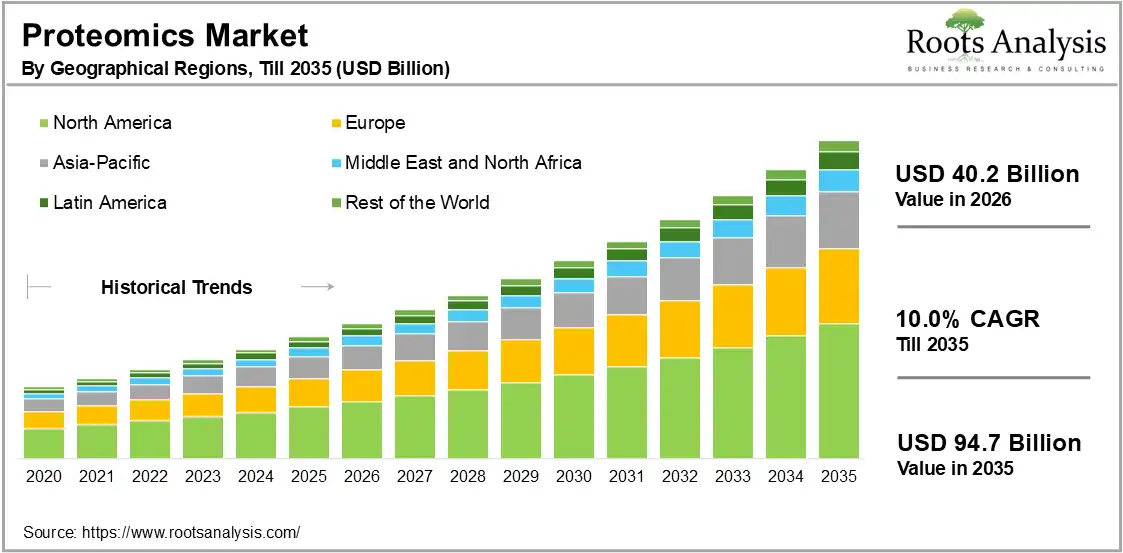
The global proteomics market, valued at USD 35.7 billion in 2025, is projected to reach USD 40.2 billion in 2026 and USD 94.7 billion by 2035, with a 10.0% CAGR during the forecast period 2026 to 2035.
See What’s in the Full Report–Request Your Complimentary Insights!
Market Report: Key Takeaways
Market Size & Trends
- In terms of type of offering, the kits and reagents segment holds the highest share (75%) of the market.
- With regards to type of instrument / technology, the spectrometry segment dominates the global market with close to 30% market share.
- Based on the type of kit and reagent, the spectrometry reagents hold the largest market share (nearly 90%) in 2026.
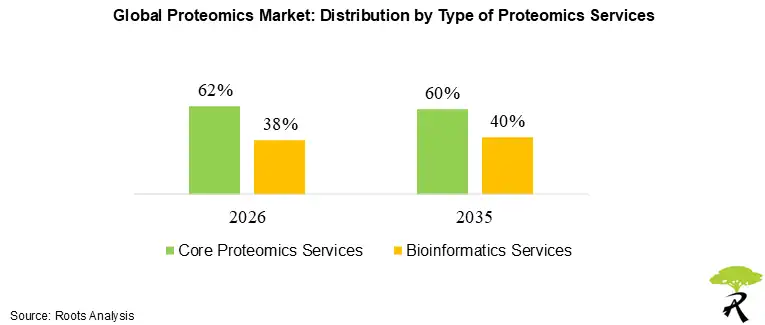
- In terms of types of proteomics service, the core proteomics services dominate the global market with more than 60% market share.
- With respect to application area, diagnostics segment captures the highest share in 2026.
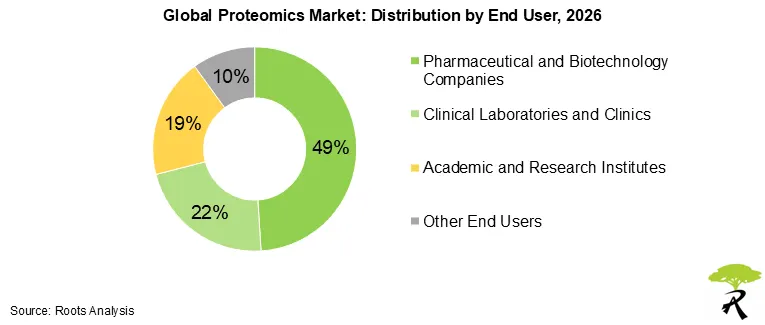
- With regards to end users, the pharmaceutical and biotechnology companies segment dominates the global market.
- In terms of geographical regions, North America captures the majority of the market share, and Asia-Pacific is likely to grow at a faster pace in the near future.
Key Market Statistics
- Market Size in 2026: $40.2 Billion
- Estimated Market Size in 2035: $94.7 Billion
- CAGR (2026-2035): 10.0%
- North America: Largest market in 2026
- Asia-Pacific: Fastest growing region
Market Overview
Since the discovery of the first human genetic map in 1987, the field of omics-based analysis has evolved significantly. Omics-based analysis is primarily aimed at identifying, describing, and quantifying large sets of biological molecules within a cell. Although, the number of omics technologies is ever expanding, the most advanced omics technologies include genomics, proteomics, transcriptomics and metabolomics. Interestingly, the success of genomics, marked by the completion of the Human Genome Project has paved the way for advancements in other omics disciplines, such as proteomics. Scientists have increasingly focused their efforts on proteomics to address several crucial challenges in understanding diseases at a molecular level. Proteomics is the large-scale analysis of proteins in a cell, tissue or organism, to understand their structure, function, and interactions. It offers deeper insights into the dynamic processes within cells and tissues by analyzing the entire set of proteins (also known as proteome) expressed by the cell.
Proteomics employs advanced technologies, such as mass spectrometry, crystallography, protein microarrays, and bioinformatics to analyze and quantify proteins, providing a holistic view of the cellular functions. This comprehensive approach has led to the identification of novel biomarkers for early disease diagnosis, development of targeted drug candidates, and a holistic understanding of drug resistance mechanisms.
Proteomics has the ability to unravel the complexities of biological processes and the intricate mechanisms of diseases such as Alzheimer’s disease, cancer, and multiple sclerosis. Owing to this, it has significantly revolutionized the landscape of biomedical research and healthcare by addressing several crucial challenges in understanding various diseases at a molecular level.
In order to capitalize the growing opportunity within this rapidly evolving market, the proteomics solution providers are engaged in improving the penetration of their proprietary technologies, within the diverse client-base, including biopharma companies, academic research centers and research institutes. For this purpose, pharmaceutical companies are striving to integrate advanced high-throughput technologies (such as next generation mass spectrometers) and multi-omics approaches in their proteomics workflow. These technologies coupled with the improved computational tools have contributed to the enhanced sensitivity, accuracy, and pace of protein analysis.
Researchers are leveraging emerging technologies, namely single-cell proteomics, spatial proteomics, and advanced imaging techniques, to decode the complex cellular heterogeneity and disease mechanisms. Moreover, the advent of artificial intelligence and machine learning algorithms is transforming data analysis, enabling predictive modeling, and accelerating the discovery of novel biomarkers. Owing to this, the adoption of these novel proteomics solutions to scale research from discovery to translational and clinical phases, is on the rise.
Driven by the growing adoption of proteomics solutions and continuous innovation in this domain, we are led to believe that the opportunity for proteomics market is likely to witness sustained market growth over the forecast period.
Get an Instant Quote in 10 Minutes. Lowest Price Guaranteed
Recent Developments
- In February 2026, Illumina announced a customer breakthrough in oncology using Illumina’s spatial transcriptomics, proteomics, and epigenomics. The ability to combine more than one omic insight reveals biological depth, all of which is streamlined by Illumina Connected Multiomics for multimodal data analysis.
- In February 2026, Nautilus Biotechnology launched the Voyager™ Platform, which is designed to power the Iterative Mapping of up to 10 billion intact proteins and proteoforms simultaneously in a single run.
- In January 2026, Illumina announced the acquisition of SomaLogic to fuel growth in the booming proteomics market, by improving customer access to proteomics solutions and multiomics capabilities.
- In October 2025, Thermo Fischer Scientific entered into a strategic collaboration with AstraZeneca BioventureHub for conducting R&D in the field of proteomic, molecular genomics and chromatography.
Market Trends
- Technological Advancements: The proteomics market growth is primarily driven by the ongoing technological advancements in mass spectrometers (for instance introduction of 4D proteomics) and bioinformatics (such as improved computational tools driven by AI and machine learning). These advancements are optimizing the proteomics process, thereby fueling the adoption of proteomics solutions in the pharmaceutical industry. In addition, increasing demand for personalized and precision therapies have emerged as the key drivers for the growing adoption of such solutions in the overall pharma market. In this context, over 10 novel personalized therapeutic modalities are anticipated to be approved by the US FDA, each year, till 2026.
- Growing Demand for Personalized Medicine: Presently, therapy developers are constantly looking out for opportunities to utilize the solutions offered by the proteomics providers, in order to streamline their development process and cater to the rising demand for personalized therapies. Further, substantial funding from governments and private organizations for proteomics infrastructure development and research is also boosting the market growth.
Market Share Insights
Market Share by Type of Offering
- Kits and reagents segment occupies the highest share currently and is expected to remain dominant during the forecast period.
- This can be attributed to the fact that kits and reagents are required to be replenished frequently, thus generating a recurring stream of revenue for the companies.
Market Share by Type of Proteomics Services
- Given the fundamental role of core proteomics (which includes protein identification, quantification and characterization) in research and clinical diagnostics applications, coupled with need for high-cost specialized equipment, core proteomics services segment is anticipated to capture the highest share and is expected to remain dominant during the forecast period.
Market Share by Type of Instrument / Technology
- The global proteomics market is segmented across various types of instruments / technologies, including chromatography, electrophoresis, protein microarrays, novel spectrometry, surface plasmon resonance, X-ray crystallography, and other technologies, based on types of instruments / technologies.
- Given that spectrometry is considered as the “gold standard” for protein analysis in proteomics industry, this segment holds the largest market share.
- Further, the increasing use of novel protein microarrays, particularly in studying molecular interactions is expected to drive the growth of the overall proteomics industry.
Want Information on Specific Region / Segment?
Market Share by Type of Kit and Reagent
- Spectrometry reagents segment occupy the highest share in the overall market and is expected to remain dominant during the forecast period. This can be attributed to the fact that spectrometry is a well-established technique, owing to its unparalleled sensitivity, specificity and versatility.
- Owing to this, kits and reagents used in spectrometry, are likely to dominate the market.
- In addition, low manufacturing expenses for reagents lead to its lower costs, enabling competitive pricing and accessibility for a wider customer base. Consequently, these reagents are witnessing high demand, driving substantial revenues in the overall proteomics market.
Market Share by Application Area
- Research segment will have highest proteomics market share due to the significant role of proteomics in understanding biological processes, identifying drug targets, discovering biomarkers, and developing new therapies, the market share for research application is likely to grow at a higher CAGR in the coming years as compared to the diagnostics and other applications segment in the proteomics industry.
Market Share by End User
- Pharmaceutical and biotechnology companies capture the highest share and this segment is expected to dominate the market during the forecast period.
- This can be attributed to the recent increase in the interest of big pharma players in evaluating several proteomics platforms that can be seamlessly integrated into their process workflows for more accurate biomarker identification, in order to advance their preclinical and clinical drug candidates.
Market Share by Geography
- According to our proteomics market forecast, North America captures the majority proteomics market share (>40%), and this trend is unlikely to change during the forecast period.
- This can be attributed to the technical advancements and capability expansions related to proteomics in the developed countries, such as the US.
- It is worth highlighting that the market for proteomics in Asia-Pacific is expected to grow at a relatively higher CAGR (11.7%), during the forecast period.
- Detailed methodology across the global proteomics industry and revenue generated across various segments is available in the full report.
Pay Only for What You Need – The Best Way to Optimize
Market Insights
Competitive Landscape of Proteomics Solution Providers
The current market landscape seems to be well-fragmented, featuring the presence of both new entrants and established players. Stakeholders in this domain offer various types of instruments, technologies, kits and reagents, proteomics services, across different application areas including clinical diagnostics and research. Majority of the proteomics solution providers offer mass spectrometry solutions, owing to their wide use in the analysis of biological samples.
Interestingly, in order to capitalize the growing opportunity within this flourishing market, the proteomics companies have undertaken several initiatives, such as entering into strategic collaborations, and expanding their existing capabilities / product portfolios.
Global Proteomics Market Size Analysis: Spectrometry to Drive Market Growth
The global market opportunity for proteomics solution providers is estimated to be worth USD 40.2 billion currently. In terms of type of instrument / technology, the market for spectrometry is anticipated to capture the largest market share, during the forecast period. The proteomics market growth is primarily driven by its broad applicability in research applications, facilitated by analytical instruments that offer enhanced sensitivity, improved resolution and high throughput output data.
Leading Proteomics Solution Providers in the Industry
Examples of key proteomics solution providers involved in the proteomics industry (which have also been captured in this market report, arranged in alphabetical order) include Agilent Technologies, Allele Life Sciences, Bertis, BGI Genomics, Bio-Rad Laboratories, Bruker, CellCarta, Creative Biolabs, Creative Proteomics, Cytiva, Macrogen, Merck, Nautilus, Olink, PerkinElmer, Promega, Promise Proteomic, Proteome Factory, Proteome Sciences, Proteomics International, SCIEX, Seer, SomaLogic, Thermo Fisher Scientific and VProteomics. This market report includes an easily searchable excel database for all the companies offering proteomics-related products / services for various industrial, research and therapeutic applications.
Have Questions? Let’s Get Them Answered.
Market Segmentation Insights
Key Report Attributes
| Key Report Attributes | Details | |
| Historical Trend | Since 2020 | |
| Forecast Period |
2026-2035 |
|
| Future Trend | Till 2035 | |
| Market Size, 2026 | 40.2 billion | |
| Market Size, 2035 | 94.7 billion | |
| CAGR (Till 2035) | 10.0% | |
| Type of Offering |
|
|
| Type of Instrument / Technology |
|
|
| Type of Kit and Reagent |
|
|
| Type of Proteomics Service |
|
|
| Application Area |
|
|
| End User |
|
|
| Geography |
|
|
| Key Players |
(Full list of 100+ companies captured is available in the report) |
|
| Customization Scope | 15% Free Customization | |
| Excel Data Packs |
|
|


