
Lowest Price Guaranteed
Pages
245
Last Updated
November 2025
View Count
14867
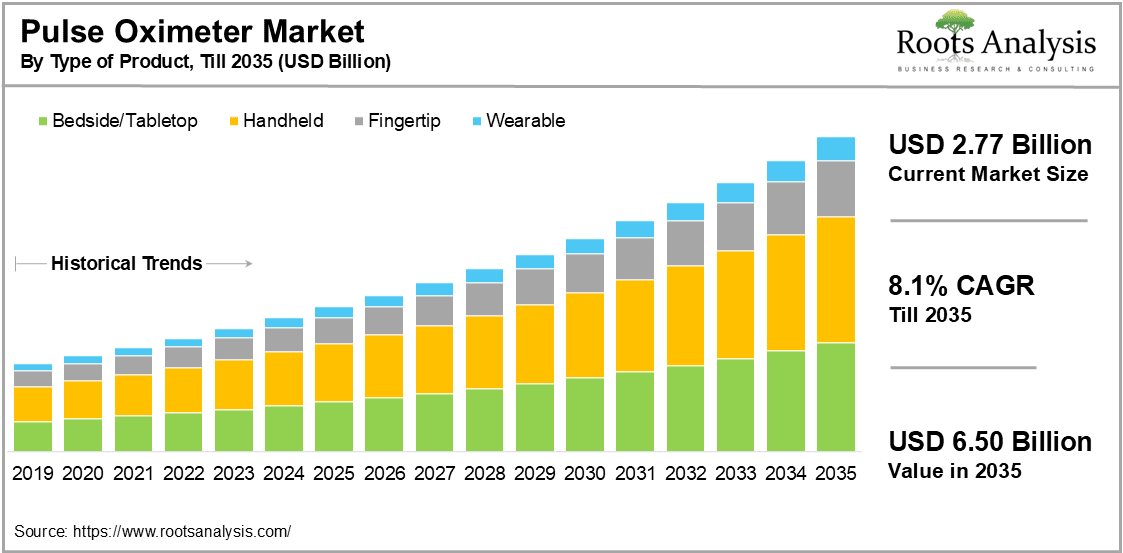
The global pulse oximeter market size is worth around USD 2.8 billion currently and is estimated to reach USD 6.6 billion by 2035, representing a CAGR of 8.1% during the forecast period.
It is worth noting here that nearly 43 states of the United States have mandated the use of pulse oximeters for newborn baby screenings to identify respiratory diseases, and congenital heart diseases. Driven by the growing usage, several players engaged in this market have shown keen interest for the development of advanced pulse oximeters that can be used in hospitals and at home settings for monitoring patients in real-time. For instance, In November 2023, GE Healthcare and Masimo signed a collaboration agreement to integrate SET® (Signal Extraction Technology) pulse oximetry with portrait mobile platforms and wearable patient health monitoring solutions.
Based on the product type, the pulse oximeter market is distributed into fingertips pulse oximeter, handheld pulse oximeter, bedside pulse oximeter, and wearable pulse oximeter. As per the projection, handheld pulse oximeters account for largest share (40%) of the market in 2024 and are projected to show lucrative growth during the forecast period. The highest share of handheld pulse oximeters is primarily attributed to the growing incidence of respiratory diseases that demand easy-to-use oximeter devices for regular monitoring at home. In the long run, fingertip pulse oximeters will grow at a higher rate during the forecast period.
 |
Based on the type of sensor, the global market is segmented into disposable sensor and reusable sensor. In terms of revenues, disposable sensors account for 75.10% of the pulse oximeter market share in 2024 and the trend is likely to remain unchanged during the forecast period. Disposable sensors are convenient to use and are specifically designed for single patient use which becomes a pivotal reason for large scale adoption.
The pulse oximeter market is segmented into conventional and smart / connected technology on the basis of type of technology. According to our projection, conventional technology accounts for the largest share (55.20%) of the market in 2024. Conventional technology-based oximeters such as handheld and fingertip ensure accuracy, are easy to use and generally affordable than advanced smart technology-based oximeters.
Based on the age group, the global pulse oximeter market is segmented into adults and pediatrics. According to our projection, the adult age group holds a significant share (62%) of the market in 2024 and is poised to grow at a steady rate during the forecast period.
Based on the type of distribution channel, the market is segmented into online and offline channels. According to our projection, online channel holds 62% of the market share in 2024 driven by the growing purchases through online mode.
Based on the type of end-user, the market for pulse oximeters is segmented into hospitals & other home healthcare facilities. According to our projection, the hospitals and clinics hold the largest share (75%) of the market in 2024. The growth can be attributed to the increasing number of patients with respiratory and cardiovascular diseases that require continuous monitoring, as well as for newborn monitoring.
Based on the key geographical insight, the global market is distributed across North America, Europe, Asia-Pacific, and the Rest of the World. Driven by the presence of established players and increasing investment by stakeholders for driving technological advancement to deliver at-home care devices for oxygen monitoring, North America currently dominates the market with 40% pulse oximeter market share.
The “Pulse Oximeter Market: Industry Trends and Global, till 2035” market report features a detailed study of the current market landscape, market size, market forecast and future opportunities for pulse oximeter manufacturers. Further, the market research report underlines an in-depth analysis, highlighting the capabilities of service providers engaged in the pulse oximeter industry
The market has been driven by the growing incidence of chronic respiratory diseases such as chronic obstructive pulmonary disease (COPD), asthma, and lung cancer. For instance, according to the American Lung Association report, in 2022, nearly 11.7 million people, or 4.6% of adults, have been diagnosed with COPD (chronic obstructive pulmonary disease, emphysema, and chronic bronchitis). Further, the growing awareness about the importance of monitoring oxygen and the consequences associated with low oxygen levels are anticipated to drive the demand for pulse oximeters during the forecast period.
Government bodies across various countries and regions have also mandated continuous monitoring of the oxygen saturation levels of patients having chronic respiratory disorders. The recommendation of the government on using pulse measuring devices has further fueled the pulse oximeter market growth during the forecast period.
Despite the increasing adoption of pulse oximeters across the healthcare sector and homecare, several factors may impede their growth during the projected period. One of the significant factors is growing concern about inaccurate results shown by pulse oximeters. There are several factors that may affect the accuracy of a pulse oximeter, such as skin thickness, skin temperature, and dark skin pigmentation. Patients with dark skin, pigmentation, and thick skin may have a higher chance of getting the wrong results. Additionally, the development of smart wearable devices equipped with SPO2 monitoring sensors along with other health parameter features is hindering the pulse oximeter market growth.
Developing economies and strategic initiatives by government bodies focusing on expansion, merger, and acquisition provide enormous opportunities to the stakeholders. It is worth highlighting here that several governments and industrial stakeholders have raised considerable investments to drive the growth of the pulse oximeter market. The aim of raising capital investments is to develop advanced oxygen monitoring devices that facilitate the monitoring of patients in homecare settings and ensure higher accuracy. For instance, in February 2024, Masimo received FDA clearance for an over-the-counter MightSat® Fingertip Pulse Oximeter for medical use without any prescription. Additionally, in January 2023, Philips and Masimo extended their partnership to augment telehealth applications and patient monitoring capabilities at home with the Masimo W1™ (advanced health parameter tracking watch). The ongoing initiatives and strategic partnerships between key players are anticipated to be the significant growth factor that drives the pulse oximeter industry over the forecast period.
Various stakeholders in the healthcare sector are investing towards the development of next generation pulse oximeters that allow measurement of multiple parameters, improved accuracy and remote patient monitoring. In August 2024, Prevounce Health announced the launch of Pylo OX1-LTE, a cellular connected pulse oximeter that can allow the transmission of readings to healthcare professionals even in areas with weak cellular networks.
Some medical device developers have also developed multimodal pulse oximeters that allow readings for multiple parameters in addition to oxygen levels. Such devices are being specifically designed for use in low- and middle-income countries and for use in community health centers. Examples of some approved multimodal pulse oximeters include neoGuard by Neopenda, NMB 200 by OrSense, Scanbo D8 by Scanbo and Rad-G by Masimo, amongst others.
The global market for pulse oximeters is expected to reach $6.6 billion by 2035, essentially driven by the growth in North American market. Presently, North America is estimated to capture the majority of the market share, and this trend is unlikely to change in the future. The global market is anticipated to grow at a CAGR of 8.1% as technologically advanced and next generation pulse oximeters are launched.
Examples of the leading players active in the industry (the complete list of which is included in the detailed report) have been listed below:
Beurer, CAS Medical Systems, CareFusion, Contec Medical Systems, Edwards Lifesciences, GE Healthcare Technologies, ICU Medical, Koninklijke Philips, Medtronic, Masimo Corporation, Meditech Equipment, Nihon Kohden, Nonin Medical, Omron, Opto Circuits, Philips Healthcare, Promed Group, Spacelabs Healthcare, Tenko Medical Systems, Welch Allyn
The market report covers an in-depth analysis of various companies that are active in the global pulse oximeter industry across different segments, as defined in the table below.
| Key Report Attributes | Details | |
| Historical Trend | From 2019 | |
| Base Year | 2023 | |
| Forecast Period | Till 2035 | |
| Market Size 2035 | USD 6.6 billion | |
| CAGR | 8.1% | |
| Distribution by Product Type |
|
|
| End User |
|
|
| Type of Sensor |
|
|
| By Age Group |
|
|
| Type of Distribution Channel |
|
|
| Key Geographical Region |
|
|
| Key Companies Profiled |
(A full list of key companies captured is available in the report) |
|
| PowerPoint Presentation (Complimentary) |
Available | |
| Customization Scope | 15% Free Customization | |
| Excel Data Packs (Complimentary) |
|
|
One of the key objectives of this market research report is to provide a comprehensive analysis in order to estimate the existing market size and future opportunities in the pulse oximeter industry over the next decade. Based on multiple parameters, such as product type (Fingertips Pulse Oximeter, Handheld Pulse Oximeter, Bedside Pulse Oximeter and Wearable Pulse Oximeter), sensor (disposable sensor and reusable sensor), technology (conventional and smart / connected), age group (adults and pediatric), distribution channel (online and offline) end user (hospitals & other healthcare settings and homecare), and geographical region (North America, Europe, Asia-Pacific, and the Rest of the World), we have developed informed estimates on the evolution of the market for the forecast period 2024-2033. The market research report also features the likely distribution of the current and forecasted opportunity across the above mentioned market segments. To account for the future uncertainties and to add robustness to our model, we have provided three pulse oximeter market forecast scenarios, namely conservative, base, and optimistic scenarios, portraying different tracks of the anticipated industry's growth.
The report also features detailed transcripts of interview(s) held with representatives of renowned organizations that are engaged in the industry.
All actual figures have been sourced and analyzed from publicly available information forums. The financial figures mentioned in this market research report are in USD unless otherwise specified.
Several recent developments have taken place in the field of pulse oximeters. We have outlined some of the recent initiatives below. These developments, even if they took place post the release of our market report, substantiate the overall market trends and have been outlined in our analysis.