


 Download Free Sample
 Buy Now
Market Size
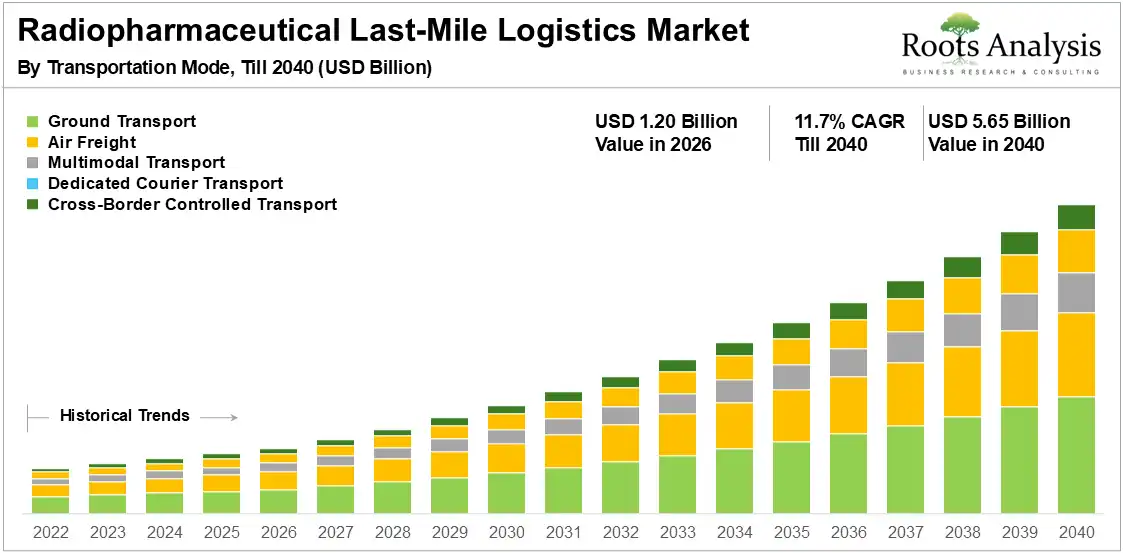
The global radiopharmaceutical last-mile logistics market reached USD 1.20 billion in 2026 and is projected to reach USD 5.65 billion by 2040, growing at a CAGR of 11.7% over the forecast period 2026 to 2040, driven by time-critical nuclear medicine delivery growth.
See What’s in the Full Report – Request Your Complimentary Insights!
Market Report: Key Takeaways
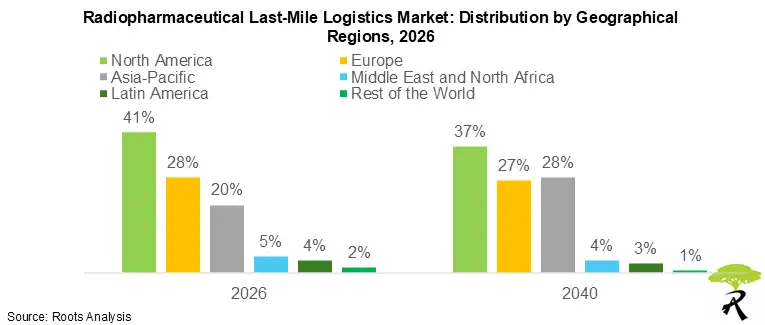
- Based on Geography, North America captures 41.6% market share in 2026, whereas Asia-Pacific registers a 14.3% CAGR through 2040, supported by faster nuclear medicine capacity localization.
- Based on Service Type, standard delivery services capture 27.0% market share in 2026, whereas white-glove final-mile delivery services registers a 13.6% CAGR through 2040, driven by patient-specific therapeutic dose workflows.
- Based on Transportation Mode, ground transport captures 38.0% market share in 2026, whereas multimodal transport registers a 13.4% CAGR through 2040, supported by cross-network isotope and dose movement.
- Based on Radiopharmaceutical Type, PET radiopharmaceuticals capture 33.0% market share in 2026, whereas theranostic radiopharmaceuticals register a 17.4% CAGR through 2040, driven by paired diagnostic and therapeutic oncology pathways.
- Based on End User, hospitals capture 42.9% market share in 2026, whereas oncology and theranostics centers registers a 17.9% CAGR through 2040, driven by radioligand therapy center expansion.
Radiopharmaceutical Last-Mile Logistics Market Outlook
Radiopharmaceutical logistics is moving from repeatable diagnostic delivery routes toward therapeutic, patient-specific dose networks. The market reached USD 1.20 billion in 2026 and will reach USD 5.65 billion by 2040, at 11.7% CAGR. Earlier PET and SPECT demand favored regional radiopharmacy distribution and fixed routes. Current demand adds radioligand therapy logistics, isotope decay scheduling, real-time tracking, temperature-monitored dangerous-goods packaging, and tighter clinic appointment coordination across networks.
Growth reflects rising oncology use, fast-decaying isotope constraints, and tighter regulatory focus on supply continuity. EMA and HMA issued April 2025 recommendations covering EU radiopharmaceutical supply vulnerabilities, transport harmonization, and national supply-chain mapping. Curium also invested more than Euro 32 million in Saclay during June 2026 to build 177 Lu-PSMA-I&T production capacity, strengthening European therapeutic dose availability.
The radiopharmaceutical logistics market will remain high-growth through 2040 as theranostic radiopharmaceuticals rise at 17.4% CAGR. White-glove final-mile delivery, multimodal transport, and dose-level traceability will gain share against standard routes. Clarity Pharmaceuticals signed an April 2026 Nucleus RadioPharma agreement for 64 Cu-SAR-bisPSMA manufacturing and distribution across all 50 U.S. states and selected international sites. The outlook remains expansionary, but compliance capacity will separate leaders from smaller providers.
Radiopharmaceutical Last-Mile Logistics Market Dynamics
Radiopharmaceutical Last-Mile Logistics Market Drivers
Therapeutic radiopharmaceutical demand is shifting logistics from batch diagnostic delivery toward patient-specific timed dosing. The market will grow from USD 1.20 billion in 2026 to USD 5.65 billion by 2040, at 11.7% CAGR. PET radiopharmaceuticals lead 2026 demand with 33.0% share, while theranostic radiopharmaceuticals will grow fastest at 17.4% CAGR. This mix raises demand for isotope decay scheduling, dose-level traceability, and radiation-safe chain-of-custody documentation.
Radiopharmaceutical Last-Mile Logistics Market Restraints
Class 7 radioactive material transport limits market entry because providers need shielded Type A packaging, trained handlers, and compliant documentation. Shielded Type A radioactive packaging holds 34.0% share in 2026, making packaging capability a core cost base. EMA and HMA April 2025 recommendations flagged transport harmonization and supply-chain mapping as EU vulnerabilities. These requirements slow scaling for general healthcare couriers without nuclear medicine infrastructure.
Radiopharmaceutical Last-Mile Logistics Market Opportunities
White-glove final-mile delivery creates a premium opportunity as oncology and theranostics centers grow from 8.0% share in 2026 to 17.0% by 2040. These centers require appointment-linked delivery, exception handling, and temperature-monitored dangerous-goods packaging. In February 2025, Marken, MNX, and Polar Speed combined under Marken, UPS Healthcare Precision Logistics. The move strengthens time-critical radiopharmaceutical delivery capacity for therapeutic workflows.
Radiopharmaceutical Last-Mile Logistics Market Challenges
Isotope decay compresses logistics planning because missed delivery windows can destroy product value before administration. Multimodal transport will grow at 13.4% CAGR through 2040, yet airport recovery, customs, and domestic courier transfer add failure points. Marken reported an April 2025 Germany-to-U.S. nuclear medicine shipment completed in under 24 hours. Replicating that performance requires network density, customs expertise, and redundant routing capacity.
Radiopharmaceutical Last-Mile Logistics Market Size Estimation Methodology
- As a starting point, the model fixed 2026 revenue at USD 1.20 billion and 2040 revenue at USD 5.65 billion. It checked the 11.7% CAGR using the ratio between those values. The base year reflected radiopharmacy delivery demand, hospital end-user share, and ground transport dominance. Historical market values from 2022 to 2025 were used to smooth the transition into the forecast window.
- Moving forward, the forecast split demand across geography, service type, transportation mode, radiopharmaceutical type, packaging, end user, and technology capability. The work used clinical trial databases, drug approval timelines, and regulatory submission counts to judge future therapeutic dose demand. It also used trade flow data to capture isotope and generator movement across borders. These inputs helped separate routine diagnostic shipments from patient-specific therapeutic delivery.
- Building on this, the segmentation assigned 2026 shares using operational indicators from radiopharmacy networks, PET radiotracer distribution, and SPECT radiopharmaceutical logistics. Hospitals captured 42.9% share because most nuclear medicine doses terminate in hospital networks. Ground transport captured 38.0% share because regional radiopharmacy-to-hospital catchments still anchor routine delivery. Packaging assumptions reflected Type A shielding, refrigerated handling, and dangerous-goods monitoring requirements.
- Drawing upon these, the model tested faster-growth segments against post-2025 investment and capacity signals. Oncology and theranostics centers received the highest end-user CAGR at 17.9%, reflecting radioligand therapy expansion. Temperature-monitored dangerous-goods packaging received 14.0% CAGR because therapeutic payloads raise excursion risk. Multimodal transport received 13.4% CAGR because isotope sourcing increasingly combines air freight, ground recovery, and local courier dispatch.
- The projected value was then built from annual growth curves rather than a straight-line extrapolation. PET radiopharmaceuticals and SPECT radiopharmaceuticals lost share as theranostic radiopharmaceuticals doubled from 10.0% to 20.0%. Asia-Pacific gained share because local isotope production, imaging access, and oncology demand expanded from a lower base. North America still led in 2026 because radiopharmacy density and reimbursement supported mature nuclear medicine utilization.
- Finally, the forecast was cross-checked against named company activities, funding rounds, and regulatory events after January 2025. Examples included Curium's Saclay investment, Nucleus RadioPharma financing, and EMA-HMA supply-chain recommendations. The final radiopharmaceutical logistics market forecast balances demand growth with compliance capacity, Class 7 transport constraints, and last-mile execution risk. Sensitivity checks tested route failures, isotope shortages, and slower therapeutic center onboarding.
Radiopharmaceutical Last-Mile Logistics Market Share Insights
Market Share by Packaging / Handling Requirement
According to our analysis, shielded Type A radioactive packaging leads because Class 7 transport rules define baseline radiopharmaceutical shipment design. In March 2026, PHSE described radiopharmaceutical transport as requiring radioactive material, traceability, and temperature-control compliance.
Further, temperature-monitored dangerous-goods packaging will expand fastest as therapeutic payloads raise excursion and documentation sensitivity. In May 2025, Life Couriers emphasized real-time tracking and strict time-temperature sensitivities in its UK radiopharma launch.
Market Share by Technology / Service Capability
According to our analysis, regulatory documentation and dangerous-goods compliance leads because radioactive shipments require verifiable transport governance. In March 2026, PHSE outlined radiopharmaceutical transport requirements spanning Class 7 rules and pharmaceutical quality controls.
Further, route optimization and delivery scheduling will grow fastest as shorter half-life therapies intensify delivery precision needs. In January 2026, Novartis said its Florida RLT facility would strengthen delivery across the southeastern U.S.
Want Information on Specific Region / Segment?
Regional Analysis: North America Leads the Market and Asia-Pacific is Likely to Register Higher CAGR
Presently, North America leads through established PET networks, centralized radiopharmacy infrastructure, and strong oncology treatment capacity. It also benefits from dense airport networks, regulated dangerous-goods expertise, and payer-supported nuclear medicine utilization. In February 2026, Novartis announced a Denton, Texas RLT manufacturing facility as its fifth U.S. site.
On the contrary, Asia-Pacific will grow fastest as oncology demand, imaging capacity, and domestic isotope programs expand from a lower base. Localized supply chains will reduce treatment delays and create new demand for compliant final-mile networks. In December 2025, PHSE highlighted the 17th Asia Oceania Congress of Nuclear Medicine and Biology in its regional activity stream.
Market Ecosystem Analysis
The radiopharmaceutical last-mile logistics market now centers on vertically integrated radiopharmacy, isotope, and Class 7 courier networks. Acquisition-driven consolidation dominates, as radiopharma developers buy distribution control and logistics specialists expand compliant cross-border capacity. The primary commercial force is theranostic demand, which compresses delivery windows and raises the value of validated, dose-level chain-of-custody.
- Telix completed its acquisition of RLS in January 2025, adding more than 30 U.S. radiopharmacies. The deal strengthened Telix’s integrated manufacturing and distribution model for PET, SPECT, and therapeutic radiopharmaceuticals. It also expanded licensed space for a next-generation radiometal production network serving commercial partners and patients.
- Curium acquired Nucleis in April 2025 to expand PET manufacturing and distribution across Western Europe. The acquisition added GMP PET radiopharmaceutical manufacturing capacity and reinforced F-18 tracer supply reliability. This improves access for Benelux and German providers operating under short radiotracer shelf lives.
- Siemens Healthineers rebranded PETNET Solutions and AdAcAp Molecular Imaging in November 2025 under its Radiopharma business segment. The move unified 60 facilities across nine countries after Siemens acquired AdAcAp Molecular Imaging from Novartis in December 2024. It positions Siemens as a PET radiopharmaceutical network operator with integrated manufacturing, CDMO, and distribution reach.
- PHSE acquired a 70% stake in World Infinity Services in January 2025 to enter Belgium. WIS specializes in international radiopharmaceutical shipments, giving PHSE deeper Benelux access for oncology logistics. The acquisition expands PHSE’s European radiopharma footprint for time-critical, temperature-controlled, and dangerous-goods deliveries.
- Life Couriers announced in February 2025 that Associated Couriers would rebrand under the Life Couriers identity. The rebrand aligned its U.S. operations with a global healthcare logistics platform. It increases brand consistency for radiopharma clients needing international operating coverage and validated delivery processes.
- Marken highlighted an April 2025 radiopharma logistics milestone involving Germany-to-U.S. nuclear medicine shipments under 24 hours. The activity showcases its next-flight-out and final-mile model for short-lived nuclear medicine products. It raises competitive pressure on couriers lacking validated transatlantic Class 7 execution.
- Cardinal Health and SHINE Technologies advanced U.S. actinium-225 production in May 2026 at an Indianapolis facility. The activity strengthens domestic radionuclide availability for targeted cancer radiopharmaceuticals. It supports Cardinal’s broader nuclear pharmacy network by improving upstream supply resilience.
- Curium and NRG PALLAS extended their collaboration in May 2025 through a multi-year molybdenum-99 agreement. The partners framed the agreement around stable technetium-99m supply for hospitals worldwide. This protects SPECT radiopharmaceutical availability, where logistics failures can rapidly disrupt scheduled imaging.
- PharmaLogic completed its majority-stake acquisition of Agilera Pharma in June 2025 to expand its global radiopharmaceutical CDMO platform. The transaction added Norwegian CDMO infrastructure and clinical-production capabilities. It strengthens the manufacturing-to-distribution bridge for therapeutic radiopharmaceutical programs moving toward broader clinical demand.
Startup Companies and their Key Highlights
1. Nucleus RadioPharma
- Event type and funding amount: Financing, $50 million
- Month and year: April 2026
- Lead investor or strategic partner name: OrbiMed
- Stated purpose of the event: Expand Rochester operations and develop a Philadelphia facility for radiopharmaceutical manufacturing capacity.
- Market implication: Accelerates U.S. CDMO and supply-chain capacity for precision oncology radiopharmaceuticals needing geographically proximate dose production.
2. Clarity Pharmaceuticals
- Event type: Commercial Manufacturing Agreement
- Month and year: April 2026
- Lead investor or strategic partner name: Nucleus RadioPharma
- Stated purpose of the event: Manufacture Cu-64 SAR-bisPSMA using Nucleus facilities in Minnesota and Pennsylvania.
- Market implication: Accelerates U.S. PET diagnostic radiopharmaceutical supply through distributed manufacturing tied to last-mile patient access.
3. Nusano
- Event type and funding amount: Long-term multi-isotope supply agreement
- Month and year: June 2025
- Lead investor or strategic partner name: Ratio Therapeutics
- Stated purpose of the event: Supply copper-64 for PET diagnostics and lutetium-177 and actinium-225 for therapeutic applications.
- Market implication: Accelerates isotope-supply security for oncology radiopharmaceutical developers building diagnostic and therapeutic pipelines.
4. Nusano
- Event type and funding amount: Multi-isotope supply agreement
- Month and year: October 2025
- Lead investor or strategic partner name: Ariceum Therapeutics
- Stated purpose of the event: Supply actinium-225 and lutetium-177 for Ariceum therapeutic programs.
- Market implication: Strengthens therapeutic radioisotope availability for European radiopharma development and downstream clinical logistics planning.
5. SpectronRx
- Event type and funding amount: Commercial-scale isotope production milestone
- Month and year: October 2025
- Stated purpose of the event: Produce actinium-225 at commercial scale using a proprietary accelerator-based method.
- Market implication: Expands alpha-emitter supply for radiopharmaceutical therapies, reducing bottlenecks before manufacturing and final-mile delivery.
Radiopharmaceutical Last-Mile Logistics Market Trends / Opportunities
Theranostic Dose Growth Expanding Radiopharmaceutical Last-Mile Logistics Market Premium Services
Theranostic radiopharmaceuticals will grow at 17.4% CAGR because linked diagnostic and therapeutic pathways require tighter dose timing. Ratio Therapeutics and Nusano signed a June 2025 multi-isotope supply agreement covering Lu-177 and Ac-225. This supports higher-value logistics contracts tied to oncology treatment reliability.
Oncology and theranostics centers will expand from 8.0% market share in 2026 to 17.0% by 2040. Novartis opened a California radioligand therapy manufacturing site in November 2025 to improve western U.S. dose availability. Regional manufacturing density will reward couriers with appointment-linked final-mile capability.
Distributed Manufacturing Capacity Reshaping Radiopharmaceutical Logistics Market Competition
Radiopharmaceutical manufacturers are adding local capacity to reduce decay losses and protect patient access. Curium announced October 2025 PET radiopharmaceutical manufacturing sites in Newcastle and Oxford for underserved UK regions. Local production will shift competition toward providers with dense city-region delivery routes.
CDMO investment is strengthening the supply side for commercial and clinical logistics. Nucleus RadioPharma secured USD 50 million in April 2026 to expand Rochester operations and support a Philadelphia facility. This creates partnership opportunities for logistics providers that can integrate manufacturing, release, and dose dispatch.
Multimodal Time-Critical Networks Creating Differentiation in Nuclear Medicine Logistics
Multimodal transport will grow at 13.4% CAGR because isotope imports often require air freight and domestic delivery. Marken reported an April 2025 Germany-to-U.S. nuclear medicine shipment completed in under 24 hours. Providers with cross-border controlled transport can win high-urgency accounts.
Dedicated courier transport will gain share as therapeutic doses require named-route accountability and exception management. PHSE acquired The Courier Company in April 2026 to expand UK radiopharmaceutical and dangerous-goods transport. Acquisitions will consolidate specialist route density and regulatory know-how.
Regulatory Harmonization Pressuring Smaller Entrants and Favoring Compliant Platforms
Regulatory documentation and dangerous-goods compliance holds 21.0% capability share in 2026 because radioactive shipments need verifiable governance. PHSE outlined March 2026 requirements across Class 7 rules, pharmaceutical quality controls, traceability, and temperature control. Compliance breadth will favor platforms with documented operating procedures.
EU policy attention is turning supply resilience into a competitive requirement. EMA and HMA issued April 2025 recommendations covering transport harmonization and national supply-chain mapping. Providers that support regulator-ready documentation will gain access to larger hospital and manufacturer contracts.
Your Business is Unique – Why Shouldn’t Your Report Be?
Market Access Considerations
Class 7 Radioactive Material Transport Authorization
Class 7 radioactive material transport creates the first market access screen because providers need trained staff, controlled routes, and compliant documentation. Shielded Type A radioactive packaging holds 34.0% share in 2026, making packaging infrastructure a core scaling cost. PHSE described March 2026 transport requirements covering radioactive material, traceability, and temperature-control compliance. Providers without this capability remain limited to non-radioactive healthcare logistics or subcontracted support roles.
Time-Temperature and Dose-Level Chain of Custody
Time-temperature control shapes market access because fast-decaying products lose clinical value when custody or timing fails. Temperature-monitored dangerous-goods packaging will grow at 14.0% CAGR as therapeutic payloads raise excursion sensitivity. Life Couriers emphasized real-time tracking and strict time-temperature sensitivities in its May 2025 UK radiopharma logistics launch. Providers with validated monitoring can scale into hospitals, oncology centers, and manufacturers. In parallel, radiopharmaceutical manufacturing combines isotope production, radiolabeling and quality control for diagnostic and therapeutic products.
Manufacturing Proximity and Regional Network Density
Manufacturing proximity enables access because short half-life products require rapid release, route planning, and clinic arrival coordination. North America holds 41.6% share in 2026 because dense PET networks and mature radiopharmacy capacity support final-mile execution. Novartis announced a February 2026 Denton, Texas RLT site to expand U.S. manufacturing capacity. Logistics providers near production hubs gain better routing economics and stronger manufacturer relationships. This density also reduces failed-dose risk for appointment-based therapies.
Cross-Border Controlled Transport and Customs Execution
Cross-border controlled transport constrains access because isotope movements can require airport recovery, customs coordination, and domestic courier handoff. Multimodal transport will grow at 13.4% CAGR through 2040 as supply chains blend air and ground routes. Marken reported an April 2025 Germany-to-U.S. nuclear medicine delivery completed in under 24 hours. Providers with customs knowledge and redundancy can serve international clinical and commercial shipments at global scale.
How Stakeholders Benefit from the Key Focus Areas of Our Radiopharmaceutical Last-Mile Logistics Market Report
Radioligand therapy growth makes time-critical nuclear medicine delivery commercially urgent because missed delivery windows can waste patient-specific doses. The report supports capacity planning, partner selection, investment screening, and technology prioritization across radiopharmacy, CDMO, and logistics networks.
- Unmet Needs and Market Gaps in Radiopharmaceutical Last-Mile Logistics Market: The report identifies gaps in white-glove final-mile delivery, route redundancy, and dose-level traceability. Service planners can use these findings to decide where standard delivery services no longer match therapeutic workflows. It also highlights where oncology and theranostics centers create unmet demand for appointment-linked logistics.
- Funding and Venture Investment Opportunities in Radiopharmaceutical Last-Mile Logistics Market: The report maps funding signals across manufacturing capacity, isotope production, and specialist logistics. Investment teams can assess why Nucleus RadioPharma, SpectronRx, Curium, and Nusano activities matter for downstream delivery demand. The analysis supports decisions on CDMO partnerships, regional platform acquisitions, and cold chain logistics exposure.
- Technology Innovation and Adoption Trends: The report tracks adoption of real-time shipment tracking, temperature and condition monitoring, route optimization, and order management. Technology leaders can compare which capabilities gain share through 2040 and which remain baseline compliance tools. The findings support build-versus-partner decisions for dose scheduling, monitoring dashboards, and documentation systems.
- Radiopharmaceutical Last-Mile Logistics Market Competitive Landscape and Industry Analysis: The report separates Tier 1 leaders, Tier 2 specialists, and emerging platforms by role and capability. Commercial teams can benchmark Cardinal Health, Jubilant Radiopharma, RLS Radiopharmacies, Siemens Healthineers, Curium, World Courier, Marken, PHSE, and Life Couriers. The analysis supports partner shortlisting, account targeting, and competitive positioning by service type.
- Mapping Strategic Partnerships and Ecosystem Synergies: The report links isotope suppliers, radiopharmaceutical developers, CDMOs, packaging specialists, and logistics providers into one operating ecosystem. Business development teams can identify where supply agreements and manufacturing contracts create final-mile demand. The mapping supports partnership decisions across NorthStar, QSA Global, Nucleus RadioPharma, Clarity Pharmaceuticals, Curium, and NRG PALLAS.
- Radiopharmaceutical Last-Mile Logistics Market CAGR and Growth Trends: The report quantifies growth from USD 1.20 billion in 2026 to USD 5.65 billion by 2040. Strategy teams can compare 11.7% market CAGR against faster segment growth in theranostics, oncology centers, multimodal transport, and temperature-monitored packaging. The findings support market entry timing, regional prioritization, and capital allocation.
Radiopharmaceutical Last-Mile Logistics Market: Scope of the Report
| Key Report Attributes | Details | |
| Forecast Period | Till 2040 | |
| Market Size 2026 | USD 1.20 Billion | |
| Market Size 2040 | USD 5.65 Billion | |
| CAGR (Till 2040) | 11.7% | |
| Segments Covered |
|
|
| Geographical Regions Covered |
|
|
| Key Sections Covered |
|
|
Market Segmentation
The radiopharmaceutical last-mile logistics market report presents an in-depth analysis, highlighting the capabilities of various stakeholders, based on different segments, such as service type, transportation mode, radiopharmaceutical type, packaging and handling requirement, end user, technology / service capability, geographical regions, and leading players.
By Service Type
- Standard Delivery Services
- Time-Critical Delivery Services
- Same-Day / Next-Flight-Out Delivery Services
- White-Glove Final-Mile Delivery Services
- End-To-End Clinical and Commercial Logistics Services
By Transportation Mode
- Ground Transport
- Air Freight
- Multimodal Transport
- Dedicated Courier Transport
- Cross-Border Controlled Transport
By Radiopharmaceutical Type
- PET Radiopharmaceuticals
- SPECT Radiopharmaceuticals
- Therapeutic Radiopharmaceuticals
- Theranostic Radiopharmaceuticals
- Radioisotope Source Materials and Generators
By Packaging and Handling Requirement
- Ambient Controlled Transport
- Refrigerated Transport
- Frozen Transport
- Shielded Type A Radioactive Packaging
- Temperature-Monitored Dangerous-Goods Packaging
By End User
- Hospitals
- Nuclear Medicine Departments
- Diagnostic Imaging Centers
- Oncology and Theranostics Centers
- Radiopharmacies
- Radiopharmaceutical Manufacturers and CDMOs
- Clinical Trial Sponsors and CROs
By Technology / Service Capability
- Real-Time Shipment Tracking
- Temperature and Condition Monitoring
- Radiation-Safe Chain-Of-Custody Documentation
- Route Optimization and Delivery Scheduling
- Regulatory Documentation and Dangerous-Goods Compliance
- Order Management and Dose-Level Traceability
By Geographical Regions
- North America
- US
- Canada
- Mexico
- Rest of North America
- Europe
- Austria
- Belgium
- Denmark
- France
- Germany
- Ireland
- Italy
- Netherlands
- Norway
- Russia
- Spain
- Sweden
- Switzerland
- UK
- Rest of Europe
- Asia-Pacific
- Australia
- China
- India
- Japan
- New-Zealand
- Singapore
- South Korea
- Rest of Asia-Pacific
- Latin America
- Argentina
- Brazil
- Chile
- Colombia
- Venezuela
- Rest of Latin America
- Middle East and Africa (MEA)
- Egypt
- Iran
- Iraq
- Israel
- Kuwait
- Saudi Arabia
- UAE
- Rest of MEA
- Rest of the World


