Market Outlook
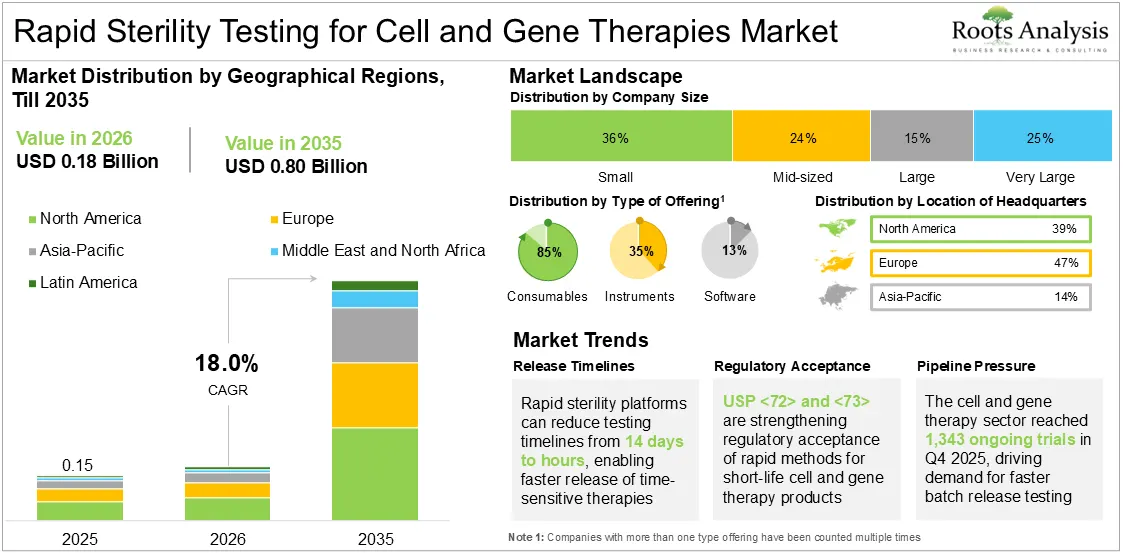
The global rapid sterility testing for cell and gene therapies market, valued at USD 0.15 billion in 2025, is projected to reach USD 0.18 billion in 2026 and USD 0.80 billion by 2035, representing a CAGR of 18.0% during the forecast period from 2026 to 2035.
To learn more about this report, request a free sample copy
Market Report: Key Takeaways
Market Size & Trends
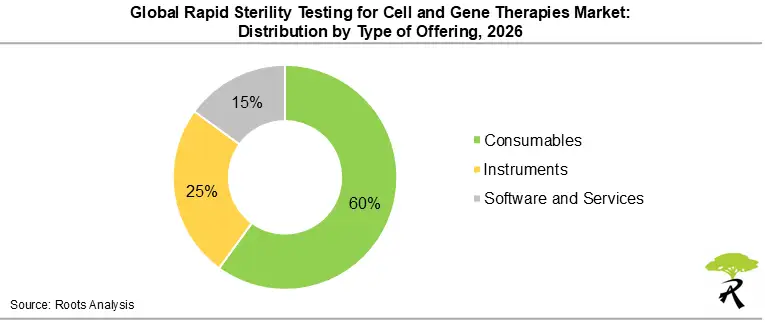
- In terms of type of offering, consumables capture the highest share in the current year, accounting for around 60% of the rapid sterility testing for cell and gene therapies market.
- Based on type of instrument, automated detection systems capture the largest share of the current market.
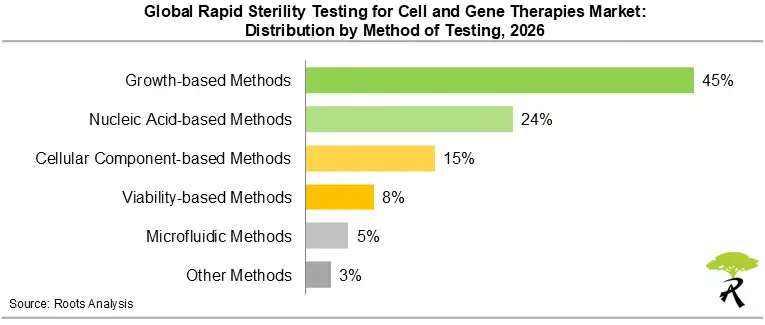
- With respect to method of testing, growth-based methods dominate the rapid sterility testing for cell and gene therapies market, capturing 45% of the overall revenue.
- Amongst the types of pathogens, bacteria account for the majority share of the current market.
- Based on end user, drug developers capture the largest share of the rapid sterility testing for cell and gene therapies market.
- In terms of geographical regions, North America currently holds the highest market share (around 40%).
Key Market Statistics
- Market Size in 2026: $ 0.18 billion
- Estimated Market Size in 2035: $ 0.80 billion
- CAGR (2026-2035): 18.0%
- North America: Largest market in 2026
- Asia-Pacific: Fastest growing region
Market Introduction
Rapid sterility testing platforms for cell and gene therapies are specialized, automated testing systems designed to rapidly detect bacterial and fungal contamination in advanced medicinal products. These systems support critical quality control workflows, including raw material validation, in-process monitoring, and final release testing for both autologous and allogeneic therapeutics.
The expanding clinical pipeline of advanced therapies has increased the demand for quality control methods that can deliver ultra-fast results. There is a prominent industry shift toward molecular diagnostics that utilize genetic targeting to detect viable contamination within compressed manufacturing timelines. For instance, in April 2026, Sapho Bio secured five million dollars in funding and completed validation for its RNA-based rapid sterility testing platform that detects contamination in approximately 20 hours.
Market adoption is also being accelerated by major life science service providers expanding their technical portfolios to offer comprehensive testing support for short-shelf-life products. Large testing organizations are increasingly undertaking strategic acquisitions to integrate specialized testing capabilities into their global networks. For instance, in January 2026, Charles River Laboratories acquired PathoQuest to strengthen its biologics supply chain and expand its automated contamination testing capabilities.
Despite growing adoption, the market continues to face challenges related to high initial capital expenditure, technical validation complexities, and strict data integrity compliance. However, continued advancements in automated microfluidics, an expanding commercial pipeline, and increasing regulatory acceptance under updated pharmacopeial chapters are likely to create significant opportunities in the rapid sterility testing market.
Key Companies Offering Rapid Sterility Testing Solutions for Cell and Gene Therapies
| Company |
YoE |
Headquarters |
Rapid Sterility Testing Platform |
Core Technology |
Cell and Gene Therapy-related Applications |
| bioMérieux |
1963 |
Marcy-l'Étoile, France |
BACT/ALERT® 3D |
Automated microbial detection |
Supports rapid sterility testing for complex cell and gene therapy matrices and approved CAR-T workflows. |
| Sartorius |
1870 |
Göttingen, Germany |
Microsart® ATMP Sterile Release Kit |
Real-time PCR |
Detects bacterial and fungal contamination in ATMPs, cell cultures and cell culture-derived biologicals. |
| Rapid Micro Biosystems |
2006 |
Massachusetts, US |
Growth Direct® Rapid Sterility System |
Automated growth-based digital imaging |
Delivers final sterility results in 1 to 3 days compared to traditional methods that can take up to 14 days. |
| Thermo Fisher Scientific |
2006 |
Massachusetts, US |
Applied Biosystems™ SteriSEQ™ Rapid Sterility Testing Kit |
TaqMan based qPCR |
Detects bacteria and fungi in complex bioproduction samples and supports cell therapy manufacturing workflows. |
| Charles River Laboratories |
1947 |
Massachusetts, US |
Celsis® / Celsis Adapt™ |
Rapid microbial detection |
Supports faster sterility testing for advanced therapies and cell and gene therapy release workflows. |
| Symcel |
2010 |
Stockholm, Sweden |
calScreener+™ / Rapid Sterility Testing Platform |
Biocalorimetry |
Enables phenotypic monitoring with detection in hours and results in 2 to 3 days for cell and gene therapies and biologics. |
Market Segmentation
Based on the research, we have segmented the rapid sterility testing for cell and gene therapies market into type of offering, type of instrument, method of testing, type of pathogen, end user, and geographical regions.
By Type of Offering
- Consumables
- Instruments
- Software and Services
By Type of Instrument
- Automated Detection Systems
- PCR Instruments
- Luminometers
- Solid Phase Cytometers / Flow Cytometers
- Other Instruments
By Method of Testing
- Growth-based Methods
- Nucleic Acid-based Methods
- Cellular Component-based Methods
- Viability-based Methods
- Microfluidic Methods
- Other Methods
By Type of Pathogen
By End User
- Drug Developers
- Contract Manufacturers
By Geographical Regions
- North America
- Europe
- Asia-Pacific
- Middle East and North Africa
- Latin America
Rapid Sterility Testing for Cell and Gene Therapies Market Key Insights
What are the Key Drivers for Rapid Sterility Testing for Cell and Gene Therapies Market Growth?
- Operational Requirement for Short-Shelf-Life Advanced Therapies: Traditional 14-day compendial sterility testing timelines are entirely incompatible with patient-specific advanced therapeutics, such as autologous CAR-T cell treatments, which frequently require reinfusion within a few days of manufacturing. Rapid testing platforms address this operational bottleneck by delivering highly sensitive contamination results in under 48 hours, enabling manufacturers to confirm sterility before product expiration. By eliminating lengthy incubation holds, these alternative methods enable just-in-time product release, minimize facility storage footprints, and ensure that fragile cellular payloads do not suffer from viability degradation prior to patient administration.
- Technological Advancements in Automated Detection: The integration of highly sensitive, non-destructive automated systems minimizes human error while providing continuous, real-time data monitoring. These advanced systems lower the technical validation barriers for quality control laboratories looking to transition away from subjective visual turbidity checks toward objective, digital testing workflows. For instance, in June 2026, Symcel initiated customer evaluation studies for its caloTrace Sterility Testing System, a platform powered by isothermal microcalorimetry that provides continuous tracking and returns negative sterility results for cell and gene therapies within two to three days.
What are the Main Challenges to Market Growth?
- Regulatory Validation, Method Justification, and Compliance Hurdles: Rapid sterility testing platforms handle highly sensitive biological samples, including autologous cell therapies with short expiration windows. This makes method validation, exhaustive regulatory documentation, and continuous system auditability critical concerns for platform adoption. Advanced therapy developers must also ensure that automated systems align perfectly with evolving global pharmacopeial requirements, particularly when platforms support final release testing workflows or generate evidence used in regulatory submissions.
- Sample Volumetric Constraints and Method Validation Requirements: The effectiveness of rapid sterility testing platforms depends on the matrix properties and volume availability of input samples. Many organizations still struggle with low-volume cell therapy batches and complex product formulations, making non-destructive sample integration difficult without consuming precious therapeutic material. In addition, automated detection methods used in microbial testing require robust validation, matrix interference screening, and context-specific performance assessment before stakeholders can rely on their outputs for clinical release decisions.
Recent Developments in Rapid Sterility Testing for Cell and Gene Therapies Market
- In June 2026, Thermo Fisher Scientific reported that its Applied Biosystems SteriSEQ Rapid Sterility Testing Kit is now being used in clinical advanced therapy workflows after customer qualification. The molecular assay supports faster sterility-related insight for cell therapy manufacturers, including broad bacterial and fungal detection.
- In June 2026, Symcel launched caloTrace for rapid microbial testing and biocalorimetry applications. The platform uses isothermal microcalorimetry for direct, label-free microbial detection and is positioned for applications including sterility testing of advanced therapies and microbial detection in complex biological samples.
- In April 2026, Kincell Bio announced a strategic expansion of its Research Triangle Park facility for late-stage and commercial autologous and allogeneic cell therapy manufacturing. The build-out includes a microbiology laboratory equipped for rapid sterility testing to accelerate release timelines for autologous therapies.
Industry Experts on Rapid Sterility Testing for Cell and Gene Therapies Market
The increasing complexity of the modern drug pipeline is creating an urgent requirement for rapid quality control in pharmaceutical manufacturing.
Stacey Ramsey (Senior Manager, Microbial Applications Lab at Charles River Laboratories), highlights this transition, stating: "The pharmaceutical market is also tackling more challenging therapies than it targeted before, including orphan diseases, rare cancers, and infections previously thought to be untreatable. Herein lies a new challenge: for these therapies to succeed, quality control can no longer take 14 days. Rapid microbial methods (RMMs) are no longer a luxury but a necessity."
Discussions with multiple stakeholders in this domain influenced the opinions and insights presented in this study. The rapid sterility testing for cell and gene therapies market report includes detailed transcripts of interviews conducted with the following individuals:
- Founder and Managing Director, Small Organization, Germany
- Chief Operating Officer and Chief Financial Officer, Small Organization, Switzerland
- Senior Vice President of Sales, Small Organization, United States
- Head of Business Development, Small Organization, Canada
- Technical Sales & Marketing Coordinator, Small Organization, United Kingdom
- Founder and Chief Operating Officer, Small Organization, Netherlands
In addition, the market report includes transcripts of the following other third-party discussions:
- Vice President, Quality & Compliance, Mid-sized Company, US
- Vice President of Analytical Sciences; Former Marketing Manager, Mid-size Company, US
- Former Scientific Director, Very Large Company, France and Vice President Sales and Marketing, Mid-sized Company, US
- Senior Director Manufacturing Operations, Large Company, US
- Global Sales Director - Pharma Analytics, Very Large Company, US
- Global Segment Director, Large Company, US
- Pharmaceutical Affairs Director, Mid-sized Company, France
- Former Director of Product Design and Development, Mid-sized Company, US
- Senior Technology Specialist; Microbiology Technology Specialist, Very Large Company, US
- Field Technology Specialist, Very Large Company, US
Market Share Insights
Which Type of Offering Accounts for the Largest Share in the Rapid Sterility Testing for Cell and Gene Therapies Market?
As per rapid sterility testing for cell and gene therapies market analysis, the consumables segment occupies the highest market share (around 60%) in the current year. This dominance is driven by the recurring use of specialized reagents, assay kits, cartridges, controls, sample preparation materials, and single-use disposables across raw material testing, in-process sampling, final product testing, and release testing. Unlike instruments, consumables are required for every test cycle, making them a high-volume revenue contributor across clinical and commercial cell and gene therapy manufacturing workflows. Their demand is further reinforced by the short shelf life of many advanced therapy products, where manufacturers need rapid and reliable contamination testing to support timely batch disposition.
The consumables segment is also likely to grow at the highest CAGR during the forecast period. This growth is supported by the expanding pipeline of genetically modified and non-genetically modified cell therapies, which is increasing the number of clinical batches requiring sterility evaluation. As more cell and gene therapy candidates move toward late-stage development and commercial production, manufacturers are expected to rely on validated, standardized, and single-use testing components to ensure lot-to-lot consistency, reduce contamination risk, and support faster product release. This continued shift towards routine, repeatable, and high-frequency testing is expected to strengthen demand for rapid sterility testing consumables.
Regional Analysis: Which Regions are Showing the Fastest Growth in Rapid Sterility Testing for Cell and Gene Therapies Market?
North America: Dominating the Market by Securing Highest Share
According to our projections, North America is likely to capture the majority share (around 40%) of the rapid sterility testing for cell and gene therapies market in 2026. The region benefits from a well-established biopharmaceutical manufacturing base, early adoption of automated quality control technologies, and a supportive regulatory framework that encourages the integration of rapid microbiological methods. Further, the high concentration of cell and gene therapy developers, extensive clinical trials, and substantial research expenditure support the large-scale deployment of alternative testing platforms across in-process monitoring and final product lot release workflows.
Asia-Pacific: Emerging as the Fastest Growing Region
The rapid sterility testing for cell and gene therapies market in Asia-Pacific is likely to grow at the highest CAGR during the forecast period. The region is witnessing a rapid expansion of advanced therapy manufacturing capacity, increasing investments in quality control infrastructure, and a growing presence of biopharmaceutical firms across emerging economies. For instance, in March 2026, AstraZeneca announced plans to establish a cell therapy manufacturing and supply base, along with an innovation center, in Shanghai to produce CAR-T cell therapies for China and the broader Asian market, reinforcing the region's emergence as a localized advanced therapy manufacturing hub. As clinical validation activities for personalized therapies accelerate across key regional centers, biomanufacturers are actively upgrading their quality control laboratories with automated contamination detection technologies to ensure rapid batch disposition and support international supply chains.
Scope of Rapid Sterility Testing for Cell and Gene Therapies Market Report
| Key Report Attribute |
Details |
| Historical Trend |
Since 2021 |
| Forecast Period |
Till 2035 |
| Market Size 2026 |
$ 0.18 billion |
| Market Size 2035 |
$ 0.80 billion |
| CAGR (Till 2035) |
18.0% |
| Segments Covered |
- Type of Offering
- Type of Instrument
- Method of Testing
- Type of Pathogen
- End User
- Geographical Regions
|
| Key Players |
- Becton, Dickinson and Company
- bioMérieux
- biotactical
- Charles River Laboratories
- IntuBio
- Mango
- Microbs
- Rapid Micro Biosystems
- Sartorius
- Symcel
- Thermo Fisher Scientific
(A complete list of players captured is available in the report) |
PowerPoint Presentation
(Complimentary) |
Available |
| Customization Scope |
15% Free Customization |
Excel Data Packs
(Complimentary) |
Available |
Frequently Asked Questions
Why is rapid sterility testing used for cell and gene therapies?
Rapid sterility testing detects contamination within 24-72 hours, allowing safe, timely release of short-shelf-life cell and gene therapies for which the 14-day traditional testing cycle is incompatible.What is the current market size of the rapid sterility testing for cell and gene therapies market, and what are the forecasts through 2035?
The global market is estimated to be valued at USD 0.18 billion in 2026 and is likely to reach USD 0.80 billion by 2035.What is the CAGR of the rapid sterility testing for cell and gene therapies market?
The rapid sterility testing for cell and gene therapies market is expected to grow at a CAGR of 18.0% over the forecast period.What are the key growth drivers in the rapid sterility testing for cell and gene therapies market?
Key growth drivers include the urgent need to safely release short-shelf-life advanced therapies, expanding pharmacopeial regulatory pathways, and the shift toward automated QC platforms that minimize human error.Which geographical region is emerging as a key market for rapid sterility testing for cell and gene therapies?
Currently, North America holds the largest share (around 40%) of the rapid sterility testing for cell and gene therapies market.Who are the leading players in the rapid sterility testing for cell and gene therapies market?
Becton, Dickinson and Company, bioMérieux, biotactical, Charles River Laboratories, IntuBio, Mango, Microbs, Rapid Micro Biosystems, Sartorius, Symcel, Thermo Fisher Scientific.