
Lowest Price Guaranteed
Pages
303
Last Updated
August 2026
View Count
5771
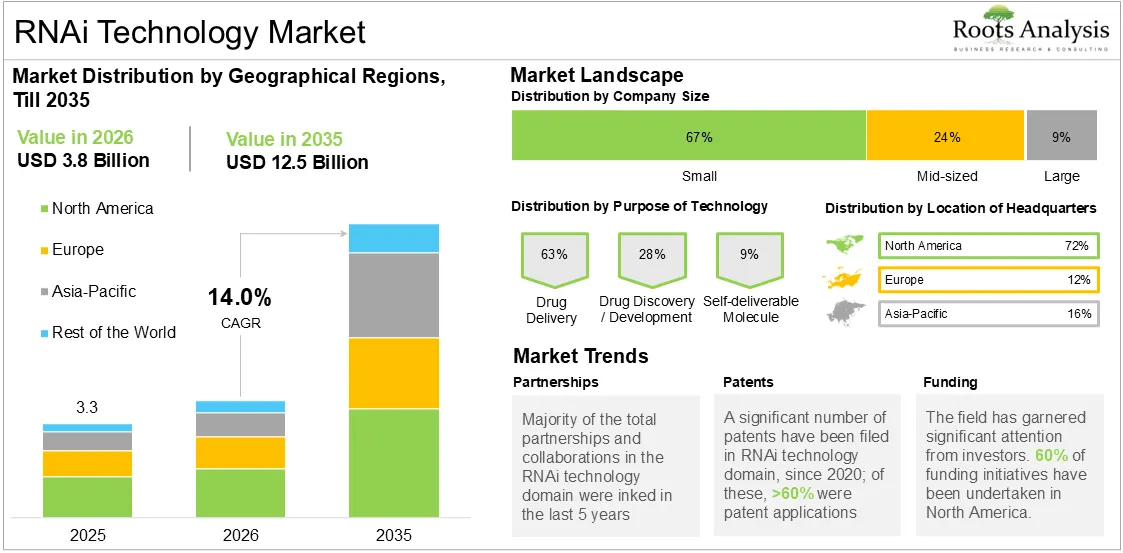
The global RNAi technology market, valued at USD 3.3 billion in 2025, is projected to reach USD 3.8 billion in 2026 and USD 12.5 billion by 2035, representing a CAGR of 14.0% during the forecast period 2026 to 2035.
To learn more about this report, request a free sample copy
RNA interference (RNAi) technology is a gene-silencing approach that selectively suppresses disease-causing genes at the messenger RNA (mRNA) level. Initially developed as a research tool, RNAi has evolved into a clinically validated therapeutic platform. The commercial success of RNAi medicines such as Onpattro and Amvuttra has demonstrated its potential to treat genetic and metabolic disorders through highly targeted mechanisms.
The RNAi field is rapidly expanding beyond rare diseases into broader therapeutic areas. A notable example is zilebesiran, an investigational RNAi therapy being developed by Alnylam Pharmaceuticals and Roche for uncontrolled hypertension. Its progression into Phase III clinical development highlights growing confidence in RNAi's ability to provide long-lasting treatment benefits for large patient populations.
Recent innovations in delivery technologies are further accelerating RNAi adoption. Advances in lipid nanoparticles (LNPs), GalNAc conjugates, and other targeted drug delivery platforms have improved tissue-specific delivery and therapeutic efficacy. In parallel, artificial intelligence is increasingly being utilized to optimize siRNA design and candidate selection, helping reduce development timelines and improve the success rate of RNAi drug discovery programs.
Beyond healthcare, RNAi technology is gaining momentum in agriculture and industrial biotechnology. RNA-based crop protection solutions are being developed to improve disease resistance, enhance productivity, and reduce dependence on conventional pesticides. These advancements are expanding the commercial applications of RNAi and positioning technology as a key enabler of innovation across both life sciences and sustainable agriculture sectors.
| Company | Headquarters | Year of Establishment | Core Expertise | RNAi Platform | Key Focus Area |
| Alnylam Pharmaceuticals | US | 2002 | Therapeutics | GalNAc-siRNA | Rare diseases |
| Arrowhead Pharmaceuticals | US | 2004 | Therapeutics | TRiM Platform | Cardiometabolic diseases |
| Dicerna Pharmaceuticals | US | 2006 | Therapeutics | GalXC Platform | Liver-targeted RNAi |
| Sirnaomics | US | 2007 | Therapeutics | Polypeptide nanoparticles | Oncology |
| Silence Therapeutics | UK | 1994 | Therapeutics | mRNAi GOLD Platform | Cardiovascular |
| OliX Pharmaceuticals | South Korea | 2010 | Therapeutics | Asymmetric siRNA | Fibrosis |
| Benitec Biopharma | Australia | 1995 | Gene Silencing | shRNA | Ocular diseases |
| Phio Pharmaceuticals | US | 2015 | Immuno-oncology | INTASYL | Cancer |
Based on the research, we have segmented the RNAi Technology Market into type of molecule, delivery technology, application area, end user and geographical regions.
By Type of Molecule
By Delivery Technology
By Application Area
By End User
By Geographical Regions
Driven by major pharmaceutical partnerships, alongside advances in extra-hepatic delivery technologies, the RNAi technology market is expected to grow in the near future.
Emphasizing this shift, William Soliman (Founder and Chief Executive Officer, Accreditation Council for Medical Affairs), in an interview with Drug Discovery News, stated, "Whoever cracks heart, lung, kidney, CNS delivery with the same precision GalNAc gave the liver will control the next wave of billion-dollar assets."
Discussions with multiple stakeholders in this domain influenced the opinions and insights presented in this study. The market report includes transcripts of the third-party discussions:
This segment highlights the distribution of market value for RNAi technology across various types of molecules, such as miRNA, shRNA, siRNA and other RNA molecules.
Currently, the siRNA segment captures the majority of the RNAi technology market share. The dominance of siRNA stems from its robust clinical and commercial validation across approved RNAi drugs and late-stage pipeline candidates. siRNA platforms leverage proven gene-silencing mechanisms, refined chemical modification approaches, and increasing adoption of targeted delivery, especially conjugate-based systems. Recently, in January 2026, researchers at the University of North Carolina at Chapel Hill have developed a new platform technology to enhance the overall RNA interference (RNAi) potency. As pharma and biotech firms progress siRNA programs for genetic, metabolic, cardiovascular, and other indications, this segment is likely to retain its market-leading position.
In contrast, the shRNA segment is expected to register the highest CAGR during the forecast period. This accelerated growth is due to the vector-based delivery that enables more persistent gene silencing, making shRNA particularly suited to indications that require sustained therapeutic activity. Increasingly, developers are exploring shRNA approaches for complex and chronic diseases where durable target suppression could provide clinical benefits. As vector design, delivery methods, and gene therapy manufacturing advance, shRNA platforms are poised to capture greater share of the RNAi technology market.
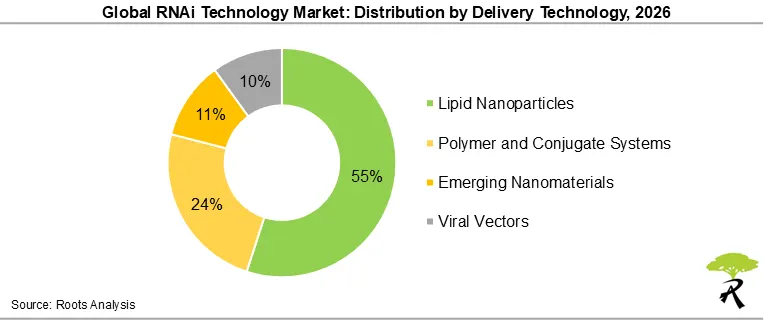
Based on the delivery technology, the global market is segmented into emerging nanomaterials, lipid nanoparticles, polymer and conjugate systems, and viral vectors.
Currently, the lipid nanoparticles sub-segment is likely to capture the majority (~55%) of the RNAi technology market size. This is due to the fact that lipid nanoparticles represent the most clinically validated and commercially scalable non-viral delivery platforms. Moreover, they offer well-established manufacturing processes, regulatory familiarity, and proven success in approved siRNA therapeutics. In addition, their ability to efficiently encapsulate and protect RNA molecules while enabling targeted delivery to the liver has made them the preferred choice for late-stage clinical programs and commercial products.
Further, it is worth highlighting that, as per the RNAi technology market analysis, the emerging nanomaterial sub-segment is likely to grow at a relatively higher CAGR during the forecast period. This is due to the industry's shift toward overcoming the limitations of conventional LNPs, particularly for extrahepatic delivery, repeat dosing, and cell-specific targeting. Novel carriers including polymeric, inorganic, biomimetic, peptide-based, and extracellular vesicle-inspired nanoparticles are being engineered to enhance biodistribution, reduce immunogenicity, and enable delivery to difficult-to-reach tissues.
Based on the application area, the global market is segmented into agriculture, diagnostics, drug discovery and screening, therapeutics, and other application areas.
According to our market analysis, therapeutics occupies the highest market share in the RNAi technology market. This trend stems from its relatively advanced commercialization pathway, supported by multiple regulatory approvals, expanding clinical pipelines, and growing investments in precision medicine. The approvals of RNAi therapeutics such as patisiran, givosiran, lumasiran, inclisiran, vutrisiran, and nedosiran have validated RNAi as a commercially viable modality and stimulated further investment in associated technology platforms. Consequently, pharmaceutical companies are increasingly deploying RNAi platforms to liver, cardiovascular, metabolic, and rare genetic indications, where targeted gene silencing can deliver differentiated clinical benefits.
On the contrary, the agriculture segment is likely to grow at a higher CAGR during the forecast period. This stems from the transition of RNAi-based crop protection solutions from research to commercial deployment, which is driven by the need for sustainable pest management, resistance mitigation, and reduced dependence on conventional chemical pesticides. For instance, RNAi-based approaches are increasingly being replaced by species-specific gene silencing. Moreover, regulatory acceptance of spray-induced gene silencing (SIGS) technologies and increasing investments from agrochemical and biotechnology companies are accelerating product development across high-value crops.
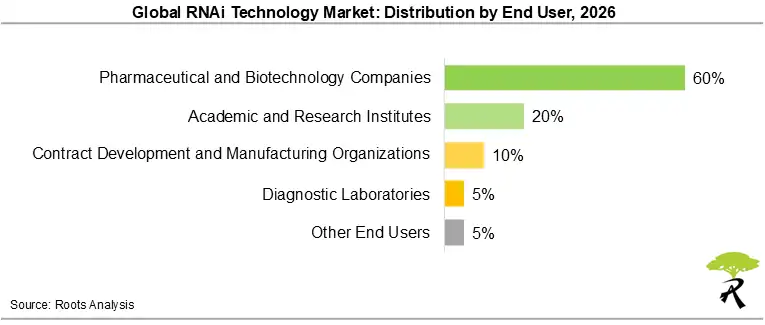
On the basis of end user, the global market is distributed into academic and research institutes, contract development and manufacturing organizations, diagnostic laboratories, pharmaceutical and biotechnology companies, and other end users.
Currently, pharmaceutical and biotechnology companies occupy the highest (around 60%) share in the overall market. This is due to the fact that these companies increasingly internalize RNAi discovery and clinical development to retain control over high-value intellectual property, platform optimization, and long-term product pipelines. Rather than relying solely on outsourced capabilities, leading developers are expanding in-house expertise in RNA design, delivery technologies, and translational research to accelerate first-in-class and follow-on therapeutic programs. Moreover, these companies possess the financial resources, technical expertise, and clinical development infrastructure required to advance RNAi platforms.
Additionally, it is worth highlighting that, as per RNAi technology market analysis, the market share for contract development and manufacturing organizations is likely to grow at a relatively higher CAGR during the forecast period. Rising outsourcing of RNAi development, formulation, analytical testing, and manufacturing by therapy developers is driving this demand. As RNAi programs grow in complexity and require specialized capabilities in oligonucleotide synthesis, delivery formulation, and stringent quality control, CDMOs are set to become increasingly critical partners in advancing RNAi therapeutics and associated technologies.
In terms of geographical regions, the global market is distributed across North America, Europe, Asia-Pacific, Middle East and North Africa, and Latin America.
According to our RNAi technology market forecast, North America is likely to capture the majority (around 40%) of the RNAi technology market share in the current year, and this trend is unlikely to change. The region's dominance is owing to its mature commercialization ecosystem, characterized by the presence of leading RNAi innovators, strong venture and public funding, advanced genomic research infrastructure, and an established regulatory pathway for nucleic acid therapeutics. Moreover, companies like Alnylam Pharmaceuticals and Arrowhead Pharmaceuticals reinforce North America's position through active pipeline development, strategic technology partnerships, and ongoing investment in next–generation RNAi platforms.
The market in Asia-Pacific is likely to grow at a high CAGR during the forecast period till 2035. This is primarily due to rapidly expanding biotechnology capabilities, increasing government investments in genomic medicine, a growing clinical trial landscape, and the emergence of cost-efficient RNA manufacturing and development hubs in the region. Moreover, countries such as China, Japan, South Korea, and Singapore are increasingly positioning themselves as key centers for RNA-based therapeutic innovation and commercialization, driving the growth of the market. For instance, China's ICAMA has drafted streamlined data requirements for RNA pesticides and has begun reviewing first-generation RNAi biopesticides (specifically double-stranded RNA targeted to suppress the Tobacco Mosaic Virus).
| Key Report Attribute | Details | |
| Historical Trend | Since 2019 | |
| Forecast Period | Till 2035 | |
| Market Size 2026 | $3.8 Billion | |
| Market Size 2035 | $12.5 Billion | |
| CAGR (Till 2035) | 14.0% | |
| Segments Covered |
|
|
| Key Players |
(A complete list of players captured is available in the report) |
|
| PowerPoint Presentation (Complimentary) |
Available | |
| Customization Scope | 15% Free Customization | |
| Excel Data Packs (Complimentary) |
Available | |