


 Download Free Sample
 Buy Now
Sepsis Diagnostics Market Overview
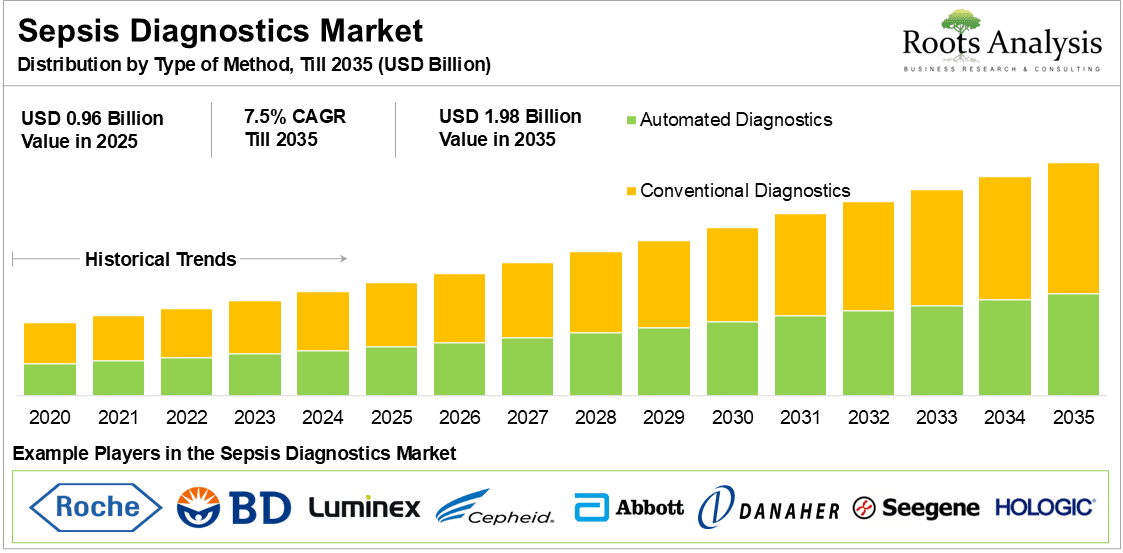
The global sepsis diagnostics market size, valued at USD 0.88 billion in 2024, is projected to reach USD 0.96 billion in 2025 and USD 1.98 billion by 2035, representing a CAGR of 7.5% during the forecast period.
 |
To learn more about this report, request a free sample copy
Sepsis Diagnostics Market: In Summary
- The sepsis diagnostics market is projected to grow from USD 0.96 billion in 2025 to USD 1.98 billion by 2035, exhibiting a CAGR of 7.5%.
- This growth is driven by the increasing global burden of sepsis (affecting ~48.9 million people annually, as per the report of World Sepsis Congress), advancements in diagnostic technologies (including AI integration), and supportive regulatory environments with increased funding.
- Companies active in this industry are securing investments to enhance technological innovations in this field. For instance, Deepull (Spain) secure oversubscribed €50 million in Series C financing. This funding will be utilized to advance UllCORE diagnostic system for direct-from-blood rapid pathogen detection.
- Significant innovations include AI-powered diagnostic models (Mednition's (US) KATE AI platform, Johns Hopkins' (US) TREWS, and UCSD's (US) COMPOSER), new rapid blood tests, and portable detection devices. Recent USUSFDA approvals for tools like Inflammatix TriVerity Test System and Abionic IVD CAPSULE PSP are accelerating market growth.
- In terms of region, North America is dominating the sepsis diagnostics testing market due to the advancements in diagnostics solutions, favorable USFDA guidelines and availability of reimbursement policies.
- Conventional diagnostics currently holds the largest share (56%), but automated diagnostics are poised for the fastest growth.
- In terms of technology, currently microbiology segment holds the largest share of the sepsis diagnostics market.
- The market is moderately competitive, with key players like Abbott (US), BD (US), bioMérieux (France), Roche (Switzerland), and Thermo Fisher Scientific (US) making substantial investments in R&D and strategic initiatives
Unlock Deeper Insights – Schedule Your Personalized Workshop Today!
Sepsis Diagnostics Industry: Introduction
Sepsis is a severe medical condition that occurs when the immune system exaggerates an infection. It leads to inflammation, organ damage, and can be fatal if not treated promptly. According to the statistics highlighted by the World Sepsis Congress, sepsis is one of the global concern, affecting nearly 48.9 million people every year. In majority of cases, sepsis remains undiagnosed due to limited access to treatment facilities, specifically in low to middle income countries. This high prevalence of sepsis has necessitated the demand for advanced diagnostic solutions.
Notably, sepsis diagnostics solutions help healthcare experts to provide optimal treatment based on the diagnostic results. Presently, numerous diagnostic solutions are available, such as immunoassays, polymerase chain reaction, and point-of-care sepsis testing devices for rural clinics. To make sepsis diagnosis more precise, several market players are aiming to integrate advanced technologies, such as artificial intelligence (AI) into diagnostics technologies.
For instance, in March 2025, Mednition (US) announced the development of an AI sepsis model (developed on the KATE AI platform). This groundbreaking model has achieved the highest published Area Under the Curve (AUC) of 99% for the diagnosis of emergency department (ED) sepsis by using Sepsis-3 criteria, revolutionizing the sepsis detection and treatment. Likewise, several industrial players are undertaking strategic initiatives, which is expected to maintain a long-term competitiveness in the sepsis diagnostics market.
Sepsis Diagnostics Market: Report Attributes
| Key Report Attribute | Details | |
| Historical Trend | Since 2020 | |
| Forecast Period | Till 2035 | |
| Market Size 2025 | USD 0.96 Billion | |
| Market Size 2035 | USD 1.98 Billion | |
| CAGR (Till 2035) | 7.5% | |
One of the key objectives of the sepsis diagnostics market report was to estimate the current size, opportunity, and the market growth potential, over the forecast period, till 2035. We have provided informed estimates on the likely evolution of the market for the forecast period.
The global sepsis diagnostics market analysis also features the likely distribution of the current and forecasted opportunity within the market across various segments, such as type of product, type of technology, type of pathogen, type of testing, type of method, end user, geographical regions, and leading players.
In order to account for future uncertainties associated with some of the key parameters and to add robustness to our model, we have provided three market forecast scenarios, namely conservative, base, and optimistic scenarios, representing different tracks of industry’s evolution.
What are the Recent Developments in Sepsis Diagnostics Market?
Several recent developments in the field of sepsis diagnostics industry have occurred, and we outlined some of these below.
- In May 2025, Canadian scientists recently developed a blood test and portable sepsis detecting device that can evaluate the onset of sepsis faster and more accurately than conventionally available methods.
- In January 2025, CARB-X (Combating Antibiotic-Resistant Bacteria Biopharmaceutical Accelerator) (US) awarded USD 3.5 million grant to Melio to develop a rapid diagnostic tool for detecting neonatal sepsis.
- In March 2025, Vail Scientific (US) revealed the new design of its proprietary VSNO sepsis screening device that can be used for speeding sepsis testing and diagnosis results to enhance patient outcomes.
Sepsis Diagnostics Market Segmentation Insights
The market report provides comprehensive information on sepsis diagnostics product developers who are currently active across various segments of the industry as mentioned in the table below.
Sepsis Diagnostics Market: Market Segmentation
| Market Segmentations | Details | |
| Type of Product |
|
|
| Type of Technology |
|
|
| Type of Pathogen |
|
|
| Type of Testing |
|
|
| Type of Method |
|
|
| End User |
|
|
| Geographical Regions |
|
|
| Market in Asia-Pacific |
|
|
| Middle East and North Africa |
|
|
| Market in Latin America |
|
|
How is Sepsis Diagnostics Market Segmented?
Market Share by Type of Product: Blood Culture Media Holds the Largest Share
- The global market is sub-categorized across different types of products, such as instruments, blood culture media, assay kits and reagents, and software. Based on recent analysis, blood culture media accounts for 39% of the overall sepsis diagnostics market share. Blood culture media is a highly convenient and cost-effective approach for testing sepsis. When combined with effective technology solutions, healthcare personnel can obtain organized data to prevent the misdiagnosis of sepsis.
- In addition, the assay kits & reagents segment is anticipated to show the fastest CAGR during the forecast period. Assay kits & reagents are widely used for high-throughput analytical outcomes. Moreover, reagents are increasingly in demand for sample preparation and sepsis testing.
Market Share by Type of Technology: Microbiology is Dominating the Market
- The global market is bifurcated into technology types such as microbiology, molecular diagnostics (polymerase chain reaction (PCR), DNA microarrays, syndromic panel testing, and others), immunoassays, flow cytometry, and others. According to the sepsis diagnostics market report, the microbiology segment holds the largest share (46%) of the market. Microbial culture remains a prominent standard for diagnosing sepsis and detecting disease-causing microorganisms. In addition, several market players are initiating the launch of advanced microbiology techniques, which further strengthen the growth of this segment. For instance, the TriVerity test, which diagnoses sepsis with reduces diagnosing time using blood sample analysis of 29 genes, received USUSFDA approval in February 2025.
- Notably, in the near future, the molecular diagnostics segment is likely to grow at a higher CAGR during the forecast period. Molecular diagnostic technologies, such as polymerase chain reaction and DNA microarrays, serve as important tools for diagnosing sepsis. Moreover, as per the molecular sepsis diagnostics market analysis, the higher adoption of molecular diagnostics technologies for bacterial sepsis identification due to their precision and high throughput is likely to drive this segment's growth at a higher rate in the future.
Market Share by Type of Pathogen: Bacterial Sepsis Holds the Largest Share
- The global market is categorized across different type of pathogen, such as bacterial sepsis (gram-positive bacteria, and gram-negative bacteria), fungal sepsis, viral sepsis, and others. Among these, bacterial sepsis segment currently holds the largest share of the sepsis diagnostics market size. This dominance is due to the high prevalence of hospital-transmitted infections, bacterial sepsis, and growing number of surgical procedures.
- In the future, the fungal segment is expected to grow at a higher CAGR during the forecast period. This is potentially due to rising sepsis incidence due to fungal infections and introduction of advanced diagnostic technologies to detect fungal infections.
Your Business is Unique – Why Shouldn’t Your Report Be?
Market Share by Type of Testing: Laboratory Testing Holds the Highest Share
- Based on the type of testing, the global market is bifurcated into laboratory testing and point-of-care-testing. According to the sepsis diagnostics market forecast, presently laboratory testing holds the largest share of the market. The availability of advanced sepsis diagnostic technologies and skilled personnels in laboratories are the key reason for highest share of this segment.
- It is interesting to note that point-of-care testing segment is likely to grow at a substantial CAGR during the forecast period. This is likely to be the result of growing demand for smart and high throughput testing methodologies for sepsis detection. Furthermore, the point-of-care diagnostics market is likely to be fueled by the high demand for advanced diagnostics solutions to facilitate remote diagnosis.
Market Share by Type of Method: Conventional Diagnostics Segment Holds the Highest Share
- This segment highlights the division of the global market across different types of methods, such as automated diagnostics and conventional diagnostics. Currently, the conventional diagnostics segment holds the highest share (56%) of the sepsis diagnostics market. This is potentially due to the fact that healthcare experts rely on conventionally available technologies and their expertise to evaluate clinical data and laboratory results.
- It is worth mentioning that the automated diagnostics segment is expected to drive the fastest CAGR during the forecast period. This is potentially due to the growing shift towards automation, AI technology, machine learning algorithms, and continuous monitoring systems for precision and faster detection. The real-time data interpretation can help healthcare professionals in providing early treatment to patients, which further supports the growth of this segment in the future.
Market Share by End User: Hospitals & Clinics Holds the Highest Share
- The end user segment is further sub-divided into hospitals & clinics, pathology & reference laboratories, and research institutes and other end users. Based on the sepsis diagnostics market analysis, hospitals & clinics segment holds the highest share (75%) of the market. This can be attributed to the availability of advanced diagnosing technologies in hospitals and growing patient pool with sepsis are the key reasons for highest share.
- Notably, the pathology & reference laboratories segment is likely to grow at a higher CAGR during the forecast period. Patient preferences and reference laboratories are offering advanced technologies for sepsis diagnosis which is expected to drive growth of this segment in the future.
Market Share by Geographical Regions: North America Holds the Largest Share
- Based on the geographical regions, the global market is further distributed into North America, Europe, Asia-Pacific, Middle East & Africa, and Latin America. According to the sepsis diagnostics industry analysis, presently North America holds maximum share (47%) of the market, and the trend is likely to remain unchanged during the forecast period. Several factors, such as high prevalence of sepsis, and growing technological innovations in this region are few reasons for the highest share of this region.
Want Information on Specific Region / Segment?
- In Asia-Pacific, the market for sepsis diagnostics is expected to grow at a higher CAGR during the forecast period. The high prevalence of hospital acquired infection and infections that result into sepsis are underscoring the demand for advanced sepsis diagnostics solutions in this region.
Sepsis Diagnostics Market: Report Deliverables
| Report Deliverables | Details | |
|
Excel Data Packs |
Available | |
| Key Sepsis Diagnostics Market Companies Profiled |
|
|
| PowerPoint Presentation (Complimentary) |
|
|
| Customization Scope |
|
|
What are the Sepsis Diagnostics Market Key Takeaways?
The “Sepsis Diagnostics Market Report: Industry Trends and Global Forecasts, till 2035” market report features an extensive study of the current market landscape, market size, market share, market growth, market trends, market value, market forecast, market outlook, statistics, and future opportunities for sepsis diagnostics industry players. The market research report lays emphasis on the sepsis diagnostic solutions that are being developed by the pharmaceutical companies. Key takeaways of the market report are briefly discussed below.
Is Sepsis Diagnostics Market Competitive?
Based on the current scenario, the market seems moderately competitive, witnessing the presence of several small, mid-sized and large industrial players. Majority of the industrial players, such as BD (US), Danaher (US) and bioMérieux (France) are accelerating their initiatives to develop advanced sepsis diagnostic solutions. Notably, several industrial players are also leveraging technological innovations and raising investments to develop diagnostic technologies.
For instance, in April 2025, Deepull (Spain) secure an oversubscribed €50 million in Series C financing to advance its UllCORE diagnostic system for direct-from-blood rapid pathogen detection. These consistent investments and innovations by industrial players will maintain a competitive edge in this industry for a long time.
What are the Key Factors Driving Growth in the Sepsis Diagnostics Market?
Rising Global Burden of Sepsis
Notably, the rising incidence of sepsis globally is the key driver for the market. According to the World Health Organization report, sepsis solely accounts for 11 million deaths globally every year, specifically in low to middle income countries. This high risk of death due to sepsis prompted the demand for rapid diagnostics solutions, specifically in emergency departments of hospitals.
Technological Advancements in Diagnostic Solutions
The growing innovation in molecular diagnostic technologies and integration of AI technology enable pathogen identification within hours rather than days. This high speed identification is likely to intensify the demand for technology driven diagnostic solutions. Furthermore, the rising technological innovations by industrial players has further supported the growth of this segment.
How is AI Technology Influencing Advancements in Sepsis Detection?
The integration of AI technology with advanced diagnostic solutions helps in early sepsis detection with higher accuracy rate. Recently, investigators at Johns Hopkins University developed a Targeted Real-Time Early Warning System (TREWS) that features machine learning and AI technology for sepsis detection. This system has been used for two years in five different hospitals.
Moreover, this system was used to analyze over 9,800 retrospectively confirmed sepsis cases and demonstrated AI's transformative potential, achieving 82% sensitivity. By processing electronic health record data, including vital signs, lab results, and medication histories, TREWS reduces time-to-antibiotic administration by 1.85 hours compared to standard protocols. Commercial AI tools now integrate with hospital workflows, providing real-time risk scores that guide clinical decision-making.
What are the Key Drivers Fueling the Growth of the Sepsis Diagnostics Market?
Regulatory Support and Funding Inflows
The growing approval of sepsis diagnostics technologies from the USFDA have accelerated the market momentum. For instance, in February 2025, sepsis test developed by Purvesh Khatri at Standford Medicine lab (US) that significantly reduces the diagnosis time has received the USFDA clearance. This breakthrough approval could help to provide early treatment for millions of patients suffering with sepsis.
In addition, the rising funding by the industrial players to develop sepsis diagnostic technologies is likely to propel the market in the future. For instance, Cytovale (US) has successfully raised USD 100 million in Series D funding round to expand the rapid sepsis diagnostics across US hospitals.
Which Regions are Expected to See the Fastest Growth in Sepsis Diagnostics Market?
North America: Technology Adoption Leader
Based on our sepsis diagnostics industry analysis, North America is dominating the market. This can be attributed to the growing expenditure for advancements in diagnostics solutions, favorable USFDA guidelines and availability of reimbursement policies. Furthermore, companies, such as Roche (Switzerland), Abbott (US), and bioMérieux (France) are widely implementing molecular diagnostic platforms in hospitals.
Europe: Collaborative Innovation Hub
Europe holds the substantial share of the sepsis diagnostics market. This can be attributed to the rising industrial players and academic partnerships. For instance, in October 2024, sepsis survivors published a call to European leaders in The Lancet, underscoring the development of European Sepsis plan. In order to support the initiatives, European Academic and Research Corporation prioritize allocating specific grants, such as Horizon Europe and Erasmus+ to support research and development in novel prevention, diagnostics, treatment, and post-sepsis care solutions.
Asia-Pacific: High-Growth Emerging Market
Notably, Asian countries, such as India and China exhibit lucrative growth projections, fueled by hospital infrastructure investments and rising antibiotic resistance rates. Moreover, the rising government initiatives to mitigate the ongoing concern of sepsis is likely to fuel the market growth in this region.
What Role do Biomarker-Based and Molecular Diagnostic Methods Play in Sepsis Diagnosis?
Traditional biomarkers like CRP and procalcitonin are being supplanted by multi-analyte panels. The TriVerity test’s bacterial-viral score (BVS) and illness severity risk (ISR) metrics exemplify this trend, offering a 0.89 AUROC for infection detection. Multiplex PCR systems simultaneously identify 25+ pathogens, while MALDI-TOF mass spectrometry reduces microbial identification time by 34 hours compared to conventional cultures.
What Role do Blood Culture Media Play in Current Sepsis Diagnostic Methods?
Current diagnostic protocols rely heavily on standardized media compositions. Notably, blood cell culture media typically featuring soybean casein digest as the base nutrient source, supplemented with anticoagulants, growth enhancers, and specialized additives such as polymeric resins for antibiotic neutralization.
The clinical significance of blood culture media optimization extends far beyond laboratory performance metrics to comprehend direct impacts on patient care, antibiotic stewardship, and clinical outcomes. Furthermore, the choice of culture media and system configuration directly influences the sensitivity of bloodstream infection detection, with implications for both initial diagnosis and ongoing monitoring of therapeutic response.
The evolution of blood culture media continues to advance through integration of molecular diagnostic technologies and optimization of traditional culture-based approaches.
What are Some Examples of AI Models or Tools Used For Sepsis Prediction?
Notably, several industrial players have developed AI-powered rapid sepsis diagnostics tools for sepsis prediction. Recently, The University of California at San Diego (UCSD) has developed an advanced AI tool (COMPOSER) that helps to addresses sepsis. COMPOSER is used to predict the complication during a before-and-after prospective study performed at two EDs.
Furthermore, in March 2025, Mednition (US) announced the launch of AI model developed on their KATE AI platform for sepsis detection.
How Will New USFDA Approvals Impact The Global Market For Sepsis Tests?
The recent USFDA approvals of novel sepsis diagnostic technologies mark a paradigm shift in bloodstream infection detection, combining advanced molecular profiling with artificial intelligence to address critical gaps in traditional diagnostic approaches. These regulatory milestones are poised to reshape the global sepsis diagnostics products market.
For instance, the USFDA approval of systems like Inflammatix's TriVerity test and MeMed's Severity assessment introduces three transformative market forces: accelerated adoption of host-response profiling, integration of machine learning algorithms, and redefinition of clinical decision pathways in emergency medicine. These innovations arrive as the global healthcare community mitigating sepsis' staggering economic burden.
Furthermore, USFDA's recent actions further indicate a strategic prioritization of sepsis diagnostics within its Digital Health Innovation Action Plan. The Breakthrough Device Designation awarded to MeMed Severity test creates a regulatory fast-track pathway that halves typical 510(k) clearance timelines from 18 months to 9 months. This acceleration is accompanied by updated CLIA categorization guidelines that reclassify AI-driven sepsis tests as moderate complexity assays, enabling rapid hospital lab adoption without requiring specialized molecular testing facilities.
What Recent USFDA Approvals Have Been Granted for Sepsis Diagnostic Tools?
The USFDA approved sepsis biomarkers for prognosis, contributing significant capabilities to the evolving landscape of patient care. These advancements represent a concerted effort to overcome the limitations of traditional diagnostic approaches and provide clinicians with more timely and precise information. Some of the recent USFDA approvals that have been granted for sepsis diagnostics tools are listed below.
| Device Name | Company Name | USFDA Approval Date | Core Technology | Indication | ||||
| Inflammatix TriVerity Test System | Inflammatix (California) | January 2025 (Marketing Authorization (510(k)) | Molecular diagnostic (gene expression, RT-LAMP) with AI/ML Aid in diagnosing acute infection / sepsis, differentiating bacteria / viral/ non-infectious | Identify infectious diseases, combat antimicrobial resistance, guide timely treatment for bacterial infections | ||||
| bioMérieux Vitek Compact Pro ID / AST System | bioMérieux (France) | March 2025 (510 (K)) | Microorganism identification (ID) and antibiotic susceptibility testing (AST) system | Identify infectious diseases, combat antimicrobial resistance, guide timely treatment for bacterial infections | ||||
| Abionic IVD CAPSULE PSP | Abionic (California) | In 2025 announced 510(k) Clearance | Nanofluidics platform measuring pancreatic stone protein (PSP) biomarker | Early detection of sepsis (24-48h earlier), accelerate time-to-detection | ||||
Your Business is Unique – Why Shouldn’t Your Report Be?
What are the Core Challenges in Sepsis Diagnostics Industry?
Diagnostic Accuracy Gaps
Despite significant advancements in diagnostic technologies, around 40% of sepsis cases yield negative blood cultures due to prior antibiotic use or fastidious pathogens. Although MALDI-TOF MS improves detection but remains unavailable in 74% of LMIC hospitals.
High Testing Cost
The high price of sepsis diagnostic test may hinder the adoption rate, which further impact the market growth. For instance, the advanced diagnostics command premium pricing host-response assays cost $150-$200, which can be expensive.
What Recent Technological Advancements Have Been Made in Sepsis Detection?
Several industrial players are focusing on the technological advancements to make sepsis detection more precise and shorten the time of detection. Some of the recent technological innovations that have been made in sepsis detection are listed below.
- AI-Integrated Wearables: Devices, such as continuous monitoring devices predicting sepsis 6–12 hours before clinical deterioration.
- Nanopore Sequencing: Portable DNA / RNA sequencers enabling pathogen identification in 30 minutes.
- Personalized Biomarker Panels: Tailored essays based on patient immunogenetics and microbiome profiles.
Get an Instant Quote in 10 Minutes. Lowest Price Guaranteed
Sepsis Diagnostics Market Size Analysis
The global sepsis diagnostics market size is projected to grow from USD 0.96 billion in 2025 to USD 1.98 billion by 2035. It is important to highlight here that rapid sepsis diagnostics market growth is driven by the technological innovations. However, it is worth mentioning that technological innovation must align with affordability and accessibility. As AI and molecular tools mature, their integration into standard care protocols will define the next decade of sepsis management.
Sepsis Diagnostics Market Report Coverage
The market report presents an in-depth analysis, highlighting the capabilities of various stakeholders in the sepsis diagnostics industry, across different geographies. Amongst other elements, the market report includes:
- An Infographic Executive Summary
- Regulatory Scenario
- Comprehensive Database of Leading Players
- Competitive Landscape
- Porter’s Five Forces Analysis
- Company Competitiveness Analysis
- Startup Ecosystem in the Sepsis Diagnostics Market
- Company Profiles
- Patent Analysis
- Recent Developments
- Market Landscape of Sepsis Diagnostics Technology Developers
- Market Opportunity Analysis
- Adjacent Market Analysis
- Value Chain Analysis
From the Author’s Desk
Author’s View on Sepsis Diagnostics Market
The recent USFDA approvals for sepsis diagnostic tools are poised to have a transformative impact on clinical practice and healthcare systems, fundamentally altering how sepsis is detected, managed, and treated. These innovations offer substantial potential for improving patient outcomes, enhancing operational efficiencies, and strengthening antimicrobial stewardship efforts.
The future of sepsis diagnosis lies in the integration of these diverse technologies. This shift, enabled by AI-powered predictive analytics, rapid host-response assays, and novel biomarker detection, allows for highly individualized treatment strategies and proactive interventions.
Glossary
- AI-Integrated Wearables: Devices, such as continuous monitoring devices predicting sepsis 6–12 hours before clinical deterioration.
- Nanopore Sequencing: Portable DNA / RNA sequencers enabling pathogen identification in 30 minutes.
- Personalized Biomarker Panels: Tailored essays based on patient immunogenetics and microbiome profiles.
- Sepsis Diagnostics: It refers to the use of tools and technologies for the detection of bacterial infection and sepsis.
- Polymerase Chain Reaction: It refers to the molecular technology that helps in the detection of diseases and sepsis.
- Flow Cytometry: It is a lab technique that is used for the analysis of chemical characteristics of cells in the fluid matrix.


