Sexually Transmitted Disease (STD) Testing Market by Disease or Pathogen Tested (Chlamydia, Gonorrhea, Syphilis, Trichomoniasis, Human Immunodeficiency Virus, Human Papillomavirus, Herpes Simplex Virus and Other Sexually Transmitted Infection), Testing Technology, Testing Delivery Model, Sample Type, End User, Geographical Regions, and Leading Players – Trends and Forecasts, 2026-2040
Market Size
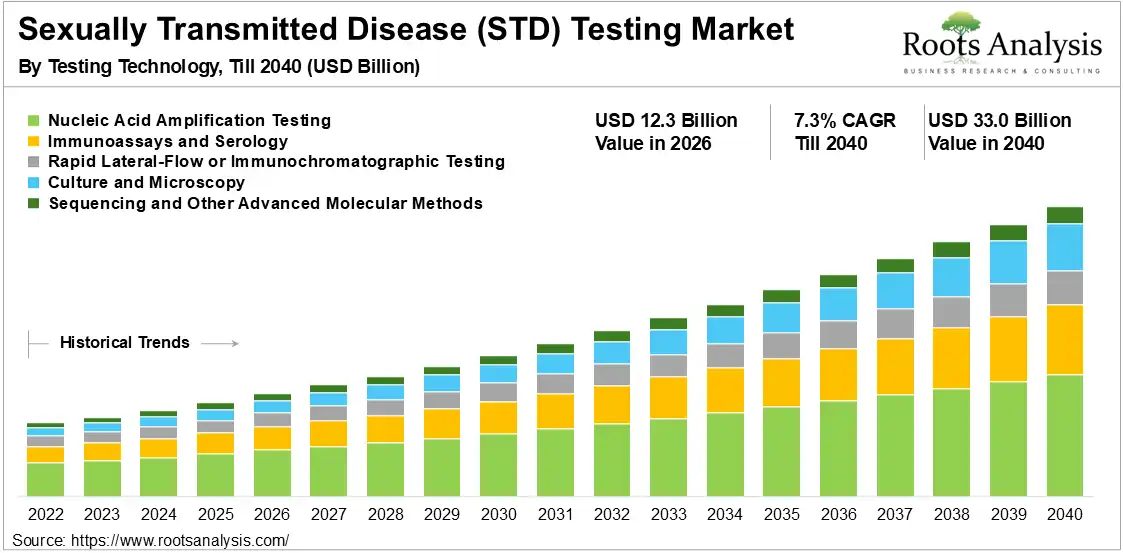
The global sexually transmitted disease (STD) testing market is expected to rise from USD 12.3 billion in 2026 to reach USD 33.0 billion by 2040, growing at a CAGR of 7.3% over the forecast period 2026 to 2040, driven by wider screening access and molecular-test adoption.
See What’s in the Full Report – Request Your Complimentary Insights!
Market Report: Key Takeaways
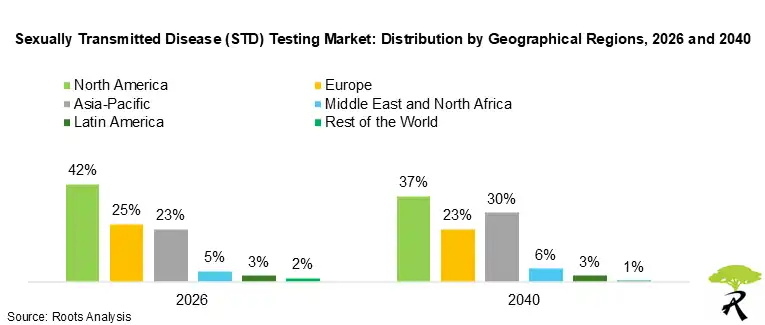
- Based on geography, North America captures 42.0% market share in 2026, whereas Asia-Pacific registers a 9.4% CAGR through 2040, supported by expanding screening infrastructure.
- Based on disease or pathogen tested, chlamydia captures 29.0% market share in 2026, whereas human papillomavirus registers an 11.3% CAGR through 2040, supported by primary HPV screening.
- Based on testing technology, nucleic acid amplification testing captures 46.0% market share in 2026, whereas sequencing and advanced molecular methods register a 12.8% CAGR through 2040, supported by genomic surveillance.
- Based on testing delivery model, laboratory-based testing captures 55.0% market share in 2026, whereas fully at-home self-testing registers a 12.8% CAGR through 2040, supported by rapid molecular platforms.
- Based on sample type, vaginal or cervical swabs are both dominant and fastest-growing, holding 30.0% share in 2026 and expanding at a 9.1% CAGR through 2040, driven by self-collection adoption.
Sexually Transmitted Disease (STD) Testing Market Outlook
Testing is shifting from centralized laboratory workflows toward rapid molecular, self-collected, and fully at-home models. Earlier demand centered on hospitals, reference laboratories, and clinics using nucleic acid amplification, serology, culture, and microscopy. Current demand increasingly favors faster chlamydia, gonorrhea, trichomoniasis, HPV, and HIV workflows across more decentralized settings. This transition expands competition beyond installed laboratory platforms toward convenient sample collection, instrument-free PCR, and near-patient testing.
Growth now comes from broader screening guidance, higher molecular sensitivity, and access models that reduce clinic visits. WHO expanded targeted chlamydia and gonorrhea screening guidance for high-prevalence settings and elevated-risk populations in July 2025. Roche also gained FDA 510(k) clearance and CLIA waivers for cobas liat CT/NG and CT/NG/MG panels in January 2025. These actions support rapid molecular point-of-care STI testing across more clinical settings.
Toward 2040, the STD testing market will increasingly separate into laboratory, near-patient, mail-in, and fully at-home pathways. Visby Medical launched its fully at-home Women’s Sexual Health PCR test in November 2025 with a mobile workflow and direct distribution. Long-term competition will center on regulatory clearance, channel access, affordability, and workflow simplicity.
Sexually Transmitted Disease (STD) Testing Market Dynamics
Sexually Transmitted Disease (STD) Testing Market Drivers
Molecular accuracy and faster treatment decisions are expanding demand for nucleic acid amplification tests for STIs. Multiplex PCR STI panels allow providers to detect chlamydia, gonorrhea, trichomoniasis, and other pathogens within consolidated workflows. WHO’s July 2025 guidance supported targeted chlamydia and gonorrhea screening in high-prevalence settings and elevated-risk populations. This policy direction strengthens testing volumes across clinics, public-health programs, and decentralized care sites.
Sexually Transmitted Disease (STD) Testing Market Restraints
Fragmented specimen requirements and regulatory pathways limit rapid scaling across the STD testing market. Blood, urine, vaginal, cervical, urethral, rectal, pharyngeal, oral, and lesion samples require different collection and validation workflows. Fully at-home tests face additional authorization, usability, and distribution requirements beyond laboratory-based assays. Companies must therefore fund broader clinical validation while supporting pathogen-specific performance across multiple testing technologies and delivery models.
Sexually Transmitted Disease (STD) Testing Market Opportunities
Decentralized molecular platforms create a clear opportunity to reach users beyond hospitals and reference laboratories. CARB-X awarded Scout Health up to USD 6 million in December 2025. The funding supports development and validation of the rapid molecular STI Scout point-of-care test. Similar investment can accelerate reader-free, near-patient, and fully at-home systems. Commercial winners can combine simple workflows, credible validation, and accessible channels across clinics, community sites, and homes.
Sexually Transmitted Disease (STD) Testing Market Challenges
Commercialization increasingly depends on coordinating diagnostic performance, consumer usability, laboratory support, and post-test pathways. Mail-in self-collection requires dependable sample transport and processing, while fully at-home self-testing requires clear result interpretation. Visby Medical established distribution relationships with Quest Diagnostics and Labcorp in January 2026 to broaden access to its at-home PCR test. Such channel complexity raises execution demands for emerging developers.
Sexually Transmitted Disease (STD) Testing Market Size Estimation Methodology
- As a starting point, the model established the STD testing market baseline from published historical and forecast estimates. It reconciled evidence from multiple credible secondary sources and checked the implied growth rate against market direction. The baseline separated direct-to-consumer services, laboratory testing, and assay-platform revenues without double counting. It also excluded prevention, treatment, and unrelated sexual-health spending from diagnostic revenues.
- Moving forward, the analysis mapped revenue pools across disease, technology, delivery model, sample type, end user, and geography. Product portfolios from Abbott, Roche, Hologic, BD, Cepheid, QIAGEN, and other listed companies supported category boundaries. Laboratory service menus from Quest Diagnostics and Labcorp distinguished assay supply from testing services. This approach prevented overlap between instrument sales, consumables, and fee-for-service testing.
- Building on this, the model assessed nucleic acid amplification, immunoassay, rapid lateral-flow, culture, microscopy, sequencing, and advanced molecular adoption. Regulatory submission counts, FDA clearances, CLIA waivers, and commercial launches indicated how quickly platforms could enter decentralized settings. At-home authorization milestones received separate weighting from mail-in self-collection services. Each regulatory milestone changed expected launch timing, setting penetration, and addressable user access.
- Drawing upon these, the forecast incorporated screening guidance, public-health program expansion, and changes in eligible testing settings. WHO guidance supported assumptions for targeted chlamydia and gonorrhea screening. The model reviewed hospitals, laboratories, clinics, public-health programs, urgent-care sites, retail locations, community sites, and home users as distinct demand channels. Regional assumptions reflected differences in screening policy, care access, and laboratory infrastructure.
- The projected value was then tested against company funding, product validation, distribution partnerships, and commercialization evidence. Financing from Visby Medical, Scout Health, and Linear Diagnostics provided signals for platform development and launch capacity. Partnerships involving Quest Diagnostics, Labcorp, Intermountain Health, and Google Cloud informed assumptions about channel reach and operating scalability. These signals shaped ramp-up periods rather than directly determining market size.
- Finally, the model applied scenario checks for regulatory timing, specimen validation breadth, molecular platform adoption, and self-collected STI specimens. The base case balanced laboratory testing scale with faster growth in point-of-care and at-home models. Sensitivity ranges addressed slower authorization, uneven public-health uptake, and execution risks across direct-to-consumer distribution. The final forecast preserved consistent annual progression and transparent segment reconciliation.
Sexually Transmitted Disease (STD) Testing Market Share Insights
Market Share by Disease or Pathogen Tested
According to our analysis, chlamydia leads because asymptomatic infection drives recurring screening, while multiplex assays use mature laboratory workflows. In March 2025, the FDA authorized Visby Medical’s at-home test covering chlamydia, gonorrhea, and trichomoniasis.
HPV testing accelerates as primary molecular screening and self-collection reduce participation barriers. In May 2025, Teal Health announced FDA approval for its at-home vaginal collection device supporting HPV screening.
Market Share by Sample Type
Vaginal or cervical swabs lead because they support chlamydia, gonorrhea, trichomoniasis, and HPV testing workflows. In April 2025, Quest Diagnostics deployed self-collected vaginal HPV specimens through physician sites and patient service centers.
This sample type also grows fastest as self-collection removes examination barriers and supports decentralized access. In May 2025, Teal Health received FDA approval for at-home vaginal sample collection and laboratory processing.
Want Information on Specific Region / Segment?
Regional Analysis: North America Leads the Market and Asia-Pacific is Likely to Register Higher CAGR
Presently, North America holds 42% market share and benefits from mature laboratory networks, reimbursement coverage, capital access, and deep regulatory expertise. Its ecosystem supports centralized testing, rapid molecular diagnostics, self-collection, and fully at-home products. In June 2025, Visby Medical secured up to USD 65 million to accelerate its United States at-home STI-test launch.
On the contrary, Asia-Pacific scales through public screening programs, growing diagnostic capacity, mobile care, and localized molecular testing. National programs increasingly integrate STI screening with maternal, reproductive, and primary healthcare.
In April 2025, WHO, UNICEF, and UNAIDS launched a roadmap supporting antenatal HIV and syphilis screening across 21 countries.
Market Ecosystem Analysis
The supplied ecosystem contains 24 companies: 12 Tier 1 leaders, seven specialists, and five emerging entrants. Commercial activity remains concentrated among leaders with established platforms, regulatory scale, and nationwide laboratory or distribution channels. Platform convergence now dominates, linking high-throughput NAAT, home collection, rapid PCR, and digital treatment pathways. Competitive advantage is shifting toward vendors that shorten diagnosis, reduce stigma, and preserve clinical follow-up across decentralized settings.
- In September 2025, Abbott's simpli-COLLECT entered Tia Health's clinician-ordered home pathway for four common STIs. This development extends Alinity m testing into home collection while retaining centralized laboratory processing. It raises barriers for mail-in providers lacking proprietary multiplex assays and strengthens urine and vaginal-swab testing.
- In June 2026, OraSure received FDA clearance for Colli-Pee Dx with Roche's cobas 5800, 6800, and 8800 systems. The combination links private home urine collection with high-throughput testing for chlamydia, gonorrhea, trichomoniasis, and Mycoplasma genitalium. It pressures standalone collection suppliers and strengthens laboratory testing, urine sampling, and population screening programs.
- In March 2025, FDA authorized Visby Medical's prescription-free home PCR test for chlamydia, gonorrhea, and trichomoniasis. The single-use device returns results in approximately 30 minutes without laboratory shipment. It pressures mail-in services and strengthens fully at-home self-testing using vaginal swabs.
- In April 2025, binx health partnered with WellStreet to deploy 30-minute CT/NG PCR across 115 urgent-care locations. The program supports same-visit diagnosis and treatment across Georgia, Ohio, and South Carolina. It raises performance expectations for near-patient competitors and strengthens urgent-care and community testing.
- In January 2026, Quest Diagnostics and Labcorp added the rapid home PCR test to their consumer channels. These relationships combine national distribution, virtual care, and immediate results within one commercial pathway. They raise channel-acquisition barriers for smaller brands and strengthen access among home users.
- In May 2025, FDA approved Teal Health's prescription home collection device for HPV-based cervical screening. The device removes the clinic collection requirement while retaining certified laboratory processing. It pressures clinic-only pathways and strengthens home self-collection, vaginal specimens, and HPV testing.
- In February 2026, Hologic received FDA approval for clinician-collected primary screening using its Aptima HPV assay. The approval positions mRNA-based detection as a differentiated laboratory alternative to DNA assays. It strengthens high-throughput HPV testing across hospitals and diagnostic or reference laboratories.
- In April 2025, Daye's diagnostic tampon entered the NHS Innovation Accelerator for HPV and broader STI screening. The tampon creates a familiar alternative to swabs and pelvic examinations. It strengthens European home collection and raises usability expectations for emerging specimen formats.
Startup Companies and their Key Highlights
- Visby Medical
- Event type and funding amount: Financing round; approximately USD 55 million raised, with potential proceeds reaching USD 65 million.
- Month and year: June 2025.
- Lead investor: Catalio Capital Management.
- Stated purpose: Accelerate launch and distribution of the FDA-authorized Women's Sexual Health Test.
- Market implication: Expands fully at-home molecular STI testing and supports broader direct-to-consumer access across the United States.
- Teal Health
- Event type: FDA approval of an at-home vaginal self-collection device for cervical cancer screening.
- Month and year: May 2025.
- Stated purpose: Enable patients to collect vaginal specimens at home for laboratory-based HPV testing.
- Market implication: Accelerates HPV self-collection and challenges clinic-only cervical screening pathways in the United States.
- binx Health
- Event type: Commercial deployment partnership.
- Month and year: April 2025.
- Strategic partner: WellStreet Urgent Care.
- Stated purpose: Introduce approximately 30-minute chlamydia and gonorrhea PCR testing across 115 urgent-care locations.
- Market implication: Accelerates same-day point-of-care testing and treatment across decentralized US urgent-care networks.
- Daye
- Event type: Selection for the NHS Innovation Accelerator.
- Month and year: April 2025.
- Strategic partner: NHS Innovation Accelerator.
- Stated purpose: Support wider adoption of Daye's diagnostic tampon for HPV, vaginal infection, and STI screening.
- Market implication: Advances tampon-based home collection and strengthens alternative specimen formats within the European market.
- Linear Diagnostics
- Event type and funding amount: NIHR funding award of GBP 1 million.
- Month and year: June 2025.
- Strategic partners: NIHR HealthTech Research Centre and North East Innovation Lab.
- Stated purpose: Finalize and validate a rapid near-patient diagnostic platform using clinical samples.
- Market implication: Advances low-cost CT/NG testing designed to support diagnosis and treatment during one clinical visit.
Sexually Transmitted Disease (STD) Testing Market Trends / Opportunities
Fully At-Home Molecular Testing Expanding Direct-to-Consumer Competition in the STD Testing Market
Fully at-home PCR is moving molecular STI testing beyond mail-in collection and laboratory processing. The FDA authorized Visby Medical’s Women’s Sexual Health Test in March 2025 for chlamydia, gonorrhea, and trichomoniasis. This milestone gives instrument-free platforms a stronger commercial position against traditional home collection services.
Direct distribution is becoming as important as analytical performance for at-home STD test kits. Visby Medical launched its Women’s Sexual Health PCR test in November 2025 using a mobile workflow and direct-to-consumer distribution. Companies with simple ordering, testing, and result workflows can compete for users outside established clinical channels.
CLIA-Waived Multiplex PCR Moving the STD Testing Market Closer to Patients
CLIA-waived molecular panels are compressing the distance between sample collection and clinical action. Roche received FDA 510(k) clearance and CLIA waivers in January 2025 for cobas liat CT/NG and CT/NG/MG panels. Point-of-care clearance strengthens suppliers that can combine multiplex detection with established near-patient instrumentation.
Male urine testing is widening the addressable use cases for rapid molecular platforms. Visby Medical submitted its Men’s Sexual Health Test for FDA 510(k) clearance and a CLIA waiver in May 2025. Successful authorization would intensify competition in decentralized chlamydia and gonorrhea diagnostics.
Self-Collected HPV Screening Broadening Access and Reshaping Channel Economics
At-home vaginal self-collection is extending sexual wellness diagnostics without requiring complete home analysis. The FDA approved Teal Health’s Teal Wand in May 2025 for home collection followed by laboratory HPV testing. This hybrid model supports laboratories while shifting collection convenience toward consumers.
Screening policy is expanding the commercial relevance of accessible specimen collection and decentralized testing. WHO strengthened targeted STI screening guidance in July 2025 for high-prevalence settings and elevated-risk populations. Suppliers that fit public-health workflows can access demand beyond private clinical testing.
Funding and Distribution Partnerships Accelerating Emerging Platform Commercialization
Development funding is reducing technical and validation barriers for emerging rapid molecular systems. CARB-X awarded Scout Health up to USD 6 million in December 2025 for its STI Scout point-of-care test. Non-dilutive support can move specialist platforms toward validation while limiting early capital pressure.
Distribution partnerships are becoming decisive after regulatory authorization and product launch. Visby Medical established relationships with Quest Diagnostics and Labcorp in January 2026 for its fully at-home PCR test. Access to national laboratory and consumer channels can separate scalable entrants from technically credible competitors.
Your Business is Unique – Why Shouldn’t Your Report Be?
Market Access Considerations
FDA Authorization and CLIA Waiver Requirements
Regulatory status directly determines which settings can adopt a new STI platform and how quickly commercialization can scale. FDA marketing authorization supports consumer access, while CLIA waivers enable broader near-patient use in eligible sites. Roche’s January 2025 clearance and waivers for cobas liat CT/NG and CT/NG/MG show this pathway’s commercial importance. Companies lacking comparable evidence remain concentrated in laboratories or limited research channels. This evidence burden also affects development budgets, launch sequencing, and partner selection.
Specimen and Pathogen Validation Breadth
Validation breadth shapes both addressable demand and the cost of market entry. STD testing spans blood, urine, vaginal, cervical, urethral, rectal, pharyngeal, oral, and lesion samples across multiple pathogens. Visby Medical’s May 2025 male urine submission targeted chlamydia and gonorrhea detection with 510(k) clearance and CLIA waiver requests. Broader claims require additional evidence but strengthen competitive reach across users and settings. It also influences panel design, study complexity, and claims available to commercial teams.
Laboratory, Retail, and Direct-to-Consumer Channel Access
Channel access determines whether an authorized product can convert technical approval into sustained testing volumes. Laboratory services, clinics, community sites, and home users require different ordering, fulfillment, and result pathways. Visby Medical partnered with Quest Diagnostics and Labcorp in January 2026 to broaden consumer access to its at-home PCR test. Developers with national distribution relationships can scale faster than single-channel competitors. Channel partnerships also reduce customer-acquisition friction and support broader post-test service integration.
Public-Health Screening Policy and Program Integration
Screening policy influences which populations receive testing, where programs deploy assays, and how public-health demand develops. WHO’s July 2025 guidance supported targeted chlamydia and gonorrhea screening in high-prevalence settings and elevated-risk populations. Platforms suited to clinics, public-health laboratories, community sites, and decentralized workflows can align more easily with program requirements. Poor workflow fit can delay procurement despite strong analytical performance. Policy-aligned evidence can improve tender relevance and strengthen positioning with national screening programs at scale.
How Stakeholders Benefit from the Key Focus Areas of Our Sexually Transmitted Disease (STD) Testing Market Report
Rapid molecular testing, self-collected specimens, and fully at-home models are changing how STI diagnostics reach users. The report connects regulatory shifts, technology adoption, competitive positioning, and the 7.9% forecast CAGR through 2032. This evidence supports product prioritization, investment screening, and market-entry planning.
- Unmet Needs and Market Gaps in Sexually Transmitted Disease (STD) Testing Market: The report identifies gaps across pathogen coverage, specimen types, delivery models, and testing settings. Corporate strategy teams can compare underserved combinations, such as rapid molecular testing across male urine, home use, or community sites. Product leaders can then prioritize assay claims, sample workflows, and channels with weaker competitive density. This supports focused development rather than broad portfolio expansion.
- Funding and Venture Investment Opportunities in Sexually Transmitted Disease (STD) Testing Market: The report tracks financing signals across reader-free molecular systems, near-patient platforms, and at-home PCR models. Investment committees can assess whether funding supports validation, regulatory progress, launch capacity, or distribution. Scout Health’s December 2025 CARB-X award illustrates capital directed toward point-of-care molecular validation. This helps distinguish technically promising programs from commercially scalable opportunities.
- Technology Innovation and Adoption Trends: The report compares nucleic acid amplification, multiplex PCR, immunoassays, rapid lateral-flow tests, culture, microscopy, and advanced molecular methods. Technology teams can evaluate which platforms are moving from centralized laboratories into near-patient and home settings. They can also assess adoption barriers linked to instruments, sample handling, and result workflows. This supports architecture, partnership, and development-roadmap decisions.
- Sexually Transmitted Disease (STD) Testing Market Competitive Landscape and Industry Analysis: The report maps Tier 1 leaders, specialists, and emerging companies across assays, instruments, laboratory services, and consumer testing. Commercial leaders can benchmark portfolio breadth, installed infrastructure, regulatory status, and delivery-channel reach. The analysis separates high-throughput laboratory competitors from point-of-care and at-home entrants. This supports positioning, account prioritization, and defensible differentiation by pathogen, setting, and workflow.
- Mapping Strategic Partnerships and Ecosystem Synergies: The report shows how developers, laboratories, health systems, cloud providers, and public-health bodies shape commercialization. Business development teams can identify partners that add validation capacity, distribution reach, clinical access, or digital workflow support. Visby Medical’s January 2026 relationships with Quest Diagnostics and Labcorp show the value of channel alignment. This supports partnership targeting and negotiation priorities.
- Sexually Transmitted Disease (STD) Testing Market CAGR and Growth Trends: The report assesses the 7.9% forecast CAGR through 2032 against regulatory approvals, screening guidance, technology shifts, and commercialization activity. Strategy and finance leaders can test whether growth assumptions reflect laboratory demand, decentralized adoption, and at-home expansion. Segment views clarify which technologies, delivery models, samples, end users, and regions warrant deeper investment. This supports forecast validation, resource allocation, and timing decisions.
Sexually Transmitted Disease (STD) Testing Market: Scope of the Report
| Key Report Attributes | Details | |
| Forecast Period | Till 2040 | |
| Market Size 2026 | USD 12.3 Billion | |
| Market Size 2040 | USD 33.0 Billion | |
| CAGR (Till 2040) | 7.3% | |
| Segments Covered |
|
|
| Geographical Regions Covered |
|
|
| Key Sections Covered |
|
|
Market Segmentation
The Sexually Transmitted Disease (STD) Testing Market report presents an in-depth analysis, highlighting the capabilities of various stakeholders, based on different segments, such as disease or pathogen tested, testing technology, testing delivery model, sample type, end user, geographical regions, and leading players.
By Disease or Pathogen Tested
- Chlamydia
- Gonorrhea
- Syphilis
- Trichomoniasis
- Human Immunodeficiency Virus
- Human Papillomavirus
- Herpes Simplex Virus
- Other Sexually Transmitted Infections
By Testing Technology
- Nucleic Acid Amplification Testing
- Immunoassays and Serology
- Rapid Lateral-Flow or Immunochromatographic Testing
- Culture and Microscopy
- Sequencing and Other Advanced Molecular Methods
By Testing Delivery Mode
- Laboratory-Based Testing
- Point-Of-Care and Near-Patient Testing
- At-Home Self-Collection with Laboratory Processing
- Fully At-Home Self-Testing
By Sample Type
- Blood, Serum or Plasma
- Urine
- Vaginal or Cervical Swabs
- Urethral Swabs
- Rectal Swabs
- Pharyngeal or Oral Swabs
- Lesion Swabs
By End User
- Hospitals
- Diagnostic and Reference Laboratories
- Sexual Health and Primary-Care Clinics
- Public-Health Laboratories and Screening Programs
- Urgent-Care, Retail and Community Testing Sites
- Home Users
By Geographical Regions
- North America
- US
- Canada
- Mexico
- Rest of North America
- Europe
- Austria
- Belgium
- Denmark
- France
- Germany
- Ireland
- Italy
- Netherlands
- Norway
- Russia
- Spain
- Sweden
- Switzerland
- UK
- Rest of Europe
- Asia-Pacific
- China
- India
- Japan
- Singapore
- South Korea
- Rest of Asia-Pacific
- Latin America
- Argentina
- Brazil
- Chile
- Colombia
- Venezuela
- Rest of Latin America
- Middle East and Africa (MEA)
- Egypt
- Iran
- Iraq
- Israel
- Kuwait
- Saudi Arabia
- UAE
- Rest of MEA
- Rest of the World


