
Lowest Price Guaranteed
Pages
198
Last Updated
May 2025
View Count
12308
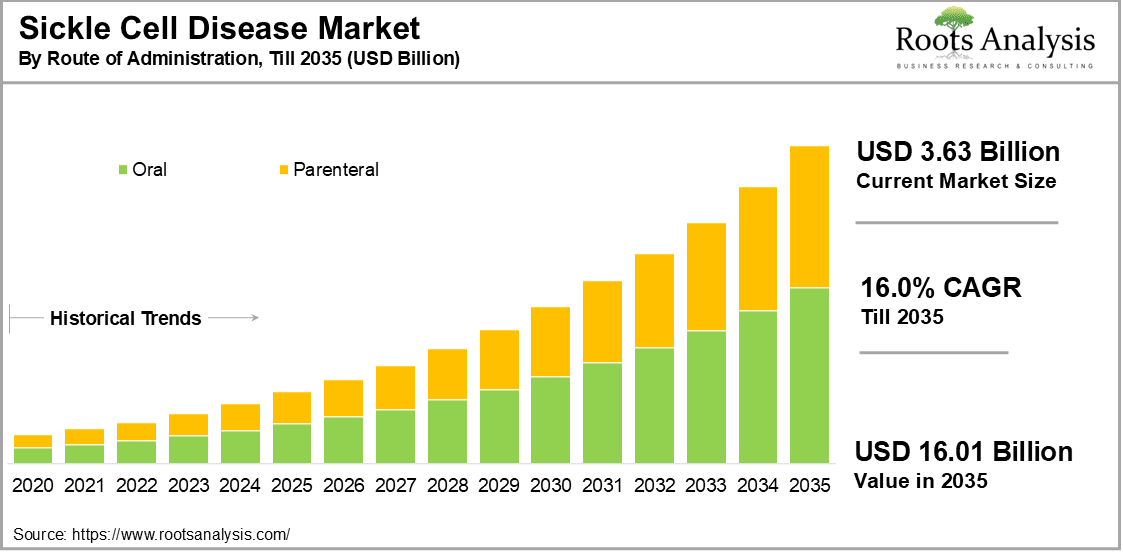
The global sickle cell disease market size, valued at USD 3.02 billion in 2024, is projected to reach USD 3.63 billion in 2025 and USD 16.01 billion by 2035, representing a CAGR of 16.0% during the forecast period.
 |
To learn more about this report, request a free sample copy
Sickle cell disease is a form of inherited blood disorder that results in shortage of red blood cells. The red blood cells become C-shape / pointed which result in early death of cells and reduce the oxygen carrying capacity in the body. According to the report published by the Centers for Disease Control and Prevention in 2024, around 100,000 people in the United States are affected from sickle cell disease.
It is worth mentioning that patients with sickle cell disease may require constant blood transfusion to manage disease conditions. However, frequent blood transfusion is discomforting and often has complications, such as iron overload, blood mismatching and alloimmunization which creates challenges in long-term disease management. Owing to the ongoing complications, there has been a surge in the demand for advanced therapeutic treatment for patients with sickle cell diseases.
It is important to highlight here that the USFDA approved cell and gene therapies - Casgevy® (gene therapy) and Lyfgenia for the treatment of sickle cell disease in December 2023. Casgevy is first-of-its-kind USFDA approved CRISPR gene editing therapy that utilizes CRISPR / Cas9 technology for editing and replacing genes to treat disease.
Driven by the approval of gene therapy, several industrial players are undertaking research initiatives to develop more novel treatment. For instance, in December 2024, Tessera Therapeutics raise the sum of USD 50 million for the Bill & Melinda Gates Foundation for the development of advanced treatment for sickle cell disease. As stated by Dr Michael Severino, (CEO, Tessera), “Sickle cell disease patients globally remain deeply underserved by existing treatment options. We are excited to develop what we believe will be a disruptive one-time curative treatment for SCD that is safer, easier, and more scalable than ex vivo genetic approaches”.
Similarly, several government organizations have taken strategic initiatives to support the development of advanced therapeutics for patients with sickle cell diseases. For instance, the Indian Prime Minister Shri Narendra Modi announced “National Sickle Cell Anaemia Elimination Mission” with a vision of eradicating sickle cell disease in India before 2047.
Driven by the ongoing initiatives, we believe that the sickle cell disease treatment market is expected to grow at a steady rate during the forecast period, offering lucrative opportunities to drug developers for investments.
The market report provides comprehensive information on industrial players who are currently active across various segments of the industry as mentioned in the table below.
| Key Report Attributes | Details | |
| Historical Trend | Since 2020 | |
| Forecast Period | Till 2035 | |
| Market Size 2025 | USD 3.63 Billion | |
| Market Size 2035 | USD 16.01 Billion | |
| CAGR (Till 2035) | 16.0% | |
| By Disease Indication |
|
|
| Type of Treatment |
|
|
| Type of Diagnosis |
|
|
| Rout of Administration |
|
|
| Age Group |
|
|
| Type of Drug Class |
|
|
| Type of Complication |
|
|
| Type of Distribution Channel |
|
|
| End User |
|
|
| Geographical Regions |
|
|
|
Key Companies Profiled |
|
|
| PowerPoint Presentation (Complimentary) |
Available | |
| Customization Scope | 15% Free Customization | |
| Excel Data Packs (Complimentary) |
Available | |
One of the key objectives of sickle cell disease market report was to estimate the current size, opportunity and the market growth potential, over the forecast period, till 2035. We have provided informed estimates on the likely evolution of the market for the forecast period.
The global sickle cell disease market analysis report also features the likely distribution of the current and forecasted opportunity within the market across various segments, such as type of disease indication (sickle cell anemia, sickle hemoglobin-C disease, sickle beta-plus thalassemia, sickle hemoglobin-D disease, sickle hemoglobin-O disease and others), type of treatment (blood transfusion, pharmacotherapy (hydroxyurea, and branded products (Endari, Adakveo, Oxbryta, Zynteglo, PYRUKYND (Mitapivat), CTX001, Inclacumab, MGTA-145, Vamifeport (VIT-2763), ALXN1820, FT-4202, and GBT021601)), gene therapy (Casgevy, and Lyfgenia) and other treatment), type of diagnosis (screening tests, new-born screening, prenatal screening and other diagnosis), route of administration (oral and parenteral), age group (adults, pediatrics and geriatrics), type of drug class (antimetabolites, amino acids, NSAIDs, monoclonal antibodies and others), type of complication (stroke, acute chest syndrome, pulmonary hypertension, organ damage and others), distribution channels (hospital pharmacies, retail pharmacies and online pharmacies), end user (hospitals, specialty clinics and other end users), geographical regions (North America, Europe, Asia-Pacific, Middle East and North Africa, and Latin America) and leading players.
In order to account for future uncertainties associated with some of the key parameters and to add robustness to our model, we have provided three market forecast scenarios, namely conservative, base, and optimistic scenarios, representing different tracks of industry’s evolution.
All actual figures have been sourced and analyzed from publicly available information forums and primary research discussions. The financial figures mentioned in this market report are in USD, unless otherwise specified.
Based on the disease indication, the global market is segmented into sickle cell anemia, sickle hemoglobin-C disease, sickle beta-plus thalassemia, sickle hemoglobin-D disease, sickle hemoglobin-O disease and others. According to our projection, currently, sickle cell anemia accounts for the highest share of the sickle cell disease market. This can be attributed to the rising incidence of sickle cell anemia and associated complications, such as vaso-occlusive crises and hemolysis has necessitated the demand for advanced treatment. Owing to the rising prevalence, this segment is likely to remain dominant and is expected to grow at a steady rate during the forecast period.
This segment highlights the distribution of global market across different types of treatment, such as bone marrow transplant, blood transfusion, pharmacotherapy (hydroxyurea, and branded products (Endari, Adakveo, Oxbryta, Zynteglo, PYRUKYND (Mitapivat), CTX001, Inclacumab, MGTA-145, Vamifeport (VIT-2763), ALXN1820, FT-4202, and GBT021601)), gene therapy (Casgevy and Lyfgenia) and other treatment.
Based on the sickle cell disease market study, currently blood transfusion accounts for the highest share (46%) of the market. This can be attributed to the fact that hematopoietic transfusion is widely accepted by the healthcare experts to manage disease condition in patients and limited availability of alternative treatment options. Additionally, the availability of large pool of blood donors for the patients to treat sickle cell disease has further contributed to the highest share of this segment.
However, in the long run, pharmacotherapy segment is likely to grow at a steady rate during the forecast period. This is likely to be the result of increasing initiatives by industrial players for the development of novel therapeutic drugs. Furthermore, government organizations are also supporting the development of pharmacotherapy to mitigate the risk associated with blood transfusion which is currently available treatment option.
December 2023 also saw FDA approve two gene therapies for treatment of sickle cell disease. Casgevy (Vertex Pharmaceuticals) and Lyfgenia (bluebird bio) both generated sales of USD 10 million each during the full year 2024. Their adoption has been slow due to the availability of other treatment options.
The global market is bifurcated on the basis of type of diagnosis into screening tests, new-born screening, prenatal screening and other diagnosis. Currently, new-born screening is dominating the market by holding the largest sickle cell disease market share. This can be attributed to the fact that early screening is essential for improving significant outcome of the treatment.
However, in the long run, prenatal screening is likely to grow at a higher CAGR during the forecast period. This is likely to be the result of increasing awareness of inheritance patterns in sickle cell disease and technological innovations in prenatal diagnosis techniques for accurate disease detection.
Based on the route of administration, the global market is segmented into oral and parenteral. According to our sickle cell disease market forecast, presently oral segment accounts for the highest share of the market. This can be attributed to the increasing preferences of non-invasive procedures to get therapeutic drugs.
Furthermore, the availability of therapeutic drugs (such as hydroxyurea) is available in the form of tablets and capsules, which are easy to administer through oral route to manage disease condition. Driven by the growing preference, this segment is likely to remain dominant and is expected to grow at a higher CAGR during the forecast period.
On the basis of drug class, the global market is segmented into antimetabolites, amino acids, NSAIDs, monoclonal antibodies and others. According to our sickle cell disease market analysis, presently antimetabolites accounts for the largest share of the market. This can be attributed to the growing usage of hydroxyurea (a form of antimetabolites) approved by the USFDA to treat patients with sickle cell disease.
However, in the future, monoclonal antibodies segment is likely to grow at a higher CAGR during the forecast period. This is likely to be the growing research on advanced gene therapies and approval of crizanlizumab (monoclonal antibody-based therapy) by the USFDA that targets P-selectin to reduce vaso-occlusive crises.
This segment highlights the distribution of global market across different types of complication such as stroke, acute chest syndrome, pulmonary hypertension, organ damage and others. According to our sickle cell disease treatment market analysis, currently acute chest syndrome accounts for the highest share of the market. This is primarily due to the high chances of having acute chest syndrome amongst patients with sickle cell disease.
It is important to highlight that sickled red blood cells can lead to breathing difficulties due to their low oxygen-carrying capacity, which ultimately results in chest pain as they flow to the lungs. In order to mitigate the concern, there is a high demand for advanced therapies for patients with sickle cell disease.
The global market is categorized based on the type of age group into adults, pediatrics and geriatrics. Currently, the adults segment holds the highest sickle cell disease market share of nearly 40%. This is likely to be the result of the requirement of frequent medical intervention to reduce the risk of complications stroke, organ damage and pulmonary hypertension in adults.
Additionally, the growing research on sickle cell disease treatment for adult age group patients has contributed to the highest market share of this segment. It is worth mentioning that the pediatrics segment is expected to register a higher CAGR during the forecast period. This is potentially due to the rising demand for sickle cell disease treatment for newborn babies and children across the globe.
Based on the type of distribution channel, the global market is segmented into hospital pharmacies, retail pharmacies and online pharmacies. Currently, hospital pharmacies account for the highest sickle cell disease market share. This can be attributed to the availability of advanced therapies in hospitals and availability of advanced infrastructure to deliver therapies under the guidance of expert healthcare practitioners. Driven by the preferences, this segment will continue to remain dominant and is anticipated to register a higher CAGR during the forecast period.
On the basis of end user, the global market is segmented into hospitals, specialty clinics and other end users. According to our sickle cell disease market analysis, currently hospitals hold the largest share (54%) of the market. This can be attributed to the large pool of patients with sickle cell diseases admitted in hospitals and availability of advanced therapeutic treatment in hospitals. It is worth mentioning that blood transfusion also require a safe and sterile environment as well as expert supervision available in hospitals.
However, in the long run, specialty clinics segment is likely to grow at a higher CAGR during the forecast period. This can be attributed to the rising demand for personalized treatment in specialized clinics and availability of gene therapies in specialty clinics.
The global market is distributed across different geographical regions, such as North America, Europe, Asia-Pacific, Middle East and North Africa, and Latin America. According to our sickle cell disease market analysis, North America accounts for the largest share (37%) of the market. This dominance is likely to be the result of increasing prevalence of sickle cell disease in this region. Furthermore, the increasing initiatives by the industrial players to develop advanced therapeutic drugs to treat patients with sickle cell disease has contributed to the highest share of this segment.
In Asia-Pacific, the market for sickle cell disease is likely to grow at a higher CAGR during the forecast period. This can be attributed to the rising incidence of sickle cell disease, increasing expenditure on healthcare infrastructure and government initiatives to eliminate the risk of disease in this region.
The “Sickle Cell Disease Market: Industry Trends and Global Forecasts, till 2035” market report features an extensive study of the current market landscape, market size, market share, market growth, market trends, market value, market forecast, market outlook, statistics and future opportunities for sickle cell disease treatment developers. The market research report lays emphasis on the sickle cell disease treatment and branded products that are being developed for the treatment of sickle cell diseases. Key takeaways of the market report are briefly discussed below.
Currently, the market landscape of treatment developers includes a wide array of well-established and new-entrants. With growing concern of sickle cell disease and limited treatment availability, these industrial players are focusing on the development of advanced therapeutic drugs. In order to leverage the competitive edge, various industrial players are undergoing strategic partnerships and collaborations. For instance, in January 2025, IMMvention Therapeutix announced a strategic collaboration with Novo Nordisk to co-develop oral therapies for sickle cell disease. As stated by Anil Goyal (Founder and CEO, Immvention), “Despite the current treatments and recent gene therapies, we believe that there remains a pressing need for globally accessible, effective, and convenient oral therapies for people with SCD.”
As more market players continue to accelerate their research efforts in this field, it is expected that the market will remain competitive throughout the projected period.
Some of the potential market drivers that are driving the market includes increasing prevalence of sickle cell disease and growing initiatives by government organizations. It is important to highlight here that sickle cell anemia is widely prevailing across the globe and exhibits phenotypic and genotypic variations due to mutations in hemoglobin genes. Thus, increasing incidence of sickle cell disease has underscored the requirement for advanced therapeutic drugs to treat patients.
In addition, several government organizations are consequently increasing their efforts to support the development of advanced therapies to treat patients, which is likely to be a key growth factor for the market.
Sickle cell disease market is consistently witnessing an upward trajectory driven by the growing research on advanced therapies. However, there are some challenges that needs to be addressed for accelerating the development of drugs. Some of the notable challenges in the market are stringent guidelines associated with approval of therapies and high cost of available treatment. In addition, sickle cell disease is genetically complex due to various mutations, leading to diverse clinical manifestations.
This complexity necessitates personalized drug development based on individual genetic profiles, posing challenges for pharmaceutical companies. Additionally, the limited availability of FDA-approved treatments further hampers the development of new therapies.
More recently, in September 2024, Pfizer withdrew its drug Oxbryta from the market and halted its further development. The company announced that its decision was based on study data that suggests the overall benefit of the drug no longer outweighs the risk in the approved population.
Despite challenges, several trends are shaping industrial growth during the forecast period. Some recent trends include rising focus on early disease diagnosis, development of cell and gene therapies and personalized medicine. Currently, researchers are focusing on understanding the disease variability based on individuals’ genetic profile to develop novel drugs and gene therapies. It is important to highlight here that gene therapy is emerging as a promising approach to correct the faulty gene by editing and replacing it with a functional gene. Therefore, the increasing emphasizing on permanent cure by using gene therapy is likely to remain a key trend of the market.
The sickle cell disease treatment market is estimated to be valued at USD 3.63 billion in 2025 and is poised to reach USD 16.01 billion by 2035, representing a CAGR of 16.0% during the forecast period. With increasing prevalence of sickle cell disease across the globe, the market players are continually focusing on undertaking strategic initiatives to develop innovative drugs for the patients.
It is important to highlight here that several therapeutic drugs for sickle cell disease are currently being investigated under clinical trials. In order to accelerate the approval process, several industrial players are entering into strategic partnerships. For instance, in October 2024, Zydus Lifesciences entered into a Memorandum of Agreement (MoA) with Indian Council of Medical Research (ICMR) for the initiation of Phase II clinical trials of Desidustat in patients with Sickle Cell Disease.
Examples of key players engaged in this domain (which have also been captured in this report) include Allergan, AstraZeneca, Amgen, AbbVie, Bristol-Myers Squibb Company, Bayer, Boehringer Ingelheim International, Eli Lilly, Gilead Sciences, GlaxoSmithKline, Johnson & Johnson, Lupin, Merck, Novartis, Pfizer, Roche, Sanofi and Teva Pharmaceutical Industries. This market report includes an easily searchable excel database of all the companies focusing on the development of sickle cell disease treatment.
The market report presents an in-depth analysis, highlighting the capabilities of various companies engaged in this domain across different segments. Amongst other elements, the market report includes:
Several recent developments have taken place in the field of sickle cell disease. We have outlined some of these recent initiatives below.