


 Download Free Sample
 Buy Now
Sleep Apnea Devices Market Size
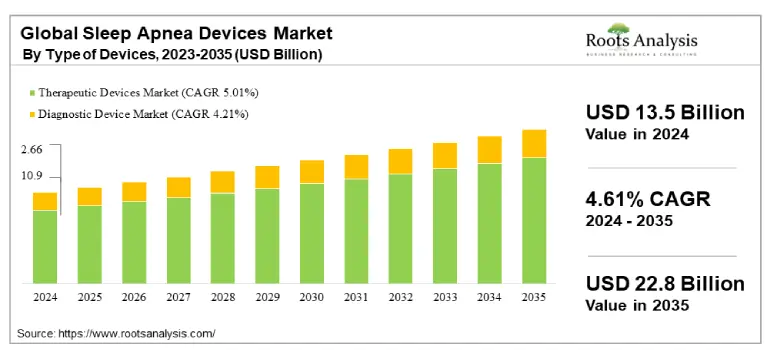
The sleep apnea devices market is estimated to be worth $13.5 billion in 2024 and is anticipated to grow at a CAGR of 4.61% during the forecast period from 2024 to 2035.
See What’s in the Full Report - Request Your Complimentary Insights!
Sleep Apnea Devices Market Report: Key Takeaways
Market Size & Trends
- In terms of product type, the sleep apnea medical devices segment holds the highest share of the market.
- With regards to type of diagnostic device, the home sleep apnea testing devices segment dominates the global market.
- Based on the type of therapeutic device, the oral devices hold the largest market share in 2025.
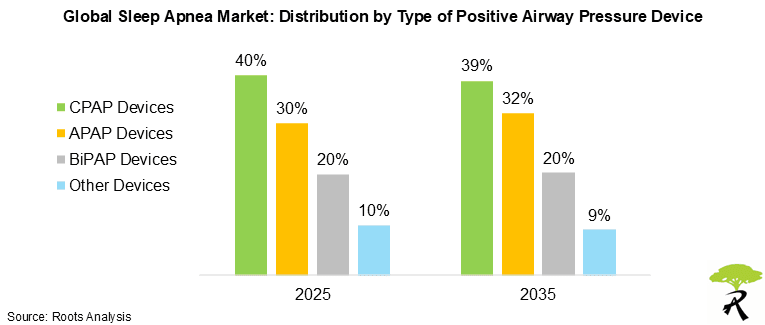
- In terms of types of positive airway pressure device, the CPAP machine dominates the global market with close to 40% market share.
- With respect to route of administration, subcutaneous segment captures the highest share in 2025.
- In terms of geographical regions, North America captures the majority of the market share, and Asia-Pacific is likely to grow at a faster pace in the near future.
Sleep Apnea Devices Market Overview
Sleep apnea, used interchangeably with sleep apnoea, is one of the serious sleep disorders characterized by repeated start or stop in breathing during sleep. These interruptions in sleep can last up to several minutes. Sleep apnea can be broadly categorized into three types, obstructive sleep apnea, central sleep apnea and complex sleep apnea. Obstructive sleep apnea and central sleep apnea are the most common types of sleep apnea with similarity in symptoms, which include loud snoring, morning headache, excessive daytime sleepiness and dry mouth.
Sleep apnea is often an underdiagnosed condition that can affect all age groups. According to a study, obesity and excess weight is the most common cause of sleep apnea in adults. Additionally, modern lifestyle-related risk factors, such as smoking, alcohol consumption, lack of physical activity and psychological stress play a crucial role in the rapidly increasing prevalence of sleep apnea. As a result, medical experts are extensively focusing on developing effective, safe and versatile sleep apnea diagnosis and treatment options. Currently, several medical devices are being employed for the treatment of sleep apnea. Owing to the rising disease burden of sleep apnea, as well as the ongoing research and development efforts to develop advanced obstructive sleep apnea medical devices, the sleep apnea devices market is anticipated to witness steady market growth during the forecast period.
Sleep Apnea Devices Market Trends
- Investment and Innovation Activity: In the past four years, close to USD 1.6 billion have been invested by various investors across the globe in sleep apnea companies. It is worth highlighting that LivaNova raised a significant capital amount (USD 595 million) through other equity. The company has planned to use this amount to advance its neurostimulator therapeutic device for sleep apnea treatment. Additionally, over 1,600 patents focused on sleep apnea have been granted / filed in the past four years, indicating the substantial efforts made by researchers engaged in this domain. Most of the patents have been filed for the advancement of sleep apnea medical devices.
- Integration of Artificial Intelligence: The future focus of industrial players will be on the integration of artificial intelligence with sleep apnea devices for real-time monitoring. Moreover, the AI integration will also be done on wearable devices to improve treatment and monitor sleep apnea efficiency by tracking sleep pattern.
- Remote Monitoring with Wearable Devices: With increasing adoption of wearable devices for remote diagnosis and monitoring, the market players are focusing on portable and travel-friendly sleep apnea devices that helps in at-home sleep screening and monitoring of breathing disturbances more conveniently.
Recent Developments
- In April 2026, ProSomnus received FDA clearance for its RPMO2 obstructive sleep apnea therapy device, an oral appliance for moderate to severe OSA patient’s intolerant to CPAP.
- In March 2026, Incannex Healthcare entered into a collaboration with AASM Foundation to fund sleep apnea research, targeting advancements in OSA devices and therapies. The collaboration supports clinical studies to enhance detection, management, and innovative treatment options in the sleep medicine field.
- In July 2025, Nyxoah's Genio system received FDA approval as an implantable hypoglossal nerve stimulator for moderate to severe OSA adults.
- In April 2025, Samsung entered into a collaboration with Stanford Medicine to advance AI-driven sleep apnea detection via wearables. The initiative enhances Samsung’s Sleep Apnea feature for accurate monitoring, management, and preventive strategies in OSA patients.
Get an Instant Quote in 10 Minutes. Lowest Price Guaranteed
Sleep Apnea Devices Market Share Insights
Market Share by Product Type
- The global sleep apnea market highlights the distribution of this segment across different types of products, such as sleep apnea medical devices and drug therapies.
- The sleep apnea devices market segment occupies the highest share in 2024 and is expected to witness substantial growth in the coming years.
Market Share by Type of Diagnostic Device
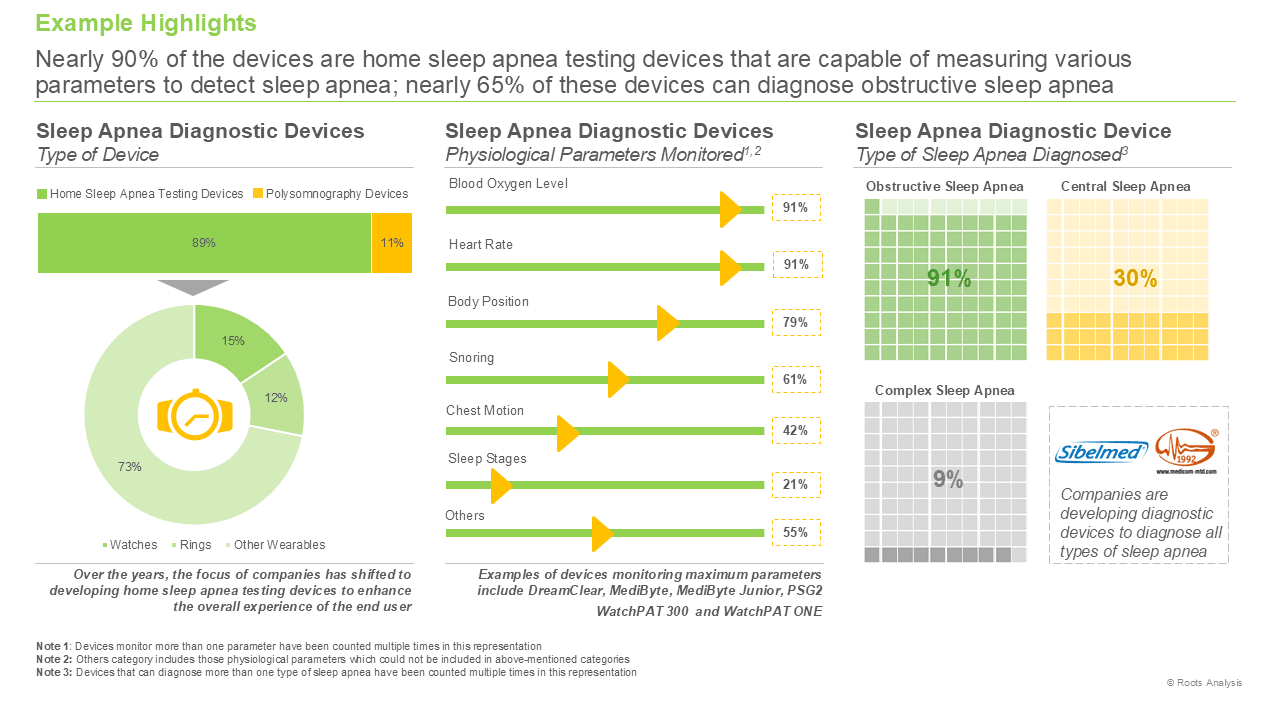
- The global sleep apnea diagnostic devices market is categorized into polysomnography devices and home sleep apnea testing devices.
- The home sleep apnea testing devices segment occupies the highest sleep apnea devices market share for diagnosis and expected to dominant during the forecast period.
- This can be primarily attributed to the fact that such devices offer a convenient and cost-effective way to monitor and diagnose sleep apnea from the comfort of their homes.
Market Share by Type of Therapeutic Device
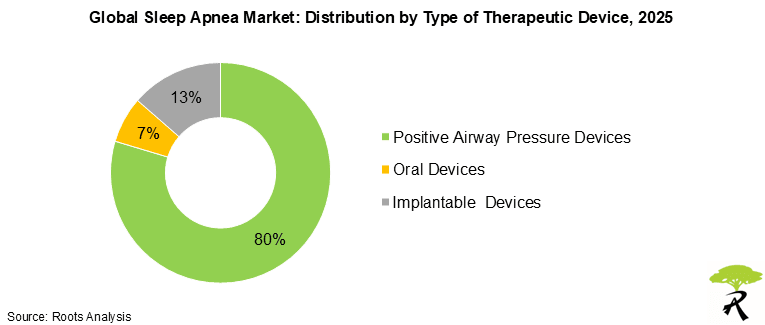
- The global sleep apnea therapeutic devices market is segmented into positive airway pressure devices, oral devices and implantable devices.
- Owing to their comfortable and convenient nature oral devices are likely to grow at a higher CAGR as compared to other devices in the coming years.
Market Share by Key Geographical Regions
- This segment highlights the distribution of sleep apnea drugs market and sleep apnea devices market share across various geographies, such as North America, Europe, Asia-Pacific and Rest of the World.
- According to our projections, the sleep apnea devices market in North America is likely to capture majority (70%) of the market share, and this trend is unlikely to change in the future.
- It is worth highlighting that the market in Asia-Pacific is expected to grow at a relatively healthy CAGR (9%), during the period.
Want Information on Specific Region / Segment?
Market Insights
Rising Prevalence of Obstructive Sleep Apnea and Central Sleep Apnea
Sleep apnea is an underrecognized medical condition that is more common in men than women and prevalence of sleep apnea tend to rise with age in the general population. It is estimated that nearly 1 billion people have mild to severe sleep apnea globally, however, a substantial portion of this population remains undiagnosed. In Europe, sleep apnea has emerged as one of the key public health problems. In fact, nearly 90 million (22.7%) people have moderate to severe obstructive sleep apnea in Europe. Similarly, around 7% of the total population and 60% of the geriatric population aged 65 and above is suffering from obstructive sleep apnea in the US. It is worth highlighting that improved detection and diagnosis of sleep apnea has also contributed to the growing number of reported cases of this clinical condition.
Pay Only for What You Need – The Best Way to Optimize
Competitive Landscape of Sleep Apnea Device Manufacturers
The sleep apnea device manufacturers landscape features over 100 companies offering a range of sleep apnea medical devices, including continuous positive airway pressure machines (CPAP machine), bilevel positive airway pressure machines (BiPAP), auto-adjusting pressure machines (APAP), oral devices, implantable devices, contactless devices, adaptive servo ventilation, expiratory positive airway pressure devices, home sleep apnea test devices and polysomnography devices. Notably, the majority of the sleep apnea medical devices can be used in home healthcare setting for the diagnosis and treatment of sleep apnea, with an aim to enhance the overall experience of end user. Some examples of obstructive sleep apnea medical devices include O2Vent Optima Mini, aura6000™, AirSense™ 11 CPAP and Bongo Rx. Overall, the market landscape of sleep apnea medical device manufacturers is well-fragmented, featuring the presence of small, mid-sized, and large sleep apnea companies located in different geographical regions.
It is interesting to note that around 50% of these sleep apnea device manufacturers are located in North America, followed by Europe. Within North America, US and Canada emerged as the hubs for sleep apnea device manufacturers. It is worth highlighting that Appscent Medical, an Israel based company, is developing an advanced artificial intelligence-based home care medical device for contactless detection and treatment of sleep apnea, which is expected to revolutionize the sleep apnea treatment in the coming years. In addition, Resmed captures the significant sleep apnea devices market share for both diagnostic and treatment devices. Furthermore, amidst the recent initiatives undertaken to develop more convenient treatment options for this medical condition, sleep apnea nasal devices have emerged as one of the most suitable options, having demonstrated the capability to treat sleep apnea.
Competitive Landscape of Sleep Apnea Drug Therapy Developers
Sleep apnea drugs market features the presence of close to 25 industry and non-industry players developing / evaluating drug therapies for sleep apnea treatment. Over 35 sleep apnea drug therapies are currently being evaluated in different phases of clinical studies, either as monotherapies or in combination with other drugs for the treatment of obstructive sleep apnea and central sleep apnea. It is worth highlighting that, in June 2022, Apnimed received fast track designation from the USFDA for its novel oral pharmacologic combination for sleep apnea treatment. Further, in October 2022, Eli Lilly and Company received the fast-track designation for its single novel molecule tirzepatide for sleep apnea treatment.
Sleep Apnea Devices Market Analysis: Sleep Apnea Therapeutic Devices Hold Majority Market Share
The global sleep apnea devices market is estimated to be worth USD 13.5 billion in 2024. The market growth is expected to be driven by the growing geriatric population, rising demand for sleep apnea therapeutic devices leading to a CAGR of 4.61% and carve out a significant sleep apnea devices market share over the forecast period.
Regional Analysis: North America Emerged as the Hub of Sleep Apnea Medical Devices and Sleep Apnea Treatment; Asia Pacific to be the Fastest Growing Market
Presently, North America capture 70% of the market share of the overall sleep apnea devices market. In the recent years, demand for sleep apnea devices has witnessed a tremendous increase in North America. Further, it is worth highlighting that, owing to the rising demand for sleep apnea devices and anticipated drug approvals, market in Asia Pacific is likely to grow at a higher CAGR as compared to other regions in the coming years.
Sleep Apnea Devices Market Segmentation Insights
| Key Report Attribute | Details | |
| Historical Trend | Since 2018 | |
| Forecast Period | 10+ Years | |
| Future Trend | Till 2035 | |
| Current Sleep Apnea Devices Market | $ 13.5 Billion | |
| CAGR | 4.94% | |
| Product Type |
|
|
| Type of Diagnostic Device |
|
|
| Type of Therapeutic Device |
|
|
| Type of Positive Airway Pressure Device |
|
|
| Route of Administration |
|
|
| Key Geographical Regions |
|
|
| Key Players |
(Full list of 110+ companies captured is available in the report) |
|
| PowerPoint Presentation (Complimentary) | Available | |
| Customization Scope | 15% Free Customization | |
| Excel Data Packs (Complimentary) |
|
|


