


 Download Free Sample
 Buy Now
Market Size
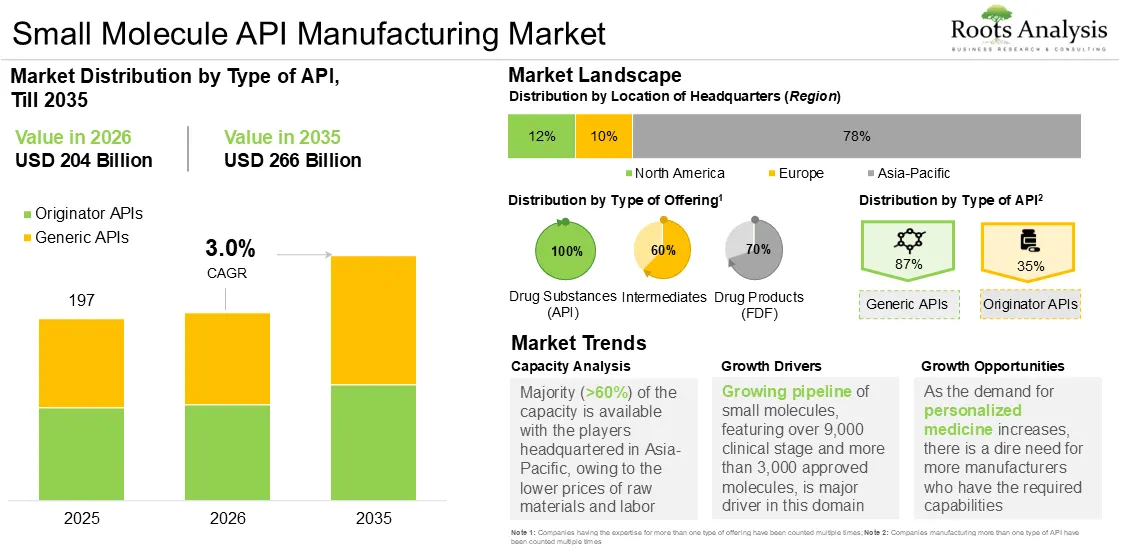
The small molecule API manufacturing market, valued at USD 197 billion in 2025, is projected to reach USD 204 billion in 2026 and USD 266 billion by 2035, representing a CAGR of 3.0% during the forecast period 2026 to 2035.
See What’s in the Full Report – Request Your Complimentary Insights!
Market Report: Key Takeaways
- Owing to the rising prevalence of chronic diseases, growing demand for cost-effective drugs, and advances in drug development technologies, the small molecule API manufacturing market is likely to grow at a significant pace.
- In terms of type of manufacturers, the in-house manufacturers are likely to secure ~65% of the overall revenue share in 2026, due to the growing preference towards large, vertically integrated pharmaceutical companies.
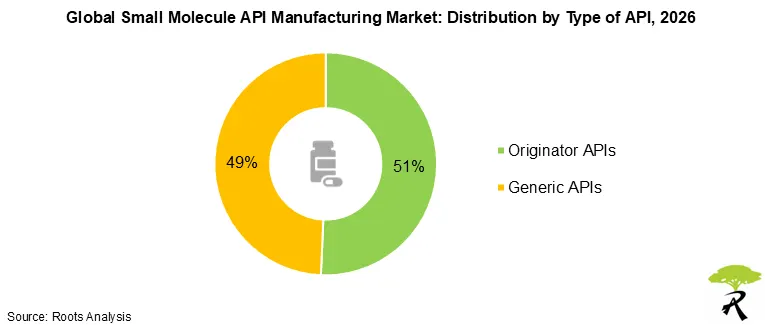
- In terms of type of API, currently, originator APIs capture the largest small molecule API manufacturing market share (~50%). This growth is due to multiple factors, including a strong clinical pipeline of small molecules and increasing focus on the development of targeted and complex molecules.
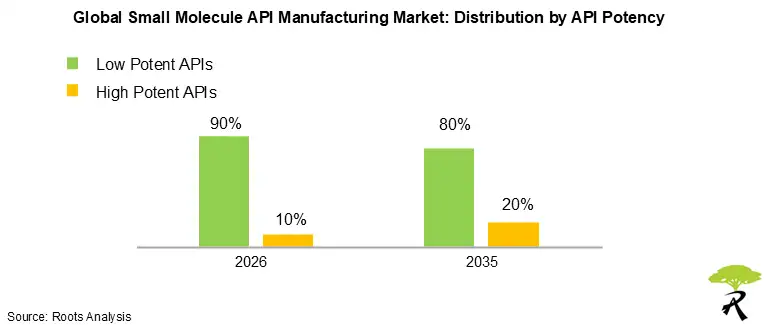
- In terms of API potency, low potent API sub-segment currently holds around 90% of the market share, due to their widespread application, lower manufacturing complexity, and cost-effectiveness.
- In terms of scale of operation, the commercial segment currently holds around 90% of the market share; preclinical and clinical segment is likely to grow at a relatively faster pace, owing to the increasing number of clinical trials and the growing focus on personalized medicines.
- In terms of geographical regions, Europe captures more than 35% of the market value in the year 2026; this is due to a well-positioned pharmaceutical base along with a strong regulatory oversight.
Market Overview
Small molecules form the backbone of modern medicine, powering the majority of oral and injectable drugs used worldwide. Unlike biologics (like antibodies or recombinant proteins), manufacturers primarily produce small molecule APIs through organic chemical synthesis, carefully optimizing multi-step reaction sequences for yield, purity, and safety.
Notably, the process starts with designing the best chemical pathway for synthesis and carrying out reactions, such as condensation or cyclization, in order to create intermediate compounds. Next comes purification through methods like filtration, chromatography, and crystallization, which boost purity above 99.9% and shape the crystals for better drug solubility. Finally, milling, drying, and adjusting particle size finalize the API, while tackling issues like heat management during larger-scale production.
Once synthesized and purified, small molecule APIs are manufactured as drug substances under strict quality and regulatory controls. These drug substances are then handed over to formulation partners, who convert them into finished dosage forms such as tablets, capsules, or injectables. These API-to-formulation relationships are also relevant to pharmaceutical contract manufacturing in China, where buyers assess both drug-substance and finished-dose capabilities.
The future of small molecule API manufacturing looks promising, driven by rapid growth in global demand fueled by new drug approvals and rising healthcare needs. Several technological advancements including adoption of AI and digital twins for process optimization, and continuous manufacturing to cut costs and boost efficiency are likely to drive the growth of this market. Additionally, with custom API services which support personalized medicine and accelerated timelines gaining traction, the market is likely to grow at a steady pace.
Recent Developments
- In March 2026, Cambrex announced the initial completion of engineering studies for its new API manufacturing plant in Iowa, US; notably, the new plant is likely to include capacity of 140,000 liters, featuring both large and mid-scale reactors.
- In March 2026, Cambrex announced a USD 30 million investment in its site in Italy, Europe, and the company expects to complete this expansion in the second half of 2027.
- In February 2026, AbbVie announced the plans to expand its API manufacturing facility by investing USD 380 million at its site in Illinois, US.
Your Business is Unique – Why Shouldn’t Your Report Be?
Small Molecule API Manufacturing Market Trends
- Asia-Pacific is Set to have Majority of the Small Molecule API Manufacturing Capacity: Asia-Pacific holds the majority of global small molecule API manufacturing capacity primarily because China and India dominate the sector with massive, cost-efficient production infrastructure that supplies affordable generic drugs worldwide. Further, these countries benefit from lower labor and raw material costs, established chemical manufacturing ecosystems, and supportive government policies that actively promote domestic API production to reduce import dependence. The region also benefits from favorable regulatory frameworks, expanding healthcare coverage, and growing investments in advanced manufacturing technologies that enhance scalability. Additionally, Asia-Pacific has become a contract manufacturing hub where multinational pharmaceutical companies outsource API production to local small molecule CDMOs for cost-effectiveness and supply chain resilience, further consolidating the region's capacity leadership.
- Tariffs Driving the Companies’ Expansion in the US: Tariffs on imported active pharmaceutical ingredients (APIs) are accelerating small molecule API manufacturing expansion in the US. This is because companies are focusing on developing in-house production suites in order to avoid escalating import costs and secure supply chains under President Trump’s America First trade policies. This reshoring effort aligns with federal priorities to create domestic jobs, strengthen supply chain resilience, and ensure drug security, even though building new API manufacturing infrastructure in the US will take time and may initially lead to temporary drug shortages. Notably, in March 2026, Wilmington PharmaTech announced a USD 50 million expansion in order to double the manufacturing capacity of Delaware site.
Industry Experts on Small Molecule API Manufacturing Market
Discussions with multiple stakeholders in this domain influenced the opinions and insights presented in this study. The market report includes detailed transcripts of interviews conducted with the following individuals:
- President and Chief Executive Officer, Corporate Strategy and Business Development, Mid-sized Company, US
- Digitalization and Artificial Intelligence Manager, Large Company, Switzerland
- Former Director, Pharmaceuticals Marketing, Large Company, France
- Former Director, Commercial Development, Cell Therapy, Mid-sized Company, Switzerland
- Former Director of Business Development, Large Company, US
- Former Vice President Business Development, Marketing, and IP, Mid-sized Company, Israel
In addition, the market report includes transcripts of the following other third-party discussions:
- Technical Director, Mid-sized Organization, UK
Small molecule API manufacturing domain will mark a turning point in the coming future. Bhaskar Venepalli, President and Chief Executive Officer, CiVentiChem, stated that “The extent of outsourcing is steadily increasing. Large pharmaceutical companies such as Pfizer and GlaxoSmithKline are buying the smaller or start-up companies. Most of the small companies are all virtual; they are getting everything done outside. Such acquisitions, where most of the smaller companies operate by outsourcing all the requirements, make the proportion of outsourcing look big in the next 4-5 years. Every day, we hear about numerous mergers and acquisitions. Pharmaceutical companies are not only buying the assets of the smaller firms but also their supply chain.”.
Market Drivers
- Escalating Global Burden of Chronic Diseases: The rising prevalence of cancer, diabetes, cardiovascular conditions, and other chronic illnesses is creating sustained demand for affordable small molecule drugs. Further, as healthcare systems prioritize accessible treatments amid aging populations and lifestyle shifts, API manufacturers benefit from higher production volumes and long-term contracts.
- Growing Pipeline of Small Molecules: The current small molecule pipeline includes more than 9,000 molecules under development for the treatment of various diseases. In addition, over 3,000 small molecule drugs have already been approved to treat various chronic disorders. The presence of these numerous late-stage candidates creates multiple opportunities for firms active in the small molecule API manufacturing domain.
- Increasing Adoption of Advanced Technologies: The adoption of advanced technologies, such as continuous manufacturing and automation by manufacturers ensures process efficiency, traceability, and real-time quality control. Moreover, such advancements allow manufacturers to produce highly complex therapeutics efficiently.
Pay Only for What You Need – The Best Way to Optimize
Market Segmentation Analysis
Originator APIs Driving Small Molecule API Manufacturing Market Growth
- According to the market forecast, originator APIs segment captures majority share (>50%) in 2026. Further, it is worth noting that the market for generic APIs is likely to grow at a higher CAGR (3.8%) during the forecast period.
- This is likely to be because of their lower production costs, coupled with patent expiration of several blockbuster originator APIs, which enables broader market entry and increased competition.
Low Potent APIs are the Most Manufactured in Small Molecule API Domain
- According to the market forecast, low potent APIs dominate the current market (~90%). Further, it is worth noting that the market for high potent APIs is likely to grow at a higher CAGR (10.7%), showcasing substantial growth potential during the forecast period.
- This growth of high potent APIs is due to the increasing advancements in treating oncological disorders and chronic diseases (which usually rely on highly potent APIs (HPAPIs)).
Market Regional Insights
Europe Dominates the Market
Currently, Europe is likely to capture the majority (>35%) of small molecule API manufacturing market. This can be due to the fact that Europe excels in high-value, complex APIs with mature pharma hubs in Germany, Switzerland, and UK. Further, the manufacturing operations in Europe are supported by EMA regulations and heavy R&D investments. Notable examples of established players within Europe (in alphabetical order) include AstraZeneca, GSK, Lonza, Novartis and Sandoz.
Small Molecule API Manufacturing Market in Asia-Pacific Expected to Capture the Majority Share in 2035
In 2035, Asia-Pacific is likely to capture majority of the small molecule API manufacturing market share, growing at a CAGR of 4.9% during the forecast period. Notable examples of key small molecule API manufacturers headquartered in Asia-Pacific include Apitoria Pharma, Divi's Laboratories, MSN Laboratories and Sun Pharma.
Get an Instant Quote in 10 Minutes. Lowest Price Guaranteed
Small Molecule API Manufacturing Market: Scope of the Report
| Key Report Attributes | Details | |
| Historical Trend | Since 2023 | |
| Forecast Period | Till 2035 | |
| Market Size 2026 | USD 204 Billion | |
| Market Size 2035 | USD 266 Billion | |
| CAGR (Till 2035) | 3.0% | |
| Key Players |
|
|
| Segments Covered |
|
|
| Excel Data Packs (Complimentary) |
|
|
| PowerPoint Presentation (Complimentary) |
|
|
| Customization Scope |
|
|
Market Segments
Based on the research, we have segmented the Small Molecule API Manufacturing Market into type of manufacturer, type of API, API potency, scale of operation and geographical regions.
By Type of Manufacturer
- In-house Manufacturers
- Contract Manufacturers
By Type of API
- Originator APIs
- Generic APIs
By API Potency
- Low Potent APIs
- High Potent APIs
By Scale of Operation
- Preclinical and Clinical Scale
- Commercial Scale
By Geographical Regions
- North America
- US
- Canada
- Europe
- Germany
- UK
- France
- Italy
- Spain
- Rest of Europe
- Asia-Pacific
- China
- Japan
- India
- South Korea
- Australia
- Rest of Asia-Pacific
- Middle East and North Africa
- Saudi Arabia
- Egypt
- Rest of Middle East and North Africa
- Latin America
- Brazil
- Argentina
- Rest of Latin America


