
Lowest Price Guaranteed
Pages
180
Last Updated
June 2025
View Count
13644
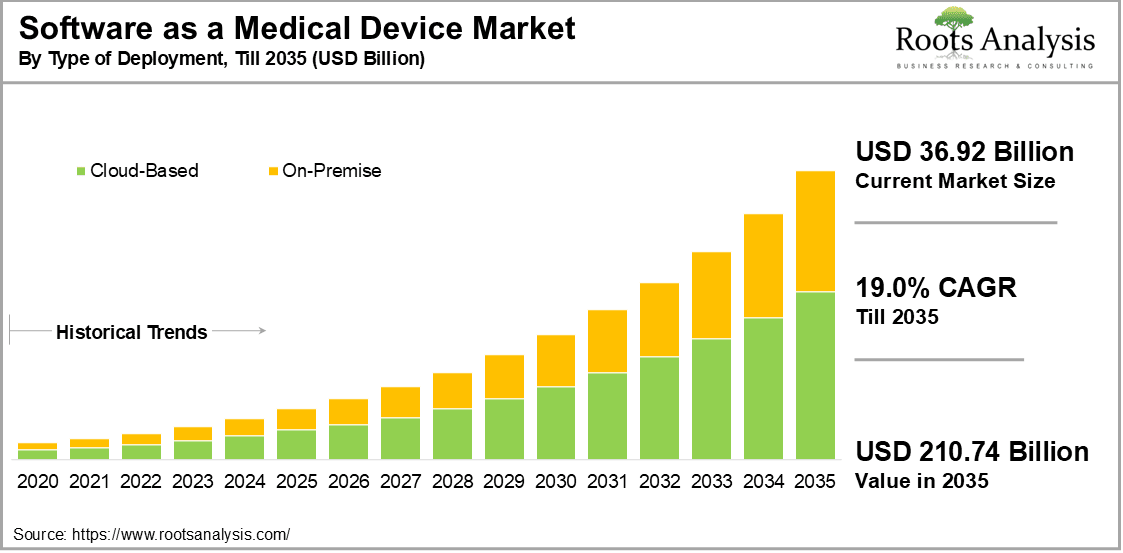
The global software as a medical device market, valued at USD 29.60 billion in 2024, is projected to reach USD 36.92 billion in 2025 and USD 210.74 billion by 2035, representing a CAGR of 19.0% during the forecast period.
 |
To learn more about this report, request a free sample copy
Software as a medical device (SaMD) is a form of software used for disease diagnosis, prognosis and treatment planning. This innovative software does not require hardware components for data collection, analysis, and management, eliminating the additional expenditure required for healthcare analytic systems.
Driven by the growing shift towards digital healthcare solutions, software as a medical device emerged as an unprecedented tool to facilitate virtual consultation for managing diseases remotely. Additionally, the growing shift towards personalized therapeutics to mitigate the growing concern of chronic conditions across the globe is fueling the market growth.
It is worth mentioning that the growing geriatric population with chronic conditions requires immediate medical attention. This software as a medical device when combined with smartphones and remote patient monitoring technologies enable healthcare professionals to facilitate remote consultation, thereby reducing emergency admission chances.
Additionally, the penetration of teleradiology services, telehealth service, telemedicine and mHealth applications are further fostering an ecosystem for the widespread adoption of software as a medical device. Owing to the ongoing opportunities, several industrial players are taking strategic initiatives in this field, such as collaborations, investments and partnerships. For instance, in July 2024, GE Healthcare announced a strategic collaboration with Amazon Web Services to develop generative AI applications and purpose-build foundation-based software models to help clinicians in improving medical diagnostics. These innovative generative AI powered models are intended to fast-track the healthcare operations, increase screening accuracy and diagnostics.
Similarly, companies like Samsung, Apple, and Roche are streamlining their operations to develop advanced software as a medical device to facilitate remote patient monitoring, disease diagnosis and treatment. These ongoing initiatives and favorable regulatory support from the USFDA is likely to support the software as a medical device market growth at a steady pace during the forecast period.
The market report provides comprehensive information on software as a medical device companies who are currently active across various segments of the industry as mentioned in the table below.
| Key Report Attributes | Details | |
| Historical Trend | Since 2020 | |
| Forecast Period | Till 2035 | |
| Market Size 2025 | USD 36.92 Billion | |
| Market Size 2035 | USD 210.74 Billion | |
| CAGR (Till 2035) | 19.0% | |
| Type of Deployment |
|
|
| Type of Device |
|
|
| Type of Software Technology |
|
|
| Application Areas |
|
|
| End-Users |
|
|
| Geographical Regions |
|
|
| Key Companies Profiled |
|
|
| PowerPoint Presentation (Complimentary) |
Available |
|
| Customization Scope | 15% Free Customization | |
| Excel Data Packs (Complimentary) |
Available | |
One of the key objectives of the software as a medical device market report was to estimate the current size, opportunity, and the market growth potential, over the forecast period, till 2035. We have provided informed estimates on the likely evolution of the market for the forecast period.
The market analysis report also features the likely distribution of the current and forecasted opportunity within the market across various segments, such type of deployment (cloud-based and on-premise), type of device (smartphones, laptop / desktops and wearable devices), type of software technology (artificial intelligence and machine learning), application areas (screening & diagnosis, monitoring & altering, chronic conditions & disease management, and digital therapeutics), end users (home healthcare, hospitals and clinics, research institutes and other end users), geographical regions (North America, Europe, Asia-Pacific, Middle East and North Africa, and Latin America) and leading players.
In order to account for future uncertainties associated with some of the key parameters and to add robustness to our model, we have provided three software as a medical device market forecast scenarios, namely conservative, base, and optimistic scenarios, representing different tracks of industry’s evolution.
All actual figures have been sourced and analyzed from publicly available information forums and primary research discussions. The financial figures mentioned in this market report are in USD, unless otherwise specified.
Based on the type of deployment, the global market is segmented into cloud based and on-premises. Currently the cloud-based deployment segment accounts for the highest software as a medical device market share (nearly 60%). This can be attributed to the fact that cloud-based offer higher flexibility and scalability to integrate medical devices. Moreover, cloud-based deployment ensures effective adaptability for data generation through software as a medical device, which is likely to key factor for the highest share. Driven by the ongoing adoption, this segment is likely to remain dominant and is poised to grow at a higher CAGR during the forecast period.
The global market is categorized across different types of devices such as smartphones, laptop / desktops and wearable devices. Currently, smartphones sub segment occupies nearly 45% of the software as a medical device market share. This can be attributed to the fact that smartphones are portable and offer high interoperability with software and medical devices for data transmission. Moreover, modern smartphones are featured with sensors, such as accelerometers and gyroscopes which help to collect physiological data, such as sleep patterns, activity levels and heart rate.
However, in the long run, the wearable medical devices market segment is expected to register a higher CAGR during the forecast period. This is due to the growing adoption of wearable medical devices for disease diagnosis and monitoring.
This segment highlights the distribution of global market across different types of technology, such as artificial intelligence and machine learning. According to our software as a medical device market report, currently artificial intelligence accounts for the highest share of the market. This is primarily due to the fact that artificial intelligence has played a pivotal role in medical devices and software as a medical device to automate data collection in real-time.
Moreover, the integration of AI technology improved accuracy in diagnosis and disease monitoring. Owing to the ongoing adoption across medical devices, this segment is likely to remain dominant and is poised to grow at a higher CAGR during the forecast period.
Based on the application area, the global market is segmented into screening & diagnosis, monitoring & altering, chronic conditions & disease management, and digital therapeutics. According to our projection, screening & diagnosis segment accounts for the highest share (51%) of the software as a medical device market size. This dominance is due to the growing adoption of software as a service for disease diagnosis and screening.
Moreover, the growing shift towards teleradiology services has further fueled the adoption of software as a medical device for screening & diagnosis. Driven by the increasing preference of software as a medical device for screening & diagnosis, this segment will continue to grow at a higher CAGR during the forecast period.
On the basis of end users, global software as a medical device market size is segmented into home healthcare, hospitals and clinics, research institutes and other end users. Currently, hospitals and clinics hold the dominating position in the market. This can be attributed to the increasing usage of software as a medical device and teleradiology services to facilitate remote diagnosis and virtual consultation.
However, in the future, home healthcare market segment is likely to register a higher CAGR during the forecast period. This can be attributed to the growing adoption of remote healthcare software and smartphone applications to facilitate remote monitoring of diseases.
Based on the geographical region, the global market is distributed across North America, Europe, Asia-Pacific, Middle East and North Africa, and Latin America. According to our projection, presently North America is dominating the software as a medical device industry by holding nearly 25% share. This dominance is due to the increasing adoption of digital health technologies and remote patient monitoring for disease diagnosis and treatment planning. Additionally, the presence of well-established players in this region, such as Roche and Thermo Fisher Scientific, is driving technological innovations further fueling market growth.
However, in Asia-Pacific, the market for software as a medical device is expected to grow at a higher CAGR during the forecast period. This is likely to be the result of increasing incidence of chronic conditions that demand advanced medical devices and technologies for monitoring diseases remotely. Additionally, the increasing government initiatives to drive the healthcare infrastructure is expanding the market growth in this region.
The “Software as a Medical Device Market: Industry Trends and Global Forecasts, till 2035” market report features an extensive study of the current market landscape, market size, market share, market growth, market trends, market value, market forecast, market outlook, statistics, and future opportunities for software as a medical device companies. The market research report lays emphasis on the software as a medical device products that are being developed. Key takeaways of the market report are briefly discussed below.
Currently, the market landscape of software as a medical device companies is moderately competitive, featuring the presence of well-established and new entrants. Majority of the market players, such as Apple, Fitbit and Roche are focusing on technological innovations that aid in diagnosis of diseases in real-time to facilitate personalized treatment. In July 2024, Qure.ai announced class III medical device license from Health Canada for its medical imaging AI SaMD products.
In order to leverage the competitive edge, various market players are focusing on mergers, agreements, partnerships and collaborations. For instance, in September 2024, Roche announced the recent expansion of its digital pathology with the integration of over 20 advanced AI algorithms from eight new collaborators. This collaboration aid to support scientists and pathologists in cancer research and diagnosis by using cutting-edge AI technology. The integration is facilitated through Roche’s navify® Digital Pathology enterprise software that now incorporates a wide range of AI-driven algorithms.
Overall, the market will remain competitive throughout the projected period, witnessing a wide array of innovations and technological advancements.
The global software as a medical device market is driven by the increasing incidence of chronic conditions and high adoption of digital technologies for real-time disease monitoring and diagnosis. Notably, chronic conditions, such as diabetes and cardiovascular diseases require prolong treatment for disease management. Therefore, healthcare professionals and patients are adopting advanced software as medical device-based technologies to initiate remote patient monitoring and consultation, which is likely to be a key growth factor for the market. Additionally, the heightened demand for user-friendly and advanced medical devices has further fueled market growth during the forecast period.
Despite immense growth, the market for software as a medical device is witnessing several challenges that need to be addressed. Some of the notable challenges are data privacy and security concern. It is worth mentioning that data transmission through the internet or software mode can lead to loss of patient information and are prone to cyber-attacks.
In addition, the regulatory complexity associated with the software validation and verification may delay the development and commercialization of software as a medical device. Moreover, data integration and interoperability challenges may limit the adoption across hospital settings and global population.
Some of the notable software as a medical device industry growth factor, includes internet of things, shift towards cloud processing and innovation in sensing technologies. Currently, the industrial players are focusing on the integration of advanced sensing technologies in medical devices that aim to enhance patient monitoring in seconds. Additionally, the industrial players are focusing on cloud processing to ensure that data can be analyzed and processed with higher computational power and offer greater accessibility without involve any local hardware.
In addition, the market players are aiming to integrate the Internet of Medical Things that offer seamless connectivity and enable real-time data collection from remote devices. However, the primary focus of industrial players will remain on enhancing cybersecurity principles to ensure safe and secure data transmission through medical devices.
The global market for software as a medical device is estimated to be valued at USD 36.92 billion in 2025 and is poised to reach USD 210.74 billion by 2035, representing a CAGR of 19.0% during the forecast period. This lucrative growth is driven by the rapid adoption of smart technologies and devices for facilitating disease diagnosis and treatment planning.
In order to enhance the technological innovations in this field, the industrial players are focusing on strategic partnerships and collaborations. For instance, in December 2024, CompuGroup Medical entered into a strategic partnership agreement with CVC Capital Partners to support the long-term innovation in medical equipment software and next generation products of CompuGroup Medical.
Owing to the ongoing initiatives in this field, we believe that the software as a medical device market will continue to maintain a competitive edge during the forecast period.
Examples of key software as a medical device companies engaged in this domain (which have also been captured in this report) include Apple, Arterys, BenevolentAI (by Odyssey), Biobeats Medical, Cambridge Cognition, Fitbit, IDx Technologies, Imagen Technologies, iSchemaView (RAPID), Johnson & Johnson, MaxQ AI, Mogrify, Philips, PEAR Therapeutics, Roche, Qlarity Imaging (by Paragon Biosciences), S3 Connected Health, Samsung Electronics, Siemens Healthineers, Tietronix Software and Velentium.
The market report presents an in-depth analysis, highlighting the capabilities of various companies engaged in this domain across different segments. Amongst other elements, the market report includes:
Several recent developments have taken place in the field of software as a medical device. We have outlined some of these recent initiatives below.