


 Download Free Sample
 Buy Now
Market Size
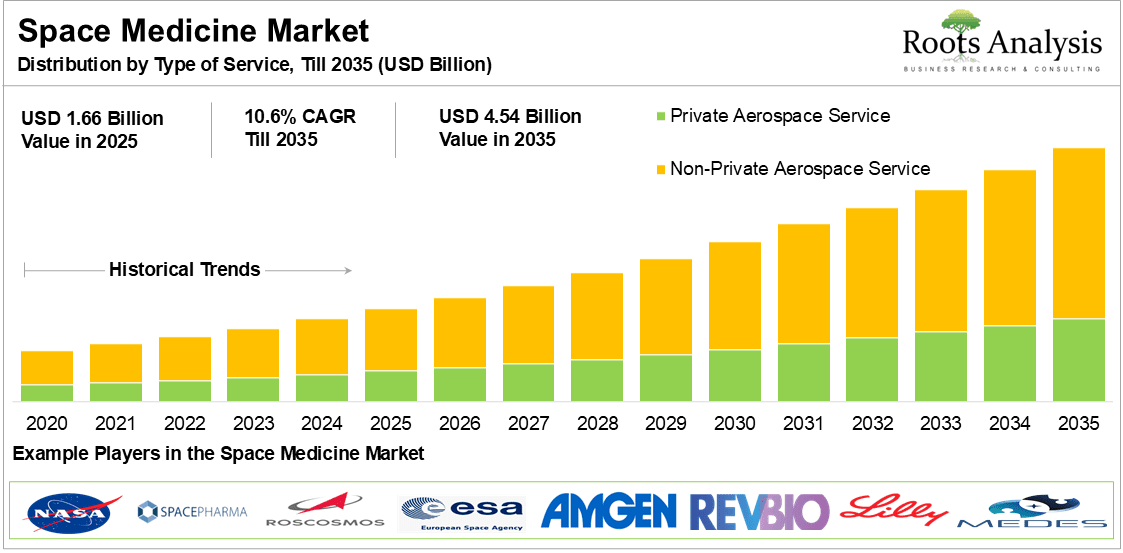
The global space medicine market, valued at USD 1.47 billion in 2024, is projected to reach USD 1.66 billion in 2025 and USD 4.54 billion by 2035, with a CAGR of 10.6% during the forecast period 2025 to 2035.
Would Like to Preview the Actual Report?
Market Report: Key Takeaways
- The space medicine market is experiencing an upward trajectory, driven by the rising space research, and growing emphasis on space tourism.
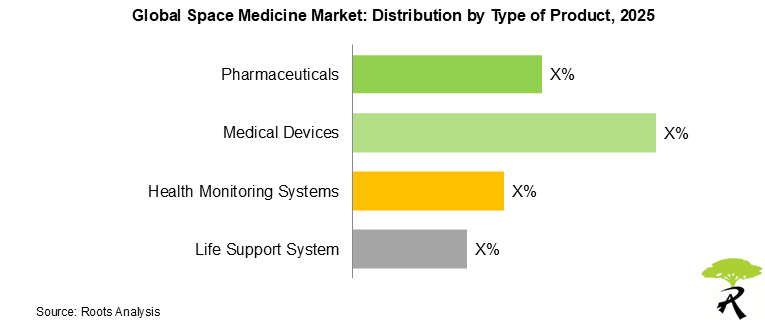
- In terms of product, the medical devices segment is dominating due to the rising demand for remote consultation solutions for regular monitoring of astronauts health condition. However, the health monitoring system segment is likely to show higher CAGR due to the increasing focus on continuous health monitoring of space travelers during long space stays.
- In terms of service, the non-private aerospace service segment is dominating the market, accounting for nearly 70% of the overall revenue share. This is due to the heightened demand for pharmaceuticals, medical devices, and radiation exposure countermeasures.
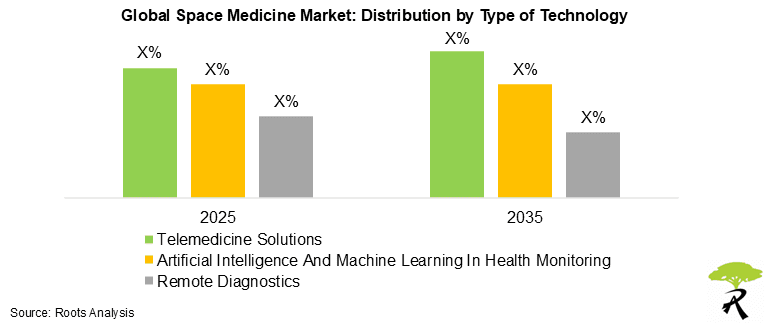
- In terms of technology, telemedicine solutions segment holds the largest share (40%) of the market due to the increasing demand for virtual health consultation solutions to assist astronauts in managing health conditions.
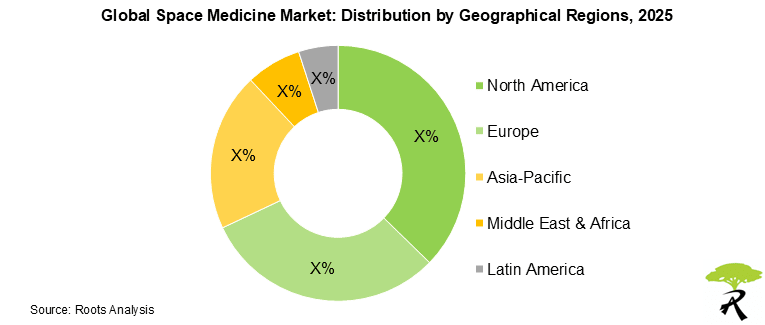
- In terms of geographical regions, North America is dominating the market by securing nearly 40% of the overall revenue share. This dominance stems from the presence of well-established space research organizations and increasing collaborations between industrial players.
Market Overview
Space medicine is a medical field that focus on the physical and physiological challenges face by the astronauts during space travel. This sector is witnessing an upward trajectory, driven by the increasing government and private space companies interest in deep-space missions. During long space missions, astronauts are required to stay for long duration. The extreme conditions of space, such as microgravity, altered atmospheres, G-forces, and altered atmosphere may impact the mental and physical health of astronauts.
Owing to the rising space exploration, and requirement of medicine, space medicine demand is likely to increase in the upcoming years. The emerging needs has catered the attention of pharmaceutical industries to undertake several initiatives to strengthen the development of space medicine. However, the primary focus will be on telemedicine, remote monitoring / surgery technologies, and virtual consultation to provide quick support to astronauts to improve overall well-being.
Additionally, several government organizations, and space research centers, such as NASA are investing heavily in personalized medicine for astronauts, life support systems, and miniature medical devices. Additionally, the increasing collaborations between industrial players, and space organizations to enhance safety standards with optimal medicinal assistance is likely to drive the space medicine market in the future.
Your Business is Unique – Why Shouldn’t Your Report Be?
Recent Developments in Space Medicine Market
- In September 2025, the NASA Administrator Sean Duffy and Australian Space Agency Head Enrico Palermo signed a 'framework agreement between the government of Australia and the government of the United States of America' on cooperation in aeronautics and the exploration and use of airspace and outer space for peaceful purposes. The key areas includes, space medicine and life sciences, geodesy, aeronautics research, and technology.
- In September 2025, The Saudi Space Agency signed a Memorandum of Understanding (MOU) with King Faisal Specialist Hospital & Research Centre. This agreement aims to strengthen conjoint efforts in biotechnology under astronaut health, microgravity conditions, education, and scientific research.
- In June 2025, NASA administrator Janet Petro signed a strategic agreement with DLR (German Aerospace Center, or Deutsches Zentrum für Luft- und Raumfahrt) to continue their partnership in space medicine research.
- In April 2025, ISRO (Indian Space Research Organization) signed a Framework Memorandum of Understanding on Cooperation in Space Medicine agreement with Sree Chitra Tirunal Institute for Medical Sciences & Technology. This agreement has been signed to foster research on space medicine, human health and space biology.
Market Trends
- Personalized Medicine Approaches in Extraterrestrial Healthcare: It is important to note here that during space travels astronauts are exposed to different environment stressors, such as microgravity and radiation. These stressors can create physical and physiological challenges for astronauts. Since, each astronaut show variable responses to space condition, such as medication efficacy variation, bone density loss, and toxicity. Therefore, it is essential to provide personalized medicine to meet their requirement. Considering the ongoing necessity, the market players will widely be emphasizing on personalized medicine that are tailored based on individuals gene profile.
- Focus on Transplantation Research: The future focus will be on microgravity research in space medicine advancements. This practice involves the use of space like conditions, such as microgravity to develop stem cells, and biofabricate human tissues. The space environment allow researchers to develop organoid models for studying various disease conditions. Therefore, the transplantation research will revolutionize the development of complex therapeutics for astronauts.
- Telemedicine in Space: The future opportunities lies in the telemedicine, telehealth services, and digital healthcare technologies. These advanced solutions offer remote monitoring of astronauts health conditions and provide adequate health assistance to mitigate the concern of medical issues. In addition, space research organizations are widely emphasizing the wearable technologies, health management platforms and telemedicine solutions for astronaut health monitoring integrated with artificial intelligence for real-time health monitoring.
Industry Experts on Space Medicine Market
NASA has already cleared that pharmaceutical development for spaceflight adaptation is an emerging area of innovation. The broad focus of industrial players will remain on technological innovations and development of pharmaceutical drugs to solve actual health challenges faced by astronauts.
Kris Lehnhardt (MD, the first director of UTHealth Houston Space Medicine Program) states that, 'NASA has been really clear, they want to invest in things that solve actual medical challenges for spaceflight. We’re developing tools that can function in extreme environments. Space just happens to be the most extreme. But rural medicine, battlefield medicine, wilderness medicine are all environments where these tools could save lives.’
Want Information on Specific Region / Segment?
Market Drivers
-
Increasing Deep Space Missions: Several government and commercial space organizations are widely focusing on deep space missions, including Mars and Moon exploration. These deep space missions require astronauts to stay in space for longer duration. Several space conditions, such as microgravity and G-forces, may impact the overall health of astronauts, which is likely to drive the market growth of commercial space medicine services.
-
Technological Advancements: The emergence of remote monitoring devices, and AI-driven astronaut health analytics tools for remote health monitoring of astronauts will be a potential space medicine market driver.
-
Emerging Space Tourism: With growing focus on the space tourism, there is a high demand for radiation protection technologies for space travelers and advanced remote diagnostic solutions to support in-flight health support to the space travelers.
Unlock Deeper Insights – Schedule Your Personalized Workshop Today!
Space Medicine Market Segmentation Analysis
Medical Devices Will Continue to Dominate the Market
- Based on the space medicine market analysis, the global market is segmented into pharmaceuticals, medical devices, health monitoring systems, and life support systems. According to our projection, the medical devices segment is dominating the market, driven by its increasing necessity to monitor astronauts during space travel to provide appropriate measures for managing their health.
- It is worth noting that the health monitoring systems segment is expected to register higher CAGR during the forecast period. This can be attributed to the fact that health monitoring systems including remote monitoring devices, wearable sensors, and remote surgical procedures in space environments have become an integral part of space missions to monitor astronaut’s health in real-time.
Which Type of Service is Expected to Register Higher CAGR?
- On the basis of service type, the global market is distributed across, private aerospace service and non-private aerospace service. According to the space medicine market forecast, the non-private aerospace service segment is accounting for nearly 70% of the overall revenue share. This growth stems from the rising adoption of telehealth platforms for deep space exploration and AI-driven astronaut health analytics to manage astronauts health during space travel.
- The private aerospace service segment is likely to grow at a higher CAGR during the forecast period. This can be attributed to the growing emphasis on space tourism by private aerospace companies, such as Virgin Galactic, Blue Origin, and SpaceX, and deployment of private satellite.
Market Regional Insights
North America: Continue to Remain Dominant in the Future
It is worth noting that the North America will hold the largest space medicine market share by holding nearly 40% of the revenue share. Notably, this region is likely to remain dominant in the future. This dominance is driven by the presence of prominent space organizations, such as NASA and Blue Origin, and rising research funding for space exploration. Additionally, the continuous investment for space tourism has further necessitated the demand for AI-driven diagnostics in space health management, and nutrition solutions in space healthcare.
Europe: Holds the Substantial Share of the Market
Europe also holds the substantial share of the space medicine market growth. This second largest share is driven by the rising focus on space exploration by the European Space Agency. In addition, the European space organizations are emphasizing the advancements of spaceflight medical monitoring devices that is propelling the market growth in this region. Moreover, the focus on space tourism has further contributed to the high demand for radiation exposure countermeasures to ensure space travelers safety during space exploration.
Asia-Pacific: The Emerging Hotspot
According to our space medicine market report, the Asia-Pacific region is expected to register a higher CAGR during the forecast period. This growth is fueled by the rising funding and investment for space exploration by Asian countries, such as Japan, India, and Japan. Additionally, the rising collaboration between government agencies, and space research centers for mars and moon missions are contributing to the market growth in this region.
Pay Only for What You Need – The Best Way to Optimize
Space Medicine Market: Scope of the Report
| Key Report Attributes | Details | |
| Historical Trend | Since 2020 | |
| Forecast Period | Till 2035 | |
| Market Size 2025 | USD 1.66 Billion | |
| Market Size 2035 | USD 4.54 Billion | |
| CAGR (Till 2035) | 10.6% | |
| Key Players Profiled | (A complete list of companies captured is available in the report) | |
| Segments Covered |
|
|
| Excel Data Packs (Complimentary) |
|
|
| PowerPoint Presentation (Complimentary) | Available | |
| Customization Scope | 15% Free Customization | |
Market Segments
Based on the research, we have segmented the space medicine market into type of product, type of service, application area, type of technology, end user, geographical regions, and leading players.
Space Medicine Market, by Type of Product
- Pharmaceuticals
- Medical Devices
- Health Monitoring Systems
- Life Support Systems
Space Medicine Market, by Type of Service
- Private Aerospace Service
- Non-private Aerospace Service
Space Medicine Market, by Application Area
- Oncology
- Regeneration Medicine
- Neurobiology
- Microbiology
- Others
Space Medicine Market, by Type of Technology
- Telemedicine Solutions
- Artificial Intelligence and Machine Learning In Health Monitoring
- Remote Diagnostics
Space Medicine Market, by End User
- Commercial Space Agencies
- Government
- Military
- Others
Space Medicine Market, by Geographical Regions
- North America
- US
- Canada
- Mexico
- Europe
- France
- Germany
- Italy
- Spain
- UK
- Rest of Europe
- Asia-Pacific
- China
- India
- Japan
- South Korea
- New Zealand
- Rest of the Asia-Pacific
- Middle East & Africa
- Egypt
- Iran
- Iraq
- Israel
- Saudi Arabia
- South Africa
- United Arab Emirates
- Latin America
- Argentina
- Brazil


