Spatial Biology Market Size, Share, Trends and Industry Forecast Report, 2026-2035
Spatial Biology Market by Product and Service (Instruments and Platforms, Consumables and Reagents, Software and Analytics, and Services), Molecular Technology (Spatial Transcriptomics and Genomics, Spatial Proteomics, Spatial Metabolomics, and Spatial Multi-omics), Type of Sample (FFPE, Fresh Frozen, and Fixed Frozen), Workflow, Application, Research Area (Oncology and Immuno-Oncology, Immunology, Neuroscience, Infectious Diseases, and Other Research Areas), End User and Geography
-
Lowest Price Guaranteed
-
Pages
446 -
Last Updated
September 2026 -
View Count
5786 -
Spatial Biology Market is Projected to Reach USD 5.14 Billion by 2035
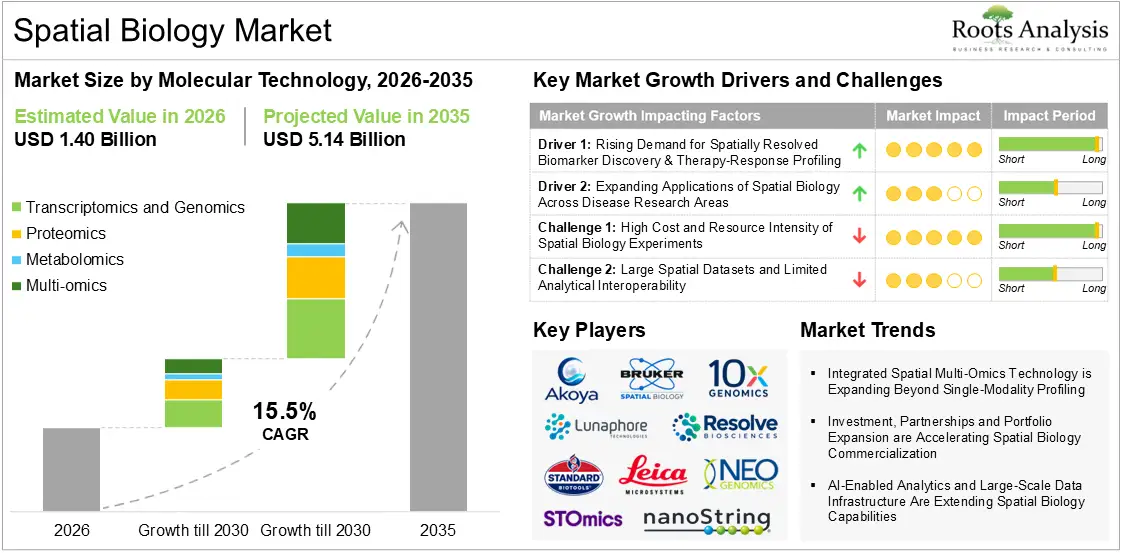
The global spatial biology market was valued at USD 1.20 billion in 2025 and is estimated at USD 1.40 billion in 2026. It is projected to reach USD 5.14 billion by 2035, representing a CAGR of 15.5% during 2026-2035. Growth is being supported by wider use of spatial profiling in translational and drug-development programs, spatial multi-omics adoption and rising demand for scalable analytics.
To learn more about this report, request a free sample copy
Market Report: Key Takeaways
- Market Share by Product and Service: In the current market scenario, consumables and reagents account for the largest share of the market at 48.0%, while software and analytics are projected to expand at the fastest CAGR through 2035.
- Market Share by Molecular Technology: Spatial transcriptomics and genomics dominate the current market, whereas spatial multi-omics is expected to grow at a faster CAGR.
- Market Share by Workflow: Instrumental analysis represents the largest market share in the current year; conversely, the data analysis and interpretation workflow segment is expected to grow at a relatively higher CAGR.
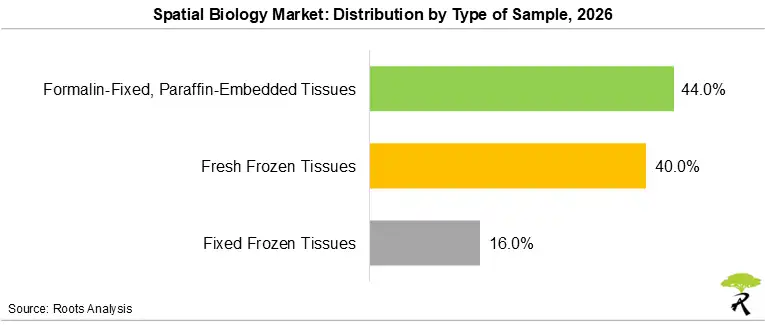
- Market Share by Type of Sample: Formalin-fixed, paraffin-embedded (FFPE) tissue leads with 44.0% share in the current market and is also expected to record the fastest growth during the forecast period.
- Market Share by Application: Translational research currently accounts for the largest market share, while applicability of spatial biology products and services in clinical diagnostics applications is projected to expand at a faster pace during the period 2026-2035.
- Market Share by Research Area: In the current global market, oncology and immuno-oncology research leads with the largest share; neuroscience and infectious diseases are jointly the fastest-growing research area categories.
- Market Share by End User: Pharmaceutical and biotechnology companies dominate the current market, while the hospitals and other clinical facilities segment is projected to grow at a faster CAGR during the forecast period.
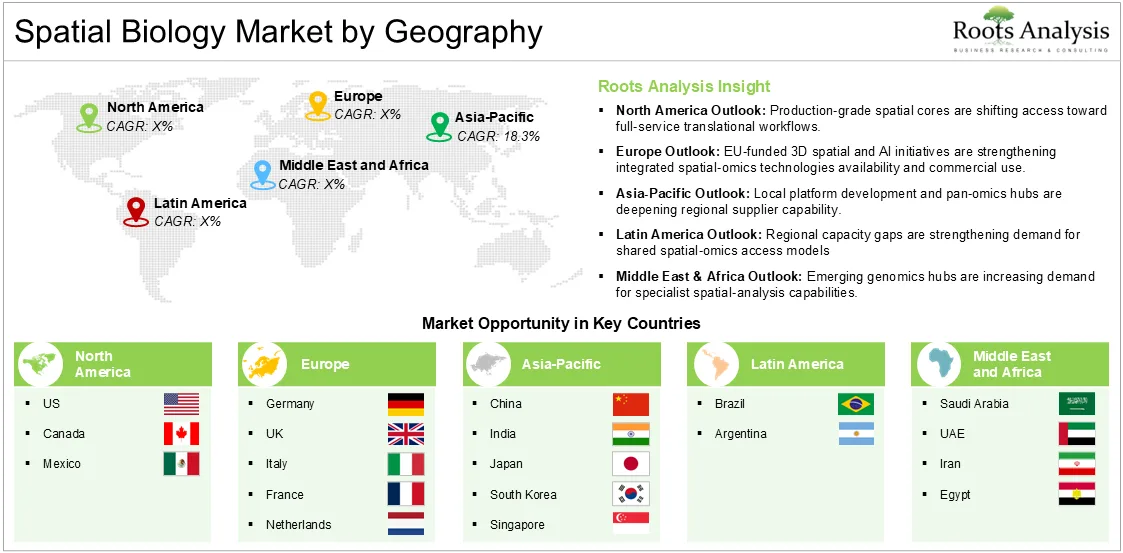
- Regional Market Forecast: North America leads with 43.0% of the market in the current year; on the contrary, Asia-Pacific is expected to be the fastest-growing region, with a projected CAGR of 18.3% through 2035.
Market Overview: Spatial Biology is Advancing from Molecular Mapping Toward Integrated Tissue Intelligence
Spatial biology is changing how researchers study complex tissues by mapping molecular profiles directly to their cellular and structural microenvironments. Traditional bulk assays blend signals across an entire sample, while dissociative single-cell methods remove native tissue relationships. Spatial genomics and transcriptomics, proteomic, metabolomic and multi-omics approaches preserve this context, allowing molecular states to be interpreted alongside cellular neighborhoods, tissue architecture and disease pathology. This is particularly important where the location of a target, immune population or stromal barrier influences biological function or treatment response. A 2026 Nature Biotechnology study combined therapeutic-antibody imaging with spatial proteomics to resolve spatial heterogeneity in drug delivery and target engagement within human tumors.
This demand for context-rich tissue analysis is reshaping the commercial outlook of the market. Competition is moving beyond stand-alone instruments toward integrated workflows that combine sample processing, molecular profiling and downstream interpretation. Providers are increasing molecular plex, expanding FFPE compatibility, automating assay steps and connecting instruments with spatial informatics, AI-enabled segmentation and service-based access. For example, Bruker's current portfolio spans transcriptomics, proteomics, 3D genome visualization and spatial informatics, while 10x Genomics' Atera integrates imaging, liquid handling and onboard analysis around high-throughput whole-transcriptome measurement. These developments are broadening the role of spatial-biology suppliers from instrument vendors toward providers of more complete sample-to-insight workflows.
At the same time, wider analytical capability is increasing the importance of platform selection and workflow design. Spatial-omics reviews and benchmarking studies continue to show material differences across modalities and platforms in sensitivity, throughput, accessibility, spatial resolution, sample handling and analytical standardization. Therefore, as studies move into larger translational cohorts and more complex multi-omic designs, sustained market adoption will increasingly depend on combining richer biological information with reproducible workflows, manageable experimental economics and scalable analysis.
Executive Market Insights
How Does the Spatial Biology Ecosystem Operate?
The spatial biology ecosystem converts preserved biological material into spatially resolved molecular information through a connected sequence of specimen preparation, molecular interrogation, imaging or sequencing, computational processing and biological interpretation. Tissue is prepared for platform-specific assays before spatial transcriptomic, proteomic, metabolomic or multi-omic measurements capture molecular signals without discarding their position within the specimen. Instrument and assay providers increasingly connect these measurements with onboard processing, cloud or specialist analytical environments, while core laboratories, CROs and spatial-biology service providers allow researchers to access workflows without owning every platform. The resulting spatial maps are then used by academic, pharmaceutical, biotechnology and clinical research teams to investigate tissue organization, cellular neighborhoods, biomarkers and treatment response. Current commercial offerings increasingly combine measurement, assay content and analysis rather than treating these functions as separate activities.
Spatial Biology Product and Service Providers: Information on Omics Solutions and Molecular Technologies
| Company | Year of Establishment | Headquarters | Spatial-Omics Solutions | Molecular Technology |
| 10x Genomics | 2012 | California, US | Instruments and Platforms: Atera In Situ, Xenium In Situ, Visium Consumables and Reagents: Assay kits, slides, panels Software and Analytics: Onboard Analysis, 10x Cloud Services: Catalyst Research Services |
Spatial Transcriptomics and Genomics, Spatial Multi-omics |
| Bruker Spatial Biology | 1960 | Massachusetts, US | Instruments and Platforms: CosMx SMI, GeoMx DSP, CellScape XR, PaintScape Consumables and Reagents: RNA/protein panels and assay kits Software and Analytics: AtoMx SIP, PowerOMX Services: Spatial CRO and data-analysis services |
Spatial Transcriptomics and Genomics, Spatial Proteomics, Spatial Multi-omics |
| Akoya (acquired by Quanterix) | 2007 | Massachusetts, US | Instruments and Platforms: PhenoCycler-Fusion, PhenoImager HT 2.0 Consumables and Reagents: PhenoCode / Opal assay content Software and Analytics: Phenochart, inForm, phenoptr Services: Managed spatial assays |
Spatial Proteomics |
| Lunaphore Technologies (acquired by Bio-Techne Spatial) | 2014 | Tolochenaz, Switzerland | Instruments and Platforms: COMET Consumables and Reagents: SPYRE panels and amplification kits, RNAscope content Software and Analytics: HORIZON Image Analysis Software |
Spatial Transcriptomics and Genomics, Spatial Proteomics, Spatial Multi-omics |
| Resolve BioSciences | 2019 | Monheim am Rhein, Germany | Instruments and Platforms: Molecular Cartography Consumables and Reagents: RNA panels/probes and protein-assay content Software and Analytics: ReCognize |
Spatial Transcriptomics and Genomics, Spatial Proteomics, Spatial Multi-omics |
| STOmics | 2020 | Shenzhen, China | Instruments and Platforms: Stereo-seq solutions Consumables and Reagents: Stereo-seq chips and transcriptomics sets Software and Analytics: Stereo-seq analytical workflow |
Spatial Transcriptomics and Genomics, Spatial Multi-omics |
Market Trends Shaping the Spatial Omics Industry
Integrated Spatial Multi-Omics Technology is Expanding Beyond Single-Modality Profiling
Spatial biology portfolios are increasingly connecting RNA, protein and other molecular layers within the same specimen or through coordinated platform workflows. This integration offers more than higher molecular plex, as it enables researchers to relate transcriptional states to protein phenotypes, tissue morphology and other biological features while preserving their spatial context. Bruker, for example, introduced same-cell CosMx whole-transcriptome and protein capabilities alongside workflows connecting GeoMx, CellScape and CosMx. Similarly, Bio-Techne's COMET portfolio supports automated same-section RNA and protein analysis. These portfolio enhancement initiatives of industry players substantiate that multi-omics holds the potential to reduce interpretive gaps created by separately generated molecular layers, although assay compatibility, analytical integration and incremental cost continue to influence adoption.
Investment, Partnerships and Portfolio Expansion are Accelerating Spatial Biology Commercialization
Commercialization in spatial biology is increasingly being shaped by capital deployment, technology partnerships and portfolio expansion that help providers scale operations and assemble more complete workflows. Vizgen's USD 48 million financing in January 2026, for example, was directed toward innovation, researcher support and manufacturing capacity, while its partnership with Hamamatsu Photonics links multiplex imaging with Vizgen assay content to streamline translational workflows. Further, Bio-Techne's March 2026 expansion of COMET added SPYRE panels, amplification kits and HORIZON analytics. These developments indicate that competitive growth is increasingly tied to integrated offerings that combine platform capability with complementary technologies and repeat-use assay and software layers.
Technology Trends: AI-Enabled Analytics & Large-Scale Data Infrastructure Expand Spatial Capabilities
High-dimensional spatial datasets are increasing the need for AI, machine learning and scalable computing to convert complex molecular and imaging outputs into interpretable biological information. Bruker's AtoMx incorporates AI-based segmentation, while its collaboration with Noetik is applying spatial data from thousands of patient samples to tissue foundation models. The 2026 Nature Genetics INSPIRE study similarly demonstrates how deep learning can integrate heterogeneous spatial-transcriptomics datasets across sources. These developments show that analytical capability is becoming increasingly important to platform performance as spatial studies scale, although data harmonization, computational requirements and model validation continue to influence adoption.
Industry Experts on Spatial Biology Market
As spatial biology expands across research and translational applications, laboratories increasingly need workflows that can scale with changing experimental requirements without committing prematurely to rigid assay configurations. Leica Microsystems addressed this adoption constraint through its 2026 early-access program for ATTOAuriga, which enables researchers to evaluate multiplex spatial workflows using their own samples before progressing toward broader implementation.
James O'Brien, Vice President, Life Sciences & Applied Solutions at Leica Microsystems, stated, "Researchers want to adopt spatial biology at their own pace, starting with data generation they can rely on and scaling as their questions evolve." His perspective highlights an important shift in the market. Adoption is increasingly influenced not only by analytical performance, but also by whether spatial workflows provide sufficient flexibility, reproducibility and scalability for laboratories to expand their use as research requirements become more complex.
Primary research discussions with multiple stakeholders in this domain influenced the opinions and insights presented in this study. The spatial biology market report includes transcripts of the following discussions:
- Co-founder, Small Company, US
- Senior Vice President of Marketing, Small Company, US
- Senior Director, Mid-sized Company, US
In addition, the spatial biology market report includes transcripts of the following third-party discussions:
- Founder and Owner, Small Company, Germany
- Chief Executive Officer and Managing Director, Large Company, India
- Chief Executive Officer and Chief Discovery Officer, Mid-sized Company, US
- Chief Scientific Officer, Co-Founder, Small Company, India
- Chief Scientific Officer, Large Company, UK
- Chief Scientific Officer, Small Company, China
- Senior Vice President and Global Head of Sales, Large Company, Switzerland
- Vice President, Large Company, Ireland
- Senior Director of Scientific Affairs and Technical Marketing, Small Company, US
- Senior Scientist, Large Institute, South Africa
Segmentation Analysis of Global Spatial Biology Market
Market Segments
Based on the research, we have segmented the spatial biology market into various key segments outlined below.
| Market Segments | Sub-segment Details | |
| Product and Service | Instruments and Platforms, Consumables and Reagents, Software and Analytics, and Services | |
| Molecular Technology | Spatial Transcriptomics and Genomics, Spatial Proteomics, Spatial Metabolomics, and Spatial Multi-omics | |
| Workflow | Sample Preparation, Instrumental Analysis, and Data Analysis and Interpretation | |
| Type of Sample | Formalin-Fixed, Paraffin-Embedded Tissue, Fresh Frozen Tissue, and Fixed Frozen Tissue | |
| Application | Fundamental and Exploratory Research, Drug Discovery and Development, Translational Research, and Clinical Diagnostics | |
| Research Area | Oncology and Immuno-Oncology, Immunology, Neuroscience, Infectious Diseases, and Other Research Areas | |
| End User | Pharmaceutical and Biotechnology Companies, Academic and Research Institutions, Contract Research Organizations, and Hospitals and Other Clinical Facilities | |
| Geography | North America, Europe, Asia-Pacific, Latin America, and Middle East and Africa | |
Market Share Insights
Regional Market Share: North America Leads on Research Depth and Biopharma Use as Asia-Pacific Builds Regional Scale
North America dominates the current global market with a 43.0% share. Its dominance is reinforced by the way research intensity, biopharmaceutical demand and commercial access support one another. The US National Cancer Institute's Human Tumor Atlas Network sustains multi-institutional spatial and 3D molecular cancer research, while Bruker's 2026 collaboration with US-based therapeutics company Noetik extends spatial analysis across thousands of patient samples for therapeutic applications. With major providers such as 10x Genomics, Bruker and Quanterix also headquartered in the region, researchers have broad access to platforms, technical support and recurring assay ecosystems. This combination creates a deeper and more continuous demand base than in regions where spatial capability remains concentrated across fewer institutions.
Asia-Pacific is projected to expand fastest at 18.3% CAGR, supported by the build-out of regional spatial-omics capacity rather than an already mature installed base. The University of Sydney's Spatial Pan-Omics Initiative brings transcriptomics, proteomics, metabolomics, imaging and analytics into shared infrastructure, while STOmics has established a China-based commercial ecosystem around Stereo-seq. Collaborative cancer-mapping programs between Australia and Japan are extending this capability across additional research networks. By bringing platforms and analytical expertise closer to more users, these initiatives are reducing access constraints and creating more room for adoption than in regions where spatial-biology infrastructure is already more established.
Repeat-Use Consumables Sustain Leadership as Data Complexity Lifts Software and Analytics Demand
Consumables and reagents account for the largest product and service share at 48.0% in 2026. Their leadership stems from the repeat-use economics of spatial experiments. Once a platform is installed or accessed, every additional tissue run requires assay kits, panels, probes and other workflow-specific inputs, whereas instrument revenue depends on less frequent capital placements and software or services may not attach to every experiment. Suppliers are also broadening assay choice, as reflected in Bio-Techne's expansion of SPYRE panels and Quanterix's spatial-proteomics content. Each installed or accessed platform can therefore continue to generate reagent demand as study volumes and assay menus expand, giving consumables a broader recurring revenue base than the other product and service categories.
Driven by a surge in both the volume and complexity of spatial experiments, the software and analytics segment is projected to grow at a faster pace during the period 2026-2035. Higher plex, larger cohorts and multi-omic designs create more work in cell segmentation, image interpretation, multimodal integration and spatial-pattern analysis, increasing the value attached to every dataset rather than only to new instrument placements. AI-assisted tools help automate parts of this workflow, although interoperability and specialist bioinformatics remain constraints. Because analytical requirements scale with experiment volume and data complexity at the same time, software and analytics can expand faster than the instrument layer.
Spatial Transcriptomics and Genomics Lead on Maturity as Multi-Omics Expands Biological Resolution
Spatial transcriptomics and genomics hold the largest share of the current market amongst the different molecular technologies. Their advantage comes from combining broad biological coverage with a comparatively mature commercial and analytical ecosystem. Researchers can choose between sequencing- and imaging-based approaches, as well as whole-transcriptome and targeted workflows, without taking on the full integration burden of multi-omics. Spatial proteomics remains important but depends more heavily on validated antibody content, while spatial metabolomics requires more specialized instrumentation and expertise. These differences make spatial genomics and transcriptomics the most accessible molecular entry point across a wider range of spatial studies and support a larger current commercial base than their sibling technologies.
Spatial multi-omics is projected to grow at a faster pace (relatively higher CAGR) through 2035. Its faster trajectory reflects a shift from locating individual molecular signals toward understanding how complementary biological layers interact within the same tissue environment. The 2026 Nature Methods DBiTplus study combined transcriptome-wide sequencing with multiplex protein imaging on the same tissue section, improving molecular colocalization and avoiding registration problems associated with adjacent-section assays. That ability to extract more information from limited tissue increases the value of integrated profiling in complex disease and biomarker research. Cost, assay design and cross-modal analysis still limit routine use, but the information advantage gives multi-omics greater growth headroom than established single-modality approaches.
Market Share by Type of Sample: FFPE Tissue Extends Its Lead as Archived Clinical Material Becomes More Addressable
Formalin-fixed, paraffin-embedded tissue represents 44.0% of the market in 2026. Its leadership is rooted in routine pathology use and the resulting availability of large tissue archives linked with clinical history, pathology findings and patient outcomes. Fresh frozen and fixed frozen specimens can offer strong molecular quality, but they depend more heavily on prospective collection and controlled storage, which limits their availability for retrospective studies. Commercial-platform benchmarking across archival tumor and normal tissues has shown that spatial cell typing and molecular profiling can be performed on FFPE material. This makes existing pathology repositories immediately usable for spatial research and gives FFPE a broader addressable specimen base than formats that require new sample collection.
FFPE is also the fastest-growing sample category at a projected 18.2% CAGR till 2035. Its growth is being driven by newer workflows that are improving the recovery of spatial molecular information from fixed tissue despite fragmentation and variation in block quality, reducing a technical barrier that previously limited the use of archived specimens. As compatibility improves, more clinically annotated cohorts can enter spatial studies without being recreated prospectively. Fresh and fixed frozen formats do not gain the same expansion in usable specimen supply from these workflow improvements, allowing FFPE demand to rise faster even though tissue age, fixation conditions and platform sensitivity remain important limitations.
Translational Research Leads on Patient-Tissue Relevance as Diagnostic Development Gains Momentum
Translational research accounts for the largest market share in 2026 because spatial biology can connect mechanistic discovery with intact patient tissue before a workflow has to satisfy the validation, regulatory and reimbursement requirements of routine diagnostics. This makes spatial profiling particularly useful for testing biomarkers, treatment-response patterns and disease mechanisms against clinically annotated specimens. At University Hospital Schleswig-Holstein, more than 1,000 clinically annotated samples have been analyzed on the CellScape platform, with plans to extend the work toward approximately 3,000 patient samples for predictive and prognostic spatial-omics research. The ability to scale this bridge between discovery and clinically meaningful validation gives translational research a broader current commercial base than exploratory research or diagnostic use.
Clinical diagnostics segment is likely to experience faster growth rate during the period 2026-2035, supported by a gradual shift from exploratory spatial signatures toward assays that are tested across defined clinical cohorts. PreludeDx and Quanterix reported validation of AidaBREAST across 922 patients at four academic and clinical centers, while 10x Genomics and Cleveland Clinic are studying diagnostic applications of spatial technologies in bladder cancer. These programs increase demand for standardized platforms, reproducible assay workflows and analytical validation, giving diagnostics more room to expand from its smaller base than the already established translational segment. Broader clinical adoption will still depend on demonstrated utility, regulatory acceptance and reimbursement.
Biopharma Leads on Programmatic Use as Clinical Institutions Expand Spatial Research Capacity
Pharmaceutical and biotechnology companies dominate the current market, capturing largest end-user share in 2026. Their dominance reflects the breadth and continuity of spatial-biology use across target discovery, mechanism-of-action studies, biomarker development and treatment-response profiling. These users can fund repeated high-dimensional studies across multiple stages of drug development, creating a more sustained demand base than project-led academic use, externally contracted CRO activity or clinically focused hospital programs. In 2026, Noetik and Bruker expanded a collaboration built on spatial data from more than 3,500 patient samples, with additional cohorts being generated for therapeutic applications. The scale and recurrence of such programs show why biopharma demand is commercially deeper than the other end-user categories today.
Hospitals and other clinical facilities are projected to grow fastest (at a higher CAGR). Their faster growth reflects the gradual removal of practical barriers that previously kept spatial analysis concentrated in specialist research settings. FFPE-compatible platforms, higher-throughput workflows and pathology-linked spatial cores allow hospitals to use existing clinical archives in larger translational programs. University Hospital Schleswig-Holstein has already analyzed more than 1,000 clinically annotated samples, while Mayo Clinic reports spatial profiling across samples from more than 4,000 people. As these capabilities become more closely integrated with pathology and translational research, clinical institutions have greater room to add new spatial activity than biopharma users with more mature adoption, although routine diagnostic use remains limited.
Market Dynamics
What are the Key Factors Which Drive Spatial Biology Industry Growth?
- Rising Demand for Spatially Resolved Biomarker Discovery and Therapy-Response Profiling: Drug developers increasingly need to understand how therapeutic activity varies across intact tissue rather than relying only on the presence of targets or cell states. Spatial analysis can reveal where drugs reach, how target engagement differs across microenvironments and which stromal or immune structures influence response, creating demand for assays, instruments, analytics and specialist profiling that preserve tissue context. The 2026 Nature Biotechnology study on single-cell spatial pharmacobiology applied therapeutic-antibody imaging and spatial proteomics to quantify drug distribution, target engagement and spatial biomarkers in human tumors. As these questions become more central to development decisions, the need for spatially resolved evidence directly increases utilization of spatial-biology products and services.
- Expanding Applications of Spatial Biology Across Disease Research Areas: Spatial biology is moving beyond its strong oncology base into inflammatory, neurological and infectious-disease research, widening the set of programs that can generate demand for spatial products and services. A 2026 Nature Communications study created an inflammatory bowel disease atlas from more than 100 tissue sections and over three million cells, while other spatial-multiomics work is examining neurodegenerative tissue and host-pathogen responses. The significance for the market is the widening of use cases rather than the existence of individual studies. Each additional disease area creates new requirements for tissue profiling, assay content and data interpretation, allowing demand to broaden across platforms, consumables, software and specialist services instead of depending disproportionately on oncology research.
What are the Challenges Limiting the Spatial-Omics Market Growth?
- High Cost and Resource Intensity of Spatial Biology Experiments: Large spatial studies remain expensive to execute because high-plex workflows can combine costly assay inputs with intensive sample preparation and prolonged instrument use. The 2026 Nature Communications study on implementing spatial transcriptomics in inflammatory bowel disease reported two to three days of preparation, up to two weeks of instrument time and experimental costs of several thousand dollars per slide for the assessed workflows. These requirements become particularly restrictive when studies need large cohorts or biological replication, because costs rise with every additional specimen rather than only with initial platform access. Researchers may therefore limit sample numbers, reduce replication or postpone project expansion, constraining the volume of spatial-biology activity that can be supported within fixed research budgets.
- Large Spatial Datasets and Limited Analytical Interoperability: Spatial studies generate a combination of molecular measurements, images, cell boundaries and physical coordinates, and multi-omic designs add further layers that may be produced on different platforms. Bringing these outputs into a comparable analytical framework can require substantial spatial computing and specialist bioinformatics, particularly when studies span multiple tissue sections or technologies. A 2026 Nature Computational Science benchmark evaluated 295 spatial-alignment tasks and identified continuing limitations in cross-platform, multi-slice and large-scale analysis. These limitations matter commercially because inconsistent integration increases the effort needed to compare studies and reproduce findings, raising the analytical burden on users and slowing adoption even as AI-enabled tools improve individual processing steps.
Spatial Omics Market Opportunity and Future Innovation
Managed Spatial Biology Access Could Broaden Adoption Beyond In-House Platform Ownership
A growing service layer can turn advanced spatial profiling from a fully internalized capability into an on-demand research function. 10x Genomics' Catalyst Research Services allows customers to submit samples for Atera whole-transcriptome spatial analysis with bioinformatics support, while Vizgen offers end-to-end spatial profiling and volumetric tissue-mapping services. These models create a future value pool around assay execution, specialist data generation and analytical support for laboratories that lack continuous utilization, capital resources or dedicated spatial-bioinformatics teams. As platforms become more sophisticated, managed access can provide an entry route for technology evaluation and complex projects before equivalent capabilities are built internally.
Volumetric Tissue Mapping Could Extend Spatial Biology Beyond Two-Dimensional Sections
Most commercial spatial workflows still analyze thin tissue sections, leaving three-dimensional cellular relationships only partially represented. Volumetric profiling creates a future value pool around 3D data generation, reconstruction software and specialist services that preserve relationships across tissue depth. Vizgen launched Volumetric Tissue Mapping datasets and services in June 2026 using MERFISH 2.0 on MERSCOPE Ultra, while a 2026 Nature Protocols paper describes volumetric DNA microscopy for reconstructing three-dimensional spatial transcriptomes in intact specimens through sequencing and computational analysis. Tissue processing, reconstruction complexity and data volume remain barriers, but the approach could extend spatial biology into new atlas, neuroscience and disease-microenvironment applications.
Recent Developments in the Spatial Biology Market
- 10x Genomics and Cleveland Clinic: In June 2026, the organizations announced a research collaboration to advance diagnostic applications of single-cell and spatial technologies in patients with bladder cancer. The collaboration provides a current example of spatial technologies being evaluated in clinically connected disease research.
- Vizgen: In June 2026, the company announced volumetric MERFISH datasets in mouse brain and human neurodegenerative brain tissue and launched Volumetric Tissue Mapping services and a Cell Atlasing Hub. The development extends commercial spatial profiling toward three-dimensional tissue analysis and service-based access.
- PreludeDx and Quanterix: In April 2026, the companies highlighted AidaBREAST, developed using the Akoya PhenoImager HT platform and Opal chemistry, with validation across 922 patients at four academic and clinical centers in the US and Sweden. The development demonstrates continuing translation of spatial proteomics toward clinically oriented assay applications.
- Bruker Spatial Biology: In February 2026, Bruker announced a broad spatial-biology portfolio expansion at AGBT 2026, including CellScape XR, PaintScape, expanded CosMx and GeoMx capabilities, and AI-ready AtoMx analysis. The release reflects simultaneous development across spatial proteomics, transcriptomics/multi-omics, 3D genome analysis and informatics.
Spatial Biology Market Report Coverage
Research Scope and Methodology
The study covers commercial revenue attributable to in-scope spatial-biology instruments, consumables, software, analytics and outsourced services across the different molecular technologies, customer groups and geographies. The different analyses covered in the market report use the proprietary Roots Analysis research framework, supported by proprietary databases and repositories, company disclosures, regulatory publications, clinical and product information, scientific literature and secondary sources. Market estimates and segment allocations were assessed against the approved scope, revenue-recognition rules, competitive activity and technology-adoption evidence to support the 2022-2035 market projections and forecast. For further details, see the complete research methodology adopted by Roots Analysis across its market reports.
Business Intelligence for Strategic Decision-Making in the Spatial Biology Market Report
- Market & Growth Intelligence: The report provides annual market estimates from 2022 to 2035 and evaluates growth across product and service, molecular technology, workflow, type of sample, application, research area, end user and geography. These views compare current revenue concentration with faster-growing areas such as software and analytics, spatial multi-omics, FFPE workflows, clinical diagnostics and Asia-Pacific expansion. The analysis also considers how translational use, recurring assay demand and broader disease applications influence market development.
- Competitive Landscape & Company Insights: Competitive analysis evaluates spatial biology product and service providers by platform portfolio, molecular technology, assay content, software, analytical capabilities and service participation. It also examines product launches, partnerships, financing, portfolio expansion and managed-access models. The assessment considers how workflow breadth, technical capability, recurring consumables and integrated analysis shape provider positioning across research and translational settings.
- Technology & Innovation Insights: The report examines spatial transcriptomics/genomics, spatial proteomics, spatial metabolomics and spatial multi-omics, together with FFPE compatibility, AI-enabled analytics, data integration and emerging 3D and volumetric approaches. Technology developments are assessed according to their influence on molecular coverage, sensitivity, throughput, spatial resolution, workflow scalability, interoperability and analytical consistency.
- Strategic Business Intelligence: The report integrates market forecasts with adoption conditions, experimental economics and operating constraints affecting supplier revenue. It considers instrument-led versus service-based access, recurring consumables, software intensity, data-analysis requirements, translational adoption and regional infrastructure expansion to assess platform strategies, service models, customer priorities and geographic growth opportunities.
Spatial Biology Market: Scope of the Report
| Key Report Attributes | Details | |
| Historical Trends | Since 2022 | |
| Forecast Period | Till 2035 | |
| Market Size 2026 | USD 1.40 Billion | |
| Market Size 2035 | USD 5.14 Billion | |
| CAGR (till 2035) | 15.5% | |
| Key Companies Profiled | 10x Genomics, Bruker Spatial Biology, Akoya (acquired by Quanterix), Lunaphore Technologies (acquired by Bio-Techne Spatial), Vizgen, Resolve BioSciences, STOmics, Standard BioTools, Leica Microsystems, NeoGenomics | |
| PowerPoint Presentation (Complimentary) |
|
|
| Customization Scope |
|
|
| Excel Data Packs (Complimentary) |
|
|