


 Download Free Sample
 Buy Now
Market Size
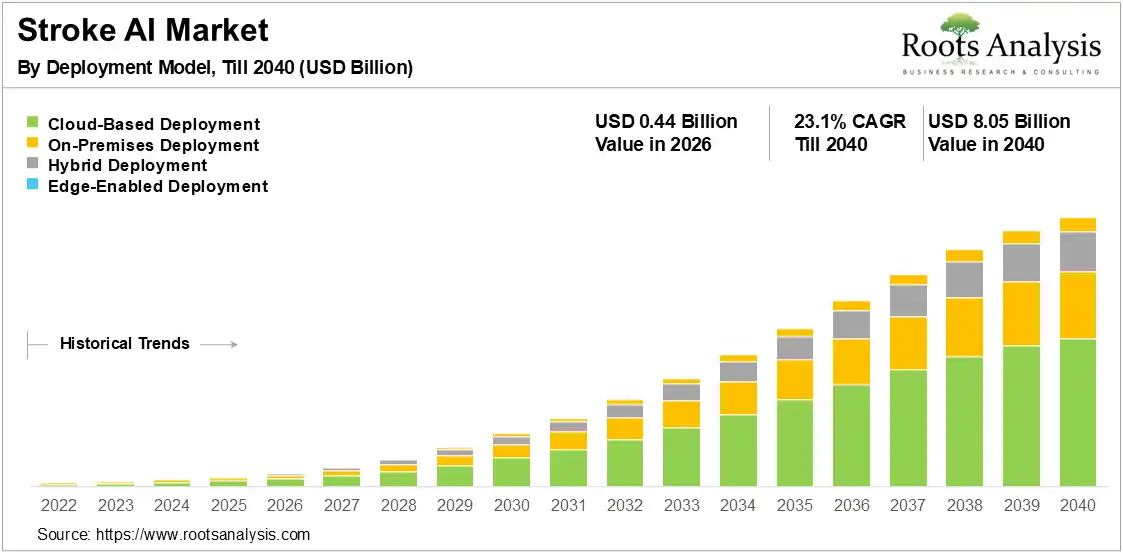
The global stroke AI market is expected to rise from USD 0.44 billion in 2026 to reach USD 8.05 billion by 2040, growing at a CAGR of 23.1% over the forecast period 2026 to 2040, driven by time-critical stroke detection, care-team activation, and automated treatment-routing workflows.
See What’s in the Full Report – Request Your Complimentary Insights!
Market Report: Key Takeaways
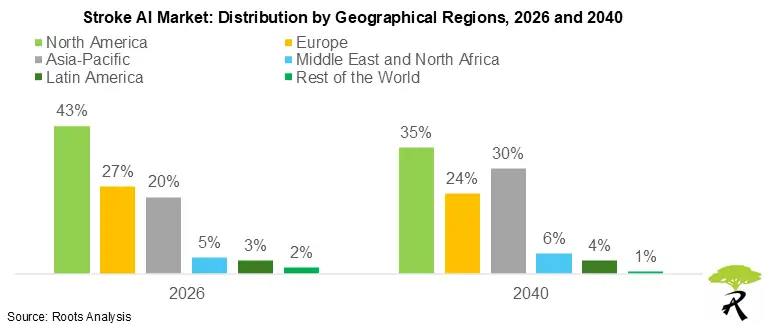
- Based on geography, North America captures 43.0% market share in 2026, whereas Asia-Pacific registers a 26.7% CAGR through 2040, driven by hub-and-spoke stroke network expansion.
- Based on offering, AI imaging and triage software captures 47.0% market share in 2026, whereas analytics and performance-management services register a 28.4% CAGR through 2040, driven by outcomes tracking.
- Based on imaging / data modality, CT angiography captures 28.0% market share in 2026, whereas cone-beam CT perfusion registers a 32.0% CAGR through 2040, driven by angio-suite decision support.
- Based on clinical application, large vessel occlusion detection captures 32.0% market share in 2026, whereas medium vessel occlusion detection registers a 28.7% CAGR through 2040, driven by distal-vessel algorithm expansion.
- Based on deployment model, cloud-based deployment captures 55.0% market share in 2026, whereas edge-enabled deployment registers a 31.0% CAGR through 2040, driven by resilient acute-care inference.
Stroke AI Market Outlook
Stroke AI adoption has moved from single-alert image triage toward integrated stroke-network orchestration. Earlier demand centered on large vessel occlusion detection and CT perfusion analysis software. Current buying now includes care-team activation, transfer routing, ASPECTS scoring automation, and performance analytics. Hospitals need fewer handoffs because thrombectomy decisions depend on minutes, specialist availability, and coordinated hub-and-spoke workflows. Vendor competition now centers on clinical breadth and hospital-system rollouts.
FDA 510(k) activity now drives stroke AI market growth because hospitals need cleared tools for acute imaging workflows. In March 2026, Harrison.ai received U.S. FDA 510(k) clearance for acute infarct triage on non-contrast CT brain imaging. This regulatory momentum strengthens procurement cases for emergency radiology triage AI, especially when platforms cover non-contrast CT, CTA, and hemorrhage pathways. Procurement teams increasingly require clearance breadth before enterprise rollout.
Through 2040, the market remains high growth as AI stroke imaging expands into multimodal data, edge inference, and outcomes coordination. Edge-enabled deployment will outpace other models because acute stroke teams need resilient inference during connectivity gaps. In December 2025, RapidAI highlighted Rapid Edge Cloud for cloud-native operation with on-premises capabilities. The outlook stays positive, with differentiation shifting from algorithm accuracy toward network-wide workflow impact. Regional scale will matter.
Stroke AI Market Dynamics
Stroke AI Market Drivers
Time-critical thrombectomy workflows drive adoption because LVO detection, CTA review, and care-team activation must happen within compressed emergency windows. Large vessel occlusion detection holds 32.0% share in 2026, making it the leading clinical application. FDA-cleared algorithms also reduce procurement friction. In November 2025, RapidAI received five U.S. FDA clearances, including Rapid LMVO for CTA-based detection of large and medium vessel occlusions.
Stroke AI Market Restraints
Integration complexity restrains adoption because stroke AI systems must connect CT scanners, PACS, radiology worklists, mobile alerts, and transfer protocols. On-premises deployment still holds 25.0% share in 2026, showing that many hospitals cannot move every acute workflow fully to cloud. Smaller emergency departments face budget pressure when implementation, support, and maintenance services accompany AI imaging and triage software purchases.
Stroke AI Market Opportunities
Workflow orchestration creates the strongest opportunity because hospitals now measure door-in-door-out time, specialist activation, and transfer coordination. Stroke workflow orchestration platforms will increase from 19.0% share in 2026 to 25.0% by 2040. In March 2026, Viz.ai highlighted International Stroke Conference data showing a 44% reduction in transfer time for LVO stroke cases. That evidence supports platform-level pricing beyond image-only detection.
Stroke AI Market Challenges
Clinical breadth creates a competitive challenge because hospitals increasingly expect one platform to support LVO, medium vessel occlusion, hemorrhage, ASPECTS, and perfusion mismatch. CT angiography leads imaging modality share at 28.0% in 2026, but non-contrast CT and multimodal integration gain share through 2040. Vendors must therefore balance specialist algorithms, regulatory updates, and workflow usability across comprehensive stroke centers and primary stroke centers.
Stroke AI Market Size Estimation Methodology
- As a starting point, the stroke AI market forecast used multiple credible secondary sources covering narrow stroke post-processing software and broader AI stroke imaging platforms. The methodology treated narrow estimates as lower-bound checks and broader Stroke AI estimates as the scope anchor. Historical 2022 to 2026 values were normalized into one annual series without naming publisher-level inputs. The model excluded adjacent general radiology AI revenue not tied to stroke workflows.
- Moving forward, the model mapped revenue pools to hospital purchasing behavior across AI imaging and triage software, stroke workflow orchestration platforms, mobile alerting tools, services, and analytics. Segment allocation used company deployment evidence, FDA 510(k) clearance activity, and hospital network adoption signals. The approach also considered whether value concentrated around first-read algorithms or expanded into network-wide coordination. Pricing sensitivity was checked against service-heavy implementations requiring integration, training, and maintenance support.
- Building on this, modality shares were tested against acute stroke imaging pathways covering non-contrast CT, CT angiography, CT perfusion, MRI, cone-beam CT perfusion, and multimodal clinical data integration. Regulatory submission counts and clearance examples informed which modalities could commercialize fastest. CTA remained the 2026 anchor because vessel-status assessment directly informs thrombectomy routing. Cone-beam CT perfusion received a faster curve because angio-suite imaging moves closer to treatment decisions.
- Drawing upon these, end-user demand was distributed across comprehensive stroke centers, primary stroke centers, acute-care hospitals, radiology groups, telestroke networks, and hub-and-spoke stroke networks. The forecast used clinical workflow KPIs, including diagnostic turnaround time, transfer time, specialist activation, and post-acute coordination. Public hospital network evidence supported faster Asia-Pacific growth assumptions. North American assumptions weighted comprehensive stroke centers, reimbursement familiarity, and FDA-cleared purchasing pathways.
- The projected value was then extended to 2040 using segment-level CAGR curves rather than one flat growth rate. Higher growth was assigned to analytics, edge-enabled deployment, cone-beam CT perfusion, medium vessel occlusion detection, and post-acute outcomes coordination. Lower growth was assigned to mature CTA, CT perfusion, and comprehensive stroke center revenue pools. Each CAGR was cross-checked against 2026 and 2040 share movement to avoid conflicting segment totals.
- Finally, the model reconciled geography, deployment model, clinical application, and workflow-stage outputs so totals matched the headline 23.1% CAGR. North America retained the largest 2026 share because FDA-cleared tools and stroke-center infrastructure remain concentrated there. Asia-Pacific received the fastest growth curve because hub-and-spoke stroke networks and district hospital deployments address specialist scarcity. The final model also checked that workflow-stage revenue aligned with offering-level revenue.
Stroke AI Market Share Insights
Market Share by Deployment Model
According to our analysis, cloud-based deployment leads because it supports multi-hospital access, centralized updates, and easier scaling across stroke networks. Cloud delivery also fits mobile alerting and distributed specialist workflows. In December 2025, RapidAI and AWS expanded their work to accelerate global deployment of deep clinical AI.
Edge-enabled deployment will grow fast because acute stroke teams need resilient inference during connectivity gaps. In December 2025, RapidAI highlighted Rapid Edge Cloud for cloud-native operation with on-premises capabilities.
Market Share by Workflow Stage
Automated image analysis leads because first-generation Stroke AI revenue concentrated around CT, CTA, and perfusion algorithms. These modules deliver measurable time savings and fit PACS-centered emergency workflows. In August 2025, Tift Regional Medical Center implemented RapidAI for real-time brain image analysis and stroke response coordination.
Post-acute follow-up and outcomes coordination will grow fastest as platforms extend beyond acute alerts. Hospitals increasingly link imaging, workflow, and longitudinal patient context to improve performance management. In January 2026, Viz.ai highlighted longitudinal patient context within its multimodal clinical data layer.
Want Information on Specific Region / Segment?
Regional Analysis: North America Leads the Market and Asia-Pacific is Likely to Register Higher CAGR
Presently, North America holds 43.0% share in 2026. The region leads because of mature stroke-center certification, FDA-cleared AI pathways, reimbursement familiarity, and large integrated health systems. It also benefits from high CT, CTA, CTP, and neurointerventional infrastructure density. In January 2026, Viz.ai reported nearly 2,000 hospital deployments, including many large US health systems.
Asia-Pacific registers a 26.7% CAGR from 2026 to 2040. Growth will accelerate as public hospitals, district networks, and emerging stroke systems adopt AI for specialist-scarce settings. India, China, Southeast Asia, and Australia will localize deployment around telestroke, hub-and-spoke transfer, and lower-cost CT workflows. In February 2026, Qure.ai reported that a Punjab stroke network cut diagnostic turnaround time by up to 85%.
Market Ecosystem Analysis
The scoped Stroke AI ecosystem concentrates around 12 Tier 1 leaders, with six Tier 2 specialists and eight emerging entrants. Four stroke-native platforms anchor commercial activity, while OEMs, therapy vendors, cloud providers, and marketplaces increasingly control distribution. Platform convergence is the dominant consolidation dynamic, and time-critical stroke-network procurement is reshaping vendor behavior now. Competitive advantage is shifting toward end-to-end neurovascular orchestration across NCCT, CTA, CTP, MR perfusion, ASPECTS, routing, and deployment.
- RapidAI received five FDA clearances in November 2025, including Rapid LMVO and longitudinal imaging modules. This raises the breadth threshold for enterprise stroke tenders. It strengthens medium vessel occlusion detection, automated image analysis, radiology prioritization, and enterprise imaging workflows.
- Brainomix received FDA clearance in April 2025 for ischemic core-volume assessment from non-contrast CT within Brainomix 360 Stroke. This lowers dependence on CTP or MRI access at primary stroke centers. It strengthens ASPECTS and infarct-core assessment, transfer coordination, and hub-and-spoke treatment routing.
- Viz.ai received FDA 510(k) clearance in June 2025 for automated subdural hemorrhage labeling and quantification. This extends neurovascular competition beyond ischemic triage into hemorrhage monitoring. It strengthens NCCT analysis, intracranial hemorrhage assessment, care-team communication, and post-acute follow-up workflows.
- Philips and Nicolab expanded their collaboration in October 2025 to advance StrokeViewer-enabled stroke care in India. This pressures standalone workflow tools in Asia-Pacific by attaching AI triage to installed imaging channels. It strengthens CT perfusion, cloud deployment, specialist communication, and thrombectomy decision support.
- Siemens Healthineers and Cercare Medical entered a May 2026 collaboration around cone-beam CT perfusion for acute stroke care. This moves tissue-viability assessment closer to thrombectomy decisions inside the angio suite. It strengthens cone-beam CT perfusion, image-guided therapy workflow, and transfer-free intervention support.
- Medtronic’s Methinks AI partnership was reported in April 2025 for stroke triage across Central and Eastern Europe, Africa, Turkey, and the Middle East. This shows neurovascular device vendors using AI to shape patient routing before intervention. It strengthens non-contrast CT triage, mobile alerting, and regional hub-and-spoke stroke networks.
- RapidAI and AWS strengthened their relationship in December 2025 to scale deep clinical AI through cloud and edge-capable deployment. This pressures smaller vendors lacking resilient deployment architecture across privacy regimes. It strengthens cloud, hybrid, edge-enabled deployment, implementation services, and performance-management services.
- Aidoc announced December 2025 partnerships with Cercare Medical and another neuroimaging specialist to expand aiOS capabilities. This makes enterprise operating systems a route to deeper clinical specialization. It strengthens MR perfusion, ASPECTS, stroke workflow orchestration, and multimodal clinical-data integration.
Startup Companies and their Key Highlights
- Methinks AI
- Event type: Strategic partnership
- Month and year: April 2025
- Strategic partner name: Medtronic
- Stated purpose: Streamline stroke triage and care coordination across regional hospitals and stroke centers
- Market implication: Accelerates non-contrast CT triage and mobile care-team coordination across EMEA stroke networks
- Cercare Medical
- Event type and funding amount: €7.4 million funding round
- Month and year: February 2025
- Lead investor name: West Hill Capital
- Stated purpose: Expand operations in the United States, the United Kingdom, and selected European countries
- Market implication: Accelerates CT and MRI perfusion decision-support expansion across leading stroke clinics
- Cerebriu
- Event type and funding amount: CE mark and €9.4 million strategic financing
- Month and year: September 2025
- Lead investor or strategic partner name: North Ventures; Siemens Healthineers
- Stated purpose: Scale MRI automation globally and move from co-development into commercial deployment
- Market implication: Accelerates MRI workflow optimization and OEM-embedded AI deployment for neuroimaging workflows
- Harrison.ai
- Event type: FDA 510(k) clearance
- Month and year: March 2026
- Stated purpose: Triage acute infarct on non-contrast CT brain scans across six vascular territories
- Market implication: Accelerates NCCT ischemic stroke triage and shifts competition beyond LVO-only detection
- JLK
- Event type: Japan regulatory approval and product launch
- Month and year: April 2025
- Stated purpose: Launch JLK-DWI for diffusion-weighted MRI stroke analysis in Japan
- Market implication: Accelerates MRI/DWI stroke analysis in Asia-Pacific and broadens multimodality stroke AI coverage
- Oxford Heartbeat
- Event type: ESMINT endorsement of clinical impact trial
- Month and year: July 2025
- Stated purpose: Quantify clinical benefits of PreSize Neurovascular decision-support in real-world practice
- Market implication: Raises the evidence barrier for neurovascular procedure planning and aneurysm treatment support
Stroke AI Market Trends / Opportunities
Stroke AI Market Shift From Image Triage to Network Orchestration Expanding Platform Competition
Stroke AI platforms are moving beyond isolated alerts because hospitals need measurable improvements across transfers, specialist activation, and treatment routing. In March 2026, Viz.ai highlighted data showing a 44% reduction in door-in-door-out transfer time for LVO stroke cases. This strengthens commercial positioning for workflow orchestration platforms over image-only point solutions.
Enterprise stroke networks now favor deployments that standardize workflows across many sites. In March 2026, Brainomix deployed Brainomix 360 Stroke AI across all 25 West Virginia University Health System sites. Multi-site wins increase switching costs and strengthen reference accounts for hospital-system sales.
NCCT and CTA Algorithm Expansion Raising Clearance Thresholds and Differentiating Clinical Breadth
Non-contrast CT is gaining commercial weight because it is widely available in emergency departments. In March 2026, Harrison.ai received FDA 510(k) clearance for acute infarct triage on non-contrast CT brain imaging. Vendors with NCCT coverage can compete in hospitals without advanced perfusion access.
CTA algorithms are expanding beyond proximal large vessel occlusions into medium and distal territories. In November 2025, RapidAI received FDA clearance for Rapid LMVO, covering large and medium vessel occlusion detection on CTA. Broader clearance scope supports premium positioning in thrombectomy-focused stroke networks.
Cloud, Edge, and Marketplace Models Reducing Deployment Friction Across Stroke Networks
Cloud deployment leads because distributed stroke teams need shared access, centralized updates, and mobile alerts. In December 2025, RapidAI and AWS expanded their work to accelerate global deployment of deep clinical AI. Cloud partnerships help vendors scale across regions without rebuilding hospital-by-hospital infrastructure.
AI marketplace models are lowering procurement friction for hospitals that want multiple algorithms through one access layer. In December 2025, Nicolab joined the Harrison.ai Open Platform as a launch partner for StrokeViewer availability. Marketplace access can shift competition toward platform distribution and partner ecosystem depth.
Your Business is Unique – Why Shouldn’t Your Report Be?
Market Access Considerations
FDA 510(k) Clearance and Intended-Use Breadth
Regulatory clearance shapes market access because acute stroke tools influence emergency triage, transfer decisions, and thrombectomy routing. FDA 510(k) pathways create a practical adoption threshold for U.S. hospitals and global reference markets. In November 2025, RapidAI received five U.S. FDA clearances, including Rapid LMVO for CTA-based occlusion detection. Broader intended-use coverage improves competitive positioning across stroke-center tenders. Narrow clearance can limit commercial use cases, even when algorithm performance appears strong.
PACS, Mobile Alerting, and Stroke-Network Integration
Technical integration determines commercialization speed because platforms must fit PACS-centered emergency imaging and mobile stroke-team workflows. Hospitals favor systems that route CT, CTA, and perfusion outputs into radiology worklists and care-team alerts. In August 2025, Tift Regional Medical Center implemented RapidAI for real-time brain image analysis and stroke response coordination. Integration depth lowers adoption risk and supports renewal pricing. Vendors that reduce IT burden can scale faster across multi-site hospital systems.
Evidence of Time-to-Treatment Impact
Market access depends on proof that AI improves operational stroke metrics, not only image interpretation. Transfer time, diagnostic turnaround time, and specialist activation metrics influence hospital procurement committees. In March 2026, Viz.ai highlighted a 44% reduction in interfacility stroke transfer times for LVO cases. Vendors with workflow evidence can justify enterprise contracts and health-system expansion. This behavior favors platforms that report operational KPIs alongside imaging results.
Cloud, Edge, and Data Infrastructure Readiness
Infrastructure readiness controls scale because stroke AI must operate across cloud, hybrid, and connectivity-constrained hospital settings. Cloud-based deployment holds 55.0% share in 2026, but edge-enabled deployment records the fastest growth through 2040. In December 2025, RapidAI highlighted Rapid Edge Cloud for cloud-native operation with on-premises capabilities. Resilient deployment options widen access for smaller hospitals and distributed stroke networks. Infrastructure flexibility also supports hybrid procurement across public and private health systems.
How Stakeholders Benefit from the Key Focus Areas of Our Stroke AI Market Report
Stroke AI matters now because acute stroke systems must shorten diagnosis, transfer, and thrombectomy decision timelines. The report links clinical workflow demand, FDA clearance activity, and hospital deployment patterns to investment, product, and partnership decisions.
- Unmet Needs and Market Gaps in Stroke AI Market: The report identifies gaps across medium vessel occlusion detection, post-acute outcomes coordination, and hub-and-spoke transfer support. Product teams can use these gaps to decide whether to build imaging modules, workflow tools, or analytics services. Hospital partners can compare unmet needs against current CT, CTA, and telestroke workflows.
- Funding and Venture Investment Opportunities in Stroke AI Market: The report highlights high-growth pockets such as analytics, edge-enabled deployment, cone-beam CT perfusion, and medium vessel occlusion detection. Investment committees can use these areas to screen companies beyond first-generation LVO alerting. Funding signals, including Methinks Neuro-rescue support, help assess where public-private capital is moving.
- Technology Innovation and Adoption Trends: The report tracks adoption across non-contrast CT, CTA, CT perfusion, MRI, cone-beam CT perfusion, and multimodal integration. Technology leaders can prioritize development roadmaps around modalities gaining share through 2040. The analysis also shows where edge inference, cloud deployment, and marketplace distribution change implementation requirements.
- Stroke AI Market Competitive Landscape and Industry Analysis: The report maps Tier 1 Leaders, Tier 2 Specialists, and Emerging or Startup companies across imaging, workflow, cloud, and care-team coordination. Commercial teams can identify direct competitors, infrastructure partners, and acquisition targets. The segmentation also shows where large imaging vendors and specialist AI developers compete or collaborate.
- Mapping Strategic Partnerships and Ecosystem Synergies: The report analyzes partnerships involving AI developers, imaging platforms, cloud infrastructure providers, and neurovascular therapy companies. Business development teams can use this ecosystem view to identify channel partners and regional expansion routes. Examples include Philips and Nicolab in India, Medtronic and Methinks AI, and RapidAI with AWS.
- Stroke AI Market CAGR and Growth Trends: The report explains why the overall market expands at 23.1% CAGR through 2040. Planning teams can compare segment CAGRs across deployment, modality, application, and geography. This supports budget allocation, market-entry timing, and portfolio prioritization across mature North American accounts and faster Asia-Pacific deployments.
Stroke AI Market: Scope of the Report
| Key Report Attributes | Details | |
| Forecast Period | Till 2040 | |
| Market Size 2026 | USD 0.44 Billion | |
| Market Size 2040 | USD 8.05 Billion | |
| CAGR (Till 2040) | 23.1% | |
| Segments Covered |
|
|
| Geographical Regions Covered |
|
|
| Key Sections Covered |
|
|
Market Segmentation
The Stroke AI Market report presents an in-depth analysis, highlighting the capabilities of various stakeholders, based on different segments, such as offering, imaging / data modality, clinical application, deployment model, end user, workflow stage, geographical regions, and leading players.
By Offering Type
- AI imaging and Triage Software
- Stroke Workflow Orchestration Platforms
- Care-Team Communication and Mobile Alerting Tools
- Implementation and Integration Services
- Training, Support and Maintenance Services
- Analytics and Performance-Management Services
By Imaging / Data Modality
- Non-contrast CT
- CT Angiography
- CT Perfusion
- MRI / MR Perfusion
- Cone-beam CT Perfusion
- Multimodal Imaging and Clinical Data Integration
By Clinical Application
- Large Vessel Occlusion Detection
- Medium Vessel Occlusion Detection
- Intracranial Hemorrhage Detection
- ASPECTS and Infarct-Core Assessment
- Perfusion Mismatch and Penumbra Analysis
- Aneurysm and Subarachnoid Hemorrhage Triage
- Transfer Coordination and Treatment-Routing Support
By Deployment Model
- Cloud-Based Deployment
- On-Premises Deployment
- Hybrid Deployment
- Edge-Enabled Deployment
By End User
- Comprehensive Stroke Centers
- Primary Stroke Centers
- Acute-Care Hospitals and Emergency Departments
- Radiology Groups and Imaging Centers
- Telestroke Networks
- Hub-And-Spoke Stroke Networks
By Workflow Stage
- Emergency Department Triage
- Image Acquisition and Routing
- Automated Image Analysis
- Radiology Worklist Prioritization
- Care-Team Activation and Communication
- Transfer And Thrombectomy Decision Support
- Post-Acute Follow-Up and Outcomes Coordination
By Geographical Regions
- North America
- US
- Canada
- Mexico
- Rest of North America
- Europe
- Austria
- Belgium
- Denmark
- France
- Germany
- Ireland
- Italy
- Netherlands
- Norway
- Russia
- Spain
- Sweden
- Switzerland
- UK
- Rest of Europe
- Asia-Pacific
- China
- India
- Japan
- Singapore
- South Korea
- Rest of Asia-Pacific
- Latin America
- Argentina
- Brazil
- Chile
- Colombia
- Venezuela
- Rest of Latin America
- Middle East and Africa (MEA)
- Egypt
- Iran
- Iraq
- Israel
- Kuwait
- Saudi Arabia
- UAE
- Rest of MEA
- Rest of the World


