
Lowest Price Guaranteed
Slides
301
Last Updated
September 2026
View Count
18035
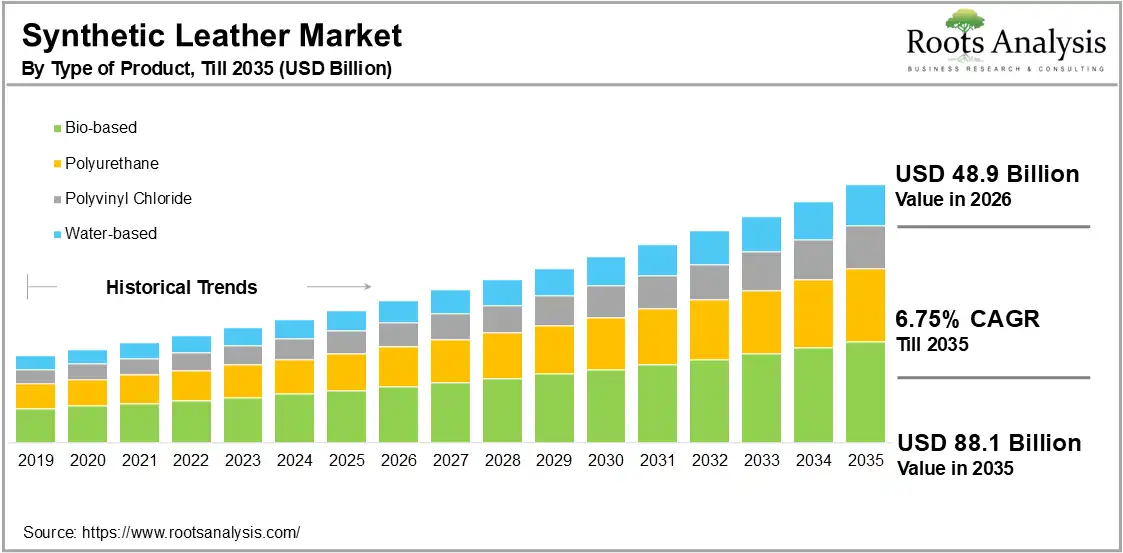
The global synthetic leather market, valued at USD 45.4 billion in 2025, is projected to reach USD 48.9 billion in 2026 and USD 88.1 billion by 2035, with a 6.75% CAGR during the forecast period 2026 to 2035.
 |
To learn more about this report, request a free sample copy
The new research study consists of industry trends, detailed market analysis, patent analysis, value chain analysis, SWOT analysis, and market forecast and opportunity analysis. The growth in the market size over the next decade is likely to be the result of the anticipated surge in demand for vegan and sustainable materials.
Synthetic leather is also known as faux leather, imitation leather, vegan leather and artificial leather. It is widely used in recent times, owing to its various advantages over genuine leather, such as sustainable nature, customization and affordability.
Synthetic leather is manufactured using various raw materials including polyurethane (PU), polyvinyl chloride (PVC) and different bio-based agricultural wastes, including banana stems, cactus, mango peels and pineapple wastes. Further, with continuous evolution and advancement in technology, synthetic leathers are crafted from cactus leaves, banana stem, corn husk and pineapples waste. Notably, the synthetic leather industry is moving towards sustainability through adoption of bio-based synthetic leather derived from natural sources. Synthetic leather provides various features, such as stain, abrasion resistant, waterproof, washable, breathable, heat-resistant and lightweight. It is worth highlighting that synthetic leather is used across different industries, including automotive industry, bags and wallets, clothing, electronics, footwear, furnishing and upholstery.
Driven by the increasing consumer demand for sustainable leather alternative, dynamic needs for various industries and evolving technologies, the synthetic leather market is expected to experience healthy market growth during the forecast period.
The market research report presents an in-depth analysis of the various synthetic leather manufacturer, across different segments, as defined in the table below:
| Key Report Attributes | Details | |
| Historical Trend | Since 2019 | |
| Future Trend | Till 2035 | |
| Forecast Period | 2026-2035 | |
| Market Size 2026 | $ 48.9 Billion | |
| CAGR | 6.75% | |
| Type of Raw Material |
|
|
| Type of Application |
|
|
| Customer Preference |
|
|
| Type of Sector |
|
|
| Geographical Regions |
|
|
| Leading Companies in Synthetic Leather Market |
|
|
| PowerPoint Presentation (Complimentary) |
Available | |
| Customization Scope | 15% Free Customization | |
| Excel Data Packs (Complimentary) |
|
|
One of the key objectives of this market report was to estimate the current market size, opportunity and the future growth potential of the market, over the forecast period. Based on multiple parameters, likely adoption trends and insights gained during our discussions with prominent stakeholders in the industry, we have provided an informed estimate on the market evolution during the forecast period till 2035.
The market report also features the likely distribution of the current and forecasted opportunity within the synthetic / artificial leather market across various segments, such as type of raw material (bio-based, polyurethane, polyvinyl chloride and water-based), type of application (automotive industry, bags and wallets, clothing, electronics, footwear, furnishing / upholstery and other applications), customer preference (breathable, heat resistant, lightweight, stain / abrasion resistant, washable, waterproof and other customer preference), type of sector (organized and unorganized), key geographical region (North America, Europe, Asia, Middle East and North Africa, Latin America and rest of the world).
In order to account for future uncertainties associated with some of the key parameters and to add robustness to our model, we have provided three market forecast scenarios, namely conservative, base, and optimistic scenarios, representing different tracks of the industry’s evolution. Further, all actual figures have been sourced and analyzed from publicly available information forums and primary research discussions. Financial figures mentioned in this market report are in USD, unless otherwise specified.
The global synthetic leather market is categorized into different products, such as bio-based, polyurethane, polyvinyl chloride and water-based. Among these products, bio-based synthetic leather segment is projected to witness the highest growth rate during the forecast period. This can be attributed to the rising awareness and demand for sustainable and ecofriendly leather alternative.
The global synthetic leather market is segmented into automotive, bags and wallets, clothing, electronics, footwear, furnishing / upholstery and other applications. Owing to the increased demand for automotives in Asia and Europe, the automotive synthetic leather and furniture synthetic leather segment is likely to grow at a higher CAGR as compared to other type of applications during the forecast period, till 2035.
The global synthetic leather market is segmented into breathable, heat-resistant, lightweight, stain / abrasion resistant, washable, waterproof and other customer preference. Currently, stain / abrasion resistant synthetic leather segment holds majority of the market, and the washable synthetic leather segment is likely to grow at a higher CAGR as compared to other customer preference during the forecast period, till 2035.
The global synthetic leather industry is segmented into organized and unorganized segment. Currently, the organized synthetic leather segment holds majority of the market, and the trend is unlikely to change during the forecast period, till 2035.
This segment highlights the distribution of synthetic leather market across various geographies, such as North America, Europe, Asia, Middle East and North Africa, Latin America and rest of the world. According to our projections, Asia is likely to capture the majority of the share in 2024, and this trend is unlikely to change in the future. It is also worth highlighting that the market in Asia is expected to grow at a relatively healthy CAGR (7.64%), during the forecast period, till 2035.
The “Synthetic Leather Market: Industry Trends and Global Forecasts, Till 2035": report features an extensive study of the current market landscape, market size and future opportunities for artificial leather manufacturers, during the given forecast period. The market report highlights the efforts of several stakeholders engaged in this market segment of the synthetic leather domain. Key takeaways of the synthetic leather industry analysis is briefly discussed below.
The current market landscape features the presence of more than 235 companies that are engaged in the manufacturing of synthetic leather. Overall, the market seems to be well-distributed, comprising of very large, large, mid-sized and small artificial leather manufacturers. It is also worth highlighting that close to 80% of the synthetic leather companies are based in Asia, followed by North America (9%) and Europe (8%).
Stakeholders in the synthetic leather industry have forged several partnerships with organizations to drive technological advancements and expand application area in synthetic leather domain. For instance, in February 2024, BASF Monomers Division and Xuchuan Chemical forged an alliance in order to facilitate the use of bio-mass balanced (BMB) Methylene Diphenyl Di-isocyanate (MDI) in synthetic leather applications. The partnership aims to reduce carbon emissions in polyurethane production for the synthetic leather industry. Further, In August 2023, DK&D entered into a strategic partnership with Ningbo Hengqide Chemical Fiber Technology to jointly produce synthetic leather for San Fang Chemical Industry customers. Such partnerships are expected to drive synthetic leather market growth during the forecast period.
The market for synthetic leather is poised for significant growth, fueled by rising demand for durable and sustainable leather alternative across diverse industries. Projections indicate a robust CAGR of 6.75% during the forecast period of till 2035. The quest for more animal friendly and sustainable leather alternative has underscored the importance of synthetic leather, which is increasingly recognized for its value addition in numerous domains, including fashion, footwear and automotive. Moreover, the market stands to benefit from the availability of tailored synthetic leather solutions designed to meet specific client requirements. Innovations, such as bio-based synthetic leather and rising adoption are expected to be key drivers propelling the expansion of the market.
Asia currently holds a substantial share of approximately 45% in the synthetic leather industry market opportunity. This dominance can be attributed to several factors, including supportive government regulations favoring the use of synthetic leather, the sustained growth of the automobile market, and easy access to raw material.
Examples of key players engaged in the synthetic leather industry (which have also been captured in this market report, arranged in alphabetical order) include Alfatex Italia Desserto, FILWEL, H.R. Polycoats, Kuraray, Mayur Uniquoters, Modern Meadows, MycoWorks, NAN YA PLASTICS, Nirmal Fibers, Responsive Industries, San Fang Chemical, Teijin Cordley, Wanhua Chemical and Zhejiang Hexin Holdings. This market report includes an easily searchable excel database of all the companies engaged in the synthetic leather production worldwide.
The market report presents an in-depth analysis, highlighting the capabilities of various companies engaged in this domain, across different segments. Amongst other elements, the market report includes:
Several recent developments have taken place in the synthetic leather market. We have outlined some of these recent initiatives below. These developments, even if they took place post the release of our market report, substantiate the overall market trends that have been outlined in our analysis.