


 Download Free Sample
 Buy Now
Market Size
The global T-Cell Engagers Market reached USD 8.6 billion in 2026 and is projected to reach USD 62.5 billion by 2040, growing at a CAGR of 15.2% over the forecast period 2026 to 2040, driven by expanding hematologic approvals and early solid-tumor validation.
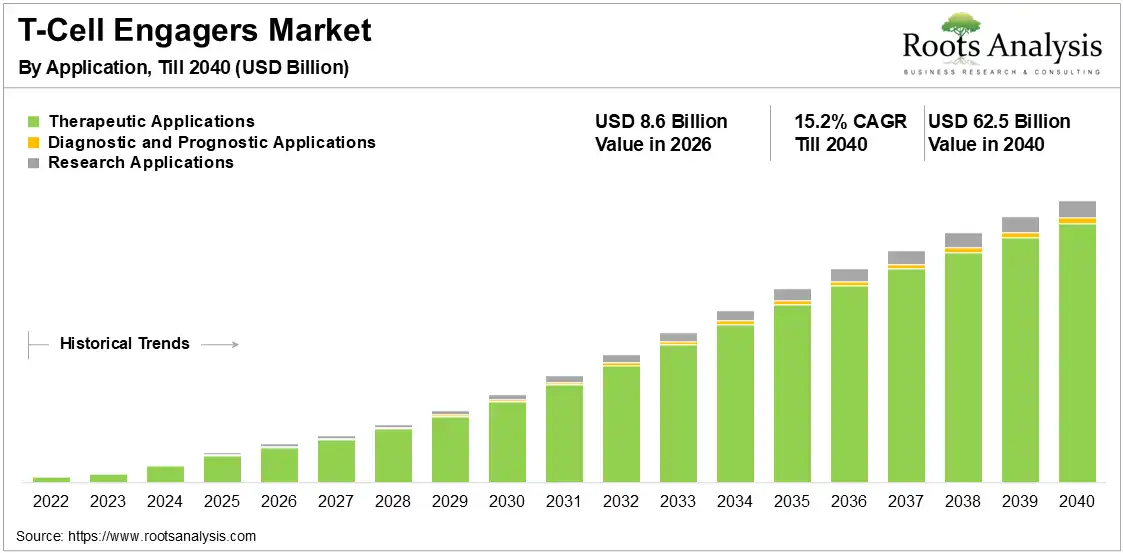
See What’s in the Full Report – Request Your Complimentary Insights!
Market Report: Key Takeaways
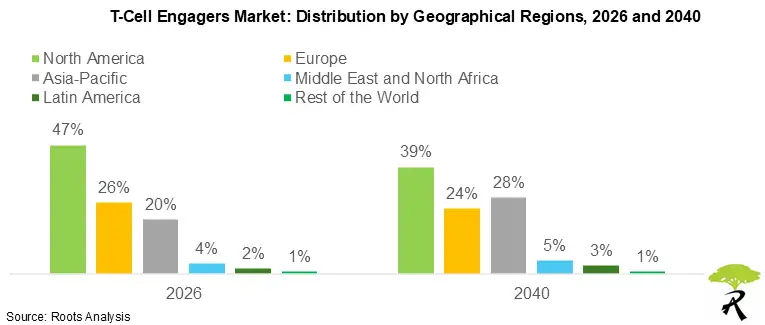
- Based on geography, North America captures 47.0% market share in 2026, whereas Asia-Pacific registers an 18.0% CAGR through 2040, driven by faster regional biologics access.
- Based on technology / engager format, other CD3-directed bispecific antibodies capture 58.0% market share in 2026, whereas masked or conditionally activated T-cell engagers register a 24.6% CAGR through 2040, driven by safer solid-tumor activation.
- Based on target antigen / binding target, CD20 captures 30.0% market share in 2026, whereas PSMA registers a 23.6% CAGR through 2040, driven by prostate cancer expansion.
- Based on disease / indication, B-cell lymphomas capture 36.0% market share in 2026, whereas other solid tumors register a 22.1% CAGR through 2040, driven by tumor-localized engager designs.
- Based on route of administration, subcutaneous administration is both the dominant and fastest-growing category, holding 52.0% share in 2026 and expanding at 17.4% CAGR through 2040, driven by outpatient workflow advantages.
T-Cell Engagers Market Outlook
Hematology-led adoption has shifted the T-cell engagers market from niche leukemia use toward broader CD3-directed bispecific commercialization. CD20, BCMA, and GPRC5D products now anchor demand across lymphoma and myeloma. DLL3 validation in small-cell lung cancer extends the category beyond blood cancers. Supply still depends on specialized biologics manufacturing, step-up dosing infrastructure, and hospital teams trained to manage cytokine-release risk. These requirements favor companies with approved products and mature hospital access.
Current growth comes from faster regulatory validation, subcutaneous dosing, and clinical expansion into relapsed oncology populations. FDA activity remains a direct access driver because approvals define eligible treatment settings and payer coverage. In November 2025, the FDA granted traditional approval to Amgen’s tarlatamab-dlle for extensive-stage small-cell lung cancer. That decision strengthened the commercial case for DLL3/CD3 engagement beyond hematologic tumors and later-line cancer care.
Through 2040, growth will remain high but become more segmented by target, safety design, and care setting. Masked T-cell engagers, trispecific formats, and gamma-delta approaches will expand the competitive field. In May 2026, Cytospire Therapeutics raised £61 million to advance a pan-gamma-delta T-cell engager pipeline into clinical trials. The outlook remains positive, with execution risk concentrated in solid-tumor safety, autoimmune positioning, outpatient readiness, and access.
T-Cell Engagers Market Dynamics
T-Cell Engagers Market Drivers
Regulatory approvals and hematology depth drive near-term adoption in the T-cell engagers market. FDA approvals for linvoseltamab, epcoritamab, and tarlatamab validate CD3-directed treatment across myeloma, lymphoma, and small-cell lung cancer. Subcutaneous administration holds 52.0% share in 2026 and grows at 17.4% CAGR through 2040. That route lowers chair-time pressure and supports wider oncology clinic use after initial hospital monitoring. These factors strengthen demand among hospitals, oncology clinics, and specialty pharmacy channels.
T-Cell Engagers Market Restraints
Cytokine-release management still slows market access outside advanced hospitals. Step-up dosing, observation protocols, and adverse-event readiness raise commercialization costs for CD3 bispecific T-cell engager launches. Hospitals hold 55.0% share in 2026 because tertiary centers manage early monitoring and formulary onboarding. Smaller oncology clinics face staffing, payer, and protocol barriers before they can scale routine use. These constraints delay decentralization despite rising subcutaneous adoption.
T-Cell Engagers Market Opportunities
Autoimmune disease expansion creates a new growth path beyond oncology. Programs targeting BCMA, CD20, and CD19 reposition T-cell engaging bispecific antibodies as immune-resetting medicines. In June 2026, METiS TechBio and Boulevard Bio entered a global licensing deal for MTS-128, a trispecific T-cell engager for autoimmune diseases. This broadens partnering demand beyond cancer-focused developers and widens strategic late-stage acquisition options.
T-Cell Engagers Market Challenges
Solid-tumor penetration remains the hardest competitive challenge for T-cell engagers. DLL3, PSMA, CLDN18.2, and peptide-HLA targets require stronger tumor localization than hematologic antigens. Masked or conditionally activated T-cell engagers grow at 24.6% CAGR through 2040 because safety limits conventional CD3 activation. Developers must prove therapeutic windows before payers and physicians accept broader outpatient use. Weak differentiation could compress pricing as more CD3 programs crowd similar indications.
T-Cell Engagers Market Size Estimation Methodology
- As a starting point, the model defined the T-cell engagers market around CD3-directed, TCR-based, gamma-delta, trispecific, and masked engager formats. Approved oncology products anchored the commercial baseline, while validated platform and pipeline companies shaped the emerging technology pool. The scope included therapeutic, research, diagnostic, hospital, clinic, and academic use cases only where the supplied segment framework supported inclusion. This prevented adjacent immunotherapy platforms from entering the demand base.
- Moving forward, historical values were normalized to common annual anchors across 2022, 2026, and 2040. The model reconciled visible estimates from multiple credible secondary sources, then down-weighted narrow bispecific-only scopes and aggressive solid-tumor penetration assumptions. This step preserved hematology revenue strength while avoiding overstatement from early solid-tumor programs. It also aligned forecast timing with approval waves rather than discovery-stage activity.
- Building on this, segment shares were allocated using drug approval timelines, regulatory submission counts, and clinical trial databases. CD20, BCMA, GPRC5D, DLL3, PSMA, and peptide-HLA targets received different adoption curves. The model also separated intravenous and subcutaneous administration because dosing route changes care setting, monitoring burden, and clinic throughput. End-user shares then reflected where those routes can be delivered safely.
- Drawing upon these, regional forecasts reflected approval velocity, oncology infrastructure, biologics access and launch sequencing. North America received the strongest 2026 share because FDA activity and tertiary cancer-center capacity support early adoption. Asia-Pacific received the fastest growth profile because Japan, China, South Korea, and Singapore can localize biologics access and trials. Europe, Latin America, and smaller regions were scaled against reimbursement speed and specialist capacity.
- The projected value was then tested against technology-specific growth rates across six engager formats. These included CD3 bispecific antibodies, BiTE therapeutics, TCR-based engagers, gamma-delta platforms, trispecific formats, and masked designs. Faster growth was assigned to formats that address solid-tumor safety or autoimmune expansion. Slower growth was assigned to mature hematologic categories where competition and treatment-line saturation increase.
- Finally, the forecast was reviewed for internal consistency across indication, route, end user, and application splits. Hospital share, oncology clinic growth, and subcutaneous adoption were cross-checked to avoid conflicting care-setting assumptions. The final CAGR reflected high-growth market expansion, with moderation after initial approval waves and stronger competition across overlapping targets. Sensitivity checks tested whether autoimmune launches could offset pricing pressure in lymphoma and myeloma.
T-Cell Engagers Market Share Insights
Market Share by Disease / Indication
According to our analysis, B-cell lymphomas lead due to validated CD20 biology, repeated approvals, and deep hematology treatment networks. Community adoption improves as subcutaneous dosing reduces infusion-center burden. Example: Genmab, November 2025, FDA approved epcoritamab-bysp for relapsed or refractory follicular lymphoma indications.
Other solid tumors will grow fastest as masked, PSMA, MAGE-A4, and CLDN18.2 programs mature. Growth depends on safer activation and stronger tumor localization. Example: Janux Therapeutics, December 2025, reported updated JANX007 data in metastatic castration-resistant prostate cancer.
Market Share by End User
Hospitals lead because cytokine-release risk, step-up dosing, and early monitoring require advanced oncology infrastructure. Tertiary centers also control formularies for newly approved hematology and solid-tumor engagers. Example: Amgen, November 2025, FDA granted traditional approval to tarlatamab-dlle after the DeLLphi-304 trial.
Oncology clinics will grow fast as subcutaneous products and clearer toxicity protocols support decentralization. Clinic adoption will rise after hospitals establish dosing pathways and payer confidence. Example: Genmab, November 2025, FDA approved epcoritamab-bysp for follicular lymphoma indications.
Want Information on Specific Region / Segment?
Regional Analysis: North America Leads the Market and Asia-Pacific is Likely to Register Higher CAGR
Presently, North America holds 47.0% market share in 2026. The region leads through faster FDA reviews, high oncology drug spending, and dense academic cancer-center networks. Capital access also supports early commercial launches, REMS implementation, and investigator-led expansion studies. Example: FDA, July 2025, granted accelerated approval to Regeneron’s linvoseltamab-gcpt for relapsed or refractory multiple myeloma.
On the contrary, Asia-Pacific registers an 18.0% CAGR from 2026 to 2040. Growth will accelerate as Japan, China, South Korea, and Singapore increase biologics access and local oncology trials. Regional partnerships will also localize development for autoimmune and cancer T-cell engager programs.
Market Ecosystem Analysis
Seven approved-product groups concentrate most commercial activity across the 23-company scope, with eight leaders controlling access scale. Seven specialists and eight emerging entrants widen the field through TCR, gamma-delta, masked, trispecific, pHLA, and autoimmune formats. Platform convergence is the dominant consolidation dynamic, as distinct engager formats now compete for similar oncology delivery pathways. The primary commercial force is earlier-line, lower-burden care, shifting advantage toward validated antigens, subcutaneous logistics, and confirmatory survival evidence.
- Johnson & Johnson used January 2026 MajesTEC-9 data to support TECVAYLI’s potential use as early as first relapse in multiple myeloma. Pfizer followed in April 2026 with MagnetisMM-5 PFS data for ELREXFIO after at least one prior line. Together, they pressure BCMA rivals and strengthen multiple myeloma use in hospitals and oncology clinics.
- Regeneron gained July 2025 FDA approval for LYNOZIFIC, adding another BCMAxCD3 option for heavily pretreated myeloma. This reduces late-line BCMA concentration and raises site-readiness requirements for CRS monitoring.
- Roche turned route convenience into differentiation in December 2025 with FDA approval of subcutaneous Lunsumio VELO. AbbVie and Genmab secured November 2025 FDA approval for EPKINLY plus rituximab-lenalidomide in follicular lymphoma. These approvals intensify CD20xCD3 rivalry and favor clinics that can move patients away from long infusions.
- Amgen set the DLL3 benchmark in June 2025 when IMDELLTRA cut death risk by 40% in Phase 3 SCLC. Boehringer Ingelheim strengthened the same segment in May 2025 through obrixtamig’s DLL3/CD3 evaluation in SCLC and neuroendocrine cancers. Amgen raises the survival-evidence bar, while Boehringer must differentiate on breadth, dosing, or combinations.
- Janux released December 2025 JANX007 data in PSMA-positive metastatic prostate cancer. Vir dosed the first patient in July 2025 with EGFR-targeted VIR-5525 across multiple solid tumors. Both strengthen masked and tumor-activated formats where safety selectivity matters more than target expression alone.
- Clasp Therapeutics dosed the first patient in April 2025 with CLSP-1025 targeting p53 R175H solid tumors. Enara Bio advanced ENA101 into IND-enabling studies in November 2025 against the DARKFOX dark antigen. These entrants raise diagnostic complexity but open differentiated peptide-HLA and novel antigen sub-segments.
- Candid Therapeutics advanced its TCE portfolio into five autoimmune diseases in June 2025. Prolium launched in March 2026 with $50 million and first patients dosed with PRO-203 CD20xCD3. These moves create a non-oncology TCE segment and pressure oncology incumbents to translate safety learnings into immunology.
Startup Companies and their Key Highlights
- Prolium Bioscience
- Event type and funding amount: $50 million Series A launch and first patients dosed.
- Month and year: March 2026.
- Lead investor or strategic partner name: RTW Investments.
- Stated purpose of the event: Advance PRO-203, a CD20xCD3 TCE for severe autoimmune disease.
- Market implication: Accelerates the autoimmune disease and CD20 target sub-segments through first-patient clinical execution.
- Janux Therapeutics
- Event type and funding amount: Worldwide collaboration and license agreement worth up to $850 million.
- Month and year: January 2026.
- Lead investor or strategic partner name: Bristol Myers Squibb.
- Stated purpose of the event: Develop a tumor-activated therapeutic for solid tumors.
- Market implication: Accelerates conditionally activated solid-tumor TCE development through large-pharma development capacity.
- Adaptin Bio
- Event type and funding amount: Alternative public offering and $7.7 million private placement.
- Month and year: April 2025.
- Stated purpose of the event: Support the first clinical trial of APTN-101 for glioblastoma.
- Market implication: Accelerates brain bispecific TCE development and the other solid tumors application segment.
- Clasp Therapeutics
- Event type: First patient dosed in Phase 1 GUARDIAN-101 trial.
- Month and year: April 2025.
- Stated purpose of the event: Evaluate CLSP-1025 in p53 R175H-mutant solid tumors.
- Market implication: Accelerates pHLA-targeted TCE development and strengthens biomarker-defined solid tumor segmentation.
- Enara Bio Therapeutics
- Event type: ENA101 advanced into IND-enabling studies.
- Month and year: November 2025.
- Stated purpose of the event: Advance a bispecific TCE targeting the cancer-specific DARKFOX dark antigen.
- Market implication: Expands the target antigen segment beyond conventional surface antigens into dark-antigen discovery.
T-Cell Engagers Market Trends / Opportunities
T-Cell Engagers Market Hematology Approvals Driving Formulary Concentration
Regulatory proof in hematology is concentrating early market power around CD20 and BCMA programs. In July 2025, the FDA granted accelerated approval to Regeneron’s linvoseltamab-gcpt for relapsed or refractory multiple myeloma. This strengthens companies with approved myeloma assets and hospital onboarding capacity.
Subcutaneous dosing is shifting adoption from infusion-heavy workflows toward clinic-scalable treatment models. In November 2025, the FDA approved epcoritamab-bysp for follicular lymphoma indications. Products that reduce chair time and monitoring complexity will gain stronger commercial differentiation.
T-Cell Engagers Market Solid-Tumor Activation Designs Expanding Competitive White Space
Tumor-activated designs are becoming central to solid-tumor competition because conventional CD3 activation creates safety constraints. In January 2026, Janux Therapeutics and Bristol Myers Squibb formed a worldwide license collaboration. The agreement covered a tumor-activated therapeutic for solid tumors. This signals rising partnership value for platforms that widen the therapeutic window.
Multi-target strategies are moving into solid tumors to reduce antigen-escape risk and improve tumor localization. In April 2026, Deck Bio launched a multi-target T-cell engager platform for solid tumors. Competitive advantage will shift toward platforms that combine safety engineering with target breadth.
Autoimmune T-Cell Engager Expansion Creating New Licensing and Acquisition Demand
Autoimmune programs are reframing T-cell engaging bispecific antibodies as immune-resetting therapies, not only cancer medicines. In March 2026, Gilead Sciences agreed to acquire Ouro Medicines and add OM336 to its autoimmune pipeline. This raises acquisition interest in assets that target validated B-cell biology outside oncology.
Trispecific and CD20xCD3 programs are expanding autoimmune development across systemic sclerosis and B-cell mediated disease. In June 2026, Prolium Bioscience dosed the first patient in a multinational Phase 1/2 study of PRO-203 in systemic sclerosis. The implication is a broader buyer universe for clinical, regulatory, and partnership intelligence.
Gamma-Delta and Multispecific Platforms Pulling Venture Capital Toward Earlier Differentiation
Gamma-delta T-cell engager platforms are attracting capital because they offer differentiation beyond crowded CD3 bispecific programs. In May 2026, Cytospire Therapeutics raised an oversubscribed £61 million Series A financing for its pan-gamma-delta pipeline. Investors will favor formats that offer novel biology and clear clinical entry points.
Next-generation platforms are also launching with financing before late clinical validation. In March 2026, Excalipoint Therapeutics launched with USD 68.7 million in seed financing for T-cell engager therapies. Early capital formation will intensify competition for targets, talent, and translational datasets.
Your Business is Unique – Why Shouldn’t Your Report Be?
Market Access Considerations
Step-Up Dosing and Cytokine-Release Readiness
Cytokine-release readiness controls how quickly providers can adopt CD3-directed bispecific antibodies. Step-up dosing, observation capacity, and trained oncology teams favor hospitals, which hold 55.0% share in 2026. Smaller oncology clinics need protocols, payer confidence, and escalation pathways before routine use. Amgen’s tarlatamab-dlle approval in extensive-stage small-cell lung cancer reinforces the need for advanced monitoring infrastructure. These requirements slow community diffusion but protect early clinical outcomes and payer confidence during launch.
Regulatory Sequencing and Label Expansion
Regulatory sequencing determines which companies access reimbursed treatment populations first. FDA approvals for linvoseltamab, epcoritamab, and tarlatamab create label-defined adoption pathways across myeloma, lymphoma, and small-cell lung cancer. Companies with earlier approvals gain formulary placement, physician familiarity, and real-world safety learning. Later entrants must show stronger efficacy, safer dosing, or better convenience to displace embedded products. Label expansion also shapes trial design, launch timing, and payer contracting priorities across launch sequences and indication sequencing.
Route of Administration and Site-of-Care Economics
Subcutaneous administration enables broader access because it reduces infusion-center pressure and supports outpatient oncology workflows. This route holds 52.0% share in 2026 and expands at 17.4% CAGR through 2040. Products still need step-up schedules and toxicity management, so clinics cannot scale without hospital-linked escalation pathways. Epcoritamab’s follicular lymphoma approval shows how subcutaneous CD20xCD3 formats can support wider commercial uptake. Site economics will favor therapies that shorten visits and simplify staffing during repeat dosing cycles and monitoring visits.
Platform Differentiation and Manufacturing Scalability
Platform differentiation affects access because payers and partners can compare similar CD3 redirection mechanisms across crowded hematology targets. Masked, gamma-delta, and trispecific formats require specialized development, translational assays, and manufacturing controls. These requirements raise entry costs but can strengthen competitive positioning in solid tumors and autoimmune diseases. Cytospire’s May 2026 Series A financing shows investor support for differentiated gamma-delta T-cell engager development. Scalable production will determine whether novel formats reach commercial volumes without margin erosion risk.
How Stakeholders Benefit from the Key Focus Areas of Our T-Cell Engagers Market Report
CD3-directed bispecific approvals, solid-tumor activation designs, and autoimmune expansion now make this market commercially urgent. The report helps teams prioritize indications, platform formats, partnerships, and access pathways before competition intensifies. It also clarifies where clinical risk, payer access, and platform differentiation intersect.
- Unmet Needs and Market Gaps in T-Cell Engagers Market: The report identifies gaps across solid tumors, autoimmune disease, outpatient administration, and target-specific safety. Portfolio planners can compare hematology saturation against faster-growth areas such as PSMA, DLL3, and masked formats. This supports decisions on whether to build, partner, or acquire differentiated engager assets. It also highlights where evidence gaps could delay launch sequencing.
- Funding and Venture Investment Opportunities in T-Cell Engagers Market: The report tracks where capital is moving across gamma-delta, trispecific, masked, and autoimmune T-cell engager platforms. Investment teams can assess why Cytospire, Excalipoint, Ouro Medicines, and Candid Therapeutics attracted financing or acquisition interest. This supports diligence on platform novelty, target selection, clinical timing, and exit potential. It also separates durable platform value from single-asset momentum.
- Technology Innovation and Adoption Trends: The report compares CD3-directed bispecific antibodies, BiTE therapeutics, TCR-based engagers, gamma-delta engagers, trispecific designs, and conditionally activated formats. Technology teams can identify which formats gain share because they solve safety, localization, or convenience problems. This supports research prioritization, translational assay planning, and platform licensing decisions. It also shows where subcutaneous dosing changes clinical adoption curves.
- T-Cell Engagers Market Competitive Landscape and Industry Analysis: The report maps approved-product leaders, platform specialists, and emerging developers across CD20, BCMA, GPRC5D, DLL3, gp100, PSMA, and other targets. Commercial teams can assess where Amgen, Regeneron, Johnson & Johnson, Pfizer, Roche, AbbVie, and Genmab hold stronger positions. This supports account targeting, differentiation strategy, and competitive response planning. It also identifies where emerging developers create partnership or displacement risk.
- Mapping Strategic Partnerships and Ecosystem Synergies: The report evaluates licensing, collaboration, and acquisition patterns that connect large pharma with differentiated platform developers. Business development teams can review moves involving Janux, Bristol Myers Squibb, METiS TechBio, and Boulevard Bio. The same mapping covers AbbVie, Xilio, Gilead, Ouro Medicines, UCB, and Candid. This supports partner shortlisting, valuation framing, and outreach sequencing.
- T-Cell Engagers Market CAGR and Growth Trends: The report links the 15.2% overall CAGR to segment-level growth across route, target, indication, technology, geography, and end user. Forecast owners can see why masked formats, trispecifics, gamma-delta approaches, PSMA, DLL3, autoimmune disease, and oncology clinics outpace mature categories. This supports budget allocation, launch planning, and long-range scenario modeling. It also helps compare high-growth categories against access and execution risk.
T-Cell Engagers Market: Scope of the Report
| Key Report Attributes | Details | |
| Forecast Period | Till 2040 | |
| Market Size 2026 | USD 8.6 Billion | |
| Market Size 2040 | USD 62.5 Billion | |
| CAGR (Till 2040) | 15.2% | |
| Segments Covered |
|
|
| Geographical Regions Covered |
|
|
| Key Sections Covered |
|
|
Market Segmentation
The T-Cell Engagers Market report presents an in-depth analysis, highlighting the capabilities of various stakeholders, based on different segments, such as technology / engager format, target antigen / binding target, disease / indication, route of administration, application, end user, geographical regions, and leading players.
By Technology / Engager Format
- Bispecific T-cell engagers / BiTEs
- Other CD3-directed Bispecific Antibodies
- TCR-based T-cell Engagers
- Gamma-delta T-cell Engagers
- Trispecific / Multispecific T-cell Engagers
- Masked or Conditionally Activated T-Cell Engagers
By Target Antigen / Binding Target
- CD19
- CD20
- BCMA
- GPRC5D
- DLL3
- gp100 / Peptide-HLA targets
- PSMA
- Others
By Disease / Indication
- Acute Lymphoblastic Leukemia
- B-Cell Lymphomas
- Multiple Myeloma
- Small-Cell Lung Cancer / Neuroendocrine Tumors
- Other Solid Tumors
- Autoimmune Diseases
By Route of Administration
- Intravenous Administration
- Subcutaneous Administration
- Other Routes of Administration
By Application
- Therapeutic Applications
- Diagnostic and Prognostic Applications
- Research Applications
By End User
- Hospitals
- Oncology Clinics
- Academic and Research Centers
- Other End Users
By Geographical Regions
- North America
- US
- Canada
- Mexico
- Rest of North America
- Europe
- Austria
- Belgium
- Denmark
- France
- Germany
- Ireland
- Italy
- Netherlands
- Norway
- Russia
- Spain
- Sweden
- Switzerland
- UK
- Rest of Europe
- Asia-Pacific
- China
- India
- Japan
- Singapore
- South Korea
- Rest of Asia-Pacific
- Latin America
- Argentina
- Brazil
- Chile
- Colombia
- Venezuela
- Rest of Latin America
- Middle East and Africa (MEA)
- Egypt
- Iran
- Iraq
- Israel
- Kuwait
- Saudi Arabia
- UAE
- Rest of MEA
- Rest of the World


