Tele-Intensive Care Unit Market Overview
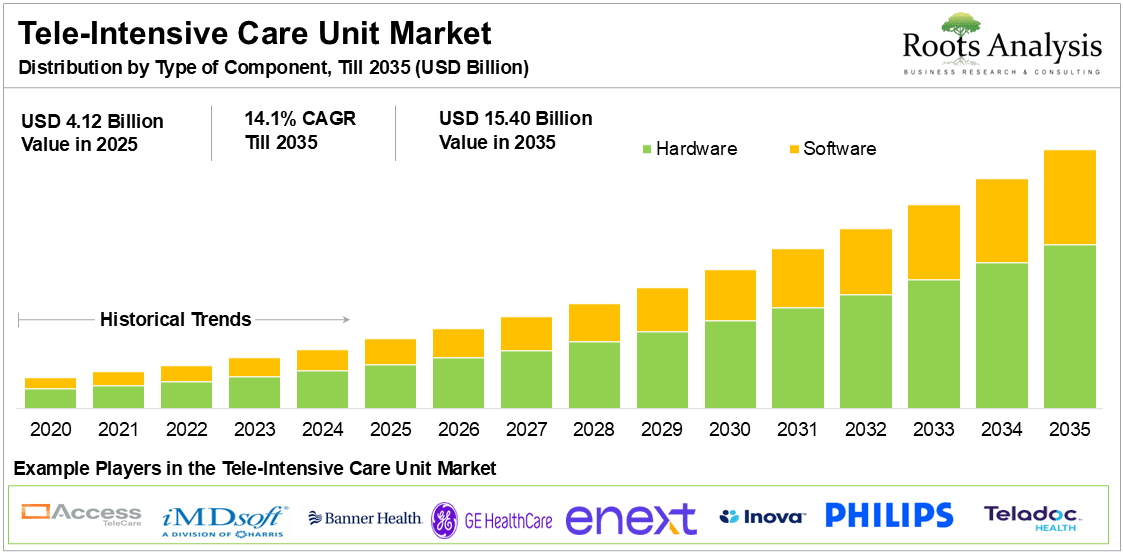
The tele-intensive care unit market is estimated to grow from USD 3.5 billion in 2024 to reach USD 4.12 billion in 2025 and USD 15.40 billion by 2035, representing a higher CAGR of 14.1% during the forecast period.
To learn more about this report, request a free sample copy
Tele-intensive care units are growing exponentially driven by the growing adoption of telehealth services to offer remote consultation. It refers to the use of telecommunication technology, computers and software to provide critical care services to patients who suffered chronic conditions or strokes. It is important to highlight that patients with chronic conditions or witness critical health conditions require urgent treatment to improve quality of life. With tele-intensive care units, healthcare experts can instantly offer consultation to patients with telecommunication technologies regardless of location. Timely access to critical care services can also help to reduce chances of mortality and enhance patient outcomes.
Owing to the ongoing demand and adoption of telehealth services for remote consultation to treat patient, several industrial players are accelerating their initiatives to develop advanced tele-intensive care units platforms and software. Notably, several industrial players are focusing on the development of tele-intensive care unit platforms and services. For instance, in March 2025, Philips launched a transformational tele-critical care program that combines predictive analytics tools, audio-visual technology and advanced reporting capabilities. Philips, U.S Department of Veterans Affairs and Department of Defense are working conjointly to build world’s largest tele-critical care network.
Tele-Intensive Care Unit Market: Report Attributes
| Key Report Attributes |
Details |
| Historical Trend |
Since 2020 |
| Forecast Period |
Till 2040 |
| Market Size 2025 |
USD 4.12 Billion |
| Market Size 2035 |
USD 15.40 Billion |
| CAGR (Till 2035) |
14.1% |
One of the key objectives of the tele-intensive care unit market report was to estimate the current size, opportunity, and the market growth potential, over the forecast period, till 2035. We have provided informed estimates on the likely evolution of the market for the forecast period.
The global tele-intensive care unit market analysis report also features the likely distribution of the current and forecasted opportunity within the market across various segments, such as type of component, type of tele-intensive care unit, type of model, type of technology, application area, end user, geographical regions and leading players.
In order to account for future uncertainties associated with some of the key parameters and to add robustness to our model, we have provided three market forecast scenarios, namely conservative, base, and optimistic scenarios, representing different tracks of industry’s evolution.
With increasing preferences for digital solutions to enhance workflow efficiency in healthcare industry, medical transcription software will continue to grow. Additionally, the increasing initiatives of well-established and new entrants for launching advanced AI-powered medical transcription software, this industry is likely to propel at a higher rate over the forecasted period.
Recent Developments in Tele-Intensive Care Unit Market
Several recent developments have taken place in the field of tele-intensive care unit. We have outlined some of these recent initiatives below.
- In February 2025, Etiometry received its 10th FDA clearance for critical care platform with enhanced cybersecurity compliance. This latest cybersecurity enhancement in Etiometry Platform will improve patient monitoring in critical care and support clinical decision.
- In February 2025, Apex Hospital, Navi Mumbai offer an electronic intensive care unit (eICU), a telemedicine system specifically designed to support critical care units in hospitals by offering remote monitoring and access to patients’ information regardless of geographical location. This system will allow critical care teams to collaborate and provide expertise to multiple ICUs in different locations at one time.
Tele-Intensive Care Unit Market Segmentation Insights
The market report provides comprehensive information on industrial players who are currently active across various segments of the industry as mentioned in the table below.
Tele-Intensive Care Unit Market: Market Segmentation
| Market Segmentations |
Details |
| Type of Component |
- Hardware (Computer System, Communication Lines, Physiological Monitors, Therapeutic Devices, Video Feed and Display Panels)
- Software
|
| Type of Tele-Intensive Care Unit |
- Open With Consultant
- Intensivist
- Co-Managed
- Open-Consultant
- Others
|
| Type of Model |
- Centralized
- Decentralized
|
| Type of Technology |
- Remote Patient Monitoring
- Telemedicine Platforms
- Artificial Intelligence Integration
- Data Analytics
|
| Application Area |
- Cardiac Care
- Neurological Care
- Respiratory Care
- Post-Surgical Care
|
| End User |
- Hospitals and Clinics
- Diagnostic Centers
- Other End Users
|
| Geographical Regions |
- North America
- Europe
- Asia-Pacific
- Middle East and North Africa
- Latin America
|
| Market in North America |
|
| Market in Europe |
- France
- Germany
- Italy
- Spain
- UK
- Rest of Europe
|
| Market in Asia-Pacific |
- China
- India
- Japan
- South Korea
- Rest of the Asia-Pacific
|
| Market in Middle East and North Africa |
- Egypt
- Saudi Arabia
- United Arab Emirates
|
| Market in Latin America |
|
Tele-Intensive Care Unit Market Share Insights
Market Share by Type of Component
- Based on the type of component, the global market is segmented into hardware (computer system, communication lines, physiological monitors, therapeutic devices, video feed and display panels) and software. According to our tele-intensive care unit market report, presently the hardware segment holds the largest share (63%) of the market. This can be attributed to the fact that hardware, such as computer systems, therapeutic devices and communication lines are essential to deliver tele-intensive care units.
- It is worth mentioning that the software segment will grow at a higher CAGR during the forecast period. Tele-intensive care unit software platforms are cost-effective and facilitate real-time data sharing, enabling healthcare professionals to access patient information and delivering care remotely.
Market Share by Type of Intensive-Care Unit: Open Consultants Holds the Largest Share of the Market
- The global market is further categorized across different types of intensive care unit, such as open with consultant, intensive, co-managed, open and others. Currently, open with consultant holds the largest share (31%) of the overall tele-intensive care unit market growth. Open consultant also provide is highly beneficial to offer consultation with experts. Moreover, open with consultant allow patients to discuss and engage with specialist for critical care recommendation.
- It is worth mentioning that intensive model is expected to grow at a higher CAGR during the forecast period. Intensive models provide support to intensive-care experts for handling tele-ICU system. Moreover, this intensive model helps to address patients’ complications and enhance clinical decisions.
Market Share by Type of Model: Centralized Model Holds the Largest Share of the Market
- The global market is analyzed across different types of centralized and decentralized. According to the tele-intensive care unit market forecast, centralized segment holds the largest share (over 49%) of the overall revenue. This dominance is due to the fact that centralized model offer a team of critical care specialized who are available 24 / 7 to support and monitor patients in ICUs at different locations.
- It is worth mentioning that centralized models are inexpensive and offer higher flexibility to support patient monitoring remotely. Owing to the significances of the centralized model, this segment will continue to grow at a higher CAGR during the forecast period.
Market Share by Type of Technology: Remote Patient Monitoring in Intensive Care Units is Dominating the Market
- Based on the type of technology, the global market is segmented into remote patient monitoring, telemedicine platforms, artificial intelligence integration, and data analytics. According to tele-intensive care unit market forecast, presently the remote patient monitoring segment is holding the highest share (over 40%) of the market. This can be ascribed to the rising adoption of remote patient monitoring devices for monitoring disease progress at home to patients.
- However, in the long run, telemedicine platforms segment is likely to grow at a higher CAGR during the forecast period. These platforms offer remote consultation specifically to patients with critical health conditions.
Market Share by Application Area: Cardiac Care Segment Holds the Highest Share
- The global market is further bifurcated based on application into cardiac care, neurological care, respiratory care, and post-surgical care. According to our tele-intensive care unit market analysis, presently cardiac care segment holds the largest share of the market. This can be attributed to the growing incidence of cardiovascular disorders and strokes that require immediate medical attention. Tele-intensive care unit play a significant role in connecting with cardiovascular specialists to get timely interventions.
- However, the respiratory care segment is likely to gain momentum at a higher CAGR during the forecast period. This is due to the growing incidence of respiratory disorders that necessitated the demand for remote care consultations.
Market Share by End User: Hospitals Segment Holds the Highest Share
- On the basis of end users, the global market is categorized hospitals, home healthcare, long-term care facilities, and emergency medical services. According to tele-intensive care unit market report, currently, the hospitals’ segment occupies the highest share (31%) of the market. This is likely to be the result of increasing adoption of remote monitoring devices, demand for specialized technologies and availability of advanced infrastructure in hospitals to handle patients.
- Tele-intensive care unit services also help to monitor patient remotely, allowing healthcare professionals in offering timely interventions. It is worth mentioning that this segment will continue to grow at a higher CAGR during the forecast period.
Market Share by Geographical Regions: North America is Dominating the Market
- Based on the geographical regions, the global market is segmented into North America, Europe, Asia-Pacific, Middle East and North Africa, and Latin America. According to our tele-intensive care unit market size, North America is dominating the market by holding 42% share of the market. Several factors, such as rising incidence of cardiovascular diseases and growing shift towards remote consultation along with adoption of telehealth services in this region are contributing to the highest share.
- In Asia-Pacific, the market for tele-intensive care unit is likely to register a higher CAGR during the forecast period. This potential growth is due to the increasing adoption of telehealth services and rising focus on delivering remote consultation to manage disease conditions at home.
Tele-Intensive Care Unit Market: Report Deliverables
| Report Deliverables |
Details |
Excel Data Packs
(Complimentary) |
Available |
| Key Tele-Intensive Care Unit Companies Profiled |
- Access TeleCare
- Apollo Telemedicine Networking Foundation
- Advanced ICU Care
- Banner Health
- Cloudphysician
- Eagle Telemedicine
- eNext ICU
- GE Healthcare
- ICU Standard
- Inova
- iMDsoft
- Philips
- RemoteICU
- Teladoc Health
(A complete list of companies captured is available in the report) |
PowerPoint Presentation
(Complimentary) |
Available |
| Customization Scope |
15% Free Customization |
What are the Major Takeaways of Tele-Intensive Care Unit Market
The “Tele-Intensive Care Unit Market Analysis Report: Industry Trends and Global Forecasts, till 2035” market report features an extensive study of the current market landscape, market size, market share, market growth, market trends, market value, market forecast, market outlook, statistics, and future opportunities for tele-intensive care unit industrial players. The market research report lays emphasis on the tele-intensive care unit that are being developed. Key takeaways of the market report are briefly discussed below.
How is the Competitive Landscape of Tele-Intensive Care Unit Market Fragmented?
The global market landscape for tele-intensive care unit is highly competitive, witness several tech giants and a wide array of industrial players who are focusing on expanding their tele-ICU services. Majority of the industrial players who are presently active in this domain include small, mid-sized and large companies. These industrial players are focusing on the development of tele-intensive care unit platforms and software that enable real-time analysis.
In order to leverage competitive edge, several industrial players are focusing on partnerships and collaborations. For instance, in January 2025, NMC Health announced its partnership with Access TeleCare to enhance access to critical care and pulmonary specialists via telemedicine.
What is the Current Size of Tele-Intensive Care Unit Market?
The global tele-intensive care unit market size is likely to be worth USD 4.12 billion in 2025 and will reach USD 15.2 billion by 2035. In terms of the type of component, hardware segment is currently holding the highest share of the market due to the increasing demand for communication channels and video consultation tools for delivering remote care. Some of the potential opportunities in this field are technological innovations, and demand robust connectivity solutions.
Which Region Holds the Largest Share of the Tele-Intensive Care Unit Market?
North America is Dominating the Market
North American tele-intensive care unit providing companies are presently holding the majority of the share. Notably, majority of the active industrial players are emphasizing the launch of platforms and services to enhance critical care services beyond geographical boundaries. Additionally, the ongoing technological innovations further solidify the market growth in this region.
Asia-Pacific: An Emerging Growth Area
In Asia-Pacific, the market for tele-intensive care unit is anticipated to grow at a higher CAGR during the forecast period, till 2035. Several factors, such as increasing adoption of telehealth services and remote monitoring devices are the key factors driving growth of market in this region.
What are the Key Drivers of Tele-Intensive Care Unit Market?
- Growing adoption of telehealth services and digital technologies to improve patient outcomes are the key drivers of the market. Moreover, the growing geriatric population who are at greater risk of cardiovascular disease and chronic conditions are fueling the tele-intensive care unit platforms demand.
- Additionally, the increasing adoption of tele-intensive care unit to provide direct consultation of critical care specialist is further contributing to the heightened growth of tele-intensive care unit market in the future.
What Are the Key Challenges in Tele-Intensive Care Unit Market?
- Technological limitations and compatibility issues remain the major concerns that may impede market growth during the forecast period.
- Additionally, the high cost associated with the installation of hardware and software may further limit the adoption of tele-intensive care units in low to middle income countries.
What are the Key Trends in the Tele-Intensive Care Unit Market?
- Integration of AI technology to support real-time consultation is one of the significant trends shaping the growth of tele-intensive care unit industry.
- Growing expansion of tele-intensive care unit and telehealth infrastructure to offer remote consultation and to identify early signs of disease progression are the key trends of the market.
- Moreover, the growing focus on delivering home based critical care and focus on cost-effective tele-intensive care unit to make consultation more feasible are likely to offer enormous opportunities to market players.
What are the Technological Advancements Which Will Fuel Innovation in Tele-Intensive Care Unit Industry?
- Development of AI integrated tele-intensive care unit platforms are the key technological innovations.
- Moreover, industrial players are greatly emphasizing the addition of big data analytical tools and technologies to enhance patient outcomes.
Tele-Intensive Care Unit Market Report Coverage
The market report presents an in-depth analysis, highlighting the capabilities of various stakeholders in the tele-intensive care industry, across different geographies. Amongst other elements, the market report includes:
- An Infographic Executive Summary
- Market Landscape of Tele-Intensive Care Unit Providers
- Company Competitiveness Analysis
- Company Profiles
- SWOT Analysis
- Market Impact Analysis
- Market Forecast Analysis
From the Author’s Desk
Author’s View on Tele-Intensive Care Unit Market
Tele-intensive care unit plays a significant role in enhancing patient care, reducing hospital stays and lowering the rate of mortality due to instant support. It is estimated that the tele-intensive care unit market remains progressive during the forecast period due to growing partnerships for technological innovations. Additionally, the combined efforts for widespread adoption of tele-intensive care unit by industrial players, healthcare sectors and government organizations are likely to solidify the market growth during the forecast period.
Glossary
- Tele-Intensive Care Unit: It refers to the use of technologies and platforms to deliver critical care services remotely to patients in ICU. These systems allow specialists to offer consultation, real-time monitoring and support beyond geographical regions.
- Telemedicine Platform: It is specifically designed for offering remote consultation virtually using video consultation tools and more.
Frequently Asked Questions
What are tele-intensive care units?
It is a form of healthcare services that are delivered to the patients remotely using telehealth platforms and technologies.What is the market potential for tele-intensive care unit?
The tele-intensive care unit market size is likely to be USD 4.12 billion in 2025 and will be worth USD 15.40 billion in 2035.What is the CAGR of tele-intensive care unit market size?
The global market for tele-intensive care unit is likely to grow at a CAGR of 14.1% till 2035.Which key geographical segment is likely to capture majority share in the tele-intensive care unit market?
North America is currently capturing the highest share of the tele-intensive care unit market.Which are the top companies in the market for tele-intensive care unit?
Access TeleCare, Apollo Telemedicine Networking Foundation, Advanced ICU Care, Banner Health, Cloudphysician, Eagle Telemedicine, eNext ICU, GE Healthcare, ICU Standard, Inova, iMDsoft, Philips, RemoteICU, Teladoc Health and zMed Healthcare Technologies.What are the factors driving the tele-intensive care unit industry?
Growing incidence of chronic conditions and demand for innovative consultation solutions to facilitate remote care.