
Lowest Price Guaranteed
Pages
198
Last Updated
June 2025
View Count
10767
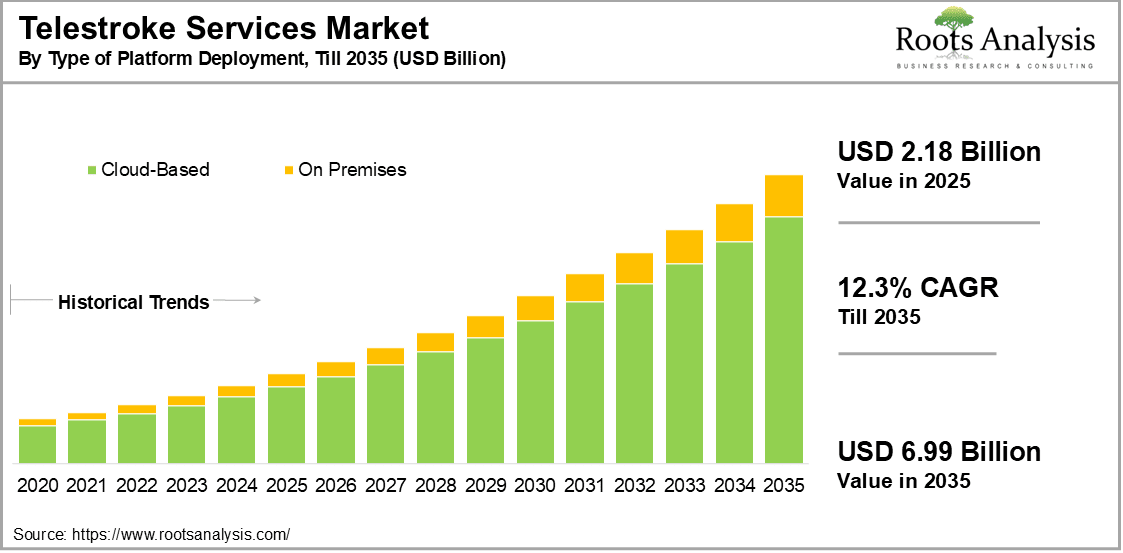
The global telestroke services market, valued at USD 1.89 billion in 2024, is projected to reach USD 2.18 billion in 2025 and USD 6.99 billion by 2035, representing a CAGR of 12.3% during the forecast period.
 |
To learn more about this report, request a free sample copy
Telestroke service is growing exponentially driven by the growing adoption of home healthcare and telehealth services to offer remote consultation. It refers to the use of telecommunication technology to treat patients who suffered strokes and are unable to visit hospitals to access specialized care.
Notably, strokes are the major cause of long-term disability / permanent disability, affecting people worldwide. It generally occurs due to sudden disruption of blood supply to the brain due to clots or ruptured blood vessels, causing damage to the brain. As per the World Stroke Organization global strokes fact sheet, published in NIH, there are over 12 million new strokes incidences recorded every year.
It is important to highlight that stroke patients require urgent treatment to reduce the chances of long-term disability. Lack of stroke specialists specifically in rural areas has necessitated the demand for telestroke services. With telestroke services, healthcare experts can instantly reach patients via telecommunication technologies regardless of location to offer consultation. Timely access to necessitated stroke treatments, such as thrombolysis, helps to improve patient outcomes.
Owing to the increasing demand for telestroke services, several industrial players have shown keen interest in this field. In order to expand global reach, presently market players are leveraging strategic partnerships and collaborations. For instance, in March 2025, Medtronic announced a strategic partnership with Medthinks artificial intelligence (AI) to enhance stroke treatment across Central and Eastern Europe, Africa, Turkiye and Middle East. The partnership aims to integrate Methinks AI into Medtronic’s stroke treatment ecosystem to streamline communication and network connectivity between specialized stroke centers, regional hospitals and care coordinators.
These ongoing initiatives by industrial players, rising demand for advanced remote consultation solutions to treat patients and technological innovations are accelerating the market growth during the forecast period.
The market report provides comprehensive information on telestroke companies who are currently active across various segments of the industry as mentioned in the table below.
| Key Report Attributes | Details | |
| Historical Trend | Since 2020 | |
| Forecast Period | Till 2035 | |
| Market Size 2025 | USD 2.18 Billion | |
| Market Size 2035 | USD 6.99 Billion | |
| CAGR (Till 2035) | 12.3% | |
| Type of Stroke |
|
|
| Type of Platform Deployment |
|
|
| Application Area |
|
|
| End User |
|
|
| Geographical Regions |
|
|
| Key Companies Profiled |
|
|
| PowerPoint Presentation (Complimentary) |
Available | |
| Customization Scope | 15% Free Customization | |
| Excel Data Packs (Complimentary) |
Available | |
One of the key objectives of telestroke services market report was to estimate the current size, opportunity and the market growth potential, over the forecast period, till 2035. We have provided informed estimates on the likely evolution of the market for the forecast period.
The global market analysis report also features the likely distribution of the current and forecasted opportunity within the market across various segments, such type of stroke (ischemic stroke, hemorrhagic stroke, and transient ischemic attack), type of platform deployment (cloud-based and on premises), application area (counseling, treatment, emergency service, and other application areas), end user (telehospitals / teleclinics, telehome and other end users), geographical regions (North America, Europe, Asia Pacific, Middle East and North Africa, and Latin America) and leading players.
In order to account for future uncertainties associated with some of the key parameters and to add robustness to our model, we have provided three telestroke services market forecast scenarios, namely conservative, base, and optimistic scenarios, representing different tracks of industry’s evolution.
All actual figures have been sourced and analyzed from publicly available information forums and primary research discussions. The financial figures mentioned in this market report are in USD, unless otherwise specified.
The global market is analyzed across different types of strokes, such as ischemic stroke, hemorrhagic stroke, and transient ischemic attack. According to our market report, currently ischemic stroke segment holds the largest share (78%) of the overall revenue. This dominance is due to the increasing incidence of ischemic strokes across the globe.
Additionally, the risk associated with ischemic strokes, such as heart disease, diabetes and hypertension has further necessitated the demand for advanced telestroke services to manage disease conditions. It is important to highlight here that ischemia strokes segment is expected to remain dominant during the forecast period, anticipated registering a higher CAGR.
Based on the type of platform deployment, the global market is segmented into cloud-based and on-premises. According to telestroke services market forecast, presently cloud-based segment is occupying the highest share (over 85%) of the market. Cloud-based platform deployment offers high flexibility, interoperability and connectivity with existing healthcare systems.
Moreover, cloud-based systems are comparatively inexpensive than other deployment methods. Owing to its cost-effectiveness, this segment will continue to remain dominant and is expected to grow at a higher CAGR during the forecast period.
The global market is further bifurcated based on application area into counseling, treatment, emergency service, and other application areas. According to our telestroke services market analysis, presently the emergency service segment holds the largest share (over 40%) of the market. Strokes, such as ischemic strokes require immediate medical attention to avoid the risk of long-term disability.
Telestroke services play a crucial role in connecting with stroke specialists to get virtual neurological consultation on time during emergencies. Owing to the time sensitive nature of strokes, emergency service segment continues to dominate the market and is poised to grow at a higher CAGR during the forecast period.
On the basis of end users, the global market is categorized across telehospitals / teleclinics, telehome and other end users. Currently, the telehospitals / teleclinics segment holds the highest share of the market. This can be attributed to the fact that telehospitals / teleclinics are equipped with advanced telecommunication technologies, healthcare specialists and imaging technologies to handle patients with strokes. Owing to the greater accessibility, this segment will continue to expand at a substantial CAGR during the forecast period.
Based on the geographical regions, the global telestroke services market size is segmented into North America, Europe, Asia-Pacific, Middle East and North Africa, and Latin America. According to the market analysis, currently North America is dominating the market by holding nearly 50% share of the market. North America witnesses the high prevalence of stroke, which necessitated the demand for advanced telehealth services to handle patients during emergencies. Furthermore, the rising adoption of telehealth services to deliver remote consultation is likely to fuel the growth of market in this region.
In Asia-Pacific, the market for telestroke services is likely to register a higher CAGR during the forecast period. This can be ascribed to the rising adoption of digital technologies and growing initiatives by government to deliver right consultation remotely to manage patients with strokes.
The “Telestroke Services Market: Industry Trends and Global Forecasts, till 2035” market report features an extensive study of the current market landscape, market size, market share, market growth, market trends, market value, market forecast, market outlook, statistics, and future opportunities for telestroke companies. The market research report lays emphasis on the telestroke services / platforms that are being developed. Key takeaways of the market report are briefly discussed below.
The market for telestroke services witness tech giants and diversified industrial players who are focusing on expanding product portfolios. Majority of the industrial players, including small, mid-sized and large companies, are aiming for technological innovations and launching telestroke services. For instance, in February 2025, UF Health Jacksonville launched a new telehealth service with an aim of expanding access to lifesaving stroke care across St. Johns County. This new telehealth service allows healthcare practitioners to identify and treat stroke patients in a timely manner.
The global telestroke services market is driven by the growing incidence of strokes across the globes. Additionally, the shift towards telehealth services to monitor patients with strokes in real-time has contributed to the growth of the telestroke services.
Furthermore, the growing penetration of digital health technologies to monitor patients remotely and managing health conditions associated with brain has further bolstered the market growth during the forecast period.
Despite growing needs of telestroke services, the market for telestroke services is experiencing challenges. Some of the notable challenges are high upfront cost associated with installation of infrastructure, high-speed connectivity and equipment may hinder the adoption of telestroke services in low to middle income countries. Additionally, interoperability challenges, regulatory issues, data privacy and security challenges may limit the market progress over the forecasted period.
Some of the emerging trends that are shaping the telestroke services industry include the expansion of services beyond hospital settings to treat and monitor patients. Furthermore, the healthcare personnel are adopting cloud-based platforms to provide timely interventions to patients with ischemic strokes, creating opportunities for industrial players to innovate in this field.
Additionally, the focus on the integration of emergency medical services with telestroke networks and emphasizing the integration of AI technology has fueled the market growth during the forecast period.
In 2025, the global market for telestroke services is estimated to be valued at USD 2.18 billion and is projected to reach USD 6.99 billion by 2035, representing a CAGR of 12.3% during the forecast period. The market is primarily driven by the rising incidence of ischemic strokes across the globe.
In order to meet with growing demand, several industrial players are forging partnerships and collaboration. In March 2025, Jacksonville announced latest addition for Florida’s first mobile stroke treatment unit network to Northeast Florida in partnership with UF Health. The aim is to enhance the speed of care of patients with stroke and reduce the risk of disability.
Examples of key players engaged in this domain (which have also been captured in this report) include American Well, DispatchHealth, GlobalMedia, Eagle Telemedicine, Lakewood Health System, Providence, SEVARO, Teladoc Health, TeleSpecialists and VeeOne Health. This market report includes an easily searchable excel database of all the companies focusing on the development of telestroke services.
The market report presents an in-depth analysis, highlighting the capabilities of various companies engaged in this domain across different segments. Amongst other elements, the market report includes:
Several recent developments have taken place in the field of telestroke services. We have outlined some of these recent initiatives below.