
Lowest Price Guaranteed
Slides
132
Last Updated
July 2026
View Count
15050
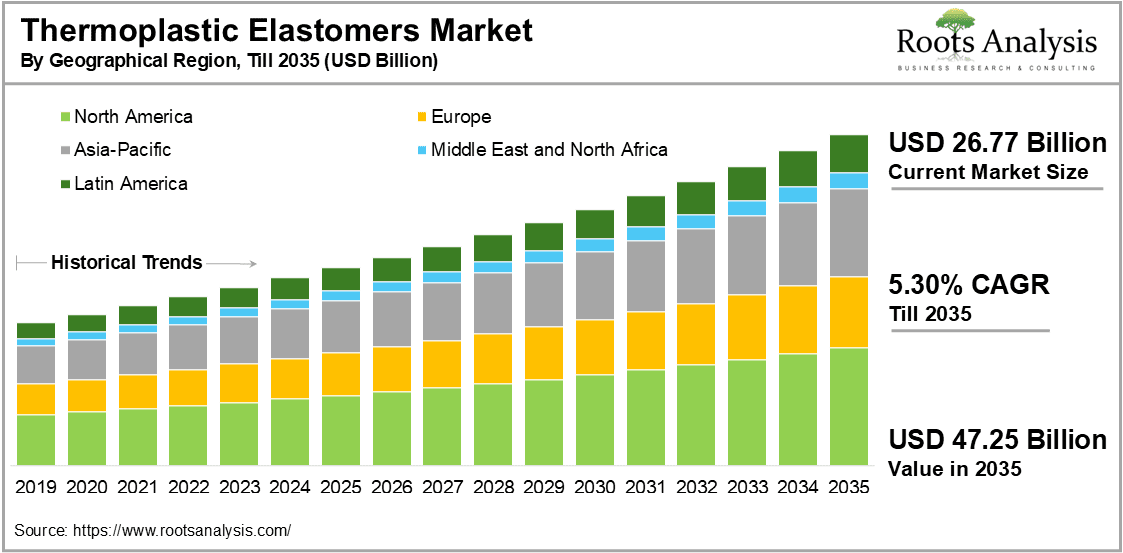
The global thermoplastic elastomers market size is valued at USD 26.77 billion in 2024 and is poised to reach USD 47.25 billion by 2035, representing a higher CAGR of 5.30% during the forecast period.
 |
To learn more about this report, request a free sample copy
Thermoplastic elastomer (also called third-generation rubber) is a subclass of polymers that combines the unique characteristics of elastomers and thermoplastic. These types of polymers can be molded using advance manufacturing equipment, such as blow molding, injection molding and extrusion into desired shapes. The significant attributes conferred by the thermoplastic polymers (including sterilizability, low level of extractables and cost-effectiveness) makes it ideal for a wide range of equipment, such as manufacturing dental equipment, lids, syringe seals and caps, membranes and valves. The high demand of these polymers can be attributed to the resistance of high temperature and prevention of cross-contamination by these medical grade plastics.
The demand for thermoplastic polymers has been further fueled by the increasing requirement of biocompatible polymers for the manufacturing of medical devices, drug packaging solutions, drug delivery systems and medical implants. Additionally, the thermoplastic polymers are being used for surgical gloves, syringes, insulin pens, catheters, IV tubes, heart valves, pacemakers, childproof caps, stents, sterilization wrap, joint replacement device and surgical basins. Moreover, TPE materials are extensively used in automotive industry (especially for production of electric vehicles) and building construction industry (for the production of hoses, ducting and suction).
Owing to the ongoing opportunities across a wide range of industry, the key players of this market are undertaking several initiatives such as partnerships, collaborations, investments and emphasizing innovative product launch. Interestingly, in August 2024, Trelleborg (through Trelleborg Sealing Solutions) announced its plan to acquire Magee Plastics, a specialist in high-performance thermoplastics and composite material solutions. . Recently, in September 2024, Avient announced the manufacturing expansion of NEU™ Custom Capabilities and NEUSoft™ thermoplastic polyurethane solution for catheter applications. Owing to the upsurge in the usage of TPE and rising initiatives between stakeholders engaged in this domain, we believe that the market will grow at a steady rate during the forecast period.
The market report provides an in-depth analysis of the product pipeline and developer companies who are currently engaged in the industry across different industrial segments as mentioned in the table below.
| Key Report Attributes | Details | |
| Historical Trend | Since 2019 | |
| Forecast Period | Till 2035 | |
| Market Size 2035 | USD 47.25 Billion | |
| Market CAGR | 5.30% | |
| Type of Product |
|
|
| Application |
|
|
| Geographical Regions |
|
|
| Key Companies Profiled |
|
|
| PowerPoint Presentation (Complimentary) |
Available | |
| Customization Scope | 15% Free Customization | |
| Excel Data Packs (Complimentary) |
Available | |
The key objective of the thermoplastic elastomers market report is to provide a detailed market analysis in order to estimate the existing caps and closures market size, market share, market growth, market trends, market value, market forecast, market outlook, statistics and future opportunity for key players active in this industry during the forecast period. Based on several parameters, such as target consumer segments, region specific adoption rates and expected prices of such products, we have provided an informed estimate on the likely evolution of the market over the forecast period till 2035.
The market report provides sales forecasts for the overall thermoplastic elastomers market, wherein both the current and upcoming opportunity is segmented across type of product (polyurethane, polyamide, vulcanizates, styrenic block copolymer, olefins and other products), type of application (automotive, electrical & electronics, industrial, medical, consumer goods and other applications), geographical region (North America, Europe, Asia-Pacific, Middle East and North Africa, and Latin America) and leading players. In order to account for future uncertainties and to add robustness to our model, we have provided three market forecast scenarios, namely conservative, base and optimistic scenarios, representing different tracks of the industry’s growth.
Based on type of product, the global market is segmented into polyurethane, polyamide, vulcanizates, styrenic block copolymer, olefins and other products. Currently, the thermoplastic elastomers market size for styrenic block copolymer is the highest (with a percentage share of 25%). This can be attributed to the wider use of styrenic block copolymer in the production of medical tubing, medical bags and consumer goods. The excellent processability and rubber-like elasticity of these TPEs makes these materials the first choice in a wide range of industries. However, the vulcanizates thermoplastic will grow at a higher CAGR during the projected period owing to the growing adoption in the medical field for the development of recyclable and reusable blood bags and catheters.
This segment highlights the distribution of global market across various types of application, such as automotive, electronic & electronics, industrial, medical, consumer goods and other applications. According to our recent study, presently the automotive industry segment accounts for the highest thermoplastic elastomers market share (~40%). This can be attributed to the growing usage of thermoplastic elastomer in the production of automobile interiors and frames. Moreover, thermoplastic elastomers are lightweight, durable and resist harsh environment conditions, making it an ideal option to reduce weight of electrical vehicles and enhance performance. However, in the long run, the medical segment is anticipated to grow at a higher CAGR during the forecast period. This can be attributed to the fact that thermoplastic elastomers have been widely adopted for the manufacturing of medical tubes, implantable devices, medical syringes and catheters.
The global market is distributed across various geographical regions, such as North America, Europe, Asia-Pacific, Middle East and North Africa, and Latin America. According to our projection, presently North America accounts for the highest (36%) thermoplastic elastomers market share. This dominance is attributed to the high usage of medical elastomers for the development of implants, surgical instruments and equipment in advanced healthcare infrastructure of North American region. Furthermore, the stringent guidelines associated with usage of implant-grade materials has underscore the demand for thermoelastic polymers. Additionally, growing efforts for the development of innovative medical grade products using thermoplastic polymers by industry stakeholders has contributed to the growth of this region.
However, the market for thermoplastic elastomers in Asia-Pacific will show lucrative growth potential and is poised to grow at a higher CAGR during the forecast period. This can be attributed to improving healthcare facilities and growing expenditure by industry stakeholders established in this region for the development of medical grade instruments.
The “Thermoplastic Elastomers Market: Industry Trends and Global Forecast, till 2035” market report highlights the in-depth information on the current practices, emerging products, and market share of the individual products. In addition to other elements, the study includes detailed assessment of the current market landscape, providing information about type of product, type of end-user, and other development activities.
Currently, the market landscape features the presence of several well-established and new entrants who are accelerating their efforts for manufacturing advanced thermoplastic polymers, based on high quality raw material. Notably, the key players active in this domain are leveraging technological advancements to develop modified polymers with desired characteristic properties. For instance, in July 2024, KRAIBURG launched THERMOLAST® (an innovative thermoplastic elastomer solution) for EV charger applications. The material is claimed to be long-lasting, withstand harsh environmental conditions and can be recycled easily. Earlier, in January 2024, Novoloop announced the construction of pilot plant in India in order to manufacture chemically upcycled thermoplastic polyurethane using the post-consumer plastic waste.
Overall, the market will remain competitive throughout the forecast period driven by the ongoing innovations in this field and active participation of industry stakeholders to explore more applications of thermoplastic polymers.
The global market of thermoplastic polymer is continually witnessing an upward trajectory owing to the growing shift towards minimal invasive treatment procedures that demand surgical instruments and devices made with TPU. Furthermore, the key market driver is rising aging population that demands advanced medical devices and mobility equipment such as walkers, canes, hearing aids as well as person-lifting equipment. With growing age, patients may require specialized equipment for mobility which has further raised the demand for thermoplastic polymers. Additionally, technological advancements for polymer formulation to develop superior medical devices and in automotive industry is likely to propel the market growth.
In addition to pharmaceutical industry, the demand for thermoplastic elastomers has significantly increased in the automotive industry. Currently, automobile companies are using thermoplastic polymers and elastomers for manufacturing interiors. The purpose of using thermoplastic elastomers is to reduce the weight of heavy vehicles for speed efficiency. It is important to highlight here that National Aeronautics and Space Administration (NASA) also initiated lightweight materials and structure projects with an aim of redesigning its material technology for space exploration in future. Furthermore, thermoplastic elastomers are also used in the manufacturing of EV vehicles charger, which is expected to increase the demand for these lightweight materials in another industrial domain.
Despite the growing demand, the thermoplastic elastomers industry is witnessing several challenges that may hinder market growth during the forecast period. Some of the potential challenges are cost fluctuation of raw materials and rising environment concerns. Furthermore, the availability of alternative raw materials such as ceramic and metals may pose a significant competition that may impede the widespread adoption of thermoplastic polymers. Moreover, complex regulatory guidelines for the approval of medical grade polymers may impact market growth during the forecast period.
The growing shift towards sustainable and eco-friendly medical grade polymers for the development of medical devices and surgical equipment has offered significant opportunities to industrial leaders. Furthermore, the demand for bioplastics and recyclable thermoplastics for the development of a wide range of medical products and instruments such as blood contact catheters, medical bags, breast implants and medical tubes has contributed to the growth of the market during the forecast period. Furthermore, several government organizations are focusing on increasing the usage of bio-based thermoplastic elastomers for applications such as plastic syringes, surgical gloves and instruments.
The global market is currently valued at USD 26.77 billion and is poised to reach USD 47.25 billion by 2035. Further, the innovations and strategic initiatives of industry stakeholders are likely to drive the market growth during the forecast period at a CAGR of 5.30%. Notably, thermoplastic polymers demand is growing exponentially across different industrial verticals including automobiles, healthcare, pharmaceuticals, building construction and other industries. However, the primary focus of industry stakeholders is to manufacture of bio-based vulcanizate thermoplastic elastomers with high performance and hardness level. It is worth mentioning that SILIKE launched SI-TPV (a patented dynamics vulcanized thermoplastic Silicone-based elastomer) made with compatible technology. This unified material offers properties of fully cross-linked silicone rubber which is suited to make wearable device surface, automobile parts, artificial leather and electronic device accessories.
Examples of key companies engaged in the development of thermoplastic elastomers industry (which have also been profiled in this market report; the complete list of companies is available in the full report) include Arkema, Asahi Kasei, BASF SE, CNPC, Covestro, Dow, DuPont, Dynasol Group, Evonik, Huntsman International, Kraton, Mitsubishi Chemical, SIBUR HOLDING, Teknor Apex, The Lubrizol, and Tosh.
Several recent developments have taken place in the field of thermoplastic elastomers. We have outlined some of these recent initiatives below. These developments, even if they took place post the release of our market report, substantiate the overall market trends that have been outlined in our analysis.