
Lowest Price Guaranteed
Pages
190
Last Updated
May 2025
View Count
12367
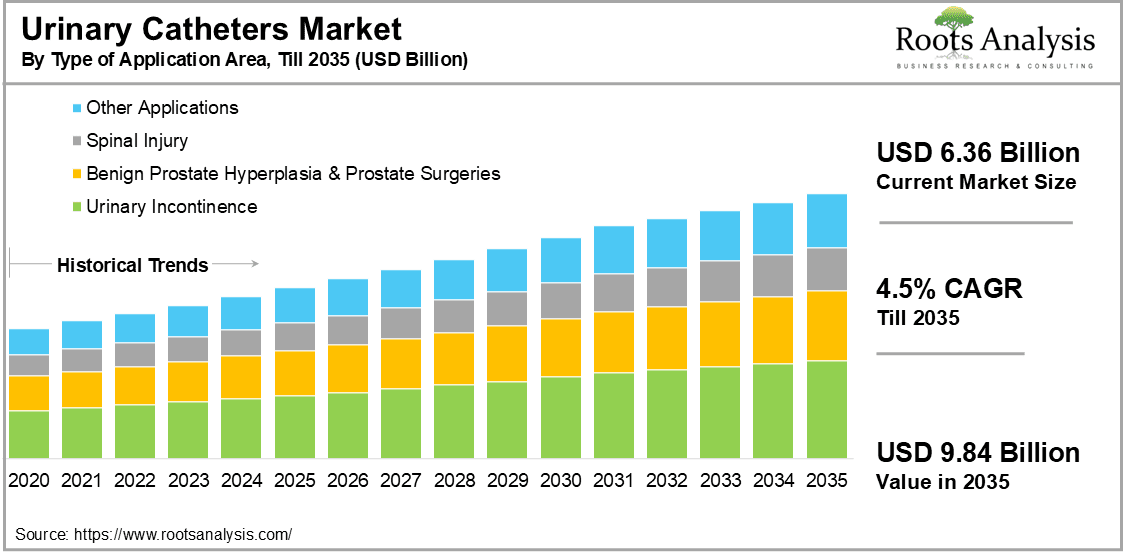
The global urinary catheters market, valued at USD 6.03 billion in 2024, is projected to reach USD 6.36 billion in 2025 and USD 9.84 billion by 2035, representing a CAGR of 4.5% during the forecast period.
 |
Urinary catheter is a form of tube placed inside the body in order to drain urine from the bladder. The healthcare professionals usually recommend these catheters to patients who are facing urinary incontinence, urinary retention, prostate surgery and certain medical conditions. According to the report published by Center for Disease Control and Prevention in 2024, nearly 15-25% hospitalized patients use urinary catheter.
Thus, there has been an augmentation in the demand for urethral catheters for urine drainage. Considering the ongoing trend, several industrial players are focusing on the development of urinary catheters. However, their primary focus will remain on reducing the residual urine and chances of infection that occur due to prolong usage of catheters.
Currently, the market is moderately competitive, featuring the presence of numerous well-established and new entrants who are consistently taking strategic initiatives to develop urinary catheters. For instance, in December 2024, Convatec (leading company of medical products and technologies) announced the launch of GentleCath Air™ for Women with FeelClean Technology™, in the United Kingdom, Italy and France. This newly designed GentleCath™ has hydrophilic properties in the catheter material, which avoid the issues of tugging and sticking associated with some coated hydrophilic catheters, thereby decreasing the issues of urine residue and mess.
Similarly, several industrial players are focusing on technological innovations to drive the development of innovative urethral catheters considering the patient discomfort as a priority. Owing to the ongoing initiatives and rising demand, we believe that the urinary catheters market will expand at a steady rate during the forecast period.
The market report provides comprehensive information on industrial players who are currently active across various segments of the industry as mentioned in the table below.
| Key Report Attributes | Details | |
| Historical Trend | Since 2020 | |
| Forecast Period | Till 2035 | |
| Current Market Size | USD 6.36 Billion | |
| Market Size 2035 | USD 9.84 Billion | |
| CAGR (Till 2035) | 4.5% | |
| Type of Product |
|
|
| Type of Application Area |
|
|
| Type of Coating |
|
|
| Type of Gender |
|
|
| Type of Material |
|
|
| End User |
|
|
| Geographical Regions |
|
|
| Key Companies Profiled |
|
|
| PowerPoint Presentation (Complimentary) |
Available | |
| Customization Scope | 15% Free Customization | |
| Excel Data Packs (Complimentary) |
Available | |
One of the key objectives of urinary catheters market report was to estimate the current size, opportunity and the market growth potential, over the forecast period, till 2035. We have provided informed estimates on the likely evolution of the market for the forecast period.
The global urinary catheters market analysis report also features the likely distribution of the current and forecasted opportunity within the market across various segments, such type of product (intermittent catheters (ported peripheral intravenous catheters and non-ported peripheral intravenous catheters), foley / indwelling catheters and external catheters), type of application area (urinary incontinence, benign prostate hyperplasia & prostate surgeries, spinal cord injury and other applications), type (coated catheters and uncoated catheters), type of gender (male and female), type of material (latex catheters, silicon catheters, PVC catheters and hydrophilic catheters), end user (hospitals, clinics, long term care facilities and other end users), geographical regions (North America, Europe, Asia Pacific, Middle East and North Africa, and Latin America) and leading players.
In order to account for future uncertainties associated with some of the key parameters and to add robustness to our model, we have provided three market forecast scenarios, namely conservative, base, and optimistic scenarios, representing different tracks of industry’s evolution.
All actual figures have been sourced and analyzed from publicly available information forums and primary research discussions. The financial figures mentioned in this market report are in USD, unless otherwise specified.
Based on the type of product, the global market is segmented into intermittent catheters (ported peripheral intravenous catheters and non-ported peripheral intravenous catheters), foley / indwelling catheters and external catheters. According to our urinary catheters market analysis, currently, intermittent catheter market segment accounts for the largest share (56%). This can be attributed to the fact that intermittent catheter is a standardized draining catheter preferred by doctors due to convenience of usage and poses low risk of complications.
However, in the future, the external catheters segment is likely to grow at a higher CAGR during the forecast period. External catheters are excellent for male patients and those who prefer self-catheterization. Moreover, these catheters are available in a wide range of sizes to meet the requirement of individual patient’s needs.
This segment highlights the distribution of global market across different types of application areas, such as urinary incontinence, benign prostate hyperplasia & prostate surgeries, spinal cord injury and other applications. Among these, presently, urinary incontinence segment is dominating the industry by holding 36% of the urinary catheters market share. This can be attributed to the growing incidence of urinary incontinence specifically in women and geriatric population across the globe. It is important to highlight here that urinary incontinence is a major reason behind widespread adoption of urinary catheters.
Contrastingly, benign prostate hyperplasia & prostate surgeries segment is likely to register the fastest CAGR during the forecast period. This is likely to be the result of growing awareness about how benign prostate hyperplasia & prostate surgeries impact the quality of life. Notably, it is a medical condition in which prostate gland becomes enlarged and create blockages in the urine flow. As a result, patients may require catheter to get relief from urine blockage and retention after a surgical procedure, which is likely to bolster its demand among patients.
The global market is categorized across different types of coating, such as coated catheters and non-coated catheters. According to our market forecast, currently coated catheters account for the highest urinary catheters market size (with a share of over 60%). This can be attributed to the rising demand for advanced coating-based catheters, such as antimicrobial coating-based catheters, hydrogel coated catheters and silver coated catheters to minimize the risk of urinary tract infection that occurs due to prolong usage of catheters. Driven by the growing preferences, this segment will continue to remain dominant and is likely to grow at a higher CAGR during the forecast period.
On the basis of gender type, the global market is distributed into male and female. Currently, male segment accounts for the largest urinary catheters market share. This can be attributed to the growing incidence of urinary incontinence in men and rising risk of benign prostatic hyperplasia in men. However, the female segment is likely to grow at a higher CAGR during the forecast period. This can be attributed to the growing demand for urinary catheters to manage urinary dysfunction specially among adult women.
The global urinary catheters market is further bifurcated based on the type of material into latex catheters, silicon catheters, PVC catheters and hydrophilic catheters. According to our market analysis, presently silicon catheters segment (28%) accounts for the highest market share. This can be attributed to silicon catheters having high biocompatibility, causing minimal discomfort and reducing the infection risk, which makes it an ideal catheter for patients who require catheters for long term. However, in the long run, PVC catheters segment is likely to gain traction at a higher CAGR during the forecast period. This is primarily due to the cost-effectiveness and improved biocompatibility.
Based on the end user, the global urinary catheters market is segmented into hospitals, clinics, long term care facilities and other end users. According to our projection, currently hospitals occupy the highest share (41%) of the market. This can be attributed to the fact that healthcare providers often recommend intermittent catheterization for patients with urinary dysfunction and incontinence problems. Furthermore, intermittent catheterization is user-friendly which makes it ideal for patients in managing urinary incontinence issues. However, in the long run, the long-term care facilities segment is likely to grow at a higher CAGR during the forecast period. This can be attributed to the rising geriatric population with chronic conditions that may cause urinary incontinence.
North America accounts for the largest urinary catheters market size (with a share of 36%). This dominance is due to the rising incidence of chronic diseases such as benign prostate hyperplasia, urinary incontinence and diabetes. In addition, the increasing adoption of antimicrobial-coated urinary catheters to manage urinary dysfunction among the population has contributed to the highest share of this region.
However, in Asia Pacific, the market for urinary catheters is likely to grow at a highest CAGR during the forecast period. This is likely to be the result of increasing geriatric population with urinary problems that have necessitated the demand for urinary catheters for long-term management. Additionally, the rising shift towards catheter innovations and growing government participation to enhance healthcare quality of geriatric population has further spurred the market growth at a significant rate during the forecast period.
The “Urinary Catheters Market: Industry Trends and Global Forecasts, till 2035” market report features an extensive study of the current market landscape, market size, market share, market growth, market trends, market value, market forecast, market outlook, statistics and future opportunities for urinary catheters industrial players. The market research report lays emphasis on the urinary catheters solutions that are being developed for the treatment of patient.
Urinary catheter is a valuable solution for patients with urinary dysfunction or those who have undergone surgical procedures. Owing to the growing need, the market landscape of urinary catheters witnesses several small, mid-sized and large industrial players who have been continually focusing on technological innovations to develop advanced urinary catheters which patients can use independently or deliver specific medicines.
For instance, in November 2024, UroGen Pharma announced the USFDA acceptance of UGN-102 which is delivered through urinary catheter. This drug will help in redefining the treatment of low-grade intermediate-risk non-muscle invasive bladder cancer. As more market players continue to evolve latest urinary catheter solutions and technologies for easy navigation of catheter tips, we believe that the market will remain immensely competitive to offer lucrative opportunities for innovations.
The market for urinary catheters is propelled by the growing geriatric population with urinary incontinence and rising prevalence of chronic conditions. It is important to highlight here that with growing age, geriatric population may witness urinary bladder outlet obstruction and urinary incontinence, which necessitated the demand for urinary catheters. Moreover, several chronic conditions and neurological disorders can cause bladder dysfunction which further necessitates the demand for urinary catheters for patients. Additionally, growing awareness about urinary health concerns and availability of effective solutions are likely to be the key drivers for the market.
Urinary catheters market is growing continually, driven by the rising incidence of urinary problems. However, there are some challenges in the urinary catheters industry that may limit the adoption. Some of the potential challenges include high complications associated with long-term usage and risk of urinary tract infections. It is important to highlight here that prolonged usage of urinary catheters can cause chronic inflammation and require frequent change of catheter to avoid risk of infection. In addition, there is the availability of alternative solutions (such as pads) which are mostly preferred by the patients specifically women which further limit the adoption of urinary catheters.
Several market growth factors that are driving the industry include technological innovations to enhance patient comfort and reduce the risk of infection. Currently, the industrial players are focusing on the development of innovative intermittent catheters with pre-lubricated and closed systems to enhance hygiene and ease of use. It is worth mentioning here that with rising home healthcare practices, the industrial players are also focusing on the development of self-catheterization devices so patients can self-use the urinary catheters to empty bladders. Furthermore, the market players are also emphasizing advanced medical device coatings such as hydrogel-coated catheters and antimicrobial-coating urinary catheters that contain zinc and solver. These coatings help to reduce the risk of microbial biofilm formation near catheter and prevent the risk of infection.
In 2025, the global market for urinary catheters is expected to be valued at USD 6.36 billion and is poised to reach USD 9.84 billion by 2035, expecting to grow at a CAGR of 4.5% during the forecast period. This lucrative growth is likely to be the result of rising incidence of chronic conditions that may result into urinary incontinence and cause difficulty in emptying bladder. In order to meet the growing demand, several industrial players are focusing on strategic partnerships and collaborations.
For instance, in April 2024, Medline and Consure Medical announced a strategic agreement to distribute the QiVi® MEC male external urine management device that help guard against catheter-associated urinary tract infections (CAUTI) and urinary incontinence-associated dermatitis (IAD). As stated by Nish Chasmawala (Co-founder and Chief Executive Officer, Consure Medical), “Our vision is to develop products that improve clinical outcomes, reduce healthcare costs, and expand coverage of use. We are incredibly excited to work with Medline to help make QiVi a standard of care across U.S. acute care hospitals. QiVi is the only product that works effectively on patients with difficult anatomies and hospitals that have implemented QiVi have seen significant reduction in their CAUTI, IAD and HAPI rates.”
Examples of key players engaged in this domain (which have also been captured in this report) include Boston Scientific, BD (C.R. Bard), B.Braun, Melsungen, Cook Medical, ConvaTec, Coloplast, Hollister, J and M Urinary Catheters, Medtronic, Medline Industries and Teleflex. This market report includes an easily searchable excel database of all the companies focusing on the development of urinary catheters.
The market report presents an in-depth analysis, highlighting the capabilities of various companies engaged in this domain across different segments. Amongst other elements, the market report includes:
Several recent developments have taken place in the field of urinary catheters. We have outlined some of these recent initiatives below.