Veterinary Hematology Analyzers Market
Veterinary Hematology Analyzers Market: Industry Trends and Global Forecast, Till 2035 - Distribution by Type of Product, Type of Animal, Type of Analysis Parameter, Type of Technology, Type of Parameter, Type of Sample, Type of Throughput, End User, Geographical Regions (North America, Europe, Asia-Pacific, Middle East and North Africa, and Latin America), and Leading Players
-
Lowest Price Guaranteed
-
Pages
198 -
Last Updated
July 2025 -
View Count
10383 -
Veterinary Hematology Analyzers Market Overview
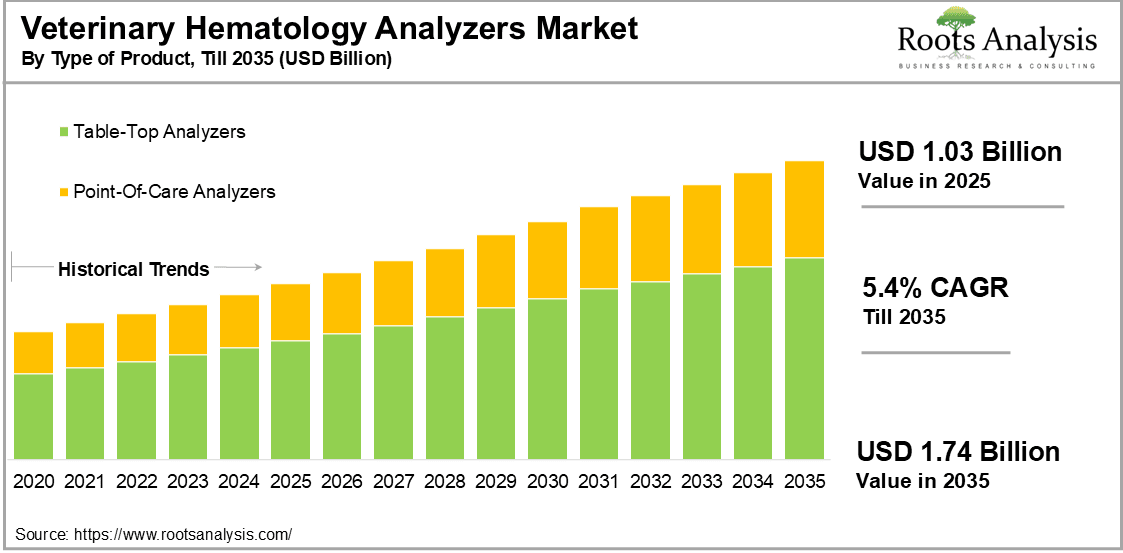
The global veterinary hematology analyzers market, valued at USD 0.96 billion in 2024, is projected to reach USD 1.03 billion in 2025 and USD 1.74 billion by 2035, representing a CAGR of 5.4% during the forecast period.
 |
To learn more about this report, request a free sample copy
Veterinary hematology analyzer is a device used to perform qualitative and quantitative analysis of complete blood count or hemogram. These instruments automate the entire process of blood samples by implementing state-of-the-art technologies, such as flow cytometry, novel spectrophotometry and impedance counting. Veterinary blood analyzer is available in different forms, such as tabletop models and handheld models for point-of-care diagnostics that help to streamline diagnostics and enhance treatment efficiency.
It is worth mentioning that the consistent surge in the adoption of companion animals has necessitated the demand for advanced diagnostics devices to enhance treatment outcomes of animals. Furthermore, the rising risk of animal diseases, such as influenza (H1N1 and H5N1) and Nipah that can be fatal and transformed to humans has further increases the adoption of veterinary hematology analyzer for early diagnosis. Considering the ongoing demand, various industrial players are aiming to accelerate technological innovations and point-of-care analyzers.
For instance, in September 2024, Zoetis revealed its latest hematology analyzer Vetscan OptiCell™ (a cartridge-based, AI-powered diagnostic tool). This newly launched diagnostic tool offers advanced complete blood count analysis. Similarly, various market players are focusing on enhancing their product portfolio by leveraging the emerging opportunities in the market.
Driven by the consistent efforts of industrial players and increasing demand, we believe that veterinary hematology analyzers market will continue to expand at a steady rate during the forecast period.
Veterinary Hematology Analyzers Market Segmentation Insights
The market report provides comprehensive information on hematology analyzer manufacturers who are currently active across various segments of the industry as mentioned in the table below.
Veterinary Hematology Analyzers Market: Report Attributes / Market Segmentation
| Key Report Attributes | Details | |
| Historical Trend | Since 2018 | |
| Forecast Period | Till 2035 | |
| Market Size 2025 | USD 1.03 Billion | |
| Market Size 2035 | USD 1.74 Billion | |
| CAGR (Till 2035) | 5.4% | |
| Type of Product |
|
|
| Type of Animal |
|
|
| Type of Analysis Parameter |
|
|
| Type of Technology |
|
|
| Type of Parameter |
|
|
| Type of Sample |
|
|
| Type of Throughput |
|
|
| End User |
|
|
| Geographical Regions |
|
|
| Key Companies Profiled |
|
|
| PowerPoint Presentation (Complimentary) |
Available | |
| Customization Scope | 15% Free Customization | |
| Excel Data Packs (Complimentary) |
Available | |
One of the key objectives of the veterinary hematology analyzer market report was to estimate the current size, opportunity, and the market growth potential, over the forecast period, till 2035. We have provided informed estimates on the likely evolution of the market for the forecast period.
The global market analysis report also features the likely distribution of the current and forecasted opportunity within the market across various segments, such as type of product (table-top analyzers (fully automatic analyzers and semi-automatic analyzers), and point-of-care analyzers (cartridge-based analyzers and direct sample based analyzers)), type of animal (companion animals (dogs, cats, horses, and other companion animals), and livestock animals (cattle, poultry, swine, and other livestock animals)), type of analysis parameter (3-part WBC differential, 5-part WBC differential and other parameters), type of technology (laser-based, electrical impedance and flow cytometry-based), type of parameter (complete blood count (CBC), white blood cell differential, red blood cell indices, platelet count and reticulocyte count), type of sample (whole blood, serum, plasma and buffy coat), type of throughput (low, medium and high), end user (veterinary hospitals & clinics, veterinary reference laboratories, point-of-care testing and veterinary research & academic institutes), geographical regions (North America, Europe, Asia-Pacific, Middle East and North Africa, and Latin America) and leading players.
In order to account for future uncertainties associated with some of the key parameters and to add robustness to our model, we have provided three veterinary hematology analyzer market forecast scenarios, namely conservative, base, and optimistic scenarios, representing different tracks of industry’s evolution.
All actual figures have been sourced and analyzed from publicly available information forums and primary research discussions. The financial figures mentioned in this market report are in USD, unless otherwise specified.
Veterinary Hematology Analyzers Market Share Insights
Market Share by Type of Product
Based on the type of product, the global market is segmented into table-top analyzers (fully automatic analyzers and semi-automatic analyzers), and point-of-care analyzers (cartridge-based analyzers and direct sample-based analyzers).
According to our veterinary hematology analyzers market report, currently table-top analyzers segment is dominating the market by holding nearly 70% of the overall revenue share. This can be attributed to the fact that table-top analyzers are easy to use and require minimal maintenance, which is likely to increase its adoption across veterinary hospitals for diagnostics. Moreover, table-top analyzers are cost-effective, which further make it a feasible option for complete blood count analysis.
However, it is worth noting that point-of-care analyzers segment is likely to register a higher CAGR during the forecast period. This lucrative growth is due to the increasing preferences for remote diagnosis.
Market Share by Type of Animal
The global market is bifurcated across different type of animal, such as companion animals (dogs, cats, horses, and other companion animals) and livestock animals (cattle, poultry, swine, and other livestock animals). According to our veterinary hematology analyzers market analysis, currently companion animals segment accounts for the highest share (over 80%) of the market. This can be attributed to the increasing adoption of companion animals across the globe and willingness to spend on animal health.
Furthermore, the increasing risk of zoonotic diseases and investment in pet insurance to maintain good health has further contributed to the highest share of this segment. Owing to the ongoing preferences, this segment is likely to remain dominant and is poised to grow at a higher CAGR during the forecast period.
Market Share by Type of Analysis Parameter
This segment highlights the distribution of global market across different types of analysis parameters, such as 3-part WBC differential, 5-part WBC differential and other parameters. According to veterinary hematology analyzers market size, currently 3-part WBC differential segment occupies the highest share (nearly 50%) of the market. This dominance is due to the widespread usage of 3-part WBC differential test for the counting of monocytes, lymphocytes and neutrophils. These tests are the adoption of veterinarian for the diagnosis of infectious diseases in animals.
However, in the long run, 5-part WBC differential test segment is likely to register a higher CAGR during the forecast period. This is primarily due to the increasing usage of 5-part WBC differential tests for the examination of complete blood count specifically five types of white blood cells to detect infection.
Market Share by Type of Technology
Based on the type of technology, the global market is segmented into laser-based, electrical impedance and flow cytometry-based. According to veterinary hematology analyzers industry, currently flow cytometry segment accounts for the highest share of the market. This can be attributed to the fact that flow cytometry offers high throughput screening and accurate results. Owing to the increasing preference for flow cytometry, this segment will continue to dominate the industry and is expecting to grow at a higher CAGR during the forecast period.
Market Share by Type of Parameter
The global market is categorized across different types of parameters, such as complete blood count (CBC), white blood cell differential, red blood cell indices, platelet count and reticulocyte count. According to our analysis, presently the complete blood count segment accounts for the highest share (nearly 55%) of the market.
This can be attributed to the fact that complete blood count test provides detailed overview about animal’s blood health, such as white blood count, blood cell count, hematocrit and hemoglobin levels, which makes it a valuable parameter to diagnose infectious diseases in animals. It is worth noting that this segment will continue to maintain a dominant position and is likely to grow at a higher CAGR during the forecast period.
Market Share by Type of Sample
Based on the type of sample, the global market is segmented into whole blood, serum, plasma and buffy coat. According to the veterinary hematology analyzers market report, presently whole blood sample segment holds the largest share of the market. Whole blood is easy to collect and provides a detailed analysis of all forms of blood cells. Veterinarians prefer whole blood sample for diagnosing diseases, which is expected to be the key reason for highest share. It is worth mentioning that this segment will continue to remain dominant, expecting to grow at a higher CAGR during the forecast period.
Market Share by Type of Throughput
The global market is distributed across different types of throughput, such as low, medium and high. According to our market report, presently the high throughput segment occupies the highest share of the global market. This can be attributed to the fact that high throughput-based analyzers are widely adopted in veterinary hospitals due to their accuracy and higher efficiency in handling large samples.
Moreover, the growing focus on automated high throughput analyzers for blood count analysis is likely to be the key reason for the highest share of this segment. Owing to the increasing preference, this segment will continue to grow at a higher CAGR during the forecast period.
Market Share by End User
This segment further categorized the global market across different types of end user, such as veterinary hospitals & clinics, veterinary reference laboratories, point-of-care testing and veterinary research & academic institutes. Currently, veterinary hospitals & clinics segment hold the highest share of the market for veterinary hematology analyzers. This can be attributed to the availability of advanced infrastructure in veterinary hospitals and the rising incidence of animal diseases which further increase the demand for hematology analyzers for diagnosing diseases.
However, in the long run, the veterinary reference laboratories segment is likely to grow at a higher CAGR during the forecast period. This is likely to be the result of the growing shift towards veterinary reference laboratories for personalized care and diagnostics.
Market Share by Geographical Regions
Based on the geographical regions, the global market is distributed across North America, Europe, Asia-Pacific, Middle East and North Africa, and Latin America. According to our analysis, presently North America is dominating the market by holding 40% share of the overall revenue. This can be attributed to the increasing adoption of companion animals in this region and the availability of pet insurance. Moreover, the industrial players established in this region are focusing on technological innovations and development of advanced handheld veterinary hematology analyzers, which further contributed to the highest share of the market.
However, the market for veterinary hematology analyzers is expected to grow at a highest CAGR during the forecast period. This unprecedented growth is likely to be the result of increasing pet population, expenditure on livestock industry and rising disposable income. Moreover, the growing government initiatives to advance veterinary healthcare infrastructure are further contributing to the lucrative growth of this region.
Veterinary Hematology Analyzers Market Dynamic Insights
The “Veterinary Hematology Analyzers Market: Industry Trends and Global Forecasts, till 2035” market report features an extensive study of the current market landscape, market size, market share, market growth, market trends, market value, market forecast, market outlook, statistics, and future opportunities for veterinary hematology analyzers industrial players. The market research report lays emphasis on the veterinary hematology analyzers that are being developed. Key takeaways of the market report are briefly discussed below.
Veterinary Hematology Analyzers Market Competitive Landscape
Currently, the veterinary hematology analyzers market landscape is highly competitive, featuring the presence of well-established and new entrants. The current focus on industrial players is on upgrading their existing product portfolio and the development of cutting-edge technologies to facilitate real-time analysis. In order to leverage competitive edge, various industrial players are undertaking strategic initiatives, such as the latest product launch, partnerships and collaborations.
For instance, in February 2024, Boule Diagnostics unveils its next generation Boule 950 series, the Swelab Alfa Plus, and Medonic M32 hematology analyzers at Medlab Middle East in Dubai. As more market players continue to strengthen their product portfolio, we believe that the market will remain competitive throughout the projected period.
Key Market Drivers: Rising Incidence of Zoonotic Disease and Adoption of Veterinary Hematology Analyzer with Automatic Data Management System
The heightened awareness about zoonotic diseases and its transmission to humans has driven the demand for advanced diagnostic tools, such as veterinary hematology analyzers. Additionally, the high adoption rate of companion animals and intensified research on animal diseases, vaccines and therapeutic drugs has necessitated the demand for advanced diagnostics tools. It is important to highlight here that government organizations across the globe are supporting research and development of advanced treatment and diagnostics tools to prevent the risk of zoonotic diseases, which further anticipated to be a key driver for the market.
Key Market Challenges: Stringent Guidelines, Limited Accessibility and High Initial Investment
Despite increasing demand, several factors that may impede market growth include stringent guidelines, limited accessibility and high initial investment. Notably, vet hematology analyzer are required to meet regulatory guidelines to ensure safety and efficacy in animal use. The stringent guidelines may delay the development and commercialization of instruments. Additionally, high initial investment for veterinary blood analyzer may limit the adoption across low to middle income countries. In addition, limited accessibility across rural areas may impact market growth.
Key Market Trends: Rising Demand for Point-of-Care Diagnostics, Technological Innovations and Automation
Some of the potential growth factors that are propelling the market include rising demand for point-of-care diagnostic tools for rapid diagnostics results and technological innovations. It is worth mentioning that automation will remain the key trend in this industry to improve the accuracy and efficiency of hematology analyzers. Additionally, the enhance connectivity and penetration of digital healthcare / diagnostic tools in veterinary industry has further necessitated the demand for modern tech-oriented hematology analyzers, which is expected to be a key market growth factor.
Veterinary Hematology Analyzers Market Size Analysis
Currently, the global veterinary hematology analyzers market is valued at USD 1.03 billion and is poised to reach USD 1.74 billion, expecting to grow at a CAGR of 5.4% during the forecast period. The market is expected to be driven by the rising demand for advanced diagnostics tools, such as veterinary hematology analyzers and handheld analyzers for diagnosing infectious diseases in animals. Driven by the ongoing demand, several market players are expected to strengthen their product portfolio and focus on the development of advanced animal hematology analyzers. In January 2024, Horiba Medical launched HELO 2.0 High throughput automated hematology platform approved by CE-IVDR. This next generation high-end hematology platform has been designed to enhance the analysis of blood samples with higher accuracy.
Leading Companies in Veterinary Hematology Analyzers Market
Examples of key players engaged in this domain (which have also been captured in this report) include Boule Medical, Clindiag Systems, Diatron MI, Drew Scientific, HemoCue, Heska, HORIBA Medical, IDEXX Laboratories, Mindray Medical International, Qreserve, Rayto Life and Analytical Sciences, Sysmex, Siemens Healthineers, Urit Medical, VetScan and Woodley Equipment. This market report includes an easily searchable excel database of all the companies focusing on the development of veterinary hematology analyzers products.
Veterinary Hematology Analyzers Market Report Coverage
The market report presents an in-depth analysis, highlighting the capabilities of various companies engaged in this domain across different segments. Amongst other elements, the market report includes:
- A preface providing an introduction to the full report, Veterinary Hematology Analyzers Market, 2020-2024 (Historical Trends), and Future Forecast till 2035 (Forecasted Estimates).
- An outline of the systematic research methodology adopted to conduct the study on the market for veterinary hematology analyzers, providing insights on the various assumptions, methodologies, and quality control measures employed to ensure the accuracy and reliability of our findings.An overview of economic factors that impact the overall veterinary hematology analyzers industry, including historical trends, currency fluctuation, foreign exchange impact, recession, and inflation measurement.
- An executive summary of the insights captured during our research. It offers a high-level view of the current state of the veterinary hematology analyzers market size and its evolution in the mid-and long-term.
- A detailed assessment of the market landscape is based on several relevant parameters, including years of experience, company size, headquarters location, and ownership structure.
- Elaborated profiles of prominent players engaged in offering veterinary hematology analyzers, featuring information on their year of establishment, location of headquarters, company size, company mission, company footprint, management team, contact details, financial information, operating business segments, veterinary hematology analyzers product portfolio, recent developments, and an informed future outlook.
- A discussion on affiliated trends, key drivers, and challenges under a SWOT framework, which is likely to impact the industry's evolution, along with a Harvey ball analysis, highlighting the relative effect of each SWOT parameter on the overall veterinary hematology analyzers industry.
- A market impact analysis features a discussion on the factors that can impact the veterinary hematology analyzers market growth.
- A detailed estimate of the current market size and the future growth potential of the market over the next decade. based on multiple parameters, we have provided an informed estimate of the market's evolution during the forecast period till 2035. The report also features the likely distribution of the current and forecasted opportunities within the veterinary hematology analyzers industry. Further, in order to account for future uncertainties and to add robustness to our model, we have provided three forecast scenarios, namely conservative, base, and optimistic scenarios, representing different tracks of the industry’s growth.
- Detailed projections of the current and future market for veterinary hematology analyzers across various types of product, including table-top analyzers (fully automatic analyzers and semi-automatic analyzers), and point-of-care analyzers (cartridge-based analyzers and direct sample based analyzers).
- Detailed projections of the current and future veterinary hematology analyzers industry across various types of animal, including companion animals (dogs, cats, horses, and other companion animals), and livestock animals (cattle, poultry, swine, and other livestock animals)
- Detailed projections of the current and future global veterinary hematology analyzers market across various types of analysis parameter, including 3-part WBC differential, 5-part WBC differential and other parameters.
- Detailed projections of the current and future market across various types of technology, including laser-based, electrical impedance and flow cytometry-based.
- Detailed projections of the current and future veterinary hematology analyzers market size across various types of parameter, including complete blood count (CBC), white blood cell differential, red blood cell indices, platelet count and reticulocyte count.
- Detailed projections of the current and future market for veterinary hematology analyzers across various types of sample, including whole blood, serum, plasma and buffy coat.
- Detailed projections of the current and future veterinary hematology analyzers market analysis across various types of throughput, including low, medium and high.
- Detailed projections of the current and future market across various types of end user, including veterinary hospitals & clinics, veterinary reference laboratories, point-of-care testing and veterinary research & academic institutes.
- Detailed projections of the current and future market for veterinary hematology analyzers across various key geographical regions, such as North America (US, Canada and Mexico), Europe (France, Germany, Italy, Spain, UK and Rest of Europe), Asia-Pacific (China, India, Japan, South Korea, and Rest of the Asia-Pacific), Middle East and North Africa (Egypt, Saudi Arabia and UAE), and Latin America (Argentina and Brazil).
Recent Developments in Veterinary Hematology Analyzers Market
Several recent developments have taken place in the field of veterinary hematology analyzers. We have outlined some of these recent initiatives below.
- In December 2024, IDEXX Laboratories revealed updates reflecting their commitment towards innovation in developing diagnostic tools including hematology analyzers. The company will continue to enhance the development of more diagnostic tools for the well-being of pets and livestock.
- In June 2024, Horiba Medical launched new models with Erythrocyte Sedimentation Rate (Yumizen H550E (autoloader), Yumizen H500E OT (open tube) and H500E CT (closed tube)), a combined testing for CBC / DIFF with ESR results from whole blood within 60 seconds.
- In January 2024, IDEXX Laboratories announced the launch of IDEXX inVue Dx™ Cellular Analyzer, the first-of-its-kind slide-free cellular analyzer for the detection of cytologic changes in blood samples.