
Lowest Price Guaranteed
Slides
202
Last Updated
June 2026
View Count
11785
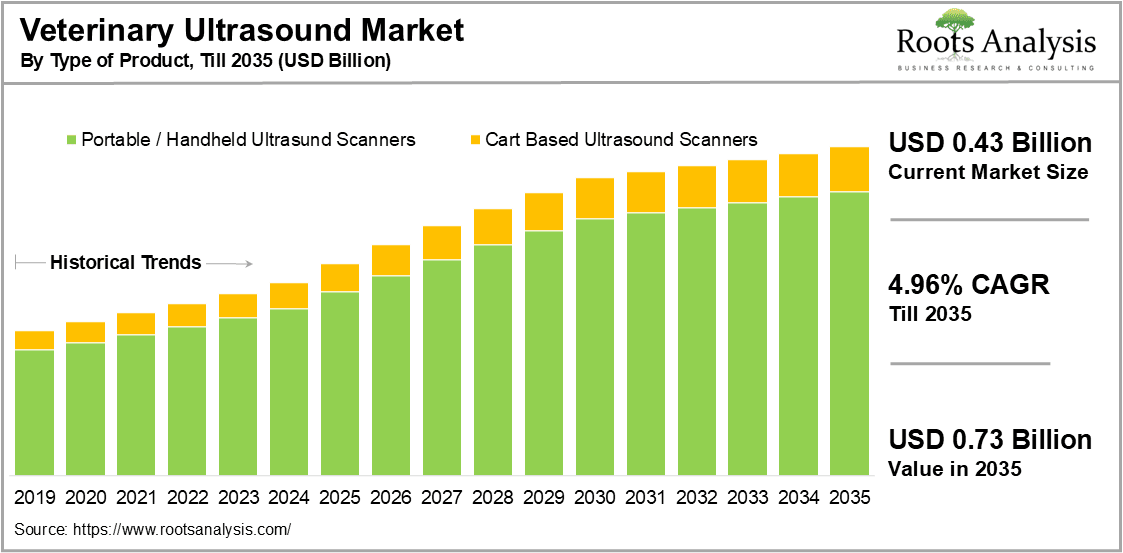
The global veterinary ultrasound market is valued at USD 0.43 billion in 2024 and is poised to reach USD 0.73 billion by 2035, representing a CAGR of 4.96% during the forecast period.
To learn more about this report, request a free sample copy
Veterinary ultrasound industry is evolving rapidly driven by the rising concern of zoonotic diseases and increasing awareness about animal health. Animal diseases such as rabies, Nipah, and influenza (H1N1 and H5N1) can be transferred to the humans and can be fatal if not treated at earliest. In addition to zoonotic diseases, rising risk of ovarian cancer and reproductive dysfunction in livestock has necessitated the requirement of advanced diagnostics solutions that aid in early detection of diseases. Veterinary ultrasound is a form of non-invasive imaging technique that creates images of animal’s internal organ for disease diagnosis. This veterinary ultrasound technique apparently plays a significant role in early diagnosis of diseases, allowing veterinarians to provide precise treatment with a tailored approach.
It is worth highlighting that the demand for veterinary ultrasound has also skyrocketed due to growing pet ownership and rising awareness of animal health. According to a recent report published by American Society for the Prevention of Cruelty to Animals, nearly 4.1 million shelter animals have been adopted by people annually in United States, among these, around 2 million are dogs and nearly 2.1 million cats. With growing adoption, pet owners are also making investments in pet insurance for providing better healthcare, which further contributed to the growth of this industry. The growing expenditure on animal health and rising concern of zoonotic diseases has caught the attention of industry players to drive innovation in veterinary diagnostic technologies that offer real-time feedback to facilitate early treatment.
Moreover, the key focus is on the development of portable / handheld ultrasound scanners that are easier to use and offer high contract images for creating smaller organ images. These portable ultrasound scanners can be utilized for visualization of abdominal organs and vascular examinations. For instance, in May 2024, Esaote (leading diagnostic imaging solutions provider) launched MyLab™Fox, an adaptable scanning solution equipped with next generation probes and AI-powered Augmented Insight™ for enhanced imaging of organ. It comes with an adaptable design and XStrain™ technology that streamline the process of examination, offering accurate results and very easy to use.
The market for veterinary ultrasound is also experiencing various breakthrough innovations such as innovative biomaterials for ultrasound technology. Similarly, several device developers are increasing strategic research initiatives for the development of artificial intelligence models to automate point-of-care ultrasound analysis. A study published in Frontiers in Veterinary Science in June 2024 to design AI models for automating point-of-care ultrasound for diagnosis in military dogs. The study shows that the three AI models MobileNetV2, SharpML and DarkNet-19 are designed to train on canine image associated datasets for the identification of injuries achieved higher accuracy exceeding 82% and prediction rate.
Such research initiatives and breakthrough technological innovations offer enormous opportunities for industrial players to make considerable investments. Overall, the veterinary ultrasound market will remain progressive and continue to expand at a steady pace during the forecast period.
The market report provide in-depth information of the key players who are active across various segments of the growing industry as mentioned in the table below.
| Key Report Attributes | Details | |
| Historical Trend | Since 2019 | |
| Forecast Period | Till 2035 | |
| Market Size 2035 | $0.73 Billion | |
| CAGR (Till 2035) | 4.96% | |
| Type of Ultrasound |
|
|
| Type of Solution |
|
|
| Type of Product |
|
|
| Type of Imaging Technology |
|
|
| Type of Animal |
|
|
| Type of Application |
|
|
| Type of End User |
|
|
| Geographical Regions |
|
|
| Key Companies Profiled |
|
|
| PowerPoint Presentation (Complimentary) |
Available | |
| Customization Scope | 15% Free Customization | |
| Excel Data Packs (Complimentary) |
Available | |
One of the key objectives of the veterinary ultrasound market report was to estimate the current market size, opportunity and the market growth potential, over the forecast period, till 2035. We have provided informed estimates on the likely evolution of the market for the forecast period.
The veterinary ultrasound market analysis also features the likely distribution of the current and forecasted opportunity within the market across various segments, such as distribution by type of ultrasound (2D ultrasound, doppler ultrasound and 3D / 4D ultrasound), type of solution (equipment and PACS), type of product (portable / handheld ultrasound scanners and cart based ultrasound scanners), type of imaging technology (digital imaging technology, analog imaging technology and contrast imaging technology), type of animal (small animals and large animals), type of application (abdominal, gynecology, orthopedics, cardiology and other applications), type of end user (veterinary hospitals & clinics, and other end users), and geography (North America, Europe, Asia-Pacific, Middle East and North Africa, and Latin America) and leading players.
In order to account for future uncertainties associated with some of the key parameters and to add robustness to our model, we have provided three market forecast scenarios, namely conservative, base, and optimistic scenarios, representing different tracks of industry’s evolution. All actual figures have been sourced and analyzed from publicly available information forums and primary research discussions. The financial figures mentioned in this market report are in USD, unless otherwise specified.
Based on the type of ultrasound, the global veterinary ultrasound market is segmented into 2D ultrasound, doppler ultrasound and 3D / 4D ultrasound. Currently, 2D ultrasound occupy the highest share of the overall market. This dominance is due to the higher adoption rate of 2D ultrasound scanners for disease diagnosis and detection of pregnancy in animals. This 2D ultrasound technology is an efficient and cost-effective solution for organ evaluation with real-time imaging. Driven by its cost-effectiveness and efficiency in disease diagnosis, the 2D ultrasound will continue to grow at a CAGR of 6% during the forecast period.
The global market for veterinary ultrasound is distributed across various types of solution, such as equipment and Picture Archiving and Communication Systems (PACS). According to our projection, equipment holds the highest share of the market. Equipment are easy to use and are widely adopted in veterinary hospitals, clinics and diagnostic centers. Moreover, industrial players such as IMV imaging, Fujifilm Sonosite and Esaote are increasing their research efforts to develop innovative or portable ultrasound equipment with advanced technologies.
However, in the long run, PACS segment is expected to grow at a CAGR of 8% during the forecast period. PACS are widely used across a variety of veterinary applications to store and retrieve images data. Furthermore, the system can easily be integrated with veterinary ultrasound systems to generate diagnostic images appropriately.
This segment highlight the distribution of global veterinary ultrasound market across various types of products, such as portable / handheld ultrasound scanners and cart-based ultrasound scanners. According to our projection, currently, portable / handheld ultrasound scanners accounts for the largest share (nearly 90%) of the market. This can be attributed to the growing demand for compact design and advanced technology-based ultrasound scanners for quick scanning of animals. Furthermore, portable ultrasound scanners are convenient and offer higher flexibility to scan animals beyond veterinary clinical settings. Ongoing technological innovations for the development of point-of-care ultrasound scanners for animals has further contributed to the highest share of this segment. Driven by the ongoing advancements and higher adoption rate, portable / handheld ultrasound scanners will remain dominant and continue to grow at a higher CAGR during the forecast period.
The global market is distributed across various types of imaging technology, such as digital imaging technology, analog imaging technology and contrast imaging technology. According to our projection, digital imaging technology accounts for the highest veterinary ultrasound market share (nearly 95%). Digital imaging technology offer superior quality images of the small organs which makes it a pivotal tool for disease diagnosis in animals with higher precision. Moreover, digital images data can be stored electronically in data management software / system. Veterinarians can easily transfer digital data and access to patient record from any places seamlessly. Additionally, digital imaging technology can easily incorporate advanced features such as 3D / 4D ultrasound scanners, color doppler and contrast-enhancing imaging for clear imaging of anatomical structures.
However, in the long run, contrast imaging technology will grow at a higher CAGR during the forecast period. The contrast imaging segment has been adopted on a large scale in veterinary hospitals and clinics for visualization of blood flow such as myocardial perfusion and M-mode imaging.
On the basis of the type of animal, the veterinary ultrasound market is segmented into small animals and large animals. Among these, small animals dominate the market with a share of nearly 70%. This can be attributed to the growing adoption rate of small animals by people. Furthermore, pet owners are making massive investment in advanced veterinary practices to keep their pet healthy.
Small animals such as dogs and cats account for the largest base of veterinary health services, which further increases the adoption of portable ultrasound scanner devices. However, in the long run, large animals market segment will grow at a higher CAGR driven by the rising risk of diseases in livestock that significantly impact their health and increases the risk of zoonotic diseases.
Based on the type of application, the veterinary ultrasound market is segmented into abdominal, gynecology, orthopedics, cardiology and other applications. Currently, the abdominal segment accounts for the highest share (nearly 30%) of the market and is likely to remain dominant during the forecast period.
Veterinary ultrasounds has been widely used for the examination of abdominal cavity such as spleen, liver, kidneys, gynecological regions, gastrointestinal tract and bladder, contributing to the highest share of the segment. However, in the long run, cardiology and gynecology segment are likely to grow at a faster CAGR rate. This can be attributed to the growing use of veterinary ultrasound for detecting pregnancy, organ enlargement, and other anomalies.
The global market is categorized based on type of end user, such as veterinary hospitals & clinics and other end users. Among these, veterinary hospitals & clinics holds the highest veterinary ultrasound market share (nearly 65%). This can be attributed to the fact that ultrasounds are widely used in veterinary hospitals for disease diagnosis and determining the anatomical structure. Furthermore, technological advancements such as portable ultrasound technologies and cloud-based data management systems has further bolstered the adoption rate of veterinary ultrasound for wide range of applications.
However, in the long run, other end users such as diagnostic laboratories, point-of-care facilities, academic & research centers and references laboratories will show lucrative growth potential and is expected to grow at a higher CAGR during the forecast period. This is due to the growing willingness of pet owners to spend on their companion animals personalized health services. Moreover, the veterinary hospitals & clinics outsource ultrasound services from reference laboratories and diagnostics centers, which further contributes to the high growth potential of other segments.
Based on the geographical region, the global veterinary ultrasound market is distributed across North America, Europe, Asia-Pacific, Middle East and North Africa, and Latin America. Currently, North America occupies the largest share (41%) of the market. The dominance is primarily due to the growing pet ownership in the United States and advanced veterinary healthcare services. According to the report of American Pet Product Association, nearly 82 million households own a pet and invest in pet health insurance, which contributed to the highest share of North American region. Furthermore, the increasing research and development activities for launching advanced AI-powered veterinary ultrasound by established players in this region is boosting market growth.
For instance, in June 2023, Esaote successfully launched MyLab X90 VET system integrated with AI for advanced imaging of internal organ of the animals.
It is important to highlight here that the market in Asia-Pacific is anticipated to grow at a higher CAGR during the forecast period. This can be attributed to the rising adoption of veterinary ultrasound for disease diagnostics beyond livestock and pets. Furthermore, increasing technological advancements for real-time imaging by industry players active in this region is likely to support the market growth at a substantial rate.
The “Veterinary Ultrasound Market: Industry Trends and Global Forecast, till 2035” market report features an extensive study focusing on the competitive landscape of strategic initiatives, emerging mega trends, big pharma initiatives, company profiles and key drivers and restraints. The market report highlights the efforts of several stakeholders engaged in this rapidly evolving segment of the veterinary health market. Key takeaways of the market report are briefly discussed below.
Presently, the market landscape of veterinary ultrasound is moderately competitive, featuring the presence of several large and small players with required expertise. Driven by the ongoing demand for advanced veterinary ultrasound scanners, the leading industry players are taking strategic initiatives followed by launching new imaging techniques, collaborations and partnerships. However, the current focus of industrial players will be on technological innovations and integration of AI technology to enhance imaging with higher precision. For instance, in March 2024 IMV Technologies launched BovIntel in the UK and France that automatically identify the key features on ultrasound images within real-time as a veterinarian take a scan. This system utilize colors to label internal structures such as corpus luteum and follicles, making animal fertility scanning easier and accurate.
As more industry leaders continue to accelerate research on advanced veterinary ultrasound, we believe the market will remain competitive throughout the projected year.
The veterinary ultrasound scanners market is experiencing unprecedented growth driven by rising pet ownership and high disposable income. It is important to highlight here that the upsurge in the adoption of pets due to assistive support and emotional companionship has amplified the demand for improved veterinary diagnostics and treatment services. Additionally, the high disposable income has further fueled the demand for innovative veterinary diagnostics solutions such as portable ultrasound scanners. Driven by the growing pet ownership across geographical regions, the market players are continuing to increase their research for technological advancements, which is likely to be a key growth driver of the market. Additionally, pet care is expensive with cost for an ultrasound running in hundreds of dollars. According to an article published in Catster in July 2024, a cat ultrasound can cost anywhere from $200 to $500.
The device developers have launched several pocket sized wireless handheld ultrasound for veterinary applications. In July 2023, Konica Minolta Healthcare Americas Inc. launched PocketPro H2 in the US in partnership with Healcerion. Similarly in January 2023, GE Healthcare and Sound Technologies entered into an agreement to grant Sound Technologies the exclusive distribution rights for Vscan Air™ in the US market.
Despite the high demand of veterinary ultrasound, the global market witness several challenges that need to be addressed. Some of the potential challenges include lack of awareness about the importance of animal health in developing countries and stringent regulatory guidelines associated with pet adoption may slow down the growth of the market during the forecast period. In addition, the underdeveloped veterinary healthcare system, particularly in low disposable income or developing countries are the key factors that may impede market growth. Additionally, the high cost of veterinary ultrasound technologies may restrict the adoption of the advanced imaging scanner technologies for disease diagnosis.
The veterinary ultrasound market growth is propelled by technological advancements and rising focus on zoonotic disease prevention. Currently, the key industry players are focusing on technological innovations such as handheld ultrasound scanners and AI-technologies that aid in early diagnosis of diseases. Furthermore, veterinary clinics are continually emphasizing 3D / 4D ultrasound imaging technologies for precise diagnosis of internal organ. Additionally, the increasing trend of pet health insurance and rising focus on animal disease prevention has opened new opportunities for the veterinary clinics to provide comprehensive diagnostic solutions that aid in ensuring early diagnosis and treatment designing.
Driven by the growing pet ownership and insurance, North America is dominating the market and is currently valued at USD 0.18 billion. In North American region, United State is experiencing a lucrative growth owing to increasing adoption of advanced ultrasound technologies into livestock industry. For instance, handheld ultrasound technologies has been adopted in livestock industry to collect valuable information of heat cycle or fertility tracking in cattle, enabling veterinarians and farm owners to make a precise decision for breeding
North American market has witnessed consolidation in the veterinary / animal clinics field. NVA and Mars Veterinary Health are amongst the leading veterinary groups in the US, each running more than 1,000 vet clinics and hospitals. In 2017, Mars acquired VCA in a deal worth $9.1 billion in order to diversify its source of income. These vet clinics offer several advanced imaging solutions including ultrasound.
It is important to highlight that the European region also holds a substantial share of the market driven by the high adoption of ultrasound technology and advanced healthcare facilities for animals. Moreover, the standardization of using advanced diagnostics technologies to maintain overall well-being of companion animals and livestock further contributed to the overall growth of the veterinary / animal ultrasound market.
The global veterinary ultrasound market is currently valued at $ 0.43 billion and is poised to reach $ 0.73 billion by 2035. Driven by the growing pet ownership and rising awareness of animal well-being, the market will continue to grow at a CAGR of 4.96% during the forecast period. Some of the notable trends that further boost the market growth includes integration of AI technology, demand for handheld ultrasound devices, development of on-platform systems and incorporation of telemedicine applications.
In order to meet with growing demand, various industrial leaders are also emphasizing collaborations and partnerships which is expected to be a robust driver of the market. For instance, recently NYSORA in collaboration with Trujanovic launched New Vet App (Veterinary Regional Anesthesia App) to examine US-guided nerve block in small animals. As more industry players continue to enter such collaborations, the market will continue to grow during the projected period.
Examples of leading veterinary ultrasound companies (which have also been profiled in this market report; the complete list of companies is available in the full report) include ASUSTeK Computer, Avante Animal Health, BenQ Medical Technology, Butterfly Network, CHISON Medical Technologies, Contec Medical Systems, Esaote, FUJIFILM, IDEXX, IMV Imaging, Mars, Shenzhen Mindray Bio-Medical Electronics, Siemens Healthcare, Samsung Healthcare and Wuhan Zoncare Bio-medical Electronics. This market report includes an easily searchable excel database of all the companies developing technology driven veterinary ultrasound.
Several recent developments have taken place in the market, some of which have been outlined below. These developments, even though they took place post the release of our market report, substantiate the overall market trends that we have outlined in our analyses.