
Lowest Price Guaranteed
Pages
343
Last Updated
September 2026
View Count
24664
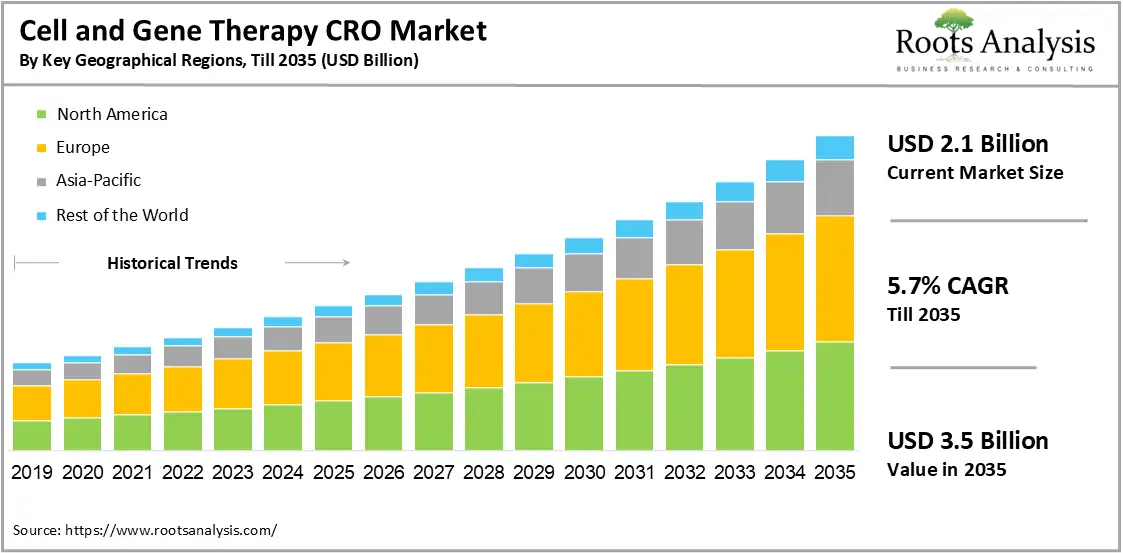
The global cell and gene therapy CRO market, valued at USD 1.9 billion in 2025, is estimated to reach USD 2.1 billion in 2026 and USD 3.5 billion by 2035, representing a CAGR of 5.7% during the forecast period. The market growth is being supported by the expanding pipeline of advanced therapies, increasing complexity of cell and gene therapy clinical development, growing outsourcing of specialized research activities and rising requirements for regulatory, clinical-operational, safety and data-management expertise.
To learn more about this report, request a free sample copy
Unlike conventional drug-development programs, cell and gene therapy studies frequently require specialized trial designs, experienced clinical sites, intensive safety monitoring, patient-specific operational workflows and close coordination between sponsors, CROs, manufacturing partners and healthcare providers. Specialty CROs address these requirements through focused scientific and operational expertise for complex or niche development programs. These requirements are strengthening the strategic role of specialized contract research organizations across discovery, preclinical development, clinical trials and regulatory submission activities.
Roots Analysis segments the cell and gene therapy CRO market by type of cell therapy, type of genetic modification, stage of development, therapeutic area, end-user and key geographical regions. The study draws on secondary research, publicly available company and clinical information and primary discussions with industry stakeholders to validate market assumptions, competitive-landscape findings and forecast estimates.
The primary and secondary research for the study includes perspectives from stakeholders with experience across business development, clinical-trial management, marketing, sales and executive leadership within the cell and gene therapy ecosystem. These discussions support the assessment of outsourcing strategies, CRO-selection criteria, operational challenges, clinical development activity and commercial opportunities. The research report features detailed transcripts of interviews held with the following industry stakeholders:
Commenting on this trend, Mark O'Dell (Associate Director of Global Operations, Immunochemistry from Labcorp Bioanalytical Services), stated that, "The pandemic had an unforeseeable impact on the CRO industry by presenting matrix supply limitations for our pre-clinical studies, mainly Cyno and Rhesus. This occurred at a time when the growth in cell and gene therapy, as well as COVID-19 therapy trials that used non-human primates, grew extensively. Previously for some of our clinical studies, the target or disease state matrix was a limiting factor at times and we had to think strategically about our approach to various projects. On top of the limitations in pre-clinical studies that we are currently seeing, we are now in a similar scenario where previously available human material is now considered rare or hard to obtain. So, we now need to think strategically about our approach to pre-clinical and clinical studies."
Based on the research, we have segmented the cell and gene therapy CRO market into the following market segments:
The cell and gene therapy CRO market encompasses outsourced research, development and clinical services provided by contract research organizations to biotechnology companies, pharmaceutical developers, academic institutions and other sponsors developing advanced cell and gene therapies. A Site Management Organization supports these studies at the site level through patient recruitment, documentation, study conduct and protocol-compliance activities. These services can span nonclinical study design, toxicology, bioanalytical testing, clinical project management, site selection, patient recruitment, clinical monitoring, data management, biostatistics, pharmacovigilance, regulatory affairs and post-treatment follow-up.
The requirements associated with these therapies differ substantially from those of conventional pharmaceutical products. Cell therapies may use autologous cells collected from an individual patient or allogeneic cells obtained from a donor, while gene therapies may modify, replace or introduce genetic material through in vivo or ex vivo approaches. Consequently, CROs supporting these programs require specialized scientific and operational experience, close coordination with clinical sites and manufacturing partners and an understanding of modality-specific regulatory and safety requirements.
For patient-specific therapies, the clinical-development process can also require synchronized scheduling, product tracking and time-sensitive delivery between collection sites, manufacturing facilities and treatment centers. These characteristics are increasing demand for CROs capable of integrating scientific expertise with clinical operations, regulatory strategy, quality oversight, data management and specialized logistics.
Cell and gene therapies are reshaping the clinical development landscape by targeting diseases through the modification, replacement or administration of cells and genetic material. Their growing use across oncology, rare diseases, neurological disorders and other complex therapeutic areas has created clinical programs with requirements that can differ considerably from conventional drug trials. Sponsors must coordinate specialized nonclinical studies, regulatory interactions, investigator-site readiness, patient recruitment, safety surveillance and clinical operations while maintaining alignment with manufacturing timelines.
The complexity is particularly pronounced for personalized and autologous cell therapies, where treatment delivery may depend on patient scheduling and chain-of-identity and chain-of-custody controls. Gene therapy may also require extended safety monitoring owing to potential for long-lasting biological effects. FDA guidance recognizes that some gene therapy products may require long-term follow-up to evaluate delayed adverse events.
The regulatory environment is also evolving rapidly. In 2026, the FDA issued or updated multiple cell and gene therapy guidance documents addressing areas including CMC flexibility, genome editing, safety assessment and development of individualized therapies. This changing framework increases the importance of regulatory-affairs expertise, submission strategy and cross-functional coordination throughout clinical development.
Pediatric development represents another important consideration, particularly because many inherited rare diseases targeted by gene therapies are present early in life. In April 2026, the FDA and Alliance for Regenerative Medicine convened a workshop specifically addressing scientific, ethical, regulatory and practical considerations for pediatric cell and gene therapy trials. These requirements are strengthening demand for experienced CROs that can combine clinical science, operational execution, safety oversight, specialized site networks and patient-centered trial strategies.
Cell and gene therapy development increasingly requires coordination between clinical research organizations, manufacturing partners, analytical-testing providers and regulatory specialists. Integrated partnerships can reduce handoffs between preclinical development, manufacturing, regulatory submission and clinical execution while helping sponsors address modality-specific operational risks.
Patient recruitment remains challenging across rare diseases and specialized oncology indications because eligible populations may be small and geographically dispersed. CROs are therefore expanding site-identification strategies, supporting less-experienced sites with training and increasing the use of patient-centered technologies to improve accessibility and retention. Industry specialists have also identified limited CGT-experienced site capacity as an important operational bottleneck.
Cell and gene therapy studies generate complex clinical, safety, biomarker and long-term follow-up datasets. As a result, CROs and technology providers are increasingly integrating clinical trial management software, digital patient-engagement tools, centralized data-management platforms and analytical capabilities into study execution. The existing market landscape also includes providers developing software for decentralized trials and CGT supply-chain management.
The CAR-T cell therapy segment currently occupies the highest share within the cell and gene therapy CRO market. This segment's leadership reflects substantial clinical development activity in haematological malignancies and the specialized requirements associated with CAR-T study design, patient selection, safety monitoring and treatment-site coordination.
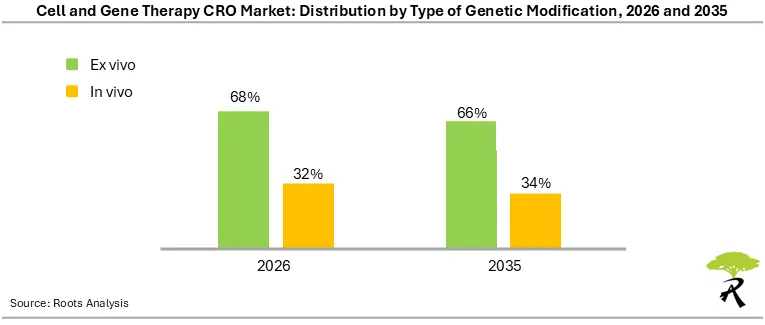
The ex vivo segment currently captures the highest market share of the cell and gene therapy CRO opportunity. Ex vivo approaches involve removing cells from the patient or donor, modifying them outside the body and subsequently administering the engineered cells, creating requirements for coordinated clinical, manufacturing and logistical workflows.
The clinical segment currently accounts for the largest share of the market. Cell and gene therapy trials require intensive clinical monitoring, specialized site management, safety reporting, regulatory oversight and patient follow-up, increasing the value of experienced CRO support as programs advance from early development toward registration.
Oncological disorders currently account for the leading therapeutic area market share, supported by the extensive development activity across CAR-T, TCR-based therapies and other engineered cellular approaches. CROs supporting oncology programs require capabilities spanning specialized site selection, patient recruitment, safety monitoring and complex protocol execution.
Based on end-users, the global cell and gene therapy CRO market is segmented into industry and non-industry players. Presently, industry players generate the majority of market revenue, and this segment is expected to retain its leading share during the forecast period.
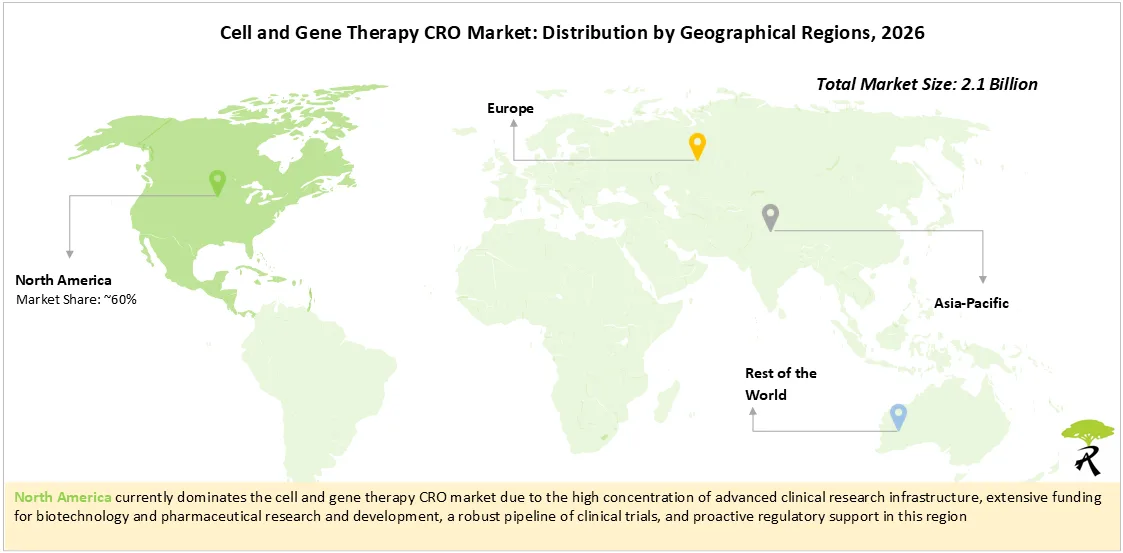
North America currently accounts for approximately 60% of the cell and gene therapy CRO market. The region benefits from extensive biotechnology R&D activity, specialized clinical research infrastructure and significant cell and gene therapy trial activity. Asia-Pacific is projected to expand at a relatively faster rate as clinical-development capabilities and advanced-therapy research activity broaden across the region.
Cell and gene therapy CROs support sponsors across multiple development stages, including nonclinical planning, toxicology, bioanalytical studies, regulatory strategy, clinical-trial design, site identification, patient recruitment, project management, clinical monitoring, biostatistics, data management, pharmacovigilance and post-market assessment. The diversity of these services enables developers to access specialized skills without establishing all capabilities internally.
For emerging biotechnology companies, an experienced CRO can also support development strategy and cross-functional project management as a therapeutic asset moves from discovery through first-in-human studies and later-stage trials. Manufacturing itself remains principally within the remit of sponsors and CDMOs; however, close CRO-CDMO collaboration is particularly important in cell therapies where clinical scheduling, release testing and product availability directly influence patient dosing.
Regulatory affairs, quality management and safety oversight are central to CGT development. CROs may support IND/CTA preparation, regulatory interactions, protocol development, pharmacovigilance, quality assurance and inspection readiness while coordinating with manufacturing and analytical partners.
The regulatory framework continues to evolve. FDA's 2026 CGT guidance activity spans CMC flexibility, genome-editing development and safety assessment, reinforcing the need for sponsors to maintain integrated regulatory, clinical and quality strategies as programs advance.
Clinical delivery can be particularly complex for autologous therapies because collection, manufacturing, product release and administration must be coordinated around an individual patient. CROs with experience in chain-of-identity, chain-of-custody, site readiness, patient scheduling and specialized logistics can therefore help reduce operational risk.
Accessibility also influences trial execution. Eligible patients may need to travel to highly specialized treatment centers, while rare-disease and pediatric programs may involve geographically dispersed populations. Patient recruitment, retention, site expansion and long-term follow-up are therefore increasingly important components of CRO performance in this market.
Advanced therapy studies can generate diverse clinical, safety, biomarker and genomic datasets requiring robust data-management infrastructure and specialized analytical expertise. CRO capabilities increasingly extend beyond conventional clinical data management to support biostatistics, biomarker analysis, digital trial technologies and, where appropriate, bioinformatics workflows.
Technology-enabled trial management can also facilitate remote patient engagement, decentralized study activities and continuous data capture, although implementation depends on protocol design, patient population, regulatory requirements and treatment-site capabilities.
The current market landscape includes more than 105 CROs offering cell and gene therapy-related research services across different development stages. The market includes large global CROs alongside specialized providers with expertise in advanced therapies, regulatory strategy, clinical operations and regional execution.
Partnerships are particularly important because no single provider necessarily controls the entire CGT development workflow. Collaborations between CROs, CDMOs, testing laboratories, technology providers and clinical-site networks can create more integrated development pathways and reduce operational fragmentation.
Examples of key cell and gene therapy CRO include Altasciences, Allucent, CMIC, Labcorp, Linical, Medpace, PPD, Precision for Medicine, QPS, Syneos Health, CMED, ICON, PharmaLex and Novotech. The complete report includes an expanded database of organizations offering contract research services to cell and gene therapy developers. Kindly note that company names and trademarks are referenced solely for market-analysis purposes; inclusion in this report does not imply affiliation, endorsement or sponsorship.
Alongside the core market report, clients receive complimentary Excel data packs covering areas such as market landscape analysis, benchmarking, partnerships and collaborations, mergers and acquisitions, clinical-trial analysis, total cost of ownership and market forecast and opportunity analysis. A complimentary PowerPoint presentation and 15% free customization are also available with the report.
The report is designed to support biotechnology and pharmaceutical business-development teams, clinical operations and project-management teams, R&D and regulatory-affairs professionals, procurement functions, investors and CRO leadership teams evaluating outsourcing partners, clinical-development strategies, competitive positioning and regional opportunities.
This report has been co-authored by Simriti Gupta and Pemba Lahmo, both part of Roots Analysis's healthcare and pharma research practice. Their work focuses on drug development and manufacturing, competitive intelligence, company benchmarking and market forecasting.
Roots Analysis is an independent secondary and primary market research publisher. This report is not affiliated with, endorsed by or produced on behalf of any CRO, pharmaceutical company, biotechnology company, therapy developer or other organization named or profiled within the study.
The findings are developed independently using secondary research, publicly available information, market analysis and primary stakeholder discussions. References to companies, therapeutic products and regulatory authorities are included solely for market-analysis and informational purposes.