Cell Therapy Manufacturing Market 8th Edition, 2026 to 2035
Cell Therapy Manufacturing Market by Type of Cell Therapies (CAR-T Cell Therapies, Stem Cell Therapies, TCR Cell Therapies, TIL Cell Therapies, Dendritic Cell Therapies and Other Cell Therapies), Source of Cells (Autologous Cells, Allogeneic Cells and Other Cells), Scale of Operation (Clinical Scale and Commercial Scale), Type of Manufacturer (In-House Manufacturers and Contract Manufacturing Organizations) and Geography- Trends and Forecast 2026-2035
-
Lowest Price Guaranteed
-
Pages
675 -
Last Updated
October 2026 -
View Count
38316 -
Market Outlook
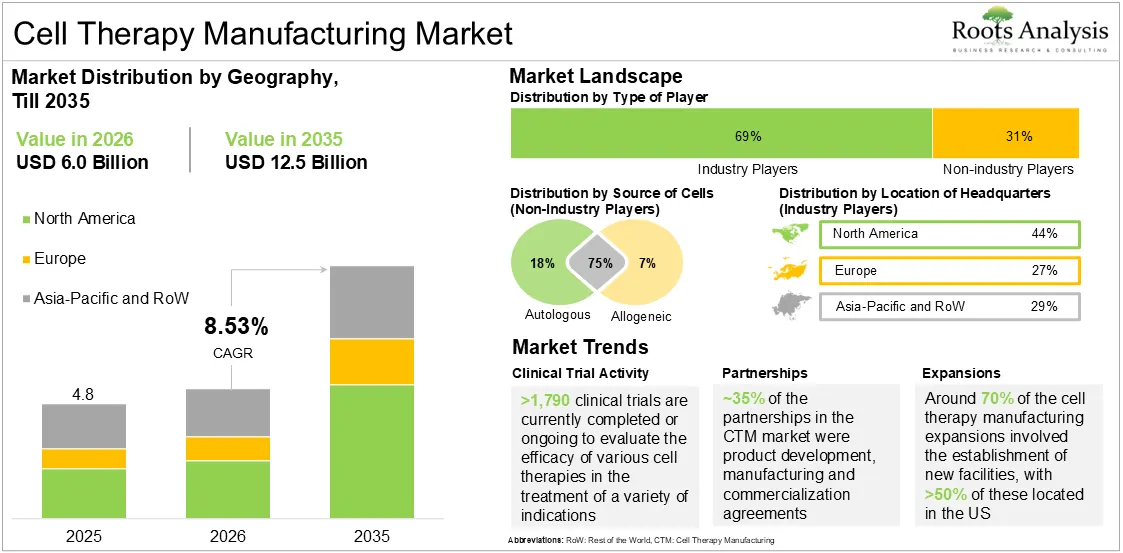
The global cell therapy manufacturing market, valued at USD 4.8 billion in 2025, is estimated to reach USD 6.0 billion in 2026 and USD 12.5 billion by 2035, representing a CAGR of 8.53% during the forecast period 2026 to 2035. Growth is being supported by the expanding clinical pipeline, additional commercial launches, increasing manufacturing outsourcing, capacity investment and adoption of closed, automated and digitally connected production systems.
To learn more about this report, request a free sample copy
Market Report: Key Takeaways
Market Size & Trends
- CAR-T cell therapies account for approximately 70% of the current market, reflecting their commercial maturity and complex, high-value manufacturing workflows.
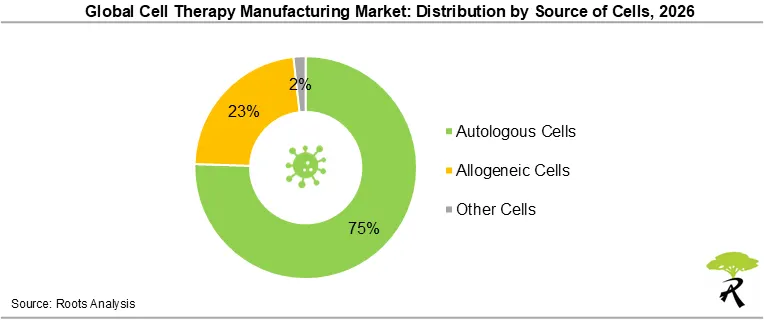
- Autologous cells account for more than 75% of the current revenues, supported by the established use of patient-specific CAR T-cell products.
- Clinical-scale manufacturing currently represents the largest share because a substantial proportion of the pipeline remains in precommercial development.
- In-house manufacturers account for the majority of current revenues.
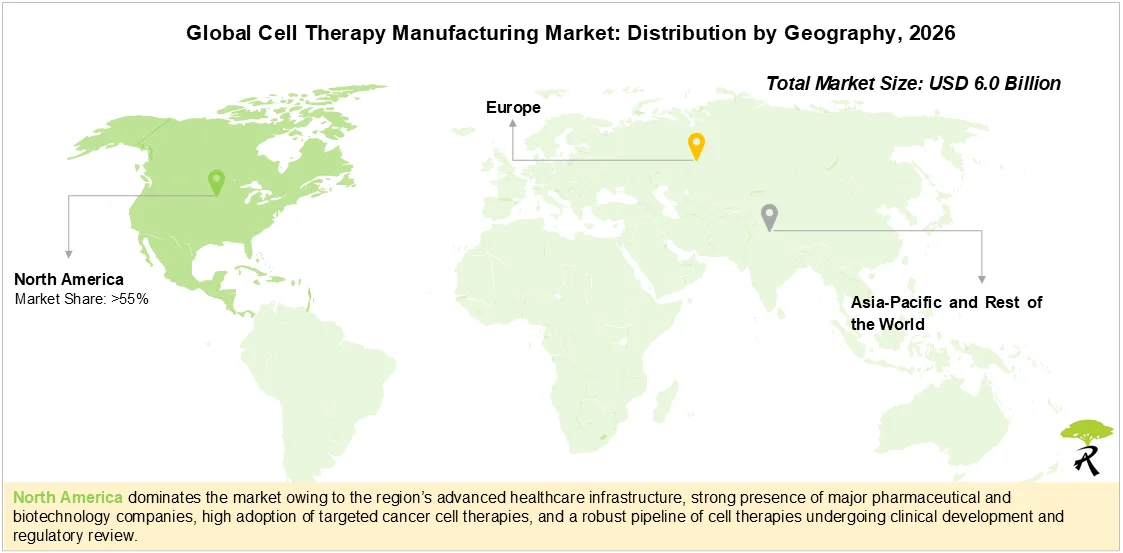
- North America accounts for more than 55% of the global market and is also expected to register the fastest regional growth during the forecast period.
Key Market Statistics
- Market Size, 2026: USD 6.0 Billion
- Market Size, 2035: USD 12.5 Billion
- CAGR (2026-2035): 8.53%
- North America: Largest market in 2026
What is Cell Therapy Manufacturing?
Cell therapy manufacturing is a complex process performed in highly controlled environments designed to prevent contamination. Depending on the product, it can involve the isolation, modification and expansion of cells, including immune cells such as T cells and stem cells. Each step requires specialized systems and strict adherence to regulatory guidelines to ensure product safety, efficacy, and consistency.
The industry is increasingly adopting closed and automated manufacturing platforms to reduce manual intervention, improve process consistency and support scalable production. For instance, Cellares is advancing automated cell therapy manufacturing through its Cell Shuttle platform, which enables end-to-end, closed-system production. Such technologies are expected to help developers reduce operational variability, address logistical challenges, and improve manufacturing efficiency.
Scope, Methodology and Industry Expert Interviews
The cell therapy manufacturing market report is segmented by type of cell therapy, source of cells, scale of operation, type of manufacturer and geography. The study draws on secondary research, publicly available company and clinical information and primary discussions with industry stakeholders to validate market assumptions, competitive-landscape findings and forecast estimates.
The primary and secondary research for the study includes perspectives from stakeholders with experience across business development, clinical-trial management, marketing, sales and executive leadership within the cell therapy manufacturing ecosystem. The research report features detailed transcripts of interviews conducted with the following industry stakeholders:
- Marketing Manager, Cell Therapy, Mid-sized Company, Australia
- Director, UK
- Marketing Director, Small Company, Belgium
- Management Board Vice-President, Large Company, Poland
- Senior Director of Sales Advanced Therapies; Vice President of Marketing, Small Company, US
- Business Administration Department Manager, Mid-sized Company, Japan
- Chief Business Officer, Small Company, Netherlands
- Director of Finance and Facility Operations, US
- Senior Director, Very Large Company, Japan
- Chief Executive Officer, Mid-sized Company, UK
- Former Chief Technical Officer, Large Company, US
- Former Chief Executive Officer, Small Company, Netherlands
- Former General Manager, Small Company, France
- Chief Executive Officer, Large Company, China
- Executive Vice President Research and Development, Small Company, Israel
- Former Business Development Manager, Mid-sized Company, UK
- Professor and American Red Cross Chair in Transfusion Medicine, US
- Former Co-Founder and Chief Executive Officer, Small Company, Singapore
- Former Manager, Business Development and Operations-cGMP Manufacturing Unit, Mid-sized Company, Canada
- Manager of Business Development, Small Company, US
- Former Department Leader, Cell Therapy Innovation and Development, Mid-sized Company, France
- Former Chief Executive Officer, Mid-sized Company, Australia
- Chief Executive Officer, Small Company, Netherlands
In addition, the market report includes transcripts of the following other third-party discussions:
- Chief Executive Officer and Co-founder, Mid-sized Company, US
- Chief Executive Officer, Mid-sized Company, UK
- Chief Executive Officer, Small Company, US
- Group Executive, Bioprocess, Very Large Company, US
- Executive Director, Global Scientific Portfolio Management, Cell and Gene Therapy, Very Large Company, US
- Vice President of Regulatory Affairs; Director of Clinical Services and Alliances, Large Company, Canada
- Vice President & Head of Quality & Compliance, Mid-sized Company, US
- Senior Product Manager, Cell Therapy, Large Company, US
- Principal Scientist, Process Development Services, Very Large Company, Germany
- Program Manager, GMP Bioprocessing, Large Company, US
Emphasizing this shift, Pierre-Alain Ruffieux (Group Executive, Bioprocess, Cytiva) stated, "Cell and gene therapies are often life-changing for patients; however, high costs and technological constraints remain barriers to access. Scaling these therapies globally will require manufacturing that is more consistent, reproducible, and cost-effective. Current processes are complex, often patient-specific, and difficult to reproduce consistently at large scales. Progress will depend on increasing standardization and automation to reduce variability and improve process control. Platform-based and modular manufacturing approaches are beginning to address these issues by enabling more predictable scale-up and scale-out."
Cell Therapy Manufacturing Market Segments
Based on the research, we have segmented the cell therapy manufacturing market into the following market segments:
- Type of Cell Therapy: CAR-T Cell Therapies, Stem Cell Therapies, TCR Therapies, TIL Therapies, Dendritic Cell Therapies and Other Cell Therapies
- Source of Cells: Autologous Cells, Allogeneic Cells and Other Cells
- Scale of Operation: Clinical Scale and Commercial Scale
- Type of Manufacturer: In-house Manufacturers and Contract Manufacturing Organizations
- Geography: North America, Europe, Asia-Pacific and Rest of the World
Cell Therapy Manufacturing Market Key Insights
What is Driving Cell Therapy Manufacturing Market Growth?
- Growing Clinical Pipeline of Cell Therapies: The cell therapy domain is rapidly expanding, with a surge in clinical trials and an increase in regulatory approvals. As more therapies move from early research to late-stage clinical trials, patients have more access to therapies. According to American Society of Gene & Cell Therapy (ASGCT) Q1 2026 report, 2,132 gene therapies, including genetically modified cell therapies such as CAR-T cell therapies, and 881 non-genetically modified cell therapies were in development from preclinical through pre-registration stages. The report also identified 871 open clinical trials for non-genetically modified cell therapies, underscoring the sustained demand for specialized clinical and commercial manufacturing capabilities.
- Emerging Economies to Drive Long-Term Growth: Emerging economies will support long-term growth by developing local cell therapy manufacturing facilities. Companies such as Laurus Labs are focusing on affordable cell therapies, while countries such as India and Saudi Arabia are expanding their manufacturing capacities through new advanced facilities.
Role of Trump Administration Tariffs on Domestic Production
Section 232 pharmaceutical tariffs and onshoring agreements may create an incentive for US-based manufacturing investment. Specific cell-therapy expansions should be described separately unless a company source confirms that tariffs influenced the investment decision. In May 2026, the US Commerce Department launched an application process for pharmaceutical manufacturers seeking reduced Section 232 tariff rates if they commit to expanding or relocating manufacturing operations in the US. This move is aimed at supporting continued investment in domestic advanced therapy manufacturing. For instance, in May 2026, FUJIFILM Cellular Dynamics launched a new iPSC development and manufacturing facility in Madison, Wisconsin, which is expected to quadruple its iPSC manufacturing capacity and support future contract manufacturing of cell therapy products.
Recent Developments in the Cell Therapy Manufacturing Market
- In June 2026, Minaris enhanced its dedicated GMP cell banking suites at its Philadelphia facility. The upgraded suites strengthen the company's biosafety testing, GMP analytics, and product characterization capabilities, supporting cell and gene therapy developers across development, scale-up, and commercial manufacturing.
- In June 2026, CCRM and its subsidiary OmniaBio entered into an agreement with Avectas to evaluate its automated, integrated and scalable cell therapy manufacturing platform. This collaboration aims to explore how the latter company's platform could complement CCRM's growing global network and OmniaBio's effort to enable automated and scalable manufacturing workflows.
- In June 2026, Made Scientific and Pluristyx collaborated, to integrate GMP iPSC lines and derivative cell types into Made Scientific's end-to-end CDMO offering. The partnership aims to provide cell therapy developers with a coordinated path from clinical-grade starting material through GMP manufacturing, reducing handoff risk and development timelines.
Market Share Insights
Which Type of Cell Therapy Accounts for the Largest Share in the Cell Therapy Manufacturing Market?
CAR-T cell therapies currently account for approximately 70% of the cell therapy manufacturing market owing to the strong clinical and commercial adoption of CAR-T therapies, particularly across hematological malignancies. The segment also benefits from a growing number of approved products, expanding treatment access, and continued investment in specialized manufacturing infrastructure. CAR-T cell therapies often involve complex, high-value manufacturing workflows, including cell collection, activation, genetic modification, expansion, quality testing, and release, which significantly increases their contribution to the overall manufacturing market.
Among Autologous, Allogeneic and Other Sources of Cells, Which Segment Holds the Highest Share in the Cell Therapy Manufacturing Market?
Autologous cells currently capture the majority share (more than 75%) of the cell therapy manufacturing market driven by strong clinical adoption of patient-specific therapies, particularly across CAR-T cell therapy manufacturing. Since autologous therapies use a patient's own cells, they reduce the risk of immune rejection and graft-versus-host disease. Recent approvals, such as Waskyra®, an autologous blood stem cell-based gene therapy for Wiskott-Aldrich syndrome, further highlight the continued clinical relevance of patient-specific cell therapy approaches.
Which Scale of Operation Dominates the Cell Therapy Manufacturing Market?
Clinical scale segment currently accounts for the largest share of the cell therapy manufacturing market, owing to the progress in cell therapies. This progress has resulted to a growing number of cell therapies transitioning to clinical development pipeline. Further, the integration of advanced technologies like CRISPR-Cas9 has enhanced the efficiency and precision of critical manufacturing steps, thereby accelerating the overall growth and adoption of cell therapies.
Regional Analysis: Cell therapy Manufacturing Market
North America: Dominating the Market by Securing the Highest Share
North America currently captures the largest share (more than 55%) of the global cell therapy manufacturing market and is expected to grow at the fastest rate during the forecast period owing to the presence of dense concentration of therapy developers, academic medical centers, clinical-trial sites, experienced CDMOs, investors and specialized technology suppliers. Continued investment in US manufacturing capacity, automation and iPSC production is expanding the regional ecosystem.
Developing regions like Asia-Pacific and rest of the world also capture a significant share of the current market. This is because companies are rapidly expanding their cell therapy manufacturing capabilities by establishing new facilities in these regions. Moreover, this growth is largely driven by reduced costs of clinical trials, availability of trained staff, and presence of supportive regulatory frameworks in these regions.
Capacity Analysis: Cell Therapy Manufacturing Capacity Installed in Facilities Based in North America
Majority (around 50%) of the cell therapy manufacturing capacity is installed at facilities located in North America, followed by the capacity installed in facilities based in Asia-Pacific. Over the past few years, the cell therapy manufacturing capacity in Asia-Pacific has increased at a substantial pace due to technological advancements, low labor costs, and socio-economic reforms that favor the development of specialty industries, such as the advanced cell therapy industry in this region.
Key Players in the Cell Therapy Manufacturing Market
Examples of industry and non-industry players profiled in this market report, arranged in alphabetical order, include AGC Biologics, Astellas Pharma, Catalent, City of Hope, Clinical Cell and Vaccine Production Facility (CVPF) , Evotec, Fraunhofer Institute for Cell Therapy and Immunology, ImmunityBio, Lonza, Merck Millipore, Miltenyi Biotec, Minaris Advanced Therapies, Newcastle Advanced Therapies, NHS Blood and Transplant, OBiO Tech, Pharmaron, Rayne Cell Therapy Suite , Resilience, Sartorius, Scottish National Blood Transfusion Service (SNBTS) Cellular Therapy Facility, SK pharmteco (Subsidiary of SK Inc.), Takara Bio and Thermo Fisher Scientific. The complete list of companies is available in the full report, which also includes an easily searchable Excel database of all the companies providing cell therapy manufacturing services worldwide.
Kindly note that the report identifies each organization's actual role and does not characterize every profiled institution as a CMO or CDMO. Additional named organizations referenced elsewhere in this report's underlying data, reflect funding and partnership activity tracked across the broader cell therapy manufacturing ecosystem, not an endorsement relationship with Roots Analysis.
Report Deliverables and Customization
Alongside the core market report, clients receive complimentary Excel data packs covering areas such as market landscape analysis, partnerships and collaborations, recent expansions, clinical-trial analysis, big pharma analysis, demand analysis, capacity analysis and market forecast and opportunity analysis. A complimentary PowerPoint presentation and 15% free customization are also available with the report.
The report is designed for biotechnology and pharmaceutical business-development teams, manufacturing and technical-operations leaders, clinical and project-management teams, quality and regulatory professionals, procurement functions, investors and service providers evaluating outsourcing partners, manufacturing strategies, competitive positioning and regional opportunities.
Report Authorship
Author: This report was authored by Pemba Lahmo, a member of the Roots Analysis healthcare and pharma research practice. The analysis draws on proprietary databases, company and regulatory disclosures, scientific and technical literature, industry interviews and secondary research, and is subject to internal review before publication.
Independence and Non-Affiliation
Roots Analysis is an independent market research and consulting firm. This report is not affiliated with, endorsed by or produced on behalf of any manufacturer, therapy developer, technology supplier, regulator or other organization named or profiled within the study. Company and product references are included solely for factual market analysis. Market estimates may differ from other studies because definition varies, particularly regarding therapy-product revenue, equipment sales and manufacturing services. References to companies, therapeutic products and regulatory authorities are included solely for market analysis and informational purposes.